Showing posts with label Robert Wise. Show all posts

“The Sound of Music” - Robert Wise (1965)

The Sound of Music (1965) was a culminating film of Hollywood’s Golden Age of musicals and still stands as one of the most popular films ever made.  The film was an adaptation of the hit Broadway musical stage production The Sound of Music (1959) and was the last work of the legendary Rodgers & Hammerstein team – the music composed by Richard Rodgers and the book and lyrics written by Oscar Hammerstein II (Oklahoma!, 1955; Carousel, 1956; The King and I, 1956; and South Pacific, 1958).  Their music, of course, is a crucial aspect of the work, but there are other interesting elements that also contributed to the film’s great popularity.  In particular, Julie Andrews’s captivating performance in the lead role and Robert Wise’s astute direction are particularly notable.

The story of The Sound of Music concerns a young postulant nun who takes leave from her nunnery to be the governess of a retired navy captain’s seven children.  Set in Austria just prior to and after Nazi Germany’s annexation (Anschluss) of that country in 1938, it is based on the real-life experiences described in Maria von Trapp’s memoir, The Story of the Trapp Family Singers (1949).  During this account, Maria wins over the hearts of Captain von Trapp’s unruly children and teaches them how to sing.  She also falls in love with and marries the Captain, and together they all manage to escape Austria before the Nazis can conscript the Captain into their military. 

Now in many films there are basically two narrative threads: (1) a primary action thread that relates the principal narrative journey of the protagonist(s) and (2) a romantic thread involving the protagonist(s) that embellishes the primary thread.  In The Sound of Music, though, there are three main threads:
  1. Maria’s evolving relationship with the Captain’s children and her sharing with them of her heartfelt warmth through music;
  2. Maria’s relationship with Captain von Trapp;
  3. Captain von Trapp’s narrow escape from the Nazi clutches.
We might expect the third of these threads to be the main one that carries this story, but that is not the case in this film.  Over the course of development – moving first from Maria von Trapp’s memoir, then to the musical stage play, and finally to the film –  the story was streamlined so that there was an increasing emphasis on the first of the above-listed threads and a de-emphasis on the other two.  Ordinarily such diminution of the action thread would lessen viewer interest, but that is not the case with this film.  Here the main focus is on Maria and how she loves and engages with life.  Indeed, the title song, which opens the film in a breathtaking panoramic scene, is what this film is truly about –
“The hills fill my heart with the sound of music
  My heart wants to sing every song it hears”
It is Maria’s loving engagement with the world through music that dominates this story.  This led to the film’s diminution of other presumably key plot elements of the stage play’s story, such as (a) the contrast between Captain von Trapp’s idealism and his cynical friend Max Detweiler’s willingness to compromise with corruption in order to maximize his own utility and (b) the Captain’s tepid romantic relationship with the wealthy Baroness Elsa von Schraeder.  This shift in focus has its downside, but it is compensated for by the richness in treatment of Maria’s soulful nature through the dynamic presentation of the musical numbers.  In this regard Wise and his team came up with skillfully edited montages for the musical numbers, which released them from the confines of a static stage production and took advantage of cinema’s vastly more expressive possibilities.

In keeping with the Hollywood musical tradition, The Sound of Music’s tale is presented in two acts separated by an intermission, with the first and longer act containing most of the musical numbers and setting the overall mood, and the second act featuring a dramatic turn in the plot.

Act 1
The film opens by introducing the viewer to the vivaciously free-spirited young postulant nun Maria (played by Julie Andrews).  She is first seen outside reveling in nature and bursting into the title song, “The Sound of Music”.  But the sisters in the Salzburg abbey where she is studying dismiss her in their song “Maria” as a flibbertigibbet and a clown.  The Mother Abbess (Peggy Wood) recognizes Maria’s insouciant nature and decides that life inside the abbey may be too confining at this stage in the young woman’s life.  So she assigns Maria to be a temporary governess for the seven children of recently widowed Captain Georg von Trapp’s (Christopher Plummer).

When Maria meets the von Trapp family, she sees that the Captain is remote and obsessed with discipline, while his children are unruly and rebellious.  Many of the memorable songs in this act, including “My Favorite Things” and “Do-Re-Mi”, show Maria engaged with the children and winning them over with her loving nature.  She teaches them how to sing as a group, which will become an important plot element in this story.

Meanwhile there is an interlude scene showing 16-year-old Liesl, the oldest von Trapp child, having a secret meeting with her boyfriend Rolf and the two of them singing to each other the song "Sixteen Going on Seventeen". 

After a trip to Vienna, the Captain returns with his romantic interest, Baroness Elsa von Schraeder (Eleanor Parker), and their humorously cynical friend Max Detweiler (Richard Haydn).  Upon seeing his children frolicking with Maria, he fires Maria on the spot. But shortly thereafter when he hears how beautifully his children have learned to sing under Maria’s tutelage, he humbly recants his dismissal. Later the Captain is regaled by the children’s and Maria’s musical  puppet show, “The Lonely Goatherd”, and of the many well presented and time-edited musical numbers in the film this scene stands out as one of the best.  The Captain is then subsequently moved to sing for them, himself, the metaphorically patriotic ballad “Edelweiss”. 

The Captain is finally persuaded to host a lavish party at the von Trapp mansion, during which
Maria and the Captain briefly dance together and exchange instinctively tender glances.  This rush of feeling makes Maria blush, and she backs away.  Later, after the children say good night by singing the coordinated “So Long, Farewell”, Baroness Elsa, who suspects something is brewing between The Captain and Maria, goes to Maria’s room and convinces her to return to  the chaste world of the abbey.

Act 2
With Maria now back at the abbey in seclusion, The Captain announces to his family his plans to marry Baroness Elsa.  The children, missing their dear tutor and companion Maria, are underwhelmed by this news. 

Meanwhile at the abbey, Maria confesses to the Mother Abbess her confused feelings that caused her to flee the von Trapp household.  The understanding Mother Abbess tells Maria that she must follow where her pure heart leads her and that she should return to the von Trapp family.  Underscoring her advice, the kindly woman then sings the inspirational “Climb Ev’ry Mountain”.

When Maria returns to the von Trapp estate, the children are delighted, but she is disappointed to hear that The Captain is now engaged to Elsa.  However, The Captain is now realizing his mounting feelings for Maria, and he breaks off his engagement with Elsa.  In the evening he finds Maria in the garden and expresses his love for her.  There in beautifully shadowed and silhouetted shots, they sing the enchanting song “Something Good”.
Perhaps I had a wicked childhood
Perhaps I had a miserable youth
But somewhere in my wicked, miserable past
There must have been a moment of truth
For here you are, standing there, loving me
Whether or not you should
So somewhere in my youth or childhood
I must have done something good
Nothing comes from nothing
Nothing ever could
So somewhere in my youth or childhood
I must have done something good
This beautiful song was written specifically for this film by Richard Rodgers alone, Oscar Hammerstein II having passed away in 1960, and it stands out as one of the film’s finest moments.

In short order Maria and The Captain are married and off on their honeymoon.  While they are away, the German government annexes Austria (the Anschluss), and Max enters the children in a musical contest for the Salzburg Festival to be held on the evening that the honeymoon couple returns.  When The Captain does return with Maria, he is informed that he has been conscripted into the German Third Reich’s navy, and he must report for duty immediately.

Unwilling to collude with the Nazis, The Captain organizes his family to leave Austria immediately.  However, when trying to escape in their car, their plans are foiled by Nazi Brownshirts following them, so they head for the Salzburg Festival to perform there. 

At the festival, they reprise some of their earlier songs, including a stirring rendition of “Edelweiss” by The Captain and Maria.   Afterwards during the awards ceremony, the family manages to sneak away to the abbey, where the Mother Abbess and the nuns place them in hiding.  But the Brownshirts, who now include Leisl’s former boyfriend Rolf among their members, are looking for their missing quarry, and they come to the abbey to snoop around.  But with the help of some canny nuns, the family gets away and heads on foot over the mountains to freedom in Switzerland as the film ends.


When The Sound of Music was first released, the US East Coast critical reaction was mixed, at best, but the film soon proved popular with the wider public.  It received 10 nominations for US Academy Awards (Oscars), and it won five of them, including for Best Picture and Best Director.  By the following year, the film had become the highest grossing film of all time, surpassing Gone with the Wind (1939). 

Despite the film’s great popularity, though, we can identify some weaknesses in the storytelling.
  • In the course of streamlining the stage play for the film, one of my favorite songs from the musical play was deleted, “No Way to Stop It”.  This was sung mainly by Max and Elsa in the early part of Act 2, and its removal was part of the diminution of those characters in the film. 
     
  • Some liberties were taken with historical reality.  Since this is a story about a real person, some caution should be exercised in making these alterations.  For example the film’s narrative collapses into a single year events that were spread over at least twelve years in Maria von Trapp’s account.  Their departure from Austria was also different from what was depicted in the film.
     
  • We are not shown enough of Captain von Trapp’s persona and charm to justify Maria’s falling in love with him.
     
  • The acting of the von Trapp children is rather artificial, even for a musical play.
     
  • Captain von Trapp’s breakup with Baroness Elsa is artificial and seems too easily accepted by her.
Nevertheless, the film‘s strengths make up for these deficiencies.  Julie Andrews’s sincerity, warmth, and charm carry the story’s main message concerning loving engagement with the world.  And Christopher Plummer, who has a rather subdued presence in this story, is extremely good at conveying inner feelings through his facial expressions.  This became more evident to me upon repeated viewings of the film. 

But it is the beautifully crafted musical numbers, with their cinematic choreography (which was completely new for the film from the stage play in order to take advantage of cinema’s wider aesthetic latitude) that carry this film.  They are what make this film still worthy of a four-star rating.

Robert Wise

Films of Robert Wise:

“West Side Story” - Robert Wise and Jerome Robbins (1961)

West Side Story, a musical stage play that recast William Shakespeare’s tragedy Romeo and Juliet into a contemporary setting, was a big hit when it opened on Broadway in 1957.  The film adaptation of the musical released in 1961 was an even bigger hit, winning 10 US Academy Awards (Oscars), including the award for Best Picture, and it remains an enduring classic for several reasons.  Made during the “Golden Age” of American stage musicals, it differed from other such works in this era by not being the creation of just one or two auteurs, such as Rodgers and Hammerstein [1], but instead being the creative concoction of a larger group.  In fact the film version of West Side Story could be said to be the synergistic concoction of six major creators:
  • William Shakespeare, author of Romeo and Juliet
  • Arthur Laurents, author of the book (script) for West Side Story
  • Leonard Bernstein, composer of the music for West Side Story
  • Stephen Sondheim, composer of the lyrics for Bernstein’s music
  • Jerome Robbins, choreographer and co-director of the film (he was the sole director of the stage musical)
  • Robert Wise, co-director of the film    
Somehow they combined to create a masterpiece that excels on many levels – story, music, and choreography. 

With respect to the music, Leonard Bernstein and Stephen Sondheim were an ideal combination.  Bernstein, who was also the conductor and musical director of the New York Philharmonic Orchestra, was a talented composer across many musical genres, including symphonic and orchestral pieces.  His music in this film is more sophisticated than the usual stage-musical fare, but it still has many memorably tuneful elements [2].  Sondheim’s lyrics are often delightfully clever, and they add emphasis to the film’s narrative themes. Particularly memorable are Sondheim’s rhythmic lyrics to the songs “America” and “Gee, Officer Krupke”.  Overall, the music is so constantly present that the film almost feels like a sung-through musical.  Throughout the film we are continually in the thrall of that music.

Closely accompanying the music is Jerome Robbins’s choreography, which goes much further than most of the musical films I have seen.  Often the dancing pieces in a musical represent reflective interludes that are essentially timeouts from the main story.  Here, however, the dancing permeates the narrative and is, like the music, almost perpetually present. In addition the coordinated finger-snapping behavior of the gang members becomes a constant metaphor for toughness, attitude, and gang solidarity. 

Robbins was apparently a perfectionist, and his demanding dance numbers required so many retakes that the production began to run beyond its shooting schedule and way over budget.  In fact when I watch some of the dance numbers, I feel like the players had not only to be precision ensemble dancers but also highly athletic acrobats, as well.  So the producers fired Robbins before shooting was complete, and the remaining dance scenes had to be supervised by Robbins’s assistants.  Nevertheless, Robbins’s choreography is one of the film’s key virtues.  It has, as I said, a different flavor than most stage-musical dancing, and it so permeates the film as almost to give it a surreal, expressionistic feeling. 

The narrative storyline is also innovative.  West Side Story’s narrative foundation is Romeo and Juliet, probably the most famous romantic tragedy in English.  In that Shakespeare play, two young people from extended families that are at war with each other, fall madly in love.  The opposition of their two families, however, leads to the tragic deaths of the two innocent lovers. But Arthur Laurents, in collaboration with Bernstein, Sondheim, and Robbins, resituated the Romeo and Juliet story into a contemporary setting associated with a major social issue in 1950s America – the emergence of urban juvenile delinquency and the rise of street gangs.

Urban street gangs in one form or another appear all across the globe, particularly in anarchic or relatively open societies.   But in the US, there seem to be many more gangs than in similarly advanced countries around the world.  It is estimated that there are now more than 30,000 gangs and more than a million gang members in the US [3].  This phenomenon may be partly due to the large number of foreign ethnic groups that have migrated to the US and also the isolation felt by some communities due to racial and ethnic prejudice in the United States.  The clash of rival street gangs was particularly apparent in New York City, which had large numbers of ethnic communities that tended to be congregated in their own lower-class urban districts within the city.  Gangs staked out their own “self-governed” territories, and at the territorial boundaries, there were often clashes between rival gangs.  Most of West Side Story’s creators were Jewish and familiar with, and likely sensitive to, the New York Jewish community’s experiences within that multi-cultured urban milieu.  In fact early versions of the script treatment concerned a Jewish street gang’s struggles with another gang in New York’s Lower East Side.  Ultimately, though, Laurents decided to fashion the story around a Puerto Rican gang’s encounters with a “white’  gang on New York’s Upper West Side.

Since the film would involve many camera closeups, the casting for the film required actors and actresses who could believably appear to be teenagers.  This led to the fortunate casting of Natalie Wood in the role of Maria (the “Juliet” role in this story). Ms. Wood, who had already achieved fame as a 17-year-old in the iconic Rebel Without a Cause (1955) and would also star the same year in Splendor in  the Grass (1961), had a special allure that made all of her roles stay in my memory.  There was something about her eyes that suggested passion and latent anguish, and her emotive facial expressions were fully exploited in West Side Story.  Her musical numbers were dubbed by Marni Nixon, who also sang (in dubbed voiceover) the songs of the female leads in two other classic musicals – The King and I (1956) and My Fair Lady (1964).

Two other performers who stand out for me are Russ Tamblyn and Rita Moreno.  Tamblyn plays a major role as the leader of the Jets street gang, and his singing and amazingly acrobatic dancing are outstanding.  Ms. Moreno, who had earlier appeared in a small but important role in The King and I, was very effective as Maria’s best friend, Anita, and she well deserved her Oscar for Best Supporting Actress.

The plot of Romeo and Juliet, which involves two young people meeting, falling madly in love, and then dying, only spans a period of about five days.  If we think about it, that timeline may seem to be too short to be about a serious love.  But Shakespeare’s poetic artistry sweeps those concerns away, and we succumb to the passions evoked.  In West Side Story, though, the narrative timeline for a similar love story only covers two days.  Nevertheless, here, too, the cinematic expressionism dominates, and any concerns about realism do not arise as we watch the story.

The story is divided into two acts.

Act 1 – The Jets and the Sharks
Like Romeo and Juliet, West Side Story opens with a street fight between two rival groups, the Jets and the Sharks.  The Sharks are a street gang made up of Hispanic immigrants who were born in Puerto Rico.  The Jets are a “white” (Polish and Irish) gang of first-generation immigrants.  Since the Jets were born in America, they feel the Sharks are foreign interlopers on their native territory.

After the fight is broken up by the police, the Jets’ leader, Riff (played by Russ Tamblyn), resolves to confront the Sharks that night at a dance that will be held at a local gym.  Riff also wants to get his best friend and former Jets co-founder, Tony (Richard Beymer), involved in the dispute.  Tony, who has a job and no longer actively participates in the gang, still feels loyalty to his old pal and agrees to come to the dance that night.

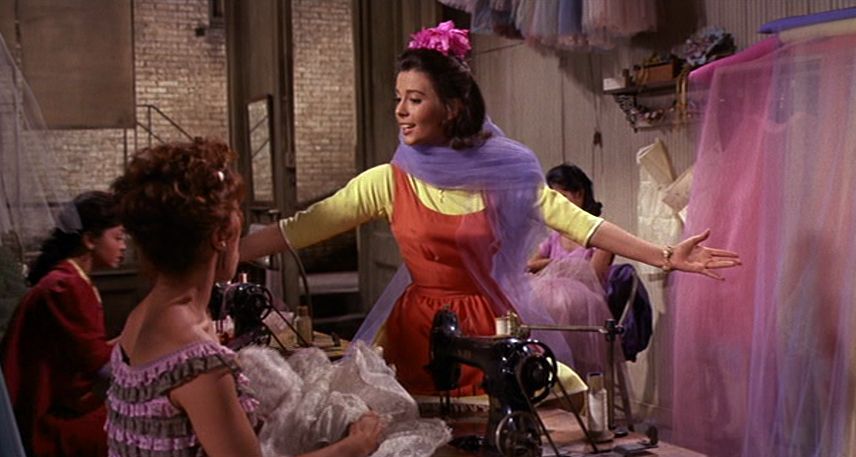
Meanwhile we see Maria (Natalie Wood) and Anita (Rita Moreno) working at a local sewing  shop.  Maria is the sister of the Sharks’ leader, Bernardo (George Chakiris), aka “Nardo”, while Anita is Nardo’s girlfriend.

At the dance, Tony and Maria see each other and immediately fall madly in love.  They start dancing, and when they are about to kiss, they are angrily interrupted by Nardo, who is concerned about “protecting” his sister (i.e. posturing about his own “honor”).  This leads to an anger-fueled agreement between Riff and Nardo for the two rival gangs to hold a “war council” at Doc’s drugstore later that evening.  Tony, meanwhile, is enthralled with the girl he has just met and wanders outside on the street singing the song “Maria”.

After the dance, Tony goes outside the window of Maria’s apartment and calls to her.  They meet on the outdoor fire escape and affirm their passionate love for each other, singing the song “Tonight”.  They agree to meet at her shop the next day after closing time.

Even later that night, at Doc’s drugstore, the two gangs have their war council to decide the terms of their “rumble” (battle) to determine the future of their neighborhood.  Tony arrives late and convinces them to only have a one-on-one battle between two chosen warriors of each gang.

Act 2 – The Rumble
The next day, Maria in her shop is delirious with love and sings the delightful song “I Feel Pretty”.  Although some might dismiss this as merely adolescent narcissism, to me it expresses something magical about the teenage experience everyone has about growing self-awareness – the realization that you have a changing identity and that you can be enamored with someone else’s changing identity. 
I feel charming,
Oh, so charming
It's alarming how charming I feel!
And so pretty
That I hardly can believe I'm real.
. . .
I feel stunning
And entrancing,
Feel like running and dancing for joy,
For I'm loved
By a pretty wonderful boy!
Tony shows up at the shop, but Anita sees him and realizes Tony and Maria have an illicit love.  Anita also reveals to Maria that later that night there will be a rumble. After Anita leaves, Maria convinces Tony to go to the rumble and stop it from happening.  They then play with the shop’s dress dummies to stage a mock wedding for themselves and sing the song “One Hand, One Heart”.  They agree to meet later that night when Tony comes back.

After Tony leaves, there is a presentation of the film’s famed “Tonight Quintet”, a beautifully crafted song combining the separately located crooning of the Jets, the Sharks, Anita, Maria, and Tony, all anticipating in their own separate ways that something thrilling is about to happen.

At the rumble between the two hostile gangs, Tony tries to stop it.  But his intervention in the fisticuffs leads only to Riff getting killed by Nardo, after which Tony kills Nardo.

Tony makes it back to Maria’s bedroom and tells her what happened.  They express their almost hopeless romantic dreams in the duet “Somewhere.” Then they make plans to escape together with money that Tony hopes to borrow from his boss Doc, and he tells her to meet him later at Doc’s drugstore.  After Tony leaves, Anita arrives at Maria’s room and confronts Maria.  Anita, overwhelmed with grief and anger over the death of her boyfriend, and Maria, concerned for the safety of her true love, then sing one of the greatest songs in musical history – the duet “A Boy Like That/I Have a Love”.

The final segments of the film are all misunderstandings, anger, and hostility.  The climax doesn’t transpire quite like Romeo and Juliet, but Tony does wind up getting killed by a vengeful member of the Sharks gang just as he is embracing Maria and about to escape.  All the Sharks and Jets assemble at the death scene, and Maria tearfully tells them all that it was not a gun that killed Tony, it was hate.


So in this story, at least on the worldly level, love is defeated by hate.  But of course it is not always that way, and in America, especially, it is not supposed to be that way.  This film in fact is partly an artistic examination of the “American Dream” – the image of a land of opportunity where people can come and be free to follows their own dreams [2].  But in the story presented, this film suggests that the current urban jungle (at least in the 1950s) is so muddied by hate that it is raising problems for the realization of the American Dream
 
Since there is a key focus on street gangs, one might be tempted to blame everything bad that happens on gangs.  But it’s not that simple.  People join gangs for several reasons:
  • Power and Wealth.  When people cooperate as a team, they are more effective in the world.  They have expanded capabilities, and this leads to a general increase in gang members’ utilities.
     
  • Respect and Identity.  Joining a powerful group enables the joiner to identify with the group and enhance his or her prestige.
     
  • Protection. Being in a gang can protect an individual from exploitation and mistreatment by other gangs.  One often has to join a gang as a means of self defense.
The last item listed, protection, is particularly important.  Encounters in crowded environments such as the urban jungle, whether between individuals or with groups, tend to be oriented along two lines (an encounter can be a mixture of these):
  • Cooperative.  Two agents (individual or group) get together to cooperate, such as by making a trade. 
     
  • Extractive.  One agent seeks to take wealth from a perceived weaker agent.  This is the law of the jungle, and most gangs seem to be engaged in extractive activities. 
Although cooperation is clearly better on the aggregate level, extraction is more straightforward and simpler to implement.  Nevertheless, gangs are usually oriented internally in a cooperative arrangement, because it is a more effective way for them to operate.  The real issue is not the elimination of gangs – they can serve a useful purpose – but how to get gangs to engage cooperatively on the external social scale.  This is where love does come in.

The moving duet between Anita and Maria, “A Boy Like That/I Have a Love”, expresses the call for us to follow our own loving hearts and overcome selfish feelings of resentment and hatred.  We can make a conscious decision to do this, and this is what Maria asks Anita to do:
Anita:
A boy like that who'd kill your brother,
Forget that boy and find another,
One of your own kind,
Stick to your own kind!
. . .
A boy who kills cannot love,
A boy who kills has no heart.
And he's the boy who gets your love
And gets your heart.
Very smart, Maria, very smart!

Maria:
Oh no, Anita, no,
Anita, no!
It isn't true, not for me,
It's true for you, not for me.
I hear your words
And in my head
I know they're smart,
But my heart, Anita,
But my heart
Knows they're wrong
. . .
I have a love, and it's all that I have.
Right or wrong, what else can I do?
I love him; I'm his,
And everything he is
I am, too.
I have a love, and it's all that I need,
Right or wrong, and he needs me, too.
I love him, we're one;
There's nothing to be done,
Not a thing I can do
But hold him, hold him forever,
Be with him now, tomorrow
And all of my life!
This is West Side Story’s true message, and it is just as relevant today in our current resentment-filled environment, which has been fueled by social and political voices expressing hatred and contempt.  We need to respond to our own inner urges to love – which is our true authentic being – and we need eloquent voices like Maria’s reminding us to do so.
★★★★

Notes:
  1. Rodgers and Hammerstein were famous for a string of Broadway hits, the filmed versions of which included Oklahoma! (1955), Carousel (1956), The King and I (1956), South Pacific (1958), and The Sound of Music (1965).
  2. Marilyn Ferdinand, “West Side Story (1961)”, Ferdy on Film, (2016).   
  3. “2011 National Gang Threat Assessment – Emerging Trends”, Federal Bureau of Investigation (FBI), (2011). 

"The Curse of the Cat People" - Val Lewton (directed by Gunther von Fritsch and Robert Wise, 1944)

The Curse of the Cat People (1944) was the sixth in a series of “horror” films produced by Val Lewton during the early 1940s and is plotted as a sequel to the first film in that sequence, Cat People. But this sequel, directed by Gunther von Fritsch and Robert Wise (his first directorial outing), is vastly different from the earlier film (directed by Jacques Tourneur) and suffers in the comparison. It is an ingenius characteristic of Lewton’s films that the expressionistic presentation evokes a sense of dread suggesting supernatural events are in play. At the same time there is always a rational explanation for these same events, and the viewers are kept on the dividing line between the two contrasting interpretations. It is this very sense of doubt that make the films plausible for the more sophisticated viewer: the viewer’s imagination is always kept on this knife edge. In The Curse of the Cat People, however, the sense of dread is only toyed with, but largely suppressed. On this occasion it is a child’s clearly imaginary fantasies which are evoked and in which we are suppose to engage, but it doesn’t really work. Instead of truly immersing ourselves in the child's fantasy world, we are only able to see her from the outside – sympathetically, to be sure – but it's not the same sense of shared participation as in other Lewton films.

The story picks up some years after the events of Cat People. Oliver and Alice, who were lovers at the end of that movie, are now married and have a six-year-old daughter, Amy, who is criticised by her parents for being too dreamy. After seeing an old photograph of Oliver’s first wife, Irena, Amy conjures up a special imaginary friend with Irena’s form. Amy also stumbles upon a spooky house in the neighbourhood, where an eccentric old actress befriends Amy and tells her scary tales. Amy wanders off one evening and gets lost, eventually finding her way to the spooky old house. Her alarmed parents alert the police and set about searching for her. They finally trace her to the old house, and the film ends happily, with the parents accepting a child psychologist’s prescription that if they love her unconditionally, Amy will stop making up imaginary characters.

This film fails on several levels, and I find it surprising that many reviewers revere the movie as a wonderful fantasy.
  1. The narrative, such as it is, barely moves forward. The only issue is that there is a child who is criticised by her parents for making up imaginary friends. She gets a spanking for this and is ostracised by her friends. At the end, the only resolution is that she still has her imaginary friend, but her parents are now more accepting of her. This is not a compelling plot.
  2. The whole intriguing idea of “cat people” (people transformed into ferocious cats when their passions are arounsed) from the earlier film is dropped here. There are no cat people in the film, and there is no curse. At one point in the film, Alice asks rhetorically if their family has been cursed – a line that was perhaps inserted into the dialogue merely to justify the film’s title.
  3. The cinematography and editing are below the standards of Lewton’s films with Tourneur and Robson. In fact there are so many jarring jump cuts in the film that one has to wonder if Wise deserves his editing credit for Citizen Kane (1941). There are numerous meaningless overhead shots that don’t fit in, and the dramatic changes in lighting that are supposed to signal Amy’s fantasies appear very artificial and are ineffective.
  4. There does appear to be some potential for drama at the old house, but this is just a tease. For example, there’s a tense, dramatic moment when Amy and family servant, Edward, are trying to leave the spooky old house and are unable to open the door to get out. But this is a complete red herring and doesn't lead anywhere. In fact the entire drama between the old actress and her estranged daughter is empty and comes to nothing, despite the poorly motivated suggestion at the end of the film that the daughter is about to murder Amy.
  5. And speaking of that daughter, since many of the characters from Cat People reappear in Curse of the Cat People and are played by the same actors and actresses, there is a particular problem with the old actress’s daughter, Barbara Farren. This role is played by Elizabeth Russell, who appeared in Cat People as a mysterious cat-like women who taunted Irena and spoke Serbian. Although the physical identification of Russell is obvious, there’s no indication in The Curse of the Cat People that Barbara Farren, not exactly a Serbian name, is this same person that was in Cat People. What are we supposed to make of this duplication?
There are a couple of redeeming elements to The Curse of the Cat People. The scenes at the old house and the old actress’s (Julia Dean's) scary storytelling do pick up our interest a bit.  There was potential here, but it was just left hanging without being developed. And Ann Carter, in the role of Amy, is wonderfully sensitive and believable. She carries the entire film on her back, so to speak, and almost makes it worthwhile. But not quite.
★★

"The Body Snatcher" - Val Lewton (directed by Robert Wise, 1945)

The Body Snatcher (1945) was one of the last of the “horror” films produced for RKO by Val Lewton during the 1940s, which included I Walked With a Zombie, The Seventh Victim, and Isle of the Dead. However, The Body Snatcher is not truly a horror film, (there is no real mystery or suggestion of dark forces), and it’s only very marginally an example of film noir. It's primarily a grisly crime film set in the past.

The plot, based on a short story by Robert Louis Stevenson, is set in Edinburgh in 1831, just three years after the notorious Burke and Hare murders and the subsequent sensational trial that led to their hanging. Burke and Hare had pursued the “resurrection trade”, robbing graves and selling the cadavers to doctors at the Ediburgh medical school, for whom cadavers needed for teaching were in short supply. Soon Burke and Hare had expanded their activities by murdering social outsiders and selling their bodies, too. The Body Snatcher is about the continuing activities of this practice.

At the beginning of the film, a young Edinburgh medical student, Donald Fettes, meets a young woman who urgently seeks an operation for her crippled daughter. Famous surgeon Wolfe MacFarlane, the mentor of Fettes, refuses, explaining that the operation would be risky, and he can more effectively use his time to promote human health by teaching student doctors who collectively can then go out and save many times more lives. This establishes the moral compass for the film. MacFarlane, who sees things in rather cold, ends-justify-the-means terms, always seeks to act on behalf of his own vision of the greater good, even if individuals may suffer now and then. As a case in point, we soon learn that he employs a common city cabman, John Gray, to supply him with cadavers robbed from local graveyards. He justifies this practice rather matter-of-factly to young Fettes by pointing out that there are just not enough human specimens available in order to provide proper instruction to medical students. Until the law is liberalised (it would be in 1832), he must engage in this unsavory, but necessary, practice. We also learn that Gray (played by Boris Karloff) shares an unsavory past with MacFarlane that he can use for blackmail purposes.

Fettes finds himself compromised into participating in these highly questionable activities, when, out of compassion for the young crippled girl, he urges Gray to go out and procure another body so that MacFarlane can prepare himself for an operation on the girl. But with graveyards more closely guarded now, Gray goes out and murders a street singer in order to supply the cadaver. When MacFarlane’s assistant, Joseph (played by Bela Lugosi), gets wind of these goings on, he goes to Gray and demands to be cut in on the take. Gray isn’t about to accept so easily, and he murders Joseph. Dr. MacFarlane now sees that Gray is out of control and goes to Gray’s apartment for a confrontation, which ends in the death of Gray. Fettes is horrified by these events, but MacFarlane assures him that with Gray out of the way, they can get back to practising medicine and serving mankind. However, MacFarlane is soon tempted to engage in his own grave robbing, and he convinces Fettes to join him. They go out to a remote graveyard on a dark and stormy night and dig up the body of an old woman to take back to the school. On the way back, MacFarlane begins hallucinating that the cadaver has somehow turned into Gray. He loses control of the carriage, which eventually goes off the road and plunges down a ravine, killing MacFarlane.

Although The Body Snatcher has a number of avid fans, it falls short of the other Lewton films. With a script based on a Robert Louis Stephenson story and a solid cast, featuring Henry Daniell, Boris Karloff, and Bela Lugosi, this film should have been much better. There are three principal shortcomings.
  1. The acting. Perhaps the biggest problem of the film is the wildly over-the-top performance of Boris Karloff. He is a constantly leering and smirking bogey man, who devours far too much screen time with these antics. There is no sense of dramatic build-up when the volume is turned up full all the time and with the Karloff's character flashing evil grins at every possible turn, making Jack Nicholson’s performance in The Shining seem tame by comparison. The second biggest problem is Russell Wade, whose performance as the naive Donald Fettes is hopelessly weak and unconvincing.
  2. The story. Lewton and director Robert Wise abandoned the polarity developed in earlier Lewton films, such as I Walked With a Zombie, wherein there was an eerie tension between the rationalist point of view and that of dark magic. What they had this time instead was the moral dilemma that can occur when utilitarian-based actions conflict with social mores. Where should one draw the line? MacFarlane thought it was OK to rob graves in order to put the cadavers to a useful purpose in medical training. Would it be acceptable to kill a person in order to save additional, other lives? MacFarlane didn't go that far, of course, but there is a potential tension here that could have beeen engaged. Unfortunately, this line was not developed effectively. Instead, the film is loaded with Karloff’s nasty grimaces and gloomy night shots, as if that alone would compensate. There is indeed one moment in a pub when Gray and MacFarlane look into the mirror and Gray reminds the doctor that, despite his high reputation, he is really just as ignorant as everybody else. He only knows the mechanical operation of the body parts, but he doesn’t understand the truly significant aspects of living. Here we have the intriguing core issue of the film, but, unfortunately, nothing more is made of it. One further weakness of the plot: Lugosi's role is so incidental that one gets the feeling his part was artificially thrown in just to have his name on the marquee.
  3. The music. There is intrusive, noisy soundtrack music that is apparently supposed to excite the viewer during action scenes, but it is merely an annoyance.
There are several things worthy of praise, though:
  • Henry Daniell gives a splendid performance as Dr. MacFarlane and almost rescues the film single-handedly.
  • Karloff’s murder of Lugosi, which demonstrates the suffocation technique of Burke and Hare, is chilling. Since all of the other murders are done off-screen, and the cadavers are never seen in the flesh, this is the one effectively shocking moment in the film.
  • The violent fistfight between MacFarlane and Gray in near silhouette darkness before the fireplace is well done. And we are kept from knowing just who kills whom until later.
  • The final, deadly carriage ride with MacFarlane and the ghostly body of Gray is also effective and memorable.
Director Robert Wise, who had worked with Orson Welles on Citizen Kane, also directed the over-praised, The Haunting, which I found talky, wooden, and lacking suspense. Admittedly, there were budget limitations, but I found the cinematography and film editing to be much better in other Lewton films that had similar budgetary constraints. Lewton did better with other directors.
★★½