Showing posts with label Alain Resnais. Show all posts

“Last Year at Marienbad” - Alain Resnais (1961)

Alain Resnais’s second feature film, Last Year at Marienbad (L'Année Dernière à Marienbad, 1961), was so spectacularly innovative that it became a landmark in the history of cinema [1,2].  There has always been widespread critical discussion not only on the film’s ultimate meaning but even on just what it was about [1,2,3,4].  Nevertheless, the film won the Golden Lion at the 1961 Venice Film Festival, and it is ranked in the British Film Institute’s Directors’ poll as one of the “100 Greatest Films of All Time” [5]. 

Resnais was already known as a respected and innovative film director, having made the famous documentary Night and Fog (Nuit et Brouillard, 1955) and his even more highly acclaimed  feature, Hiroshima Mon Amour (1959).  In fact both Resnais and Last Year at Marienbad’s script-writer, Alain Robbe-Grillet, were considered to be members of the French intellectual avant-garde of the late 1950s.  Resnais was loosely associated with the French Nouvelle Vague (New Wave) film movement (which included the likes of François Truffaut, Jean-Luc Godard, Éric Rohmer, Jacques Rivette, and Claude Chabrol).  And Robbe-Grillet was associated with the Nouvelle Roman (New Novel) movement (which included the likes of Nathalie Sarraute, Claude Simon, Marguerite Duras, Julio Cortázar, and Italo Calvino).  So with such an intellectual pedigree behind Last Year at Marienbad, critics could expect a challenge, and that’s what they got. 

The story of Last Year at Marienbad is concerned with an extended encounter between an unnamed man and woman who are staying at an elaborate Baroque hotel that has been fashioned from some palatial aristocratic estate.  The man tries to convince the woman that they had met the previous year and had fallen in love and that they had agreed to meet again at this hotel in order to run away together.  But the woman politely tells this man that she has no recollection of ever having met him, much less of ever having agreed to meet him again here this year. 

Because of the intimate nature of their extended conversation’s subject matter, the man has to meet the woman at various opportune moments and circumstances when they can talk privately; so their conversation is fragmented.  Complicating the man’s problems further is the fact that the woman he desires appears to already have a romantic partner, who may or may not be her husband.  So in order to discuss things further, I will refer to the three unnamed characters in this story by the names that were used to reference them in the screenplay:
  • “X” (played by Giorgio Albertazzi) is the man seeking to reconnect with the woman he allegedly met last year.
  • “A” (Delphine Seyrig) is the woman sought by X.
  • “M” (Sacha Pitoëff) is the alleged husband of A.
Note that this story, which consists mostly of X’s account of what allegedly happened in the past and which constitutes the bulk of what the film shows us, is anything but straightforward.  Much of it is presented in a dreamlike, stream-of-consciousness manner that suggests that the viewer is privy to the sometimes confused imaginings of the main character.  This interiorized effect is further accentuated by the persistent, almost funereal, organ music (by Francis Seyrig, Delphine Seyrig’s brother) in the background. 

The story begins with long tracking shots down mostly vacant corridors of the Baroque hotel, while a disjointed and repetitive voice-over describes recollections of a mostly suffocating social atmosphere there.  Eventually the camera tracks up to door of a chamber inside of which a theatrical play is being presented to the seated hotel guests.  In the narrative scheme of the remembered events of this story, the performance of this play takes place at the end, when X may be in the act of running away with A.  Anyway, it is referred to early on, and the play the guests are shown watching here, titled Rosmer, is probably a version of Henrik Ibsen’s play Rosmersholmz, a drama about memory and guilt.  But an astute viewer may notice that a placard on the room door advertising Rosmer says it is written by “Niala Sianser”, which is this film’s director’s name spelled backwards.  Such is the malleability of objective reality in this tale.

Afterwards, the hotel guests are shown in the lounge standing in clusters and seemingly chatting, but they are in almost (but not quite) frozen in static positions, as if these are images from X’s memory.  Gradually we move to scenes showing X with A, first dancing with her in a hotel lounge and later talking with her somewhere apart from others.  He is trying to convince her that they met here last year – or perhaps, he says, they met at Frederiksbad, Karlstadt, Marienbad, or Baden-Salsa.  So it is clear that his own memory is not perfect.  In any case, he insists, the two of them fell in love back then, but A had told him to wait for a year before they would be free to run away together.  But A demurely continues to insist that she doesn’t remember X at all.

The rest of the film continues along the lines of this extended conversation, with some interspersed scenes showing occasional interactions with M, who is A’s presumed partner.  M is an austere, somewhat forbidding character who contrasts markedly with X.  While X represents romantic exceptionalism, M represents uncompromising, rule-following rigidity.  M likes to engage in target-practice shooting games with his gun and in the stick-drawing table game of nim, at which he never loses.

Note that as the film proceeds, the viewer may begin to have questions concerning the reality of what he or she is seeing:
  • Is the story of what X claims happened between himself and A one year ago a figment of his imagination?
     
  • Is what is happening “now” also a figment of X’s imagination?
There is conflicting evidence in this regard.  X and A are sometimes shown conversing on the patio outside the hotel next to a statue of mythical figures.  But the background garden seen behind this statue is markedly different for different scenes of this conversation.  And although the focalization of the film is mostly on X, there are a few sometimes contradictory shots and scenes shown at which X was not present.  In one bedroom scene, the otherwise dour and taciturn M professes his love for A.  And there is also even one shot in which M is shown shooting and killing A.  So how “real” is what is being presented in those shots?

At the end of the film, supposedly during the performance of the play Rosmer, X and A meet at an appointed time and place in the hotel and apparently depart together, at last.  Or do they?  It’s not clear. 

Given these ambiguities, there have been various critical interpretations of Last Year at Marienbad.  And these different opinions may be associated with questions concerning who was the real author of Marienbad, Robbe–Grillet or Resnais?  Robbe-Grillet originally submitted a detailed shooting script and storyboard for the film.  But he was not present for the shooting of the film, and Resnais introduced some changes, including the use of the interiorizing organ music.  In any case these two creators probably had some conflicting perspectives [6].
“According to Resnais, Robbe-Grillet used to insist that it was he who wrote Marienbad, without question, and that Resnais's filming of it was a betrayal—but that since he found it very beautiful he did not blame him for it.” [1]   
So there have been a number of planes of interpretation.  Here are a few.

Memory and Narrative
It is true that most all of our memories are narrative constructions.  And these involve a selection of supposedly factual details that fit into the narratives we construct.  So the film can be considered to be a creative exploration of this aspect of “reality” [3].
“Resnais’ film may be a study in the workings of memory, but not necessarily memory as guarantor of history and truth. Marienbad may also be about memory as power, false memory masquerading as history.”
Socio-political
Since Resnais’s earlier films featured an emphasis on mass social empathy, it would likely cause some critics to look in this direction.  So some people view the film as showing a decadent pre-War European culture (represented by M) that was oblivious of the social issues that were threatening it.  The whole film is then seen as a parody of such escapism [3,7].

Romanticism vs. Classicism
To some extent X represents Romanticism and M represents Classicism.  This contrast is sometimes discussed in the context of comparisons between English Gardens (Romanticism ) and French Gardens (Classicism).  And the Baroque hotel’s surrounding French Gardens offer a visual reminder of this contrast.

Male vs. Female  
To some extent A may represent an embodiment of the eternal female mystery to X [3].  It is interesting that the female character, A, is said to have been the product of Resnais, while the two male characters, X and M, are said to have been products or Robbe-Grillet [8].

But then there are also some critics who just love to be immersed in the mesmerizing narrative flow of Last Year at Marienbad, without giving analytical thought to the film’s ultimate meaning [2,9,10,11,12].  Even Robbe-Grillet, himself, observed in the introduction to the published screenplay of the film [1]:
"(E)ither the spectator will try to reconstitute some 'Cartesian' scheme — the most linear, the most rational he can devise — and this spectator will certainly find the film difficult if not incomprehensible; or else the spectator will let himself be carried along by the extraordinary images in front of him…and to this spectator, the film will seem the easiest he has ever seen: a film addressed exclusively to his sensibility, to his faculties of sight, hearing, feeling."
And similarly, critic Roger Ebert remarked [2]:
"Viewing the film again, I expected to have a cerebral experience, to see a film more fun to talk about than to watch. What I was not prepared for was the voluptuous quality of 'Marienbad', its command of tone and mood, its hypnotic way of drawing us into its puzzle, its austere visual beauty. Yes, it involves a story that remains a mystery, even to the characters themselves. But one would not want to know the answer to this mystery. Storybooks with happy endings are for children. Adults know that stories keep on unfolding, repeating, turning back on themselves, on and on until that end that no story can evade.”
And that is more or less the way that I look at Last Year at Marienbad, too.  It is truly a hypnotic cinematic dream.
★★★★

Notes:
  1. “Last Year at Marienbad”, Wikipedia, (10 May 2020).   
  2. Roger Ebert, “Last Year at Marienbad”, RogerEbert.com, (30 May 1999).   
  3. Darragh O’Donoghue, “L’année dernière à Marienbad (Last Year at Marienbad)”. Senses of Cinema, (October 2004).   
  4. Jonas Mekas, “Movie Journal”, The Village Voice, (15 March 1962).   
  5. “Directors’ top 100", Sight & Sound, British Film Institute”, (2012).  
  6. Mark Polizzotti, “Last Year at Marienbad: Which Year at Where?”, The Criterion Collection, (22 June 2009).   
  7. Richard Brody, “DVD of the Week: Last Year at Marienbad”, The New Yorker, (19 March 2011).   
  8. Luc Lagier, Dans le Labyrinthe de Marienbad, (In the Labyrinthe of Marienbad), [film], (2008).
  9. Jonathan Rosenbaum, “Last Year at Marienbad”, Chicago Reader, (n.d.).   
  10. Jonathan Rosenbaum, “The Greatest Film Ever Made?”, Chicago Reader, (1 May 2008).   
  11. Edward Copeland, “No explanations for the inexplicable  Why do we feel the need to force meaning upon magic?”, Edward Copeland's Tangents, (7 March 2012).  
  12. Edward Copeland, “What's so funny about critics, taste and Marienbad?”, Edward Copeland's Tangents, (11 March 2012).   

“La Guerre est Finie” - Alain Resnais (1966)

Alain Resnais’s fourth feature film, La Guerre est Finie (English: The War is Over, 1966) was, like his previous three features – Hiroshima Mon Amour (1959), Last Year at Marienbad (1961), and Muriel (1963) – another cinematic expedition into how we construct our personal narratives from ideas and past memories.  On this occasion, though, his film was less overtly theoretical and had more dramatic action and a tense political context that perhaps makes it more accessible than his earlier works [1,2]. Nevertheless, the film is very much a continuation of Resnais’s contemplative themes about love and life.

The story of La Guerre est Finie concerns a few days in the life of a contemporary (1965) Spanish revolutionary, Diego Mora, who has spent his life working to overthrow the long-ruling fascist Spanish dictator, Francisco Franco.  Franco had come to power during the Spanish Civil War (1936-39) [3], when fascist forces overthrew the democratically elected Republican government.  Since, at the time, that  overthrown Spanish republican government had included communists and socialists, it was one of the rare times in history in which such a leftist government had emerged in a democratic fashion.  As such, that Spanish republican government has always been cherished by leftists who believed in the peaceful emergence of socialism, and so its restoration had always been for them a romantic dream. 
   
Thus, on one level at least, Diego represents one of those romantic dreamers dedicated to (re-)establishing that idyllic socialist paradise.  But Diego in this film is not just an abstraction; he undoubtedly reflects to some degree the real-life characteristics and circumstances of the film’s screenwriter, Jorge Semprun.  Semprun had a fascinating background. After having been  imprisoned in the Buchenwald concentration camp during World War II, he worked clandestinely in Spain as an anti-Franco revolutionary for the Communist party from 1953 to 1962.  In 1964 he was expelled from the Spanish Communist Party over ideological differences, whereupon he commenced his writing career, with La Guerre est Finie as his first output.  He would subsequently contribute to the scripts of a number of political thrillers, including Costa-Gavras’s Z (1969), The Confession (1970), Special Section (1979), and Resnais’s Stavisky... (1974).  He later even served as Spain’s Minister of Culture from 1988 to 1991.

So Semprun was not only a social activist but a thinker, and what we have in La Guerre est Finie is a full-spectrum depiction of a thoughtful man, a man with ideas, worries, goals, and passions. Resnais tells this tale, in cooperation with his frequent cinematographer Sacha Vierny and musical composer Giovanni Fusco (Hiroshima Mon Amour, L’Avventura, L’Eclisse, Red Desert), by offering in slow-disclosure fashion a potpourri of incidental detail that conjures up the inner, mental life of the protagonist [4].  This includes momentary flashbacks as well as imaginary “flash-forwards” – worriedly imagined possible future events.  These suggest that the narrative witness is not just an external companion that is observing the action, but is also privy to Diego’s stream of consciousness. All this is more impressionistic than expressionist (although the word “impressionistic” has been confusingly used in the past with respect to films, and I will not dwell on that term), and it represents one of the most refined examples of Resnais’s unique style of storytelling.

Resnais’s approach here can only work if the director has good acting in the key roles, and Resnais was fortunate to work on this occasion with two stars who gave outstanding performances: Yves Montand and Ingrid Thulin.  Indeed, although the film’s focalization is almost exclusively on Diego, Thulin’s sensitive performance as his girlfriend is, to me, the most crucial element in the film.

As mentioned above, the film dwells in Diego’s mental space, and he we see that he is not just a monomaniac obsessed with his revolutionary activism; he is, like most all people, a complex individual with multiple areas of concern.  Three of these areas, or levels, are of especial significance, each of which has its associated narrative:
  • Political Justice
    Diego is a professional revolutionary who has no other occupation than to work secretly to undermine the Franco government.  Associated with this level of concern is the Marxist-Leninist narrative that prescribes a roadmap for obtaining the desired revolutionary outcome. Diego operates within this narrative, but since it has failed to make progress in Spain for more than twenty-five years, he has serious doubts as to its efficacy.
     
  • Romantic Adventure.
    Diego is an adventurer who enjoys the excitement and camaraderie of working together on dangerous missions. He tells his girlfriend, Marianne, that when he is outside of Spain, he misses “being part of something together.” Irrespective of whether the grand communist design is succeeding, Diego revels in his abilities to be a major player in this game, and this includes spontaneous romantic episodes with similarly inclined adventurers of the opposite sex. In this connection Diego plays many distinct roles with separate aliases for each role.
     
  • Love.
    One of those past romantic episodes evolved into a serious relationship with a woman who loves him passionately. His now steady girlfriend, Marianne, wants them to have a long life together, and she spends her time thinking of narrative possibilities that could make this happen.
All of Diego’s sometimes-conflicting narratives on these three levels involve wishful goals that are fraught with roadblocks. And in none of these narrative levels of Diego's does hatred or resentment play a role. As the film proceeds, we see Diego’s struggles to come to terms with his multi-layered life.
       
In the opening sequence, Diego Mora (played by Yves Montand) and his communist sympathizer friend Jude arrive from Spain at the French border town of Biriatou, where Diego is interrogated by a French border inspector (Michel Piccoli).  Diego is illegally entering under the name of René Sallanches, whose passport he is using, and when he is interrogated he coolly fools the guards with his detailed knowledge of the Sallanches family, information about whom he has memorized but whom he has never met. 

Diego goes by many names, and to his communist colleagues, he is “Carlos”.  He spends six months of the year in Madrid and the other six months in Paris working for the party in its efforts to upend the Spanish government by means of labor unrest.  We learn that Diego is returning on his own initiative to France on this occasion in order to warn his communist colleague Juan not to enter Spain from France, because the Spanish authorities are arresting all his close comrades in Madrid and will likely arrest Juan, too, if he arrives there.

Diego goes to Paris and eventually hooks up with (these people are always shifting to clandestine locations) cell boss, Roberto (Paul Crauchet), whom he urges to stop Juan’s imminent departure to Spain. But Roberto overrules Diego, telling him that Juan is urgently needed in Spain to make preparations for a May Day general strike and public demonstration that is only twelve days away.  Roberto, who is doctrinaire communist functionary, tells him that the comrades in Madrid always exaggerate any danger: “they’re too close to things to see the situation clearly.”  So here is a conflict across Diego’s narrative levels.  On the personal “Romantic Adventure” level Diego is concerned about the safety of his comrade Juan; but his superior on the “Public Justice” level tells him that the bigger picture is more important and that he should ignore his concerns about Juan.

But Diego persists on the Romantic Adventure level.  Curious to know more about the Sallanches family, whose daughter Nadine had covered for him when the border police had called her, he tracks down their apartment and is greeted by the beautiful Nadine (Genevieve Bujold).  Nadine, who has communist sympathies,  is impressed that Diego, he calls himself “Domingo” here, is a full-time revolutionary.  Before long they are kissing and wind up making love.  Afterwards they part with the mutual understanding that their encounter was just a romantic moment.

Then Diego goes to his real girlfriend Marianne’s (Ingrid Thulin) apartment, which is where he normally resides when he is in Paris.  Now we enter into the “Love” narrative level, and in this context Diego begins to acknowledge aloud some of the absurdities of his long-frustrated political activities. He tells some of Marianne’s guests,
“Spain is no longer the dream of 1936, but the truth of 1965.”
Later that night Diego and Marianne passionately make love.  It is interesting to compare the two love-making scenes.  With both women, Diego’s approach of undressing his lovers is the same, suggesting he is initially in similar mental states.  But although the two scenes are sensuous, they have distinct feelings to them.  The scene with Nadine is abstract and full of tender innocence (Romantic Adventure); while the scene with Marianne is deeper and more intensely involving (Love).

The next morning Diego attends a meeting with his doctrinaire Spanish Communist Party overseers, and he internally reflects on the futility of “trying to rebuild your country from afar in the likeness of your memory.”  But he is loyal.  As he enters the meeting room he thinks to himself,
“You see once more those desiccated, tireless, worn-out men, fastidious about detail but less clear about the larger picture. . . . Ready to die: your comrades.”
He urges them to cancel the May Day strike, because the Spanish government will be ready for it, but again he is overruled.  In this context, factual evidence and good sense are less important than the ability to quote Lenin.

Later Diego becomes aware that the supposedly innocent Nadine is involved with a youthful gang of communist revolutionaries who pursue a more violent agenda: they want to destabilize the Spanish government by disrupting the tourism industry with terrorist bombings.  Diego is also concerned about Nadine’s safety when he learns that she and her friends are now under police surveillance. 

When Diego returns to Marianne’s apartment, she informs him that he has new, urgent orders to return to Spain the next morning.  Now Diego’s three narrative levels are coming clashingly together.
  • He wants to stop Nadine and her gang from undertaking terrorist acts.
  • He wants to be with Marianne
  • He doesn’t want to carry out the Party’s orders for the new mission.
But Marianne, realizing how important his political activities in Spain are for him, offers her loving support and even says she is willing to move to Spain in order to be with him.  Diego is his typical noncommital self in this exchange:
Marianne: “I love you.”
Diego: “I know you do.”
Nevertheless, Marianne’s love for Diego is boundless.

The next morning Diego resignedly gets ready to go and reflects that, despite his world-weariness, he is still committed to action:
“You’re seized again by the comradeship of long battles. . . . by the stubborn joy of taking action.”
This would seem to indicate that the Political Justice narrative takes final precedence in the film.  However, in the film’s final five minutes the focalization, which had exclusively been on Diego up to this point, shifts to Nadine and Marianne.  We learn that the film’s initial border-crossing event was not so successfully transacted as we had presumed.  Diego’s return to Spain will place him in extreme danger, and Nadine and Marianne rush to try stop him from reentering Spain before it is too late.  Love comes to the fore.

The final shot of the film features a slow dissolve, superposing images of the fatalistically committed Diego and Marianne’s desperate, unvanquishable love, as she attempts to save him.  This, combined with Giovanni Fusco’s celestial music, gave me an epiphany of love’s limitless grace, and it represents one of the greatest film endings I have ever seen.


What makes La Guerre est Finie a great film is that it is not just about a fading political dream, but about life itself.  It is more generally concerned with how we can manage to blend the “I” (Romantic Adventure) with the “We” (Political Justice), and Love is the mysterious key to this, as exemplified by Ingrid Thulin’s moving performance.  Diego’s commitment to his communist goals can be considered in this case to stand for whatever we choose to do in the public world.  These goals we need to fit together with a meaningful sense of spirited adventure that animates our existence.  This can be hard to manage and sustain, but love can often offer the grace to save us and keep us going.

It is especially appropriate to see La Guerre est Finie now, in these recent times of social catastrophe, when the US electorate has pushed America onto a course of permanent eclipse.  The election of a volatile man and his bigoted, rent-seeking entourage bent on dismantling the American institutional structures of democracy, human rights, and the rule-of-law that have long served as a beacon to the wider world can be disheartening to those who have dedicated their lives to making the world a better, more cooperative, place [5,6,7,8]. Many people may be demoralized in the face of the relentlessly backwards-moving  path we are now facing, as another fascist specter has arisen.  But we should not give up [6]. We should instead be inspired by the inarticulable message implicit in this story of La Guerre est Finie.  Look at Marianne’s earnest gaze at the close of the film and forever hold onto it.
★★★★

Notes:
  1. Acquarello, “06-06-04: Alain Resnais by James Monaco”, Strictly Film School, (2004).  
  2. Acquarello, “La Guerre est finie, 1966 [The War is Over]”, Strictly Film School, (2003).  
  3. Matthew White, “Spanish Civil War (1936-39) and Franco Regime (1939-75)”, Necrometrics, The Historical Atlas of the 20th Century, (2011).   
  4. Lisa Broad, “La Guerre est finie”, Issue 58, Senses of Cinema, (14 March 2011). 
  5. Meghan O’Rourke, “Mourning Trump and the America We Could Have Been”, The New Yorker, (10 November 2016).  
  6. Masha Gessen, “Autocracy: Rules for Survival”. The New York Review of Books, (10 November 2016).  
  7. Adam Davidson, “What Donald Trump Doesn’t Understand About ‘the Deal’”, The New York Times, (17 March 2016).   
  8. Zoe Williams, “The Dangerous Fantasy Behind Trump’s Normalisation”, The Guardian, (15 November 2016).  

“Night and Fog” - Alain Resnais (1955)


Alain Resnais’s Night and Fog (Nuit et Brouillard, 1955) is a 31-minute film about the Nazi concentration camps that has been called the greatest documentary film every made (indeed, Francois Truffaut called it simply the greatest film ever made [1]). 

Certainly the idea of making a film about such a horror must have been a daunting prospect to a person of Resnais’s integrity, and  when he was initially offered the opportunity to make this film, he declined on the grounds that he did not have the experiences to authentically engage with this subject [2].  He changed his mind when the poet, novelist, and essayist, Jean Cayrol, who himself had been a concentration camp survivor, was brought in as a script collaborator.  Cayrol’s most famous work, in fact, was his collection of poetry, Poèmes de la Nuit et du Brouillard (1946), concerning his sufferings in the notorious Mauthausen concentration camp [3].

Interestingly, a few years later Resnais would have similar misgivings when invited to make a film about the Hiroshima nuclear holocaust. But he changed his mind on that occasion, too, by making something quite different.  For that project he shifted his narrative to a differnt, more personal, level, and crafted another masterpiece in Hiroshima Mon Amour (1959).  For the case here of Night and Fog, Resnais and Cayrol managed to come up with something that, in the space of half an hour, did bring about a meaningful presentation about the general topic at hand – the concentration camps.  This was done not by minute documentation of all the horrific details, but instead by providing a meditation into the very problem of trying to grasp just what happened back there in time.

This problem of trying to construct and hold on to meaningful memories of the past is something that has been a general focus of Resnais’s work and was addressed in virtually all of his movies.  Resnais had the key insight that our memories constitute an essential aspect of how we deal with time, itself.  One could say that our very notions of time, and ultimately of our selves, are intimately linked with our memorial representations.

I have discussed in past reviews how we fundamentally understand ourselves, as temporal agents, in terms of narratives [4], and this perspective harmonizes with Resnais’s presentations in his works.  The narratives that we construct about ourselves represent how we see ourselves.  And the narratives we construct about past historical events similarly represent how we culturally view those historical events. Naturally, these two perspectives – our personal views about ourselves and our views about the social world around us – are closely linked.  So then what kind of meaningful understanding can be developed concerning the Nazi concentration camps? 

The numbers on this subject are mind-numbing.  Over the course of the Nazi regime (1933-45), there were thousands (the precise number is disputed, depending on the definition of camps and sub-camps) of concentration camps constructed and millions of people imprisoned in them [5].  Perhaps four million of those imprisoned, more than half of the prisoners, did not survive.  A heavily disproportionate number of the victims were Jewish: at the end of the war, only about 21,000 of the original 600,000 Jews were left in Germany [6].  But statistical and documented accounts like these  [7] are difficult to get a feeling for; and Resnais wanted to pursue a different path toward understanding.

Night and Fog
puts the viewer into the mind-frame of someone actively trying to track down what was the reality of the camps. We start off in the “present” (i.e. 1955) with color footage showing the empty and grass-overgrown grounds of some former concentration camps.  The camera moves incessantly as if searching for something. The tone of the narration is dispassionate, like an objective investigator. We can speculate that the subdued tone perhaps comes from a person like Cayrol who had experienced some of the horrors and is trying to approach the subject with some wounded trepidation.  In any case, the detached tone of the narrator is crucial and more effective than typical emotive narrations about past avoidable human tragedies, such as the US-Academy-Award-nominated To Die in Madrid (1963), which was narrated by John Gielgud and Irene Worth in very emotional tones.  Here in Night and Fog the dry narration and the distancing, almost frosty, music by Hanns Eisler put the viewer into almost a dream state to contemplate the unimaginable.

In those opening color shots of the empty countryside, the narration remarks that even following a pastoral country road can lead one to a concentration camp – just as the camera then pans over to a barbed-wire fence that encloses one such now-empty camp. Then the images shift to black-and-white footage documenting the early activities and decrees in 1933 that initiated the camps.  The film will proceed in this way, shifting back and forth at least twelve times between the color-signified “present” reflective mode and the black-and-white-signified documentary footage of the past.  The durations of the color sequences are actually quite short, but they always feature the prowling, searching camera movement that helps maintain the vitality and pace of the narration. 

Early on, the black-and-white footage shows the constructions and designs of the concentration camp buildings, where were relatively ordinary and mundane.  Then images are shown of the massive round-up activities, as the Nazis gathered the many ordinary people to populate these concentration camps.  In the early stages the prisoners were not specifically targeted to be Jewish.  The Nazis just wanted to imprison those they deemed to be troublemakers – activists, Communists, socialists, slackers, etc.  But after Himmler took over the overall management, they specifically went after “racially undesirable elements”, such as Jews, Romani, homosexuals, and people deemed to be criminals.  Associated with this was the 1941 “Nacht und Nebel” (which means “Night and Fog” in German) decree, which targeted anyone thought likely to support the resistance.

Gradually, the images become even more disturbing.  The workers were just treated like disposable slaves or animals.  An image of some stone steps leading to the Mauthausen quarry is accompanied with the remark that “3,000 Spaniards died to build these steps.” 

Again, in color, the narrator struggles to uncover what really happened in those quarters that looked like ordinary blockhouses. The explorations of the abandoned camp grounds takes the viewer over to some curious buildings: a hospital, even a prison.  The hospitals were often used for experimental amputations, as if the prisoners were laboratory rats.  Similarly, major drug companies tested the effects of danerous drugs on prisoners. The prisons were closed quarters where even more unspeakable torture could be inflicted on those who disobeyed.

Later, some of the camps were turned into extermination camps, specifically designed to kill its short-term visitors.  When new inmates arrived at such camps in boxcars, they were immediately separated: “workers” were instructed to go to the left, while those ordered to the right were destined for immediate execution. The Nazi overseers of the camps strove for efficiency and found that Zyklon B cyanide-based pesticide was particularly effective as a lethal instrument. 

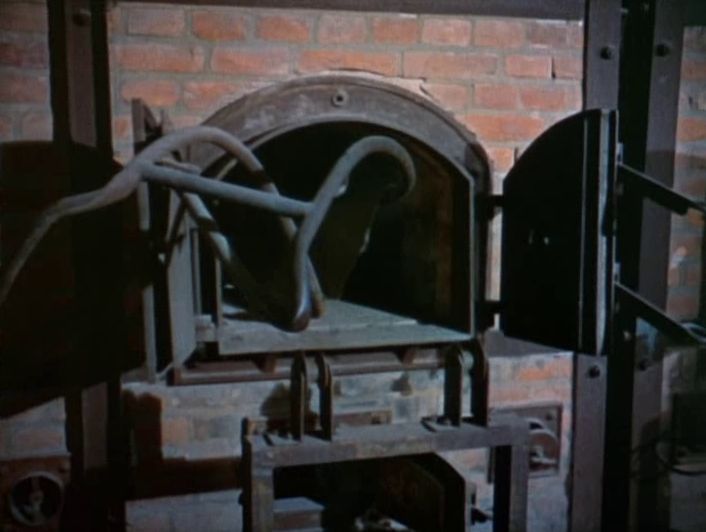
In the end we come to the most devastating images – shots showing the wasted bodies of tortured prisoners, as well as mounds of emaciated corpses.  The Nazis became more efficient in dealing with this wastage, too, replacing their death pyres with new ovens that “could deal with several thousand bodies a day.”

And nothing in the execution camps was wasted.  We see images showing mountains of women’s hair that was used to make clothing material and rugs.  Human bones were used to make fertilizer.  And “with the bodies they tried to make soap.”  Here we see humans being treated like animals.  But in fact we don’t even have to treat animals this way, and we shouldn’t.  I will return to this point.

At the end of Night and Fog, there is the question asked as to who is responsible.
“‘I’m not responsible’, says the kapo.” 
“‘I’m not responsible’, says the officer.” 
“Who is responsible, then?”
The film closes with a warning.  It says there are people around
“. . . who see the monster buried under these ruins. . . finding hope in being finally rid of this totalitarian disease, pretending to believe it happened but once, in one country, not seeing what goes on around us, not heeding the unending cry.”
Here was a concern expressed by Resnais and Cayrol just ten years after the concentration camps were exposed to the world that, as memory fades, people might lose track of what happened there and consider that to have been just one never-to-be-repeated anomaly. Now sixty years further on, the concern should be even greater, because those events have faded even further and are even more abstract in the popular consciousness.  What can we do to hold on to what happened there and help us see how those past events relate to what is going on around us today?   That is what you feel as the film comes to an end. 

To me this film highlighted two things worth considering in this respect.

1.  See this film
You can visit historical monuments and see the sights of historical events, but you are unlikely to be able to fathom what happened.  I have personally visited Dachau and Auschwitz and seen the exhibitions there, which were powerful.  But I got much more out of seeing Night and Fog than from paying those visits.  As the narration in Night and Fog remarks, there are limitations in what you can get from looking at architecture.  I have heard architects say that a building incorporates all the possible "journeys" and processes that can go on within it.  It is true that the building provides a spatially structured context, but it is too general for us to know everything that goes on there.  As the film commentary says,
“The reality of these camps is hard for us to uncover traces of now.”

“No image, no description, can capture their true dimension of constant fear.”
When we see those steps leading to the Mauthausen quarry, it is not evident from the architecture that 3,000 Spaniards died in the construction of those steps.  We have to be told that, and it is best that we are told within the structure of a narrative.  Night and Fog provides that narrative.


The “method of loci” (aka “memory palace”) is a memorization technique that combines architecture and narrative.  It consists of an imaginary journey (i.e. a narrative) through a remembered architecture (the “palace”), during which individual memories are stored in different palace locations.  Since our memories work through the construction and exploration of narrative structure, the method of loci offers up a customized narrative that one can use to store memories.  Resnais has done that for us in Night and Fog.  He presents a prowling narrator who (in color) wanders among the camp ruins and evokes images (in black and white) that fit into this memory-palace journey.  By seeing (and re-seeing) this film, we get a better feeling of what happened there.


2.  Consider the slaughterhouses
As I watched this film, I could see that the prisoners were treated like material objects.  They were put to slavish work in factory hellholes, and then when they were no longer useful, they were exterminated.  Their hair, bones, and bodies were then harvested to make further material objects.  This is the same thing that our modern society does to animals. It is worth remembering, however, that there are several negative outcomes that come from slaughtering animals for meat and material goods, as I have discussed earlier [8].  Such activities
  • worsen our health,
  • reduce the availability of water and arable land,
  • greatly contribute to global warming

Moreover, there are also social issues in this regard that are equally important.  When animals are raised and then sent to the slaughterhouse, they are viewed as objects whose only value is the extent to which they contribute to our material utility.  We eat their meat and use their hair and skin to make clothing.  We close our eyes to the fact that animals are sentient beings who can anticipate and suffer.  When we heartlessly treat animals as senseless “things”, we close ourselves off from our own native capacities for compassion. 

Apart from the inhumanity of treating animals this way, there is a further damaging side effect – the transition from treating animals that way to treating humans that way is not such a big step. That is where the   problem gets worse. It would be better for everyone if we moved our society in the direction of universal compassion  – so that treating any animals, including humans, that way is held to be unthinkable. When I watched Night and Fog, I felt I was exploring animal slaughterhouses for humans, and it made me think of animal slaughterhouses, generally, as well. Maybe you will get that feeling, too, when you watch the film (it is freely available).
★★★★

Notes:
  1. Phillip Lopate, “Night and Fog”, The Criterion Collection, (23 June 2003).
  2. James Leahy, “Nuit et Brouillard”, Senses of Cinema, (May 2003).
  3. Cayrol would go on to write the screenplay for Resnais’s Muriel (1963), which was also concerned efforts to fashion and hold on to memories about a disturbing past, in this case the Algerian War.
  4. See for example, my reviews of
  5. “Nazi Camps”, Holocaust Encyclopedia, (20 June 2014), United States Holocaust Memorial Museum, Washington, DC, USA.
  6. Roger Cohen, “Europe’s Deepest Debt”, International New York Times, (10 August 2015).
  7. Richard J. Evans, “The Anatomy of Hell”, The New York Review of Books, (9 July 2015).
  8. See my reviews of

Alain Resnais

Films of Alain Resnais:

“Hiroshima Mon Amour” - Alain Resnais (1959)


After establishing himself as an inventive and artistic documentary filmmaker, Alain Resnais made his first dramatic feature in 1959 with Hiroshima Mon AmourIt was an immediate sensation, winning the International Critics’ Prize at the 1959 Cannes Film Festival, and to this day it continues to stand as a must-see work for anyone interested in the possibilities of cinematic expression. The film appeared at the onset of, and is sometimes loosely associated with,  the French New Wave (Nouvelle Vague), although Resnais did not identify himself with that movement. Despite the film’s popularity with the critics [1,2], however, it was and remains controversial on several levels.  For one thing, how could one make a film that relates to the atomic bombings of Hiroshima (and Nagasaki) that would encompass the full horror and suffering of the event?  And additionally, there were questions concerning what was the ultimate subject matter of the film and whether it reached any meaningful resolution.

Resnais was originally commissioned to make this film as another documentary in the fashion of his famous Night and Fog (Nuit et Brouillard, 1955), which was about the Nazi concentration camps.  But after thinking about his subject, Resnais felt that he couldn’t do justice to the topic in that fashion, and he declined the offer.  However, the producers already had French-Japanese co-funding lined up and encouraged Resnais to reconsider and expand the topic with the cooperation of a French fiction writer.  Eventually he hooked up with the distinguished novelist Marguerite Duras, who scripted the film with Resnais and who fashioned its famous dialogue. 

The story of the film concerns a brief love affair – not much more than a one-night stand, really – between a French woman and a Japanese man during the woman’s visit to Hiroshima.  She is there to act in a film about the Hiroshima bombing, and she has met the man casually just before the end of the location-shooting of her film production.  What Hiroshima Mon Amour goes on to present is essentially an extended conversation between these two people; but the conversation is enlivened visually by showing stream-of-consciousness images from the perspective of the French woman (the focalization of the film is entirely on her). The conversation they have touches on, in a natural manner, a number of profound themes, including love, memory, forgetting, historical reality, and time, itself.


In fact, before going further, I would remind the reader that the nature of time and narrative are inextricably linked, as Paul Ricoeur pointed out.  He argued that narrative lies at the very root of our understanding of time [3].  At its primordial level, time is not a succession of instants – that notion is only an abstract, theoretical construct.  Time, fundamentally, is understood through the narratives we construct about ourselves and the world around us with which we interact.  For his part, Resnais seems to be operating almost at the pre-narrative level – how shards of experience keep reappearing in our consciousness and how we may try to suppress them or hold onto them, depending on whether they are deemed to be parts of narratives that we want to retain about ourselves. 

These fragments of psychological experience/expression as presented in the film are mostly of four types;
  1. Objective images of the present
  2. Subjective impressionistic images of the present
  3. Subjective impressionistic images of the past
  4. Verbal (in voice-over) commentaries.
Type 1 is associated with an exterior focus, and types 2, 3, and 4 are associated with an interior focus.  These fragments are accompanied by nondiegetic music that has its role to play.  This music, most of which was composed by Giovanni Fusco, varies from dolorous or contemplative  to perky in order to reflect changes in mood and concentration. Although many people praise the musical score, I found it mostly a distraction and a weakness to the film.  Your mileage on this score may vary according to tastes.

On a thematic level, I would say that the film has four phases to it.  Since the woman and the man are never named, I will sometimes refer to them here as FW (French woman) and JM (Japanese man) [4].
                   
1.  The Hiroshima Atomic Bombing
The film opens, memorably. with the couple naked in bed, while the woman talks about having four times visited the atomic bombing museum in Hiroshima.  The psychological subjectivity of the images is evident when we sometimes see the couple doused with nuclear ash – a visual importation of images from the bombing victims shown in the museum.

Although the film’s focalization is always on FW, the focus in this section of the film is on FW’s interior.  What she saw (and thus the images that the viewer sees) are not “objectively” what happened, but instead dramatic recreations of the bombing presented in the museum.  Nevertheless, the viewer sees FW, from an interior perspective, trying to grasp what objectively happened in Hiroshima in 1945. 

She expresses horror at what she saw – how surviving women would wake in the morning and find all their hair had fallen out.  But the man soothingly tells her, in his broken French, that she saw nothing.  Whenever she says, “I saw X” (where X concerns something specific that she saw), he responds with, “No, you didn’t see X”.  She knows that, as a tourist, she probably has no right to tell a Japanese person her thoughts on these things. 

Finally she tells him, “like you, I know what it is to forget.”  And he responds with, “No you don’t know what it is to forget.”  But the woman continues:
“Like you, I have struggled with all my might not to forget.  Like you, I forgot.  Like you, I longed for a memory beyond consolation, a memory of shadows and stone.  For my part I struggled every day with all my might against the horror of no longer understanding the reason to remember.   Like you, I forgot.”
This is the historical reality that she doesn’t want the “world” to forget.  We anchor our own memories on events that are taken to be objective facts.  But sometimes the world doesn’t have a common understanding of some world-famous events. 

She goes on,
“I know something else.  It will begin again. 200,000 dead and 80,000 wounded in nine seconds.  Those are the official figures.  It will begin again. It will be 10,000 degrees on the earth.  10,000 suns, people will say.  The asphalt will burn. Chaos will prevail. An entire city will be lifted off the ground, then fall back to the earth in ashes.“
It is worth pausing and reflecting on this for a minute in light of our present circumstances in the world today.  The American people are currently traumatized by acts of terrorism, particularly the 911 World Trade Center atrocity.  But they are reluctant to concede that the American government actually perpetrated perhaps the most villainous single terrorist act [5] – for the Hiroshima and Nagasaki bombings were intended to terrorize an entire people. Many people today (even some in Japan) prefer to believe that the atomic bombings precipitated the end of the Pacific War and therefore saved lives. There is considerable evidence, however, to say that such wishful thinking is not true [6,7,8].  The Japanese were about to surrender, and the Hiroshima and Nagasaki sights were not integral to the Japanese war effort. Those bombings were meant, and only served, to terrorize a civiliain population.

FW, back in 1959, did not want the world to forget Hiroshima and what really happened there.  This part of Hiroshima Mon Amour, just by itself, is worth holding on to in an era when people seem unmindful of what happened then and could happen again.

2.  The Lovers Get Up
With the lovers still in bed, the focus turns to the lovers, themselves.  For the most part, the focus is more external and objective in this section, although there are occasional brief images reflecting FW’s memories of past events (which will be explained later in the film’s third section). 

FW now wants to immerse herself in her new love and forget about the world around her.  She says randomly in voice-over:
"How could I know this city was tailor-made for love? 
How could I know you fit my body like a glove? 
I like you.  How unlikely.
. . .
You’re destroying me.  You’re good for me.
. . .
Devour me.  Deform me to the point of ugliness."
Now after their night of passion, FW and JM get to know each other more.  She’s an actress; he’s an architect.  He asks her what the Hiroshima bombing meant to her when she heard news of it back in France, and she says it meant “the end of the war”.  He muses somewhat somberly that “the whole world rejoiced, and you rejoiced with it.”

But in the light of day, FW becomes more aware of her mundane responsibilities. She shocks JM by announcing to him that her plans are to return to France the next morning.  He wants to continue their relationship, but she doesn’t.  Departing in a taxi for her film shoot, she tells him that she is a married woman with children and that she just regards their tryst as a nice fling. 

3. Her Story
JM wants to pursue the relationship, however, and tracks her down at the film-shooting location.  After finishing her filming responsibilities, FW agrees to accompany JM to his home, where she learns that he, too, is married, though his wife is away at the moment.  Soon they are in bed again, but JM wants to know more about the woman he has come to love.  He suspects that an offhand remark she earlier made about her hometown of Nevers, France, points to something crucial, and he urges her to tell him more.

Now the mise-en-scene returns to the interior focus on FW.  Gradually, tearfully, she tells him about the traumatic event of her past – her secret teenage love affair with a German soldier in occupied France.  They had numerous secret, romantic trysts, but on the eve of the liberation, her lover was killed.  FW’s intense grief exposed her as a traitor, and she had her head shaved in public to highlight her shame.  Her family kept her locked in a cold cellar for months, and the sobbing girl was abandoned in her dungeon and assumed to be mad. Time passed, she was finally released from the cellar, and she made her way alone to Paris just before the Hiroshima bombing. 

FW tells him that the intensity of her grief was so great that she cannot believe she is now living a normal life.  Her greatest horror is that she will gradually forget her lost love and consequently cease to be herself:
“One day I will no longer remember it. . . . at all. . . . nothing.”
JM is thrilled to learn that she has never told this story before to anyone, not even to her husband.   He tells her
“In a few years when I have forgotten you, and other adventures like this one will happen to me from sheer force of habit, I’ll remember you as the symbol of love’s forgetfulness. I’ll think of this story as the horror of forgetting.” 
Mutually realizing that they will probably never see each other again, she tells him to leave her, and he walks away.  At this point, we might expect the film to end here.  But it doesn’t, and this is where the film loses some viewers.

4.  Indecision
The remaining one-quarter of the film (22 minutes) tracks FW’s struggle with herself.  She has finally met a man who could open her up, and she doesn’t know what to do.  At one point she promises to herself that she will stay in Hiroshima and be with him every night.  But then she realizes this would be impossible.

JM comes to her again – he cannot forget her, either – and they go walking on the street.  While walking silently ahead of him, FW imagines a mini-narrative that fails to take place – that he will come up and grab her and kiss her and that she will surrender to him.  Contradictory thoughts and images are passing through her mind as she thinks about her old love and JM (she sometimes conflates the two).

She runs away back to her hotel room, but she knows he will come after her, and she lets him in.   She breaks down and cries to him, 
“I’ll forget you.  I’m forgetting you already! . . . Look how I’m forgetting you!  Look at me!”
They look at each other in search of an answer.
FW: “Hiroshima, that’s your name”
JM: “and your name is Nevers. “
Starting from different perspectives, they have both arrived at, and labeled, their distinctive narrative understandings of love and compassion.  With that the film ends.

There are differences of opinion concerning what happens at the end.  Some people believe she will stay with him in Hiroshima, while the majority believe she will part with him forever and return to France.   What really matters, though, is whether the overall narrative has reached some resolution.

Some people might say, in fact, that with respect to this narrative, FW has made no real progress at all.  She is still agonizing about the erosion of her memory, and now she simply has another fresh memory of importance that will also fade away like all the others. But I would disagree with that judgement. The experience she has had in Hiroshima – the unavoidable confrontation with the great suffering that that bombing event caused – has opened her up again. Feeling the unbearable pain associated with that historical event, has reconnected her to the depths of her feelings – including the unbearable pain of another event from her own past and also the wonders of giving herself to another soul. 

And opening up empathically, means being alive again, being herself again, being able to love deeply again.
★★★½ 

Notes:
  1. Andrew Sarris, “Movie Journal” (review of “Hiroshima Mon Amour”), The Village Voice (24 November 1960), part 1 & part 2.
  2. Acquarello, “Hiroshima Mon Amour, 1959 Strictly Film School, (2000).
  3. Paul Ricoeur, Time and Narrative, volumes 1, 2, and 3, (1984, 1985, 1988), The University of Chicago Press, Chicago.
  4. They are often referred to in other quarters as “Elle” (She) and “Lui” (He), but I think this  can get unnecessarily confusing.
  5. The 1945 fire-bombings of Tokyo and other parts of Japan (not to mention the WWII firebombing in Europe) were collectively just as lethal, but they were more than a “single act”.
  6. Gareth Cook, “Why Did Japan Surrender?”, Bostom.com, (7 August 2011).
  7. Ward Wilson, “Rethinking Nuclear Weapons”, (2015).
  8. Ward Wilson, Five Myths About Nuclear Weapons, Mariner Books, (2014).