Showing posts with label Ingmar Bergman. Show all posts

“Persona” - Ingmar Bergman (1966)

Persona (1966), written and directed by Ingmar Bergman, is one of that great Swedish filmmaker’s most challenging films.  Many viewers and critics alike have found this film, mostly just showing two isolated women looking to interact with each other, to be largely incomprehensible, and they could not understand even what the film is about.  Their difficulties were exacerbated by the problems they had making out which key scenes in the film were supposed to be imaginary and which ones were supposed to be “real”.  Not surprisingly, Persona won few awards when it was released, and it has drawn heavy criticism from such leading critics as Andrew Sarris [1] and Jonathan Rosenbaum [2].
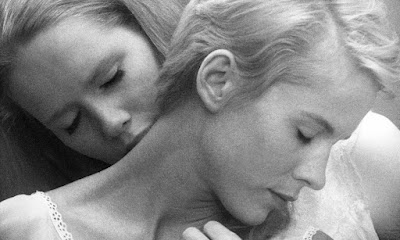
Nevertheless and despite the film’s supposed inscrutability, Persona’s novel and artistic treatment of fundamental aspects of personhood has gradually attracted an enthusiastic global following, and it is now regarded by many as Bergman’s masterpiece and as one of the greatest films ever made [3,4,5,6,7,8,9].  The British Film Institute's 2012 international poll of film critics ranked Persona as the 17th greatest film of all time [11], and its 2012 international poll of film directors ranked Persona as the 13th greatest film of all time [12].  But even though Persona has attracted a devoted following, there is still widespread disagreement about what it all means.  As a result, there have been several books and collections devoted to the film, and film scholar Thomas Elsaesser has suggested that Persona may be the most seriously written-about film ever [6].
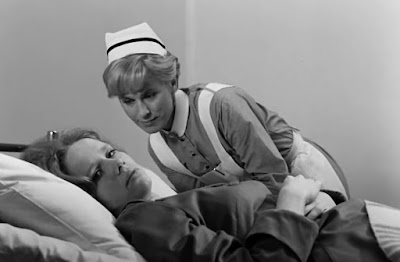
The film concerns two women, Elisabet Vogler (played Liv by Ullmann), who is a famous stage actress, and Alma (Bibi Andersson), who is a young nurse.  But before introducing these two personages, Bergman begins his film cryptically by showing an old film projector and then some disconnected images, including a slapstick silent-film sequence, a spider, a crucifixion, and a lamb being slaughtered.  Then we see a young boy waking up in a hospital cot and looking around, finally gazing on a large screen showing a blurry image of a woman’s face.

Then we are introduced to the two women, Elisabet and Alma.  In the middle of one of her stage performances, Elisabet suddenly and mysteriously became mute.  Her doctors subsequently determined that there is nothing physically wrong with Elisabet and that her now-total silence is the result of a stubborn decision on her part.  Elisabet’s psychiatrist doctor (played by Margaretha Krook) believes that Elisabet’s total withdrawal is due to a fanatic concern about her personal authenticity – Elisabet apparently doesn’t want to express anything that is not fundamentally true about herself, and so she is holding to her silence.  Consequently the doctor assigns nurse Alma to take Elisabet to the doctor’s remote island cottage and see if she can spend some relaxing time with the actress and help bring the woman out of her malaise.  

As I mentioned, it is argued by many (e.g. [5,6]) that the events shown in the film don’t add up to a single coherent story, thereby leaving viewers to construct their own stories out of the subsequent narrative shards that are presented.  These narrative shards can be grouped into six collections.
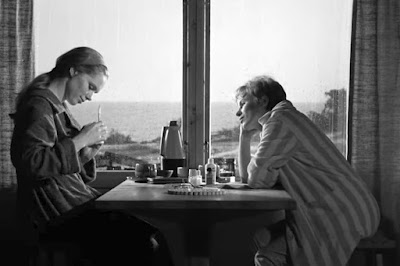
First “Conversation”
At the cottage, Alma tells her mute companion that she is happy to finally find someone to listen to her own babbling.  She begins talking about her current fiancé and also about her first romantic affair that was with an older man and that lasted five years.  

Then she tells a more detailed and sexually explicit story about a time when she was already involved with her fiancé and she went alone to the beach.  There she met another woman and the two of them engaged in some nude sunbathing.  Two young men then appeared, and Alma’s new woman friend uninhibitedly got them involved in a sex orgy.  Alma describes experiencing some intense orgasms, and film critic Roger Ebert commented that this was “the most real experience Alma has ever had” [4].  Later, however, Alma became pregnant and had an abortion, and she still feels guilty about this.  All this is told verbally, and there are no flashbacks here, as the mute Elisabet listens attentively.

Nighttime Encounter
It is becoming increasingly evident that Alma idolizes her patient, Elisabet, and wants to be like the famous star.  In the evening Alma thinks she hears Elisabet whispering to her to go to bed.  And then later at night, Alma wakes up to see (or perhaps dreams) Elisabet coming to her and embracing her tenderly.  In the morning, though, Allma asks Elisabet about these two incidents, and the woman silently denies that they occurred.
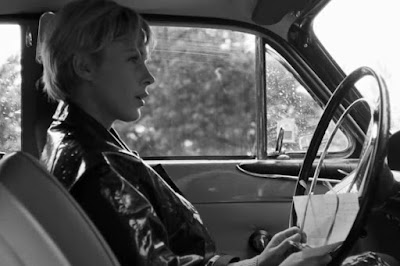
The Argument

One day Alma drives to town to mail some letters they have written, and she notices that Elisabet's letter to her doctor is not sealed, so she proceeds to read it.  It is a patronizing letter that is dismissive of Alma and mentions the nurse's personal story about her beach orgy and abortion. Alma, of course, becomes angry and withdraws from her hitherto worshipful feelings about her patient.

At this point the film briefly breaks up with some artificial cinema edits like in the opening sequence, thereby reminding the viewers that they are just watching a movie.

When Alma returns home, she angrily confronts Elisabet and threatens to scald her with a pot of boiling water.  Frightened, Elisabet speaks out for the first and begs Alma not to do it.  Then Alma furiously goes on to tell her that she knows the woman is a very bad person.  Elisabet runs off, and when Alma, coming to her senses, chases after her and begs her for forgiveness, Elisabet refuses to forgive her.
Elisabet’s Husband Comes
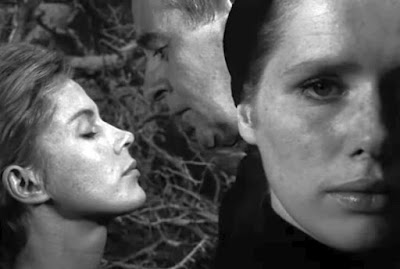
One night, Alma hears a man outside calling for Elisabet, and it turns out to be Elisabet's husband (played by Gunnar Björnstrand).  The man seems to have bad eyesight, and he mistakes Alma for his wife.    Although Alma tells him he is mistaken, she very soon succumbs and assumes Elisabet's identity.  Alma and the husband then go on to have sex together while Elisabet, close by, silently watches.

Elisabet's Confession
Earlier, Elisabet had received a letter from her husband that contained a picture of her son, which she had proceeded to tear up.  Now Alma meets with Elisabet to talk about why Elisabet tore up the picture.  Elisabet proceeds to give her account, and we see her face, but her account is told in Alma’s voice.  The voice says that the only thing that Elisabet wanted that she did not have was motherhood, and so she became pregnant. However, she soon regretted her decision and tried to have a self-induced abortion, but she failed in this effort.  She wound up giving birth to a boy who she hoped would die and whom she has since always  despised.  Nevertheless her rejected son has always craved her love.

Strangely, this same story is then repeated word-for-word, only now showing Alma’s face telling the exact same story.

Ending
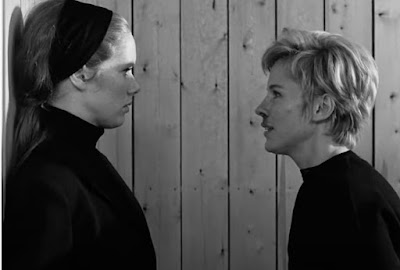
The film ends with Alma in a distressed state.  She adamantly asserts to Elisabet that she has her own identity that is very distinct from that of Elisabet.  She later finally manages to get Elisabet to say something – the word "nothing".  Then Alma packs up her things and gets on a bus to leave the cottage, which is accompanied by a shot showing  a modern film crew filming her.

So what can be said about the overall meaning of this odd, disjointed work?  As one watches it, it is possible to make out some key themes that resonate throughout:
  • Personal authenticity (and inauthenticity).  What is the true essence of a person and how is it revealed?  
  • Images of the face and the degree to which they can reveal or mask one’s true personhood.  
  • Touching with hands and the degree to which that can confirm the reality of what one sees.
  • The inadequacy of language for revealing the essential nature of experience.
  • The never-ending quest for the true meaning of life.
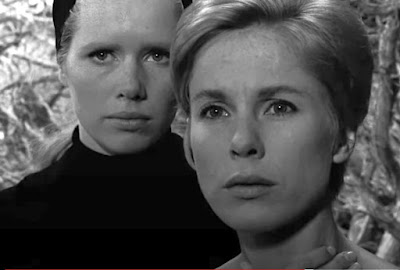
These various themes and metaphors in the film have elicited a range of commentary over the years, but the most interesting thoughts I have come across have been those of Susan Sontag, who wrote an insightful essay on Persona in 1967, soon after the film was released [5].  For example, on the issue of plot and how one might best construct a coherent narrative with what is shown in the film, Sontag doesn’t believe that Bergman ever had any intention offering a real plot [5]:
“Once it is conceived that the desire to ‘know’ may be (in part) systematically thwarted, the old expectations about plotting can no longer hold. At first, it may seem that a plot in the old sense is still there; only it’s being related at an oblique, uncomfortable angle, where vision is obscured. Eventually though it needs to be seen that the plot isn’t there at all in the old sense, and therefore that the point isn’t to tantalise but to involve the audience more directly in other matters, for instance in the very processes of ‘knowing’ and ‘seeing’.”
And on the interesting topic of what is Alma’s authentic self and to what degree does she move to find herself, Sontag has an interesting take.  She asserts that Alma and Elisabet can be considered to be two sides of one person [5]:
“It’s correct to speak of the film in terms of the fortunes of two characters named Elizabeth and Alma who are engaged in a desperate duel of identities. But it is no less true, or relevant, to treat Persona as what might be misleadingly called an allegory: as relating the duel between two mythical parts of a single ‘person’, the corrupted person who acts (Elizabeth) and the ingenuous soul (Alma) who founders in contact with corruption.”
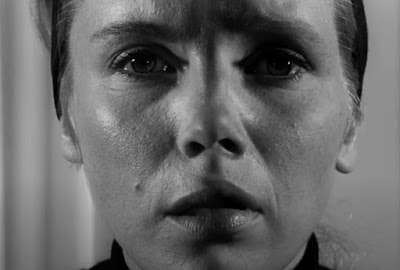
(Indeed, at one point Bergman shows a special image of a single face that consists of half of Elisabet’s face on one side and half of Alma’s face on the other side.)

Sontag’s comment here is,  to me, the most compelling interpretive observation on the film, and it fits well with several other expressionistic sequences of the film, too, such as (a) the nighttime encounter between Elisabet and  Alma, (b) Elisabet’s husband mistakenly taking Alma for his wife, and (c) the exact repetition of Elisabet’s confession, showing first Elisabet’s face and then Alma’s face, but each time spoken in Alma’s voice.

So Persona is a challenging and perplexing film, but it also has a fascinating focus, and I believe it is worthy of your interest.  
 

Notes:
  1. Andrew Sarris, “films”, The Village Voice, (23 March 1967).  
  2. Jonathan Rosenbaum, “Scenes From an Overrated Career”, The New York Times, (4 August 2007).   
  3. Roger Ebert, “Persona”, RogerEbert.com, (7 November 1967).   
  4. Roger Ebert, “Persona”, Great Movie, “RogerEbert.com”, (7 January 2001).   
  5. Susan Sontag, “Persona – Review by Susan Sontag”, Sight and Sound, (Autumn 1967).  
  6. Thomas Elsaesser, “The Persistence of Persona”, The Criterion Collection, (17 March 2016).   
  7. Chuck Bowen, “Blu-ray Review: Ingmar Bergman’s Persona on the Criterion Collection”, Slant Magazine, (21 March 2014).   
  8. Peter Bradshaw, “Persona review – Ingmar Bergman's enigmatic masterpiece still captivates”, The Guardian, (29 December 2017).   
  9. Acquarello, “Persona, 1966", Strictly Film School, (25 December 2017).   
  10. “Critics’ Top 100", Analysis: The Greatest Films of All Time 2012, Sight and Sound, British Film Institute, (2012).      
  11. “Directors’ Top 100", Analysis: The Greatest Films of All Time 2012, Sight and Sound, British Film Institute, (2012).      

“Cries and Whispers” - Ingmar Bergman (1972)

Ingmar Bergman’s Cries and Whispers (Viskningar och rop, 1972) is a unique film in several respects and is unlike other films in Bergman’s oeuvre.  For one thing, the film doesn’t trace out a straightforward, coherent narrative like most filmed dramas.  Instead, it consists of a collection of emotion-tempered recollections and visions on the parts of its four main characters.  On account of this, the film has drawn a range of reactions from various reviewers.  Famed film critic Andrew Sarris hated the film [1].  On the other hand, Roger Ebert was captivated by the film and had this to say about it [2]:
"’Cries and Whispers’ is like no movie I've seen before, and like no movie Ingmar Bergman has made before, although we are all likely to see many films in our lives, there will be few like this one.  It is hypnotic, disturbing, frightening.”
And overall, the film has come to be regarded as a classic [2,3,4,5,6,7,8,9].  Moreover, the  artistic craftsmanship employed in the making of this offering was recognized by the U.S. Academy of Motion Picture Arts and Sciences by earning five Oscar nominations, including one for “Best Picture” (not just a nomination for “Best International Feature Film”, i.e. Best Foreign Film).

For my part, as I watched Cries and Whispers, I was initially somewhat skeptical and thought that some of the characters were perhaps too schematically drawn to fuel a gripping drama.  But as the film played on, I became increasingly drawn in to the psychological themes on display.  As critic Emma Wilson remarked [8],
“Its [Cries and Whispers’s] achievement, making it emerge from Bergman’s extraordinary corpus as unique, is in its incandescent touching of love and horror in their fullest extremes.”
Indeed, there are a number of passionate human existential themes interwoven into this tale:
  • Honesty and authenticity
  • Communication
  • Human intimacy 
  • Pain
  • Death
  • Love
But before we look at the coverage of these themes in the film, we need to clear up a matter concerning the English title of the film.  “Cries and Whispers” is an English translation of the Swedish title, “Viskningar och rop”, but the English rendering likely suggests the feelings of whimpering sadness.  However, as Norman Holland has pointed out, the English word ‘cries’ has two meanings – (a) “crying out”, i.e. shouting, and (b) tearful sadness, whereas the Swedish word ‘rop’ connotes only shouting [4].  So a more precise, though less poetic, translation of “Viskningar och rop” would be “Whispers and Shouts”.  This suggests that a key aspect of this film is concerned not so much with sadness, but with contrasting types of spoken communication, which is one of the above-listed themes of the film.  

The events in the film take place in a large manor house in the Swedish countryside near the end of the 19th century, and they concern the thoughts and feelings of the four adult women who are staying there.  (There are men in this film, but they are mostly mechanical ciphers with little feeling.)  Three of these women are sisters – Agnes (played by Harriet Andersson), her older sister Karin (Ingrid Thulin), and Agnes’s younger sister Maria (Liv Ullmann) – and the fourth woman is the housemaid, Anna (Kari Sylwan), who has served at the home for twelve years.  Karin and Maria have come to the mansion to attend to their terminally ill sister, Agnes, who is suffering in the final stages of intestinal cancer.  The film opens showing Agnes in bed and suffering extreme pain, the intensity of which is underlined by a two-minute extreme closeup shot showing Agnes’s agonized face.  In the adjoining room the other three women are shown expressing their concern.  

Then the film begins its sequence of subjective recollections and visions, some of which seem to be fantasies.  These are all encapsulated by fade-ins and fade-outs from and to a deep red color, rather than black, and they feature a closeup of the woman having the vision before fully fading to a deep red hue.  Indeed color is a key feature of this film, particularly red, which Bergman once said represented for him the “interior of the soul” [5].  And of course black and white have also always been key shades for Bergman.  Norman Holland has symbolized these three colors for Bergman as “red for the fruitful, sensuous mother; white for the virgin; black for the death-goddess” [4].  Here in this film we can further identify these colors with the four women: Maria (red), Karin (black), Anna (white), and Agnes (white).

The sequence of subjective recollections and visions provide little narratives concerning how the four women see themselves and the others.  After all, this is only natural – we tend to characterize ourselves and other people in our acquaintance not as lists of facts, but in terms of brief narratives that we have constructed for the purpose [10,11,12].  

To reveal Maria’s nature, there is a revelatory recollection of an occasion when Agnes’s doctor, David (Erland Josephson), pays a brief clinical visit to the mansion and before departing is privately approached by Maria.  We learn that Maria and David had had a past extramarital affair (which had induced her neglected husband Joakim (Henning Moritzen) to attempt suicide) and that now Maria wants to rekindle things.  But David doesn’t want to restart anything with the woman, and he holds her in front of a mirror so she can see his description of how her many years of selfish, good-natured  superficiality has affected her face.  Maria, looking at her image in the mirror, seems to accept David’s painful diagnosis.  

On another occasion, though, Maria is shown approaching her sister Karin and seeking to restore their once affectionate relationship when they were growing up.  Maria wants to again touch and kiss her sister, but Karin is standoffish and reluctant to do that.  However, Karin eventually succumbs to Maria’s approaches, and they embrace affectionately.  On a later occasion, though, Karin wants to resume the affectionate gestures with her sister, but Maria is shocked and has forgotten all about the earlier encounter.  This reveals that, essentially, Maria is a mostly genial, outward-going, touchy-feely person, but she lives mostly in the present and generally doesn’t retain long-held feelings.

Karin, on the other hand, is a lonely and thoughtful, inner-directed person who harbors long-held resentments.  There is a recollective vision which shows her having dinner with her husband, Fredrik (Georg Årlin), who is cold and self-centered.  Afterwards, she takes a piece of broken glass and uses it to painfully mutilate her genitalia so that she can deny her husband from having sex with her.

Anna, the maid, is a simple person but full of warmth and compassion.  She is religious and prays to God regularly, and she doesn’t question what she considers God’s unfathomable wisdom for having years ago taken the life of her young daughter.  After Agnes’s death, Anna recalls or imagines a period when Agnes briefly came back to life and called out for solace from her deathbed.  Karin and Maria were disturbed at the sight of such an apparition and withdrew in horror, but Anna went to Agnes and instinctively enfolded her in her bosom the way a mother would do to comfort her suffering child.

We don’t get much about Agnes’s inner personal vision until the end of the film.  Maria’s and Karin’s  husbands come to the manor home to shut things down, and they cold-heartedly dismiss Anna without any severance.  So Anna must clear out her things, and in the process of tidying things up, she comes across Agnes’s diary.  Anna reads an entry in the diary, which is dramatically visualized, in which Agnes describes an earlier time when she was feeling better, and an occasion when she, Karin, Maria, and Anna frolicked together in a park.  In particular, Agnes highlighted a shared moment of oneness when they engaged in swinging on a swing.  This was such a special moment for Agnes, and she said [4],
“The people I am most fond of in all the world were with me. I could hear their chatting around me. I could feel the presence of their bodies, the warmth of their hands.  I wanted to hold the moment fast and thought,
‘Come what may, this is happiness. I cannot wish for anything better. Now, for a few minutes, I can experience perfection. And I feel profoundly grateful to my life, which gives me so much.’”
So the film ends giving one the feeling that though her life was painful and tragically shortened, Agnes was perhaps the one who lived life most authentically and thereby to the fullest.  She had the ability to recognize and hold onto all the beautiful moments she experienced in life.  This is the scene that brings things together and makes the film a coherent whole.  But this is only one of the film’s moving expressions of engagement (or would-be engagement).

In fact there are several scenes in Cries and Whispers that critics have singled out as being uniquely brilliant, even for Ingmar Bergman.  Emma Wilson, writing for The Criterion Collection, treasured two other scenes – one of Anna enfolding Agnes in her bosom and another of Agnes returning to life, to the horror of her sisters [8]:
“These two scenes are unequaled in any film, I think, in their finding of a form, an image, to hold unspeakable emotions.“
Roger Ebert had his own take on favorite scenes [2]:
"These two scenes – of Anna, embracing Agnes, and of Karin and Maria touching like frightened kittens – are two of the greatest Bergman has ever created.”
When you see the film, you may have your own favorites.  Together, all these moments of visionary emotive expression in Cries and Whispers add up to a moving cinematic experience.


Notes:
  1. Andrew Sarris, “films in focus”, The Village Voice, (28 December 1972).   
  2. Roger Ebert, “Cries and Whispers”, RogerEbert.com, (12 February 1973).   
  3. Vincent Canby, “Bergman's New ‘Cries and Whispers’”, The New York Times, (22  December 1972).   
  4. Norman N. Holland, “Ingmar Bergman, Cries and Whispers, Viskningar och rop, 1984.”, A Sharper Focus, (1984).   
  5. Peter Cowie, “Cries and Whispers”, The Criterion Collection, (18 June 2001).   
  6. Roger Ebert, “Cries and Whispers”, Great Movies, RogerEbert.com, (18 August 2002).   
  7. Marco Lanzagorta, “Cries and Whispers”, Senses of Cinema. (March 2003).   
  8. Emma Wilson, “Cries and Whispers: Love and Death”, The Criterion Collection, (1 April 2015).
  9. Margarita Landazuri, "Cries and Whispers”, Turner Classic Movies, (23 February 2016).  
  10. Roger Schank and Gary Saul Morrison, Tell Me a Story: Narrative and Intelligence (Rethinking Theory), Northwestern, (1990).  
  11. Jerome Bruner, “The Narrative Construction of Reality”, in Narrative Intelligence (2003), Michael Mateas and Phoebe Sengers (eds.), John Benjamin Publishing Co.
  12. Paul Ricoeur, Time and Narrative, vols. I- III, (1983-1985), University of Chicago Press.

“Autumn Sonata” - Ingmar Bergman (1978)

One of Ingmar Bergman’s last movies made expressly for the cinema, Autumn Sonata (Höstsonaten, 1978), was something of a masterpiece in both style and content.  Consisting of mostly an extended, bitter colloquy between an elderly mother and her married daughter, one wouldn’t expect material of this nature would be suitable for a fascinating film.  But writer-director Ingmar Bergman, with the help of his two leading actresses, Liv Ullmann and Ingrid Bergman, fashioned a gripping psychological drama that keeps the viewer interested all the way, and Autumn Sonata has been highly regarded by a number of critics over the years [1,2,3,4,5,6,7,8].  This was Ingrid Bergman’s last film appearance (and the only collaboration between the two famous Swedish Bergmans), but she gives here one of her most moving performances to cap off her career.

At the time when this film was made (1977), Ingmar Bergman was going through an anguishing period, because he had been charged and arrested by the Swedish authorities for tax-evasion in 1976.  Although the charges were soon dropped later that year, the now-depressed Bergman went into self-exile for the next four years and thereby cut off his ties with the Swedish filmmaking industry during that period.  Nevertheless, he continued to make films during this time, and Autumn Sonata was shot in Norway and produced in West Germany.  And with this film Bergman also continued with his relatively later-in-his-career focus on the complex moods and interactions of female psyches.  Many of these films featured Liv Ullmann (in addition to Autumn Sonata, these include Persona (1966), Shame (Skammen, 1968), The Passion of Anna (En Passion, 1969), Cries and Whispers (1972), and Scenes from a Marriage (Scener ur ett Aktenskap, 1973)), who was also a sometime romantic partner of Bergman’s.

The story of Autumn Sonata concerns the wife of a country parson, Eva (played by Liv Ullmann), who invites her semi-estranged mother Charlotte (Ingrid Bergman) to come to her rural home for an extended visit.  Charlotte, who is a famous concert pianist, is grieving over the recent death of her romantic partner of eighteen years, and although the mother and daughter have not seen each other for seven years, Eva now wants to extend a loving hand of support to her long-unseen mother.  

The film actually begins with Eva’s husband, parson Viktor (Halvar Björk), directly looking into the camera and describing his wife, who can be seen in the background but is out of earshot.  But although the film starts with Viktor, he turns out to be a minor character – a kindly and basically passive observer to what will really be a story about Eva and Charlotte and their contrasting personalities.  Although Eva is successful and has written two books, we will soon see that she is a modest, self-effacing person who is bent on helping and nurturing the people around her.  Charlotte, in contrast, is a vivacious,  self-confident performer, and she is used to projecting what is on her mind to the people around her.  As we soon learn, the reason why Eva hasn’t seen her mother for seven years is that Charlotte has been just too occupied with her own affairs to attend to the affairs of others.

When Charlotte arrives at Eva’s country home, she is joyfully greeted by her gracious daughter, who is thrilled to hear that her mother intends to stay there indefinitely.  But when mother and daughter sit down and start talking, troubles arise.  The first issue is that Eva reveals that she has taken her severely-handicapped younger sister, Helena (Lena Nyman), out of a medical care home and brought her into her own home to look after her.  Helena is suffering from an incurable, degenerative neurological condition that has left her mostly paralyzed and unable to speak intelligibly.  Years earlier, when Charlotte had been confronted with her daughter Helena’s deteriorating condition, she had ultimately chosen to have the girl institutionalized and had thereafter never even bothered to go visit Helena there – evidently out of sight, out of mind!  So Charlotte is severely uncomfortable about seeing and facing up to Helena now.  But Charlotte now decides to buckle up, and she goes into Helena’s room, where she graciously greets her crippled daughter and puts on a show of motherly affection.  Although she cannot talk intelligibly, it is clear that Helena is ecstatic to see her long-absent mother.

A bit later while Charlotte and Eva are talking, Charlotte urges the reluctant Eva to play a piano piece that her daughter has been working on, Chopin’s “Prelude No. 2 in A Minor”.  Although Eva is competent at the piano, she is by no means a concert-level pianist like her mother.  As she listens to her daughter play, Charlotte can be seen wincing at some of the passages – she doesn’t agree with Eva’s interpretation of the piece.  Then Charlotte sits down at the keyboard and plays the same piece the way she thinks it should be played.  Although Eva doesn’t say much, we can see that she is traumatized by the way her proud mother has dismissed her efforts.  Clearly a caring mother should have shown some appreciation for her daughter’s humble attempt to play a piece for her.

Still later, Eva talks to Charlotte about her son Erik, who died just before his fourth birthday and for whom she still grieves.  At that time, Charlotte had been too busy to come and attend her grandson’s funeral.

That night Charlotte has a nightmare of Helena coming to her bed and choking her, and she cries out in the night.  Eva comes to Charlotte’s room to comfort her, and they begin a long, ultimately heated conversation that is the core narrative sequence in the film and takes up about 36 minutes of the film’s running time.  The theme of the ensuing colloquy becomes Eva’s complaints about Charlotte’s failure as a mother.  The viewer has already seen that Charlotte is cordial and self-confident, but she is also self-centered, and Eva feels that selfishness more or less defines her mother and accounts for all of her unforgivable failures.  

Gradually Eva’s commentary turns into a long diatribe against her mother.  She complains that her mother was always away from home on concert tours or attending to endless practice and rehearsals.  The few periods that Charlotte did spend at home, she was, according to Eva, domineering and insensitive to her daughter’s needs.  For example, there was the time when Eva was 18 and pregnant, and her mother forced her to have an abortion.  Eva says she was a sensitive, introverted person and that her always imperious, super-confident mother continually made her feel inferior, which suppressed her development growing up.

Throughout this invective, Liv Ullmann performs movingly and realistically, and Ingmar Bergman, along with his long-time cinematographer Sven Nykvist, maintain the emotive tension with a back-and-forth sequence of adroit closeups showing Ullmann speaking and Ingrid Bergman in horrified reaction.  In this story, Charlotte, who is always used to projecting herself, has to shut up and listen.

Charlotte, sympathetically now, starts talking about her own anguished childhood, which she thinks contributed to her shortcomings as a mother.  But Eva won’t letup and now begins talking about Charlotte’s neglect of Helena when she was a child.  In fact Eva claims that Charlotte’s neglect of Helena when she was an infant was a cause of Helena’s neurological condition.  During this part of the conversation, there are intercut shots of Helena rolling out of her bed upstairs and struggling to crawl out on the landing.  She cries out – shockingly, because her words are for the first time intelligible – “Mama, come!”.  Clearly her mother’s presence in the house has a powerful effect on Helena.

At the end of the long indictment, Charlotte, now full of remorse, tearfully begs Eva for forgiveness.  But it remains unclear whether her resentful daughter is willing to do that.

The next day shows Charlotte on a train out of town with her agent Paul (Gunnar Björnstrand).  She has apparently made good on her vow to donate the expensive car in which she had arrived to her daughter, and she appears to be back to her old self.  She tells Paul about Helena and wonders out loud why couldn’t Helena just die?  So we have to wonder how much Charlotte’s encounter with Eva really changed her.

Meanwhile Eva is shown walking in the cemetery around her son Erik’s grave and brooding about suicide.  At the same time Helena is shown to be hysterically upset at the news that her mother has departed.

Later, in the closing shots, Eva composes a letter to Charlotte apologizing for what she had said the previous night and expressing her hope that the two of them can get together and have a renewed relationship.  It is by no means clear that this is likely to happen, though.

Ingmar Bergman shot Autumn Sonata in just 15 days, but still managed to produce an extremely polished work.  So it is surprising to read that there were clashes between Ingrid Bergman and Ingmar Bergman during the film concerning the interpretation of the Charlotte character [3,5].  It seems that Ingrid favored a softer, more sympathetic interpretation, while Ingmar wanted a more hard-boiled version.  I’m not sure how it played out on the set, but I would say that Ingrid Bergman’s sensitive portrayal of this character was a key to the film’s success, and anything she may have done to soften and deepen the role was a probably a valuable contribution.

In fact what is fascinating about Autumn Sonata is that we have an encounter between two complex characters, the types of which we all have some familiarity with.  Charlotte is absorbed with her own concerns, but she has confidence and is used to projecting her cordial self in social encounters.  She is upbeat, but she is selfish.  Eva, in contrast, is more contemplative and internalized – she wants to know herself.  While Charlotte is unlikely to examine herself, Eva is eternally mystified by herself.  

Compared to her mother, indeed compared to most everyone, Eva is very self-effacing and continually devoted to helping and nurturing others.  This is all part of her trying to be who she wants to be.  She doesn’t really love anybody, not even her husband Viktor.  But she wants to care for him and for so many others, like her crippled sister, Helena.  Thus Eva’s sympathetic efforts have made her the only one who can make sense of Helena’s unintelligible grunts and jabbers.

But Eva is not completely benign.  She is full of resentment for her mother, and she can’t resist spewing out her long pent-up anger towards the woman during her night-long vituperative condemnation of her mother’s parental sins.  You have to wonder what good can come now from bombarding a sixtyish woman with such angry accusations concerning the woman’s selfishness and motherly neglect.  It seems she wants to make her mother suffer the way she suffered.  

So no one is completely innocent here, and Ingmar managed to fashion an emotive psychodrama concerning these characters by showing their intense interactions, mostly in closeup.  (The only real longshots are those involving flashback sequences concerning Charlotte, Eva, and Helena in the past.)  These extended, somber-colored sequences of expressive closeups, both of the one explaining her feelings of resentment and of the reactions of the horrified listener trying to be sympathetic, are what make Autumn Sonata a special presentation of long-held-back human emotion.


Notes:
  1. Norman N. Holland, “Ingmar Bergman, Autumn Sonata, Höstsonaten, 1978.”, A Sharper Focus, (n.d.).   
  2. Peter Cowie, “Autumn Sonata”, The Criterion Collection, (31 December 1999).   
  3. David Sterritt, “Autumn Sonata”, Turner Classic Movies, (8 June 2010).   
  4. Chuck Bowen, “Blu-ray Review: Ingmar Bergman’s Autumn Sonata on the Criterion Collection, Slant Magazine, (12 September 2013).   
  5. Farran Smith Nehme, Autumn Sonata: Mothers, Daughters, and Monsters”, The Criterion Collection, (16 September 2013).   
  6. Julian Murphy, “Three Doors into the Chamber of Ingmar Bergman’s Autumn Sonata, Senses of Cinema, Issue 75, (June 2015).   
  7. Acquarello, “Autumn Sonata, 1978", Strictly Film School, (27 December 2017).    
  8. Frederic and Mary Ann Brussat, “Autumn Sonata”, Spirituality & Practice, (n.d.).

“Prison” - Ingmar Bergman (1949)

Prison (Fängelse, also known in the US and UK as The Devil’s Wanton; 1949) was the earliest Ingmar Bergman film based on his own original screenplay and over which he had full control of all aspects of production.  Because in this instance Bergman was following his own artistic compass and eschewing box-office goals, the film’s independent producer restricted him to a very tight budget and a shooting schedule of only eighteen days [1].  Despite these limitations, though, the film’s production values are remarkably strong and polished, an accomplishment that was likely supported by Bergman’s experience in theatrical stage production.  In fact any weaknesses that one might identify in the film are not so much an outcome of Prison's tight shooting constraints and are more a matter of the film's schematic narrative structure.

Actually, as it turns out, the film’s narrative structure is an explicit issue that is held up to question in this story-within-a-story format.  In the film’s outer story, the prospective creators of a proposed film express doubts over whether the story they are thinking about (which is the subject of the film’s inner story) is even  possible to make into a film. This gives the film a self-reflective character that may appeal to the more philosophically inclined viewer. 

That philosophical question concerns the problem of evil: how can (or why would) an omnipotent creator of the world produce evil that preys on the innocent, who seek only love [2,3]?  And Prison explores, without answering, that insoluble conundrum, which has led to a variety of responses to the film [4,5,6,7].

The story proceeds through five phases, the first and last of which constitute the outer, encapsulating narrative.

1.  The Film Set 1
In the opening sequence Paul, an older man, comes to a film production set and is recognized as the former mathematics professor of the film director Martin (played by Hasse Ekman, who was at the time an even more well-known Swedish film director than Bergman).   Paul, who has recently been released from a mental hospital, has an idea for a film that he would like to propose to Martin. 

Paul’s idea is that in the proposed film the Devil has taken over the world.  Once doing so, he outlaws atomic weapons and punishes those who perpetrated the nuclear slaughter in Hiroshima, but otherwise allows things to carry on pretty much as before.  When Martin and his colleagues ask what is the Devil’s plan, Paul says,
“The devil does not have a plan.  That is the secret of his success.”
 . . .
“See how life hoods itself like a cruel and sensual arc, from birth to death. A great work of humorous art.  Beautiful and terrible at the same time, without mercy and meaning.”
Later Martin relates Paul’s crazy idea to his brother Tomas (Birger Malmsten) and Tomas’s wife Sofi (played by Eva Henning, who was Hasse Ekman’s wife at the time).  Tomas, who is a writer, thinks he can relate Paul’s idea of Hell on earth to an article he has been working on about a teenage prostitute, Birgitta Carolina (Doris Svedlund), whom he encountered recently.  He tells Peters, shown in a dramatized sequence, how innocent, carefree, and seductive the seventeen-year-old Birgitta is and how she guilelessly enjoys being a prostitute.

The rest of the film somewhat unexpectedly shifts away from Paul and Martin and now concerns itself with the inner-narrative – the lives of Tomas, Birgitta, and Sofi.

2.  Dissatisfaction
The film moves six months forward in time and shows Birgitta after giving birth to a child. Her lover Peter (Stig Olin), who is also her pimp, wants to do away with the baby, and he and his sister Linnea (Irma Christenson) force Birgitta to give in to their demands.  This is all shown in a fascinating moving-camera shot of 3:24 duration that is one of the film’s cinematic highlights.

Meanwhile Tomas is shown to be a troubled neurotic.  His marriage with Sofi is on the rocks, he has a serious drinking problem, and he is becoming suicidal.  He rhetorically talks to Sofi in Hamlet-like fashion about whether continued existence is worthwhile, and then he proposes that they both commit suicide.  The horrified Sofi knocks out Tomas with a bottle and runs away.

Back with Birgitta and Peter, the police come around to their place to investigate Birgitta’s reported prostitution.  Seeing the police, Birgitta runs off to hide in the cellar, where she encounters a young boy hiding a knife that he has acquired without permission. It is a seemingly minor event, but it shows up the film’s schematic narrative structure, because it is an artificial and unmotivated insertion into the story – we know that that knife will be come into play later on.

Eventually Peter and Birgitta are arrested, but Peter talks his way out their difficulties, and they begin walking home.  Along the way they encounter the disconsolate Tomas, and Birgitta takes advantage of a moment when Peter is off looking for a taxi to run away with Tomas.

3.  Birgitta and Tomas
Tomas and Birgitta run off to rent a cheap attic boarding room and begin an unlikely romance.  There are a number of interesting scenes in this section of the film, including one of them giddily watching a silent slapstick film that Tomas found in the attic.  After they kiss and make love, Birgitta falls asleep and has a moody, expressionistic nightmare.  This is probably the most memorable scene in the film and lasts more than four-and-a-half minutes.  In the dream she walks through a dark "forest" of static, standing people. Then she comes upon her late mother, who is shown giving her a precious jewel, which represents to Birgitta the mysterious secret of happiness.  Later she encounters Tomas, who is depressed about his damaged hobbyhorse, and she affirms her love for him.  Finally her nightmare brings her to Peter drowning her little baby, and she wakes up screaming in horror and implicit guilt.  However, Tomas soothes her and swears his love for her.

4.  Threats and Separation
Things now start to unwind.  The police discover the drowned infant and are looking for the culprit.  Peter and Linnea feel that if Birgitta doesn’t disavow Tomas, she will be accused of the murder.  Again Birgitta regretfully succumbs to their demands and has to pretend to reject her love.  Everything heads for a disturbing conclusion of the inner narrative, which I will leave to you to discover.

5.  Film Set 2
We return to the outer narrative, as Martin tells Paul that he has thought about his film proposal but must reject it since the idea is not possible to film.  He says that it would end with an impossible question about the world.  When Paul asks to whom would that impossible question be asked, Paul’s workmate Arne responds by saying that that second question is the macabre point – there is noone to ask.  Unless, of course, one believes in God.  Paul, Martin, and Arne nod their heads in gloomy agreement that they see no option in that direction.
  
 
Prison ends on a despairing note.  The central notion is that our lives are constituted by the narratives in which we become engaged.  The idea of God is simply one narrative that would be nice if it lived up to its promise.  But the God story cannot account for the cruelty and selfishness that dominates so many narratives, in particular Birgitta’s narrative shown here.  Birgitta is totally innocent, and she offers her love without reservation.  But she is surrounded by cruel hooligans and exploiters who are only governed by self-satisfaction.  Life is truly “beautiful and terrible at the same time, without mercy and meaning.”  We can only try to make the best of it, the doleful Bergman seems to be telling us.

As such, Prison is not a particularly uplifting experience, nor does it offer a compelling and organic narrative.  The cinematography is admittedly atmospheric and expressionistic (and includes some of Bergman’s preferred “mirror shots” [8]).  But many of the camera angles lack a focalizing perspective and motivation.  There is a saving grace, however.  Doris Svedlund’s emotive performance as Birgitta is so genuine and sympathetically energized that it almost on its own points us in the right direction.  We must remember that even in a seemingly meaningless world, love is the beacon we must follow.  Birgitta gave up, but we must not.
★★

Notes:
  1. “Prison”, IngmarBergman.se, (n.d.).    
  2. Michael Tooley, “The Problem of Evil”, Stanford Encyclopedia of Philosophy, (3 March 2015).   
  3. “Problem of evil”, Wikipedia, (14 May 2017).   
  4. “Fengelset (The Prison)”, Variety, (6 April 1949).  
  5. A. H. Weiler, “Screen: 'The Devil's Wanton' Opens: Ingmar Bergman Film Was Made in 1948 Movie Concerns Battle of Good and Evil”, The New York Times, (5 July 1962).  
  6. Noel Megahey, “Prison”, Film, The Digital Fix, (16 August 2006).  
  7. James Travers, “Prison (1949)”, FILMS de France, (2007).   
  8. For a further discussion of mirror shots, see my review of Torment (1944).   For a production that featured heaps of mirror shots, see the British television series Downton Abbey (2011 - 2016).

“Hour of the Wolf” -- Ingmar Bergman (1968)

Ingmar Bergman’s Hour of the Wolf (Swedish: Vargtimmen, 1968) is a horror film that journeys into the realm of personal dread – a frightful dimension from which there is seemingly no escape, since the disturbing threats come from within.  The film was made during a particularly introspective period of Bergman’s life, and it probably explores his own personal traumas and demons.   Thus as a drama, the film is particularly somber, even for Bergman.  Primarily for that reason, Hour of the Wolf initially drew mixed reviews.  However, those who were sensitive to Bergman’s existential themes were more appreciative of the work [1,2].  And the film has gained in stature as time has gone by, so that by the time of the British Film Institute’s 2012 Director’s Poll concerning the greatest films ever, Hour of the Wolf, was ranked 44th [3].

One of the fascinating, and challenging aspects of Hour of the Wolf is the stance that it adopts concerning reality.  At the outset the film presents itself as an account of objective reality concerning what happened to a troubled artist who had apparently vanished without a trace.  But as the film progresses, the presentation becomes more subjective and problematic in terms of its objectivity.  Are we watching what really happened, or are we seeing the imagined fantasies of disturbed individuals?  Bergman shifts the perspective at various points and leaves the viewer, like the artist, on precarious middle ground.  This is what annoys some viewers and fascinates others.

The story of Hour of the Wolf is about an artist and his pregnant wife when they made a holiday stay at a small island.  In the end the artist disappears, and the film is said to be based on the diary that the artist had left behind and his wife’s recollections of those last days.  So the beginning of the film is presented almost as if it is a documentary reconstruction of past events.  This sense of objectivity and narrative “distancing” from the subjects is heightened at the beginning of the film during the opening credits, when Bergman and his film production team can be heard on the soundtrack preparing for a cinematic take.  (Apparently Bergman intended to have even more of these production intrusions that break the viewer’s suspension of disbelief in the film, and this was because Bergman felt that the artist’s problems in this story were too closely linked with his own personal issues [4]).

The narrative objective distancing effect is gradually abandoned as the story proceeds, and soon the viewer is seeing the world from the subjective viewpoints of the artist and his wife.  In fact since the artist is an opaque and narcissistic character, the wife’s sympathetic perspective and her consequent efforts to empathize with her husband’s experiences are crucial to the overall message of this story.

In addition to the brief opening and closing scenes showing the artist’s wife recounting and reflecting upon what happened to them, there are five narrative segments making up the story that the wife tells.  Collectively those narrative segments show the artist’s descent into the maelstrom.

In the beginning of the film, the artist’s wife, Alma Borg (played by Liv Ullmann) faces the camera, in a long 3:37 shot, and offers some background about her husband Johan (Max von Sydow) and their marriage of seven years.  She then begins recounting their arrival at the small island of Baltrum, which is one of the Frisian Islands off Germany.

1.  Arrival
The loving couple of Johan and Alma Borg arrive at the island to stay in a small cottage, but it is soon clear that the painter is troubled about himself and his inability to work effectively.  He suffers from insomnia, and she stays up with him during his sleepless nights.  He soon shows her some of his sketches of bizarre people he has met on the island, and based on his brief descriptions (the viewer doesn’t see the sketches), we and Alma know that he is seeing phantasmagorical images.  Alma lovingly (and hopefully) tells him, though, that she believes that when people live together for a long time, they start to resemble each other.  She wants to share everything with him.

2.  The Diary
The next morning outside the cottage, Alma suddenly sees an old woman oddly dressed all in white.  This is the beginning of the surreal images that will eventually pervade the film.  The old woman seems to know something, though, and tells Alma to read Johan’s diary, which has been hidden under their bed.

Alma finds and begins reading the diary, the accounts of which are now presented dramatically.  One account concerns Johan meeting Baron won Merkens (Erland Josephson), who owns the small island. The Baron invites Johan and Alma to a party at his castle on the other side of the island.  Another account shows Johan painting outside and approached by an attractive woman, Veronica Vogler (Ingrid Thulin), with whom, we will later learn, Johan had previously had a five-year affair.  Johan passionately kisses and then undresses the woman out in the open.

3.  The Party
At the party, the modest Johan and Alma are introduced to a number of wealthy attendees, but the atmosphere is oppressive and suffocating.  The other partygoers are pushy and raucous, and Bergman cinematically presents the garish goings-on with obtrusive closeups and swish pans.  (Some of these people were presumably the triggers for Johan’s earlier disturbed illusionary sketches.)  Eventually, Johan is hailed by the others as a great artist and asked to comment about art to them.  To this invitation Johan nervously responds with an awkward and self-indulgent speech that only adds to his discomfiture.

He is further embarrassed when the Baron’s wife, Corinne von Merkens (Gertrud Fridh) shows the couple a portrait by Johan of Veronica Vogler and then makes rude comments about Johan’s earlier affair with the woman, to the discomfort of Alma.  The entire oppressive atmosphere is pushing Johan closer to a nervous breakdown.  Alma can only watch in sympathetic alarm.

4.  The Hour of the Wolf
At home, Johan has another sleepless night and tells Alma about the Hour of the Wolf, which is the last hour before dawn:
"The hour of the wolf is the hour between night and dawn. It is the hour when most people die, when sleep is the deepest, when nightmares feel most real. It is the hour when the demons are most powerful. The hour of the wolf is also the hour when most children are born.”
He then tells her about a traumatic moment when he was a young boy and his parents had punished him by locking him in a dark closet.  This was a horrifying experience of threatening annihilation that he had never gotten over.

Then he recites another recent event that is shown in dramatized form – an early teenage boy had approached him while he was fishing off the edge of a cliff.  The proud boy was silent, but impudent and intrusive, and this somehow greatly disturbed Johan’s sense of his own dignity.  He finally attacks the boy and beats him to death.

In the morning Johan and Alma are visited by another member of the castle entourage, who invites them to another party, at which Veronica Vogler is expected to be present. The visitor also leaves with them a handgun to defend themselves from small game on the island.  After Alma expresses her concerns about her husband’s obsession with Veronica and reads aloud to him a telling passage about the woman from his diary, Johan picks up the gun and shoots her.  He then runs away to the castle.

5.  The Shattering
At the castle, the distraught Johan encounters still more disturbing freakishness. An old countess commands him to kiss her feet, and he submits, almost helplessly.  Another castle resident says he will lead Johan to Veronica, but first he must prepare Johan with powdery, effeminate makeup.

When he finally enters the room where Veronica is, he sees her naked, motionless body on a slab and  presumes she is dead.  As he lightly caresses her inanimate body, she suddenly laughs out loud and pulls him to an erotic embrace.  But Johan’s lovemaking is stalled by the raucous laughter of all the castle residents who are now seen jeering his amorous attempts from the back of the room.  Some viewers see the brutal mockery here as black comedy, but it is only a horrific manifestation of sadism on the part of his tormentors.  Johan is totally broken now, and he tearfully thanks them all and says to them,
“the mirror has been shattered, but what do the splinters reflect?”
Then Johan returns to his cottage and writes further in his diary.  Alma was not killed by Johan’s gunshots, but she is hiding away in fear.  After Johan runs away into the woods again, the worried Alma follows him at a safe distance.  She does find him lying down morosely, and she soothes him with an embrace.  But after dozing with him in her arms for a moment, she awakens
to find he has run away again, further into the forest.  She sees him in the distance being beaten by the illusionary castle people, after which they all finally disappear from view.

Back in the “present” and with her tale now finished, a demoralized Alma asks her interviewer whether if she had loved Johan less she could have protected him more.  This is Bergman’s question, too.


It was a continuous downward spiral for Johan all the way in Hour of the Wolf.  Alma was sympathetically drawn into Johan’s netherworld, but she was unable to save him.  She came to empathize with his horror, but she couldn’t get inside his head in order to steer him to safety.  So there are two fundamental perspectives presented in the film:
  • Existential horror, as evinced by Johan.  His fear is that of annihilation, and it presumably goes back to his childhood experience in that dark closet.  His self-understanding, which is something he tried to promote and achieve through his art and his passion for Veronica, has dissolved into nothingness by the end of the story.  Some viewers criticize Johan for being narcissistic, but when one is faced with utter extinction, one can’t help but be obsessed with his or her own fate. 
     
  • Love and commitment, as shown by Alma.  She has surrendered to her love for her husband and never questions this even when he tries to kill her.  Her solution to despair is total submission to love.
Some critics have suggested that these two perspectives reflect the differing real-life positions of Ingmar Bergman and Liv Ullmann, who were lovers during this period [5].  But I suspect instead that the two perspectives in the film reflected a division within Bergman’s own mind.  He felt the horror, but knew what the love was, too.

A weakness of the film is that the narrative offers no temporary gains or upward turns, no grounds for hope.  And despite the existential horror that Johan faced, it is difficult for the viewer to empathize with him.  He seems opaque and closed off.  But one can empathize with Alma.  Liv Ullmann’s sensuously expressive face throughout the film shows a person continually suffering for her beloved.  It is her journey, not Johan’s, that ultimately makes the film worthwhile.  She was different from Veronica in that she offered not romantic flights of fancy but total loving engagement. Johan’s only path to life was probably through her, but he was too far gone to be able to do anything about it.
★★★

Notes:
  1. Renata Adler, “Screen: Where Nightmares Converge:Bergman Puts Spirits in 'Hour of the Wolf'”, New York Times, (10 April 1968).  
  2. Roger Ebert, “Hour of the Wolf”, RogerEbert.com, (11 December 1968).  
  3. “Directors’ Top 100", Analysis: The Greatest Films of All Time 2012, Sight & Sound, British Film Institute, (2012).  
  4. “Hour of the Wolf”, Wikipedia, (3 December 2016).  
  5. Gordon Thomas, “In Love with Liv Who Loves Life: Surviving Ingmar Bergman’s Hour of the Wolf, Bright Lights Film Journal, (1 August 2006). 

“Wild Strawberries” - Ingmar Bergman (1957)


Ingmar Bergman’s Wild Strawberries (1957), widely considered to be one of his greatest films, came directly after his The Seventh Seal (1957), when he reached the pinnacle of his artistic success [1,2]. Though those two films had quite different settings (The Seventh Seal was an expressionistic fable set in the Middle Ages, while Wild Strawberries was a contemporary story about one day in the life of an old man), they both covered people agonizing over life’s meaning. In some ways, though, as I will mention further on, Wild Strawberries continues with an outlook that Bergman had touched on in his earlier To Joy (1950) and Summer Interlude (1951).

In Wild Strawberries, a 78-year-old emeritus medical professor and physician is about to be conferred as a doctor jubilaris (jubilee doctor), celebrating fifty years of distinguished service.  The occasion sets him to reflect on just what he has accomplished and whether he has achieved his goals in life. The film covers his day-long journey by car from his home in Stockholm to Lund, where he had originally received his doctorate and where the doctor jubilaris ceremony is to take place.  Over the course of that journey, he has encounters with people along the way and has several disturbing dreams during occasional snoozes that contribute to his increasingly reflective mood.

Some reviewers of the film have found it to be a confusing jumble, because of the heterogeneous collection of characters and circumstances that appear in the journey [3].  I will suggest, however, that this confusion may be due to the many interacting issues and themes that Bergman covers in the film.  Here are a few of them:
  • Death.  We all know that we will eventually die, but an old man feels death to be imminent.  He then becomes, in Heidegger’s terminology, a more authentic “Being-towards-death” and must confront this issue.
  • Judgment.  As suggested in Bergman’s earlier To Joy, most young men seek some sort of greatness, without necessarily knowing what form it is to take.  Usually men seek honors, wealth, professional distinction, and a successful love life, and these successes are to be verified by external judgments.
     
  • Resentment. When one is hurt or rejected, one may feel resentment towards the responsible parties.  We usually know that this resentment is counterproductive and wasteful – it is a pain even to be around resentful people – but it is difficult to overcome resentful feelings.
     
  • Withdrawal. One approach to reducing resentful encounters is to withdraw from the conflicting scene.  This can make one detached and more objective, but it also means disengagement.  Some people nurture a natural tendency to withdraw whenever there is something contentious.
     
  • Age Perspective. There are basically three age groups in the story: young people (late teens or early twenties); mature people (thirties),and old people.  Each group has its own outlook, set of responsibilities, and perspective.  Depending on your own age, you are likely to see this movie more specifically from one of these perspectives.
     
  • Relations with Women.  Bergman was fascinated with women and how they related to the world and to men.  In this story Isak Borg has interesting relationships with a number of women (Miss Agda, his mother, Marianne, the two Saras, and his wife).
All of these themes and issues interrelate to each other and are touched on in the course of the narrative presentation.  The various scenes of the film can be grouped into the following sections.

1.   Isak
The story begins with Isak (played by famous Swedish actor-director Victor Sjöström) at his writing desk stating that our personal relationships are mainly devoted to discussing and evaluating other people’s behavior (i.e. they are mainly judgmental).  That is why he has gradually “withdrawn from nearly all so-called relations.”  He also mentions that he started out in life working for money, but ended up with a love for science.  Thus it seems that he has chosen a career where his achievements can be measured objectively.

He then describes a disturbing, expressionistic dream (Dream1) he had, where he is wandering around in the deserted streets of an old part of Stockholm and sees several symbols of death: a mounted clock with no hands, an eerie man with no face who falls down dead and bleeds profusely, and a horse-drawn hearse carrying a casket.  The casket falls to the street, revealing a corpse that is another Isak, a doppelganger.

2.  The Journey Begins
Very early in the summer morning of the commemoration, Isak wakes up and decides he can drive the 600 kilometers to Lund in his car and make it in time for the 5pm ceremony.  He gets into an argument over this decision with his fussy maid, Miss Agda, who is about as old as Isak is and has been serving him for forty years.  In this connection, Isak remarks,
“I hate resentful people.  I wouldn’t hurt a fly, let alone Miss Agda.”
At breakfast, Isak’s daughter-in-law, Marianne (Ingrid Thulin), who has recently been staying with him, says she would like to ride with Isak so that she can go home to her husband (and Isak’s son), Evald (Gunnar Björnstrand) back in Lund.

As Isak drives with Marianane in his old sedan, their conversation is cordial, but distant.  He peremptorily tells  her not to smoke and that there should be a law forbidding women to smoke. Finally Marianne comes forth with her real opinions about Isak:
“You’re a selfish old man. You’re utterly ruthless and never listen to anyone but yourself.”  . . . . . . “Your judgements are very categorical.”
Isak is stunned by these remarks, but as is his custom, he tries to hide his feelings. Note that though the protagonist of this tale is Isak, we will see throughout the film that Marianne seems to be the voice of Bergman.  They soon decide to stop and visit the summer house that Isak’s family used to use during his first twenty years.

3.  Stop at the Summer House
Isak sits down and looks at the now-vacated summer house and lapses into a dream (Dream2a).  He has a vision of a time almost six decades earlier when the young girl he loved, Sara (Bibi Andersson,  who was Ingmar Bergman’s paramour at this time) is outside the summer house picking wild strawberries.  Since there are two Saras in this story, I will refer this one as ‘Sara1'. Sara1 is then approached by Isak’s cocky younger brother, Sigfrid, who impudently flirts with and kisses the girl, even though she falteringly insists she is loyal to her upstanding boyfriend Isak.  This is clearly a most painful memory for Isak, when the girl he most loved became susceptible to the oily charms of a “good-for-nothing” rogue in his own family. The dream shifts to a luncheon right afterwards in the summer house involving the large Borg family (Dream2b), where Isak’s young twin sisters tease Sara1 and Sigfrid about having seen the two of them kissing.

Waking from his painful dream, Isak encounters a young woman hitchhiker, also named Sara (Sara2, also played by Bibi Andersson).  Sara2 is unquenchably bubbly, innocent, and flirtatious – a modern girl. She and her two male admirers, one of whom studies science and the other theology, are also headed to Lund and so are invited to climb into the car and travel with Isak and Marianne. 

4.  Encounter with Anger
On the road, they almost hit an oncoming errant car, which crashes off to the side.  The two occupants of this car, Mr. and Mrs. Alman, turn out to be a hopelessly bickering mature couple who spend all of their time in outspoken mutual resentment.  This six-minute interlude seems to be a demonstration of just the kind of relationship that Isak abhorred and always sought to avoid. Yet this can be a natural outcome for judgmental people who feel they can score points by continually lodging telling criticisms.

5.  Stop for Gas
Stopping for gas in the area where Isak had his first medical practice, the gas station proprietor (Max von Sydow) recognizes Isak and tells him that everyone in the area still cherishes his memory and his contributions.  Hearing this heartfelt praise, Isak wonders to himself if perhaps he should have stayed in that town all his life instead of going off to pursue greatness.

6.  Stop for Lunch
Further on, they stop for lunch at an open café near the home of Isak’s 96-year-old mother, giving Isak and Marianne the time to go off and pay her a short visit.  The mother, who was seen in the Dream2b to be bossy and judgmental, is now ice-cold and grumpy.  She has outlived all but one  (Isak) of her ten children, and now all she has is their old children’s toys – but she can’t remember whose was whose.

7. Further Dreams

Isak then snoozes and falls into more dreams, each of which includes impossible aspects and so cannot fully represent true memories.  In the first of them (Dream3a), Sarah1 is outside the summer house and coldly holds a mirror up to Isak’s 78-year-old face and tells him how ugly and old he looks.  Then she berates him, telling that she is going to marry his brother Sigfrid and pointing out how useless all his learning has been:
“You know so much, and you don’t know anything.”
Sara1 then goes over to Isak’s sister Sigbritt Borg’s baby and offers it motherly tenderness and caresses – exactly the kind of mothering that Isak missed out on.  Afterwards Isak peers through a window from outside to see Sara1 and Sigfrid inside showing marital tenderness towards each other. 

The dream then shifts to a bizarre and nightmarish medical examination conducted by the extremely judgmental Mr. Alman (Dream3b).  Isak badly fails all the tests, and Mr. Alman tells him, “you have been accused of guilt” and that he is incompetent.  Moreover, Mr. Alman goes on, Isak has been accused by his dead wife, Karin, of being “callous, selfish and ruthless.”

Mr. Alman then takes Isak outside into the wood and allows him to re-watch a remembered 40-years-earlier scene of his wife cavorting with an extra-marital lover (Dream3c).  After they make love, Karin speaks dismissively of Isak’s hypocritical pseudo-sympathy.  She tells her lover that whenever she tearfully confesses her sins to her husband, he will always say that there is nothing to forgive,
“but he doesn’t mean a word he says, because he’s cold as ice.”
Clearly the marriage of Isak and Karin was a failure and perhaps merely a more reticent and civil version of the type of marriage exhibited by the Almans.

At the end of these three dream segments, Mr. Alman remarks that the dreams have all been concoctions of Isak’s mind in order to separate himself from the world.  When Isak asks Alman what will be his punishment for this guilt, his judgmental critic responds by saying it will presumably be the usual one: loneliness.

In the original Bergman screenplay that I saw, but is not present in the film, there is a fourth brief dream segment at this point where Sara1 comes to Isak and tells him he is supposed to go get his father.  She stretches out her hand to him, but then rushes off too fast for the old man to follow her and disappears.  “If only you had stayed with me,” he yells out to her.  This missing segment would offer further evidence that losing Sara1 was the main regret in Isak’s life.

8. Marianne and Evald
When Evald awakens, he and Marianne are alone together in the parked car, and she confides to him about her troubles with her husband Evald.  She had informed Evald a few months earlier that she was pregnant, but he was adamantly opposed to bringing a child into the world.  He emphasized how different they were by pointing out that her overall desire was to live and create life, while his was to be “stone-cold dead.”  She was told by Evald that she would have to make a choice between him and the baby.  This level of coldness goes beyond Isak’s, but as she tells Isak, when she saw his cold-as-ice mother, she understood how both Isak and Evald had grown up to be so cold – it was in the family.  She tells Isak that when she gets to Lund she will tell her husband that her choice is the baby. 

Then the effervescent Sara2 and her two buddies rush up to the car to present Isak with the wildflowers they have just picked.

9.  Ending in Lund
They arrive in Lund on time, and Isak’s doctor jubilaris ceremony with all its Latinate pomp is duly held. It all appears somewhat stuffy and hollow, though.  Later in the evening as Isak is about to go to bed, he hears outside his window Sara2 and her two friends joyously singing a serenade for him.  Then after her two boyfriends are out of earshot, Sara2 tells him,
“It’s you I really love, you know.  Today, tomorrow, always.” 
Isak smiles and says, “I’ll remember.”

Evald comes to Isak’s bedside, and Isak asks him about his relationship with Marianne.  Evald glumly says he will give in to her demands, because he cannot live without her.  After Evald leaves, the film closes with Isak, now more contented, settling into sleep as he recalls a pleasant childhood memory of his parents relaxing outside the summer cottage.


Wild Strawberries ends its rather subtle and complex story in a contemplative mood.  It all goes down smoothly for the viewer thanks to the film’s superb production values.  The cinematography, editing, and acting are all so well done that we barely notice just how smoothly they were performed.  They effectively enhance our fascination with what interests us, Isak’s journey and its meaning.

Over the course of Isak Borg’s long day, people from different generations have been presented – from  the headstrong exuberance of youth, through the quarrelsome bickering of mature couples, to the cold rigidity of old age.  According to the way Isak was accustomed to viewing things, everything and everyone is accountable; and guilt is to be assigned appropriately. But this kind of judgmental accounting, characteristic of Isak, Evald, and others, can only lead to accumulated resentment and a desire to withdraw from life.  However, this is not where Isak ends up at the end of the film, from my perspective.

At the end, there is a change in Isak. He is willing to suspend his judgmental side. He is comforted to hear that Evald and Marianne are on the way to working out their own problems.  At the same time, he is not simply giving up and accepting things just as they are. No, I think he has come to a more enlightened state. Rather than perpetually mourn the departure of Sara1 from his life, Isak has turned to see that the mysterious magic of love and life is always present.  Sara1 can be reincarnated into Sara2, who represents the eternal vitality of life.  After all, she loves him “today, tomorrow, always.” In this sense I detect an echo of Bergman’s To Joy, and even more, of his Summer Interlude, wherein the female protagonist learned to celebrate and affirm the wonder of life’s  mysteries, even when they are sometimes terminated in an early death.  After all, death is inevitable for all of us, and we must remember to accentuate those opportunities that life perpetually affords us, as well as savor those memories of beautiful moments.
★★★★

Notes:
  1. Mark Le Fanu, “Wild Strawberries: ‘Where Is the Friend I Seek?’”, The Criterion Collection, (11 June 2013). 
  2. Peter Cowie, “Wild Strawberries”, The Criterion Collection, (11 February 2002).  
  3. Bosley Crowther, “Screen: Elusive Message; Wild Strawberries' Is a Swedish Import”, The New York Times, (23 June 1959).