The Big Sleep (1946) is a famous film noir directed by Howard Hawks – in fact some people think it is the greatest of all films noir [1,2,3,4,5,6]. It is based on famous detective fiction writer 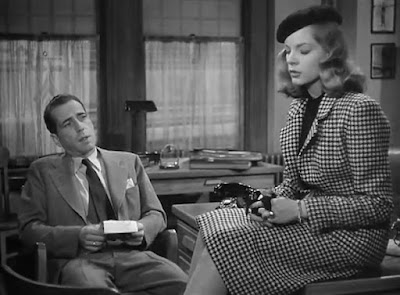 Raymond Chandler’s first novel, The Big Sleep (1939), which featured Chandler’s favorite fictional protagonist, private detective Philip Marlowe. In Hawks’s film version here, Marlowe is played by Humphrey Bogart, and this was one of the factors that made this film noir so popular – it turned out to be one of Bogart’s more famous roles. Another factor in the film’s popularity was the romantic pairing of Bogart (aged 44) with Lauren Bacall (aged 20), a combo that had already achieved significant traction with the public from Hawks’s earlier To Have and Have Not (1944). “Bogie and Bacall” were coupled offscreen, too, and they got married during this period.
Despite the fame of this film, though, there are aspects of it that make the work problematical. For one thing, the plot of The Big Sleep (both that of the film and the novel) is so convoluted that most viewers can’t keep track of it. This is partly a consequence of Chandler’s practice of basing each of his novels on several of his earlier-published short stories, each of which had its own plot. And anyway, plot was less important for Chandler than atmosphere and characterization. It seems that he wanted more to create a sense of tension rather than to tell a story. So the task was considerable for the esteemed screenwriters who worked on the film:
Raymond Chandler’s first novel, The Big Sleep (1939), which featured Chandler’s favorite fictional protagonist, private detective Philip Marlowe. In Hawks’s film version here, Marlowe is played by Humphrey Bogart, and this was one of the factors that made this film noir so popular – it turned out to be one of Bogart’s more famous roles. Another factor in the film’s popularity was the romantic pairing of Bogart (aged 44) with Lauren Bacall (aged 20), a combo that had already achieved significant traction with the public from Hawks’s earlier To Have and Have Not (1944). “Bogie and Bacall” were coupled offscreen, too, and they got married during this period.Despite the fame of this film, though, there are aspects of it that make the work problematical. For one thing, the plot of The Big Sleep (both that of the film and the novel) is so convoluted that most viewers can’t keep track of it. This is partly a consequence of Chandler’s practice of basing each of his novels on several of his earlier-published short stories, each of which had its own plot. And anyway, plot was less important for Chandler than atmosphere and characterization. It seems that he wanted more to create a sense of tension rather than to tell a story. So the task was considerable for the esteemed screenwriters who worked on the film:
- William Faulkner, a novelist and short story writer who won the 1949 Nobel Prize for Literature,
- Leigh Brackett, who later scripted another famous film noir based on a Raymond Chandler novel, The Long Goodbye (1973), and
- Jules Furthman, a prolific screenwriter whose vast repertoire includes the scripting of seven of Josef von Sternberg’s films.
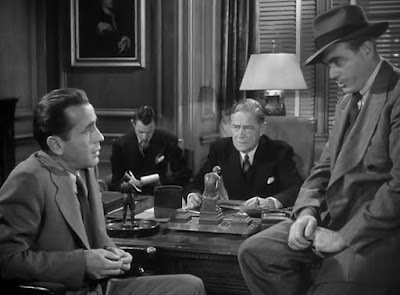 Not only did Faulkner, Brackett, and Furthman need to tone down the explicit sexuality (including homosexuality) in Chandler’s original account, they also had to understand and try to make some sense of Chandler’s tangled plot in the novel. One notable example of this difficulty occurred during the shooting of the film when Bogart and Hawks wanted to know who committed one of the seven key murders in the film [5]. That is, was Sternwood’s chauffeur murdered or was it a suicide? It bothered Bogart and Hawks so much that Hawks sent a telegram to Chandler to find out. But it turned out that Chandler didn’t know, either! As I said, Chandler was mainly concerned with atmosphere, not facts about who did what.
The story, such as it is, of The Big Sleep begins with Los Angeles private detective Philip Marlowe (Humphrey Bogart) being summoned to the mansion of General Sternwood (Charles Waldron), a wealthy invalid with two wanton young daughters – the lewd and self-indulgent Carmen (Martha Vickers) and the divorced Vivian Rutledge (Lauren Bacall).. Sternwood is concerned that Carmen is being threatened for the nonpayment of her gambling debts. Marlowe agrees to look into the matter.
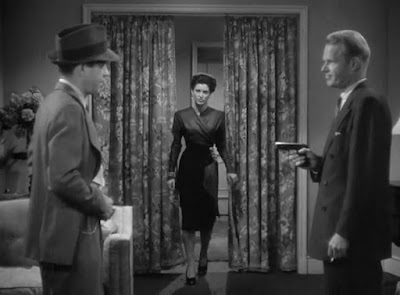 But things turn out to be not so simple as that. Marlowe soon learns that Carmen was being blackmailed by her phony creditor, whom Marlowe soon finds murdered. And Marlowe learns from Vivian that her younger sister Carmen has been blackmailed before by other mysterious gangsters and miscreants, who may or may not be involved in this current murder. Throughout all the various violent events that come along and the corpses that pile up, Marlowe tries to figure out what is going on. But he is always one step behind. However, along the way, Marlowe and Vivian (who also turns out to be a victim of blackmailing) gradually develop an attachment for each other.
I won’t go over the plot details here, but I can say that in the end, things get somewhat resolved, although we do learn that Marlowe, Vivian, and Carmen each killed someone who was threatening them individually [2].
So what is it that accounts for The Big Sleep’s popularity? I don’t think it is the intricate plot, because the plot is too random and loose-ended. Moreover, we don’t get much of a feeling for what motivates most of the events that transpire. And I don’t think it is the “Bogie and Bacall” Mystique, either. That relationship is very much in the background and never really occupies center stage.

- a dark, cynical, and obscure protagonist
- attractive women with unclear pasts and ambiguous intentions
- unexpected encounters with shady characters
- unanticipated violence
- cynical and innuendo-loaded wisecracks and dialogue
[5]:
Working from Chandler's original words and adding spins of their own, the writers (William Faulkner, Jules Furthman and Leigh Brackett) wrote one of the most quotable of screenplays: It's unusual to find yourself laughing in a movie not because something is funny but because it's so wickedly clever. (Marlowe on the "nymphy" kid sister: "She tried to sit in my lap while I was standing up.") Unlike modern crime movies which are loaded with action, "The Big Sleep" is heavy with dialogue--the characters talk and talk, just like in the Chandler novels; it's as if there's a competition to see who has the mostBut I don’t see things that way. An outstanding film cannot be just all clever talk; it has to have a compelling narrative, and The Big Sleep doesn’t have that. The story of this film is too loose-ended and contorted. So although the film has some entertaining moments (I did like the brief, separate interactions Marlowe had with Carmen (Martha Vickers) and Harry Jones (Elisha Cook, Jr.)), this is certainly not a great film noir.verbal style.
★★★
Notes:
- Leonard Maltin (ed.), “The Big Sleep (1946)”, Leonard Maltin’s Classic Movie Guide, Plume, (2005), p. 47.
- Tim Dirth. “The Big Sleep (1946)”, “Filmsite”, (n.d.).
- Andrew Sarris, “Living the private-eye genre”, films in focus, The Village Voice” (8 November 1973).
- Jeffrey M. Anderson, “I'd Like More”, The Big Sleep (1946), Combustible Celluloid, (n.d.).
- Roger Ebert, “The Big Sleep”, Great Movies, RogerEbert.com, (22 June 1997).
- Brian Cady, Margarita Landazuri, and Frank Miller, “The Big Sleep”, Turner Classic Movies, (17 February 2005).


 Posts
Posts


