 10 US Academy Awards (Oscars), including the award for Best Picture, and it remains an enduring classic for several reasons. Made during the “Golden Age” of American stage musicals, it differed from other such works in this era by not being the creation of just one or two auteurs, such as Rodgers and Hammerstein [1], but instead being the creative concoction of a larger group. In fact the film version of West Side Story could be said to be the synergistic concoction of six major creators:
 - William Shakespeare, author of Romeo and Juliet
- Arthur Laurents, author of the book (script) for West Side Story
- Leonard Bernstein, composer of the music for West Side Story
- Stephen Sondheim, composer of the lyrics for Bernstein’s music
- Jerome Robbins, choreographer and co-director of the film (he was the sole director of the stage musical)
- Robert Wise, co-director of the film
Somehow they combined to create a masterpiece that excels on many levels – story, music, and choreography.
 With respect to the music, Leonard Bernstein and Stephen Sondheim were an ideal combination. Bernstein, who was also the conductor and musical director of the New York Philharmonic Orchestra, was a talented composer across many musical genres, including symphonic and orchestral pieces. His music in this film is more sophisticated than the usual stage-musical fare, but it still has many memorably tuneful elements [2]. Sondheim’s lyrics are often delightfully clever, and they add emphasis to the film’s narrative themes. Particularly memorable are Sondheim’s rhythmic lyrics to the songs “America” and “Gee, Officer Krupke”. Overall, the music is so constantly present that the film almost feels like a sung-through musical. Throughout the film we are continually in the thrall of that music.
Closely accompanying the music is Jerome Robbins’s choreography, which goes much further than most of the musical films I have seen. Often the dancing pieces in a musical represent reflective interludes that are essentially timeouts from the main story. Here, however, the dancing permeates the narrative and is, like the music, almost perpetually present. In addition the coordinated finger-snapping behavior of the gang members becomes a constant metaphor for toughness, attitude, and gang solidarity.
 Robbins was apparently a perfectionist, and his demanding dance numbers required so many retakes that the production began to run beyond its shooting schedule and way over budget. In fact when I watch some of the dance numbers, I feel like the players had not only to be precision ensemble dancers but also highly athletic acrobats, as well. So the producers fired Robbins before shooting was complete, and the remaining dance scenes had to be supervised by Robbins’s assistants. Nevertheless, Robbins’s choreography is one of the film’s key virtues. It has, as I said, a different flavor than most stage-musical dancing, and it so permeates the film as almost to give it a surreal, expressionistic feeling.
The narrative storyline is also innovative. West Side Story’s narrative foundation is Romeo and Juliet, probably the most famous romantic tragedy in English. In that Shakespeare play, two young people from extended families that are at war with each other, fall madly in love. The opposition of their two families, however, leads to the tragic deaths of the two innocent lovers. But Arthur Laurents, in collaboration with Bernstein, Sondheim, and Robbins, resituated the Romeo and Juliet story into a contemporary setting associated with a major social issue in 1950s America – the emergence of urban juvenile delinquency and the rise of street gangs.
 Urban street gangs in one form or another appear all across the globe, particularly in anarchic or relatively open societies. But in the US, there seem to be many more gangs than in similarly advanced countries around the world. It is estimated that there are now more than 30,000 gangs and more than a million gang members in the US [3]. This phenomenon may be partly due to the large number of foreign ethnic groups that have migrated to the US and also the isolation felt by some communities due to racial and ethnic prejudice in the United States. The clash of rival street gangs was particularly apparent in New York City, which had large numbers of ethnic communities that tended to be congregated in their own lower-class urban districts within the city. Gangs staked out their own “self-governed” territories, and at the territorial boundaries, there were often clashes between rival gangs. Most of West Side Story’s creators were Jewish and familiar with, and likely sensitive to, the New York Jewish community’s experiences within that multi-cultured urban milieu. In fact early versions of the script treatment concerned a Jewish street gang’s struggles with another gang in New York’s Lower East Side. Ultimately, though, Laurents decided to fashion the story around a Puerto Rican gang’s encounters with a “white’ gang on New York’s Upper West Side.
Since the film would involve many camera closeups, the casting for the film required actors and actresses who could believably appear to be teenagers. This led to the fortunate casting of Natalie Wood in the role of Maria (the “Juliet” role in this story). Ms. Wood, who had already achieved fame as a 17-year-old in the iconic Rebel Without a Cause (1955) and would also star the same year in Splendor in the Grass (1961), had a special allure that made all of her roles stay in my memory. There was something about her eyes that suggested passion and latent anguish, and her emotive facial expressions were fully exploited in West Side Story. Her musical numbers were dubbed by Marni Nixon, who also sang (in dubbed voiceover) the songs of the female leads in two other classic musicals – The King and I (1956) and My Fair Lady (1964).
Two other performers who stand out for me are Russ Tamblyn and Rita Moreno. Tamblyn plays a major role as the leader of the Jets street gang, and his singing and amazingly acrobatic dancing are outstanding. Ms. Moreno, who had earlier appeared in a small but important role in The King and I, was very effective as Maria’s best friend, Anita, and she well deserved her Oscar for Best Supporting Actress.
The plot of Romeo and Juliet, which involves two young people meeting, falling madly in love, and then dying, only spans a period of about five days. If we think about it, that timeline may seem to be too short to be about a serious love. But Shakespeare’s poetic artistry sweeps those concerns away, and we succumb to the passions evoked. In West Side Story, though, the narrative timeline for a similar love story only covers two days. Nevertheless, here, too, the cinematic expressionism dominates, and any concerns about realism do not arise as we watch the story.
The story is divided into two acts.
Act 1 – The Jets and the Sharks
Like Romeo and Juliet, West Side Story opens with a street fight between two rival groups, the Jets and the Sharks. The Sharks are a street gang made up of Hispanic immigrants who were born in Puerto Rico. The Jets are a “white” (Polish and Irish) gang of first-generation immigrants. Since the Jets were born in America, they feel the Sharks are foreign interlopers on their native territory.
 After the fight is broken up by the police, the Jets’ leader, Riff (played by Russ Tamblyn), resolves to confront the Sharks that night at a dance that will be held at a local gym. Riff also wants to get his best friend and former Jets co-founder, Tony (Richard Beymer), involved in the dispute. Tony, who has a job and no longer actively participates in the gang, still feels loyalty to his old pal and agrees to come to the dance that night.
Meanwhile we see Maria (Natalie Wood) and Anita (Rita Moreno) working at a local sewing shop. Maria is the sister of the Sharks’ leader, Bernardo (George Chakiris), aka “Nardo”, while Anita is Nardo’s girlfriend.
At the dance, Tony and Maria see each other and immediately fall madly in love. They start dancing, and when they are about to kiss, they are angrily interrupted by Nardo, who is concerned about “protecting” his sister (i.e. posturing about his own “honor”). This leads to an anger-fueled agreement between Riff and Nardo for the two rival gangs to hold a “war council” at Doc’s drugstore later that evening. Tony, meanwhile, is enthralled with the girl he has just met and wanders outside on the street singing the song “Maria”.
After the dance, Tony goes outside the window of Maria’s apartment and calls to her. They meet on the outdoor fire escape and affirm their passionate love for each other, singing the song “Tonight”. They agree to meet at her shop the next day after closing time.
Even later that night, at Doc’s drugstore, the two gangs have their war council to decide the terms of their “rumble” (battle) to determine the future of their neighborhood. Tony arrives late and convinces them to only have a one-on-one battle between two chosen warriors of each gang.
Act 2 – The Rumble
 The next day, Maria in her shop is delirious with love and sings the delightful song “I Feel Pretty”. Although some might dismiss this as merely adolescent narcissism, to me it expresses something magical about the teenage experience everyone has about growing self-awareness – the realization that you have a changing identity and that you can be enamored with someone else’s changing identity.

 Robbins was apparently a perfectionist, and his demanding dance numbers required so many retakes that the production began to run beyond its shooting schedule and way over budget. In fact when I watch some of the dance numbers, I feel like the players had not only to be precision ensemble dancers but also highly athletic acrobats, as well. So the producers fired Robbins before shooting was complete, and the remaining dance scenes had to be supervised by Robbins’s assistants. Nevertheless, Robbins’s choreography is one of the film’s key virtues. It has, as I said, a different flavor than most stage-musical dancing, and it so permeates the film as almost to give it a surreal, expressionistic feeling.
 The narrative storyline is also innovative. West Side Story’s narrative foundation is Romeo and Juliet, probably the most famous romantic tragedy in English. In that Shakespeare play, two young people from extended families that are at war with each other, fall madly in love. The opposition of their two families, however, leads to the tragic deaths of the two innocent lovers. But Arthur Laurents, in collaboration with Bernstein, Sondheim, and Robbins, resituated the Romeo and Juliet story into a contemporary setting associated with a major social issue in 1950s America – the emergence of urban juvenile delinquency and the rise of street gangs.

Since the film would involve many camera closeups, the casting for the film required actors and actresses who could believably appear to be teenagers. This led to the fortunate casting of Natalie Wood in the role of Maria (the “Juliet” role in this story). Ms. Wood, who had already achieved fame as a 17-year-old in the iconic Rebel Without a Cause (1955) and would also star the same year in Splendor in the Grass (1961), had a special allure that made all of her roles stay in my memory.
 There was something about her eyes that suggested passion and latent anguish, and her emotive facial expressions were fully exploited in West Side Story. Her musical numbers were dubbed by Marni Nixon, who also sang (in dubbed voiceover) the songs of the female leads in two other classic musicals – The King and I (1956) and My Fair Lady (1964).
Two other performers who stand out for me are Russ Tamblyn and Rita Moreno. Tamblyn plays a major role as the leader of the Jets street gang, and his singing and amazingly acrobatic dancing are outstanding. Ms. Moreno, who had earlier appeared in a small but important role in The King and I, was very effective as Maria’s best friend, Anita, and she well deserved her Oscar for Best Supporting Actress.
The plot of Romeo and Juliet, which involves two young people meeting, falling madly in love, and then dying, only spans a period of about five days. If we think about it, that timeline may seem to be too short to be about a serious love. But Shakespeare’s poetic artistry sweeps those concerns away, and we succumb to the passions evoked. In West Side Story, though, the narrative timeline for a similar love story only covers two days. Nevertheless, here, too, the cinematic expressionism dominates, and any concerns about realism do not arise as we watch the story.
The story is divided into two acts.
Act 1 – The Jets and the Sharks
Like Romeo and Juliet, West Side Story opens with a street fight between two rival groups, the Jets and the Sharks. The Sharks are a street gang made up of Hispanic immigrants who were born in Puerto Rico. The Jets are a “white” (Polish and Irish) gang of first-generation immigrants. Since the Jets were born in America, they feel the Sharks are foreign interlopers on their native territory.

Meanwhile we see Maria (Natalie Wood) and Anita (Rita Moreno) working at a local sewing shop. Maria is the sister of the Sharks’ leader, Bernardo (George Chakiris), aka “Nardo”, while Anita is Nardo’s girlfriend.
At the dance, Tony and Maria see each other and immediately fall madly in love. They start dancing, and when they are about to kiss, they are angrily interrupted by Nardo, who is concerned about “protecting” his sister (i.e. posturing about his own “honor”). This leads to an anger-fueled agreement between Riff and Nardo for the two rival gangs to hold a “war council” at Doc’s drugstore later that evening.
 Tony, meanwhile, is enthralled with the girl he has just met and wanders outside on the street singing the song “Maria”.
After the dance, Tony goes outside the window of Maria’s apartment and calls to her. They meet on the outdoor fire escape and affirm their passionate love for each other, singing the song “Tonight”. They agree to meet at her shop the next day after closing time.
Even later that night, at Doc’s drugstore, the two gangs have their war council to decide the terms of their “rumble” (battle) to determine the future of their neighborhood. Tony arrives late and convinces them to only have a one-on-one battle between two chosen warriors of each gang.
Act 2 – The Rumble
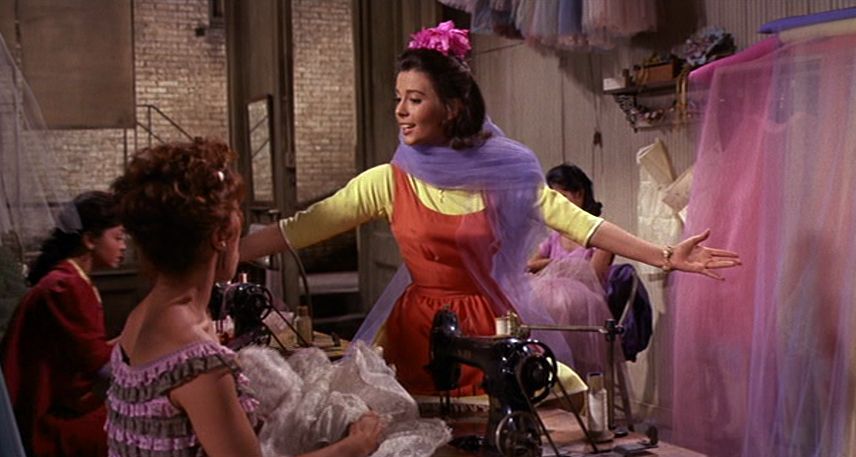 The next day, Maria in her shop is delirious with love and sings the delightful song “I Feel Pretty”. Although some might dismiss this as merely adolescent narcissism, to me it expresses something magical about the teenage experience everyone has about growing self-awareness – the realization that you have a changing identity and that you can be enamored with someone else’s changing identity.
 I feel charming,
Oh, so charming
It's alarming how charming I feel!
And so pretty
That I hardly can believe I'm real.
. . .
I feel stunning
And entrancing,
Feel like running and dancing for joy,
For I'm loved
By a pretty wonderful boy!

After Tony leaves, there is a presentation of the film’s famed “Tonight Quintet”, a beautifully crafted song combining the separately located crooning of the Jets, the Sharks, Anita, Maria, and Tony, all anticipating in their own separate ways that something thrilling is about to happen.
At the rumble between the two hostile gangs, Tony tries to stop it. But his intervention in the fisticuffs leads only to Riff getting killed by Nardo, after which Tony kills Nardo.
 Then they make plans to escape together with money that Tony hopes to borrow from his boss Doc, and he tells her to meet him later at Doc’s drugstore. After Tony leaves, Anita arrives at Maria’s room and confronts Maria. Anita, overwhelmed with grief and anger over the death of her boyfriend, and Maria, concerned for the safety of her true love, then sing one of the greatest songs in musical history – the duet “A Boy Like That/I Have a Love”.
 The final segments of the film are all misunderstandings, anger, and hostility. The climax doesn’t transpire quite like Romeo and Juliet, but Tony does wind up getting killed by a vengeful member of the Sharks gang just as he is embracing Maria and about to escape. All the Sharks and Jets assemble at the death scene, and Maria tearfully tells them all that it was not a gun that killed Tony, it was hate.
So in this story, at least on the worldly level, love is defeated by hate. But of course it is not always that way, and in America, especially, it is not supposed to be that way. This film in fact is partly an artistic examination of the “American Dream” – the image of a land of opportunity where people can come and be free to follows their own dreams [2].
 But in the story presented, this film suggests that the current urban jungle (at least in the 1950s) is so muddied by hate that it is raising problems for the realization of the American Dream
Since there is a key focus on street gangs, one might be tempted to blame everything bad that happens on gangs. But it’s not that simple. People join gangs for several reasons:
- Power and Wealth. When people cooperate as a team, they are more effective in the world. They have expanded capabilities, and this leads to a general increase in gang members’ utilities.
- Respect and Identity. Joining a powerful group enables the joiner to identify with the group and enhance his or her prestige.
- Protection. Being in a gang can protect an individual from exploitation and mistreatment by other gangs. One often has to join a gang as a means of self defense.
The last item listed, protection, is particularly important. Encounters in crowded environments such as the urban jungle, whether between individuals or with groups, tend to be oriented along two lines (an encounter can be a mixture of these):
- Cooperative. Two agents (individual or group) get together to cooperate, such as by making a trade.
- Extractive. One agent seeks to take wealth from a perceived weaker agent. This is the law of the jungle, and most gangs seem to be engaged in extractive activities.
Although cooperation is clearly better on the aggregate level, extraction is more straightforward and simpler to implement. Nevertheless, gangs are usually oriented internally in a cooperative arrangement, because it is a more effective way for them to operate. The real issue is not the elimination of gangs – they can serve a useful purpose –  but how to get gangs to engage cooperatively on the external social scale. This is where love does come in.
The moving duet between Anita and Maria, “A Boy Like That/I Have a Love”, expresses the call for us to follow our own loving hearts and overcome selfish feelings of resentment and hatred. We can make a conscious decision to do this, and this is what Maria asks Anita to do:
 but how to get gangs to engage cooperatively on the external social scale. This is where love does come in.
The moving duet between Anita and Maria, “A Boy Like That/I Have a Love”, expresses the call for us to follow our own loving hearts and overcome selfish feelings of resentment and hatred. We can make a conscious decision to do this, and this is what Maria asks Anita to do:
Anita:
A boy like that who'd kill your brother,
Forget that boy and find another,
One of your own kind,
Stick to your own kind!
. . .
A boy who kills cannot love,
A boy who kills has no heart.
And he's the boy who gets your love
And gets your heart.
Very smart, Maria, very smart!
Maria:
Oh no, Anita, no,
Anita, no!
It isn't true, not for me,
It's true for you, not for me.
I hear your words
And in my head
I know they're smart,
But my heart, Anita,
But my heart
Knows they're wrong
. . .
I have a love, and it's all that I have.
Right or wrong, what else can I do?
I love him; I'm his,
And everything he is
I am, too.
I have a love, and it's all that I need,
Right or wrong, and he needs me, too.
I love him, we're one;
There's nothing to be done,
Not a thing I can do
But hold him, hold him forever,
Be with him now, tomorrow
And all of my life!
 This is West Side Story’s true message, and it is just as relevant today in our current resentment-filled environment, which has been fueled by social and political voices expressing hatred and contempt. We need to respond to our own inner urges to love – which is our true authentic being – and we need eloquent voices like Maria’s reminding us to do so.
★★★★
Notes:
- Rodgers and Hammerstein were famous for a string of Broadway hits, the filmed versions of which included Oklahoma! (1955), Carousel (1956), The King and I (1956), South Pacific (1958), and The Sound of Music (1965).
- Marilyn Ferdinand, “West Side Story (1961)”, Ferdy on Film, (2016).
- “2011 National Gang Threat Assessment – Emerging Trends”, Federal Bureau of Investigation (FBI), (2011).


 Posts
Posts


