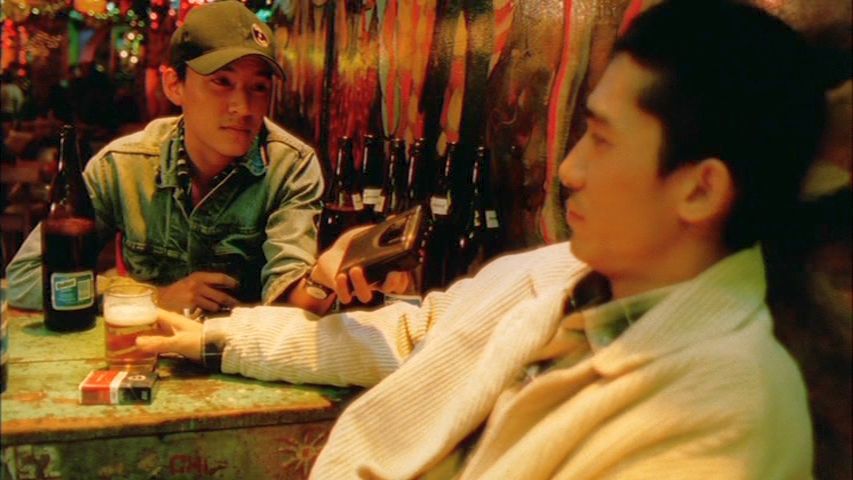
“Shutter Island” - Martin Scorsese (2010)


Stories of paranoia are especially gripping when shown on film – indeed that medium seems almost tailored for paranoiac narrative.  Why is that?  Certainly it’s partly due to the immersiveness of the film experience; but there is another aspect to it, as well.  As with all narrative, we reader/viewers are actively engaged in constructing the fabula (i.e. the  “world” of the story), but in the film case we are doing this on the fly and in real time.  This is just like the way we are always and continuously constructing the mini narratives around us in real time.  So if a filmmaker presents images and scenes that can have alternative fabula constructions, we are faced with the dilemma of deciding which of two alternative “worlds” is correct.  If we begin to suspect that the “true” world is different from the one everyone around is assuming, paranoia can take over.  Either we are crazy or everyone else is, which makes for an intense and involving viewing experience.  Movies have the unique power to evoke this feeling, and some memorable past efforts come to mind, including

Shutter Island (2010) is another worthy offering in this line.  In fact given director Martin Scorsese’s mindfulness of movie history, it is not surprising that this film features more than a few references to some of those past works and directors.  There are two interesting aspects or angles to this film: it’s narrative structure and the psychiatric theme, which I will discuss in turn.

The Narrative Angle
The story, which has several layers of paranoia-inspiring schemes, begins in 1954 with federal US Marshals Teddy Daniels and Chuck Aule on a patrol boat headed for Ashecliffe Hospital, an insane asylum on an Alcatraz-like island in Boston Harbor.  The asylum houses the most incurable and dangerous lunatics in the country, and the two marshals have come to investigate the disappearance of a female inmate named Rachel Solando who has somehow vanished from the supposedly inescapable confinement.     

Narrative 1
Anyway, early on in the film, we’re following along on narrative level number one: the two marshals are trying to find out what happened to Rachel Solando, who is said to have murdered her three young children but is now living in a dream world and believing that her children are still alive.  Daniels and Aule are given free rein to explore the asylum by doctors Cawley (Ben Kingsley, in an eerily effective performance) and Sheehan (Max von Sydow), but they are warned not to go Ward C, where the most dangerous inmates are housed.  So the narrative goal to be achieved is to find the potentially dangerous antagonist, Rachel Solando, and see what has happened to her.

From the very outset there is a foreboding air of unreality about everything.  On the boat, Daniels and Aule are shown in unnatural studio back-projection and artificial lighting – a cinematic  technique that characterized Hollywood films of the 1950s, but which is conspicuously weird for a modern film.  In addition, the cinematography includes awkward axis-crossing reverse shots and rapid camera pans that contribute further to a contrived sense of unreality. The pounding offscreen music and mannered greeting that the two marshals receive on their arrival to the island only add to an odd sense of oppressive claustrophobia even in the outdoor surroundings of the pier.  Later, when the two marshals are interviewing the hospital’s staff about Solando’s disappearance, there is a bizarre sense of artificiality in the way everyone acts, as if everything is being staged for them.

Narrative 2
Soon there are additional narrative threads.  Daniels is haunted by memories of his deceased wife, who died two years earlier in a fire, and of his experiences in World War II, when he participated in the liberation of the Dachau concentration camp and the ensuring massacre of German soldiers.  He has nightmares of the Dachau horrors and daydreams of his wife talking to him and giving him obscure messages about his current mission.  So it is clear that Daniels is not exactly mentally stable, himself.  A little bit later Daniels confides to his partner Aule (whom he had only just met on the boat coming to the island) that his wife was killed in a fire set by a pyromaniac named Andrew Laeddis, whom he believes is an inmate at Ashecliffe, possibly held in the off-limits asylum Ward C.  Daniels wants to find and kill Laeddis.  The Daniels backstory narrative thread is obscure but obviously significant.  A new, presumably more significant narrative task has now been presented: to find the antagonist Andrew Laeddis.

Narrative 3
Eventually Daniels confides to Aule that his real reason for investigating the island is a personal mission to uncover secret medical experimentation allegedly being performed on the mental patients there.  He says these violations of human rights have allegedly been authorized by HUAC (the US House of Representative Committee on Un-American Activities), and they are being conducted in Ward C or at an isolated lighthouse just offshore. So now there is another narrative thread concerning the unsavory and inhumane medical experiments being conducted by a sinister and clandestine government agency.  This presents another narrative goal: to uncover and deal with a new set of antagonists, the evil psychiatrist miscreants.

Narrative 4
Finally, there is still another and culminating narrative explanation presented – that everything shown so far has been a sham and that Teddy Daniels is really the one who is insane. According to this narrative scheme, the preceding two hours of film have been depicting an elaborate playacting contrivance conducted as a vast psychiatric experiment in order to cure Teddy Daniels, whose real name turns out to be Andrew Laeddis, a man who killed his own wife.  In this narrative, the psychiatrists are the good guys, and the narrative goal has been to cure the mental illness suffered by Daniels/Laeddis.

If you watch Shutter Island a second time, you will see a number of visual cues along the way that point to the authenticity of this last narrative.  This may be disappointing for some viewers, because a good many people want to see psychiatrists cast in their usual roles as insidious and hypocritical villains.  They can’t really be the good guys this time, can they?  I like MaryAnn Johanson’s (the Flick Filosopher)  response to all this: “If what I think is happening here, is happening here, it better not be.” So some people have looked for even more devious explanations as to what has happened in the film.

Throughout the course of Shutter Island, the viewer is given the plot (i.e. the syuzhet) and seeks to construct the causal world surrounding that plot (i.e. the fabula).  But here it can be frustrating.  Likening narrative structure to travel, Kai Mikkonen sees this as constructing the map (fabula) from the itinerary (syuzhet) [1].  But Mikkonen also stresses that as we experience the events (for example, as we pass along through a journey), the “map” is open-ended.  There are all sorts of roads not taken that could have been.  We are constructing the itinerary as we go.  Thus the on-the-fly map/itinerary construction may be rather different from that final map/itinerary that we settle on in the end.  This distinction between the on-the-fly narratives and the final narrative is what lies at the heart of Shutter Island.

The Psychiatry Angle
Since the treatment of mental illness is a key aspect of Shutter Island, there are interesting issues associated with psychiatry under display.  Psychiatric treatment of mental illness has gone through roughly five phases over the last century:
  1. Confinement (before the 1930s). Procedure: lock up mentally ill people in asylums to keep them out of harm’s way, but more or less neglect them.
  2. Surgery and invasive procedures (1930s - 1950s). Procedure: subject mental patients to invasive and essentially trial-and-error surgery, such as electroconvulsive shock therapy and lobotomies.
  3. Psychotherapy (1950s - ). Psychotherapy and Psychoanalysis.  Procedure: the therapist hypothesizes the existence of flawed mental structures in the mind of the patient and attempts to achieve a cure by making the patient aware of these flaws.
  4. Psycho-chemicals (1960s - ). This development has involved a push towards achieving the status of a cause-and-effect “natural science”.  Based on the idea that the brain is simply a chemical structure that can be "repaired" by subjecting it to chemical treatment via drug ingestion, new pharmaceuticals were developed that were believed to cure mental illnesses. This reductionist approach has gone further in recent years to the point of assuming that psychiatric illnesses can be traced to individual genes, the detection of which via scanning can be used to see if patients are likely to suffer various disorders [2,3].
  5. Social psychiatry (2000 - ).  More recently psychiatrists, seeing the frustrating failures associated with the preceding movements, have attempted to incorporate into their treatment the consideration of sociological influences on mental conditions [4].
Shutter Island puts us at the juncture of phases 2, 3, and 4.  Convulsive electroshock therapy was on the decline at the time of the story (1954).  Nevertheless, there is an indication throughout the film that Daniels/Laeddis had earlier been subjected to electroconvulsive shock therapy, although this is never explained in the film.  He is shown to have a bandage over his left forehead, corresponding to where the electrodes were likely to have been placed for this therapy [5].  Later on, after this bandage has been washed off in the shower, we can see a telltale scar on his forehead in the same spot.  Lobotomies were still being performed in those days, and that is the specter that haunts Daniels/Laeddis towards the end of the film.  But psychiatry was starting to take over and replace invasive surgery in the 1950s, while psycho-chemicals were just on the horizon – 1954 was the year that thorazine (chlorpromazine) was introduced.  Thus in Shutter Island the psychiatrists are, surprisingly, the heroes.  However, in the final scene of the film, there is a curious revelation.  It was always the psychiatrists’s belief that a patient would be cured by simply generating the self-recognition on the part of the patient of his or her own obsessions and fantasies.  This self-recognition would generate a miraculous cure, all by itself.  At the end of Shutter Island, however, the self-realization of Daniels/Laeddis lead to his recognition of his own monstrosity, and hence not to salvation but to self-destruction.

But the public at large was right to be suspicious of professional psychiatry’s pretensions to cure mental illness.  Psychiatry professor Thomas Szasz, in his book The Myth of Mental Illness (1961) [6], exposed the severe limitations of psychiatry, which went down the path of taking an innocent metaphor (that a person could be mentally “ill”) and attempting to attribute scientific exactitude to that term and at the same time asserting the scientific authority of its treatments.  Regrettably, however, psychiatry has never been more than a pseudoscience and has failed to come to any understanding of the etiology behind mental illness [7,8,9,10,11].


So it is a disappointment and a flaw of Shutter Island for Scorsese to celebrate psychiatry.  It is a flaw, too, that at the conclusion of the film, the viewer is compelled to reconstruct the entire narrative based on revelations made only near the conclusion. There is too much that is revealed at the end of the film, and this is a weakness of Shutter Island. Admittedly, there had been many clues that things were not quite right all the way along – the initial hypothesized narratives just didn’t add up and there was a clear suspicion that something was wrong. But, anyway, I guess that is what paranoia is all about.
★★★
       
Notes:
  1. Mikkonen, Kai, “The ‘Narrative is Travel’ Metaphor: Between Spatial Sequence and Open Consequence” (2007), NARRATIVE, vol. 15, no. 3 (October 2007): 286-305.
  2. Poole, Stephen, “Your Brain on Pseudoscience: the Rise of Popular Neurobollocks” (2012), New Statesman, 6 September 2012.
  3. Tallis, Raymond, Aping Mankind: Neuromania, Darwinitis and the Mirsrepresentation of Humanity (2012), Acumen, Durham, UK.
  4. Lurhmann, Tanya Marie “Beyond the Brain”, The Wilson Quarterly, Summer 2012.
  5. See, for example:
  6. Szasz, Thomas, The Myth of Mental Illness (1961), Harper and Row, NY.
  7. Rosenhan, David L., “On Being Sane in Insane Places”, Science,  19 January 1973: Vol. 179 no. 4070 pp. 250-258, DOI: 10.1126.
  8. Scull, Andrew, “Psychiatry’s Legitimacy Crisis” (2012), Los Angeles Review of Books, August 8, 2012.
  9. Greenberg, Gary, "The Future of an Illusion", Book Forum, February 2015.
  10. "Psychoanalytic theory is the most stupendous intellectual confidence trick of the twentieth century and a terminal product as well—something akin to a dinosaur or zeppelin in the history of ideas, a vast structure of radically unsound design and with no posterity." – Sir Peter B. Medawar (Nobel Prize winner in Physiology or Medicine, 1960), The New York Review of Books (23 Jan 1975). 
  11. More recently, psychotherapists have sought to counter the public's loss of confidence in their objective, technical proficiency by marketing more personal and specialized bite-sized services in the form of "life coaching".  See, for example, "What Brand Is Your Therapist?", by Lori Gottlieb, New York Times, 23 November 2012. 

“Mean Streets” - Martin Scorsese (1973)

Martin Scorsese’s Mean Streets (1973) was a breakthrough film, both for himself and for actor Robert De Niro. Although both Scorsese and De Niro were barely thirty years old at the time and at the outsets of their long successful careers, Mean Streets still stands as a showcase of their very best work. The film’s story concerns life of some young men in New York’s “Little Italy” area of lower Manhattan, a locale familiar to both Scorsese and De Niro, who grew up in those environs.  In fact Mean Streets is said to be a semi-autobiographical account of some of Scorsese’s experiences and was intended to be a sequel of Scorsese’s first feature, Who’s That Knocking at My Door? (1967). 

As the outset, it looks like the film will cover the interlocking exploits of a group of young men from Little Italy:
  • Charlie (Harvey Keitel), who seeks to work his way up in the New York mafia by working for his uncle Giovanni, a high-ranking figure in the Italian crime “family”.
  • Johnny Boy (Robert De Niro), an irresponsible friend of Charlie’s who constantly borrows money from his friends and is hopelessly in debt.
  • Tony (David Proval), who runs a bar in Little Italy where everyone hangs out.
  • Michael (Richard Romanus), another young man who seeks financial gain by various shady business operations, including working as a loan shark.
The narrative style of following the disparate stories of people grouped by some common goal has a long tradition, particularly in connection with war films and special joint missions; and Mean Streets would go on to inspire renewed popularity of the genre, such as The Deer Hunter (1978).  But actually, Mean Streets is not really about that group just listed, but is primarily just about Charlie, with the others on the periphery.  In fact the focalization of the film is almost exclusively with Charlie, and everything is seen from essentially his perspective.

Overall, there are four issues that attract or concern Charlie, and it is this complex of attractions and distractions that make the film fascinating:

  • Respect, Group Belonging.  Charlie works as a loan collector for the Mafia and wants to be a respected member an organization that places a great emphasis on dignity and “honor”, as they define it.
  • Moral Obligation.  Although part of an organization that operates by its own, questionable rules, Charlie is a Roman Catholic and deeply concerned about the consequences of sin.  On several occasions Charlie prays in the cathedral and wonders about the eternal horrors from God’s punishment of Hell fire that await the guilty sinner after death.
  • Compassion.  Charlie is close friends with Johnny Boy and tries to look after him, not only for moral reasons related to some obscure family connections, but also out of genuine friendship.  He just likes being with Johnny Boy.
  • Love.  Charlie is having a secret love affair with Johnny Boy’s cousin, Teresa (Amy Ronbinson), a comely girl who offers him true love.  Like most young men, Charlie avoids making any commitments, but his feelings for her are genuine.  But Charlie is attracted to other women, too, including a glamorous black go-go dancer.
Unfortunately, all these tensions on Charlie are in conflict with each other.  Giovanni is a stern patriarch and warns Michael not to associate with anyone or activity that could lead to dishonor.  He tells Michael to say away from the recklessly irresponsible Johnny Boy with the admonition, “honorable men go with honorable men.”  Similarly Giovanni dismisses Teresa (whose relationship with Charlie is unknown to him) as a mentally ill person, because she suffers from epilepsy.  Nevertheless, Charlie tries to straighten out Johnny Boy, continues his clandestine (unbeknownst even to Johnny Boy) affair with Teresa, tries to maintain good relations with other hoods like Michael and Tony, and worries about living a moral life up to the standards of God’s precepts.  It’s not easy in his muddled world, and this is what drives the film.

The narrative progression in Mean Streets is somewhat episodic.  This highlights a Scorcese strength and weakness: very realistic settings and active cinematography that produce a spontaneous vitality to individual scenes – even if those scenes are not well connected together into a coherent narrative threading.  Even so, you might say that there are roughly three sections to the story. 

The first third of the film focuses on the semi-violent social milieu of Charlie’s Little Italy world, and it also introduces us to Charlie’s special problem: the terminally feckless Johnny Boy. In particular, Johnny Boy owes several thousand dollars to Michael, whose business it is to collect his money from deadbeats by any means, fair or foul.  Early on Charlie, Tony, Johnny Boy, and friends go to a pool hall to collect a debt, whereupon a violent fight breaks erupts over the payment and some perceived disrespect.  There is also a gangland murder at Tony’s bar (involving a brief appearance of Keith Carradine), because of what was perceived to be an insult to some senior Mafia member.

After we have been introduced to the various social tensions, the film delves into the relationship between Charlie and Teresa during the second phase of the film.  Charlie has other amorous intentions, though, and he finds himself attracted to a black go-go dancer at the bar.  But his community-influenced prejudice against blacks prevents him from following up on his inclinations in that direction.  Similarly in another scene later, Michael feels repugnance when he learns that a girl he likes has kissed a black man.  Although this is the big city, prejudices and clannish traditions prevail in these circles.
The final section of the film involves the increasingly intense standoff between Michael and Johnny Boy, with Charlie in the middle, trying to defend his errant and self-destructive friend and head off a violent confrontation.
It’s interesting to compare Mean Streets with Wong Kar Wai’s As Tears Go By (1988), whose plot was reputedly inspired by Mean Streets.  There are significant differences between the two films, though.  While Mean Streets has some concern for the group milieu, this aspect is largely ignored in As Tears Go By, which focuses on the lonely individual and the existential tension he feels between group-oriented gangland obligations, and individual feelings of personal love.  Both of these films are worthy, but you could say that Mean Streets covers a wider spectrum. 

In particular, there are two additional themes in Mean Streets that stand out in comparison to As Tears Go By.  One of them revolves around the religious concerns of Charlie and his obsessions about guilt.  Guilt, of course, is a central concern in Roman Catholicism, and it would clearly be difficult for one to reconcile life as a mafioso with the strict sacraments of Catholicism.  A second and related theme is associated with pride and respect.  The entire social milieu of Mean Streets shows macho-oriented men all suffering from the extreme anxiety of self-doubt.  They don’t really have the inner self-confidence that they try to project towards others.  These characterological issues of guilt and self-doubt are supported by superb acting portrayals of various people under stress.

For example, the Michael character is a particularly well-drawn image of this machismo anxiety, and he is perpetually revealing uptight insecurity over his perceived image in front of others. Tony, the bar owner, is more laid-back, but this is primarily because he has to maintain smooth relations with this volatile crowd, and even he occasionally erupts violently when the equanimity of his bar is threatened. De Niro’s portrayal of the reckless Johnny Boy is the most memorable of all.  This might have been his best performance, even though it was essentially in a supporting role.

The relationship between Michael and Teresa is another strong point of the film.  It has a believable electricity that stays in your memory.  It is not as romantic as the encounter between Wah and Ngor in As Tears Go By, but the portrayed relationship in Mean Streets has the character of a real, ongoing and meaningful connection between two people who have a strong affinity for each other despite the ups and downs.

All these complicated and conflicting relationships among insecure people (Charlie is the most balanced among the generally insecure men) make the film interesting.  But basically none of these conflicts is resolved by the film’s end.  This is characteristic of Scorsese films: there are ongoing conflicts that evolve for some period, but they don’t come to a clear resolution.  You may say this is true to life, but I feel that this is often an aesthetic weakness in Scorcese’s tales.  Nevertheless, the issues, milieu, and personal characterizations are often gripping enough to make his films worthwhile.
★★★

“Happy Together” - Wong Kar Wai (1997)


The seemingly aimless melancholic meanderings of Wong Kar Wai (Wáng Jia-wèi) were extended into the world of gay romance with his Happy Together (Chun Guang Zha Xie, 1997). Whether this was a step forward of backward for Wong remains to be seen. Like his earlier efforts along these general lines, this film didn’t have much of a goal or clear-cut narrative movement other than to follow for awhile the sufferings of people in the throes of romantic heartbreak. Except, of course, this time we are dealing with a gay couple, which to me changes the tune somewhat.

As I have commented on Wong’s earlier films in this vein, As Tears Go By (1988), Days of Being Wild (1990), Chungking Express (1993), and Fallen Angels (1995), his films generally take the viewer into a mental space that is entirely different from mainstream cinematic narratives.  Rather than telling a story about people on a narrative journey that seeks out some goal(s) and usually comes to some conclusion, Wong’s films are dreamy mood pieces that seem to wander about in a lonely place.  Watching one of his films is like listening to an extended flamenco guitar piece – there is movement, to be sure, but one doesn’t know where one is headed and one never seems to arrive anywhere.  We do get inside some of Wong’s characters and share their romantic longing and their sense of resignation to loss.  But at the same time the viewer is also aware of things from a perspective outside the scope of the protagonists – the missed opportunities, lost connections, and the utter hopelessness of the depicted romantic longings.  When the film is finished, we remember not so much the events, but the mood.  And it this quality of Wong’s films that make them comparable to music. 

The uniqueness of Wong’s cinematic style is a reflection of his production methods.  Although Wong started his film career as a screenwriter, he is notorious for working without a script on his own films and making things up as he goes along.  In other words the aimlessness of his films reflect the apparent aimlessness of Wong’s filmmaking style. 

Nevertheless, Wong Kar Wai has a devoted following, including that of serious film theorists and critics. There are roughly two lines that people take with respect to Wong’s narrative style. 
  • On the one hand, one could say that Wong is exploring new pathways in the area of cinematic expression.  The idea is that rather than simply translate some narrative text into the film medium, Wong is actually showing us that cinema has a vastly greater space and opportunities for dynamic visual expressiveness and tone.  According to this line of thinking, the narrative is always exclusively embodied in the medium (film/text).  Wong Kar Wai is then seen as pushing the boundaries of narrative and is exposing conventional filmmaking as restricted and old-fashioned. 
  • Another point of view concerning Wong would not attribute an entirely new form of visual narrative to his work.  Instead, one would say, following along the lines I believe of David Bordwell, that Wong is simply taking advantage of the audience’s by-now rather sophisticated capabilities of mentally constructing a narrative.  According to this line of thinking, the viewer is always the co-constructor of any narrative.  He or she inevitably must fill in the missing information and gaps of what is told and imagine the activities and events based on his or her own past experiences that flesh out the story.  Thus narrative is not just embodied by the “text”, but in fact encompasses three items: the teller (creator/sender/narrator), the narrative message (film/text), and the listener (viewer/receiver).  So Wong Kar Wai, from this perspective, is not doing anything really radically new, but is instead just providing only (narrative-message) bits and pieces and is thereby leaving more narrative gaps to be filed in by the spectator from his or her own romantic recollections.  This forces the viewer to take a more active narrative construction role.

I subscribe to the second, call it “Bordwellian”, view of narrative and Wong Kar Wai, but that perspective doesn’t diminish my appreciation of Wong’s films.  Despite the apparent aimlessness of his filmmaking style, there is certainly some method to his madness that enables him to keep producing interesting cinematic experiences.  Nevertheless, Happy Together, despite earning for Wong Kar Wai the Best Director award at the 1997 Cannes Film Festival and receiving high praise from some respected quarters [1], wasn’t for me one of those satisfying experiences.  Perhaps contemplating some of its shortcoming can reveal a bit about what makes Wong’s other films work so well and why this one didn't.

The story concerns two gay men from Hong Kong who have traveled to the “other end of the earth”, in this case to Buenos Aires [2], in hopes of rekindling their on-again/off-again relationship. As usual, Wong has cast top Cantopop music and cinema performers in the leading roles, in this case Leslie Cheung and Tony Leung Chiu-Wai, as the two gay lovers. And as usual with Wong Kar Wai’s films, nothing much seems to happen. 

The first twenty or so minutes of the film are in black-and-white and outline the dysfunctional romantic relationship between the two main characters.  Ho Po-Wing (Leslie Cheung) is the extrovert – a spoiled, self-absorbed narcissist who continually avoids responsibility and seeks to charm his way through all circumstances.  His lover, Lai Yiu-Fai (Tony Leung Chiu-Wai), is the introvert and is more responsible, sensitive, and caring.  For most of the film, the focalization is on Lai, and the viewer is privy to Lai’s inner monologue describing his emotional responses and reflections.  The film’s story, reflected by voiceover narration, seems to be that of a memoire – a recollection of the meaningful moments that have taken place sometime in the past.  And like all recollections, seemingly random moments and images are  magnified and elongated in time. 

The two men have a stated goal of eventually making a trip to the famous Iguazu Falls about a thousand kilometers north of the city. And this goal has metaphorical overtones for the story.  For the two men, this goal is almost an unrealizable fantasy, and the closest they seem to be able to get to is to stare at a rotating frosted souvenir lamp depicting the falls in Lai’s apartment.

But neither of them has much money.  We later learn that for them even to get to Argentina, Lai stole money from his father. Now he lands a job as a greeter at a Buenos Aires tango bar to provide some support. Ho just lives off Lai whenever he needs money, but he also continually drifts away into other male liaisons and appears to be more or less a male prostitute.  The relationship of the two men is persistently rocky.  Ho is habitually petulant and demanding, so naturally Lai constantly gets fed up with Ho’s selfish behaviour.  But at the same time Lai can’t resist Ho’s coquettish charm, and he continually melts and gives in to whatever demands Ho makes.

After one of their separations, Ho shows up at Lai’s apartment beaten up after some unexplained nocturnal escapade and has to be taken to the hospital.  Ho’s hands are left all bandaged up, and he must be waited on and spoon-fed (chopsticks-fed) by Lai.  Although Ho is now more petulant and demanding than ever, Lai reflects in voiceover that Ho’s helpless dependency on Lai make this his happiest period with Ho.   It was then that they were truly happy together, and accordingly the film presentation suddenly shifts from black-and-white to color.

After some time (about forty minutes into the film) Lai takes a job working in a restaurant kitchen. One of his  coworkers is a Taiwanese expatriate, Chang (Chang Chen), who casually befriends Lai. Meanwhile the Lai-Ho relationship is going through ever-worsening ups and downs, finally leading Lai to despair.  After coming to the conclusion that he can’t go on with it anymore, Lai is heartbroken, and he spends time with Chang to get his mind off Ho. The focalization and narrative voiceover, which up to this point had been exclusively associated with Lai, now occasionally shifts to Chang, with Chang’s voiceover reflections about Lai.  Chang, incidentally, is almost the opposite of Ho.  Rather than focusing on his own self and image, Chang is a serious listener of other people – so serious, he tells Lai, that he can discern other people’s inner emotional states just by listening to them. And so he likes to eavesdrop all the time on Lai’s conversations whenever he is in the vicinity.  We never really learn if Chang is gay or not, but there is clearly an affinity between Lai and Chang that slowly develops over the rest of the story. 

Eventually Chang departs for a trip to the southern tip of Argentina, perhaps, it is hinted, to try and rid himself of his own sad memories.  Lai manages to save up enough money to afford a trip back to Hong Kong; but before he leaves, he makes that promised visit to the Iguazu Falls. While Lai seeks to re-engage with the real world by visiting the real falls, Ho is shown moving back into Lai’s old apartment and staring dejectedly at the souvenir lamp depicting a crude artificial image of the falls.
 
On his return trip to China, Lai has a stopover in Taiwan, and though Chang is absent, Lai visits Chang’s family street market café in Taipei. While there, he spies a picture of Chang at the back counter and steals it for future reference. .

There are several reasons, to me, why this story never really gets into gear. One problem with Happy Together is the excessive and mundane repetitiveness of the Ho-Lai interactions.  They don’t even convey a hint of progression.  Perhaps this was Wong Kar Wai’s intent – to convey the idea that the relationship wasn’t going anywhere – but depicting tedium in a film is always a losing proposition.  Wong got around this kind of problem in his earlier films by effectively telling two shorter stories, either sequentially or in parallel, so that we did not wear out one story over the routine running time of a feature film.  It is true that there is also the Chang-Lai story in this film, but it’s too inconsequential to give the viewer relief from the tedium of the Ho-Lai story.         

 
Another difficulty with the film is the cinematography from Christopher Doyle, whose previous work for Wong Kar Wai and elsewhere has been superb. As usual with Doyle, there are the overt temporal-flow variations, as well as the deliriously moving camera shots, but they all seem more mechanical on this occasion.  Moreover, the switching back and forth from black-and-white to color seems artificial and pointless.  And the excessive contrast in many of the shots often leaves darker portions of the images clouded in blackness.  This excessive contrast seems to be intentional, but why?  For example, there are several sequences showing Lai and Chang playing soccer in a back street with some  mates.  For these sequences, the camera is aimed directly into the sun, whose brightness leaves all the players indistinctly dark.  Although this visual effect does perhaps evoke a memory of looking into the sun on some occasion, there doesn’t seem to be any point to these shots, and so they stand out as oddities while the viewer struggles to make out what is going on in the frame.

Maybe the most fundamental issue with the film is the almost total absence of women.  Although Wong Kar Wai insisted that Happy Together was simply a story about two people relating to each other and was not a gay film, in fact the missing feminine component in the film compromises his aesthetic virtues. The opening images orient the viewer quickly about this matter, showing an extended scene of two naked men in bed aggressively making love. Of course I recognize that your mileage may vary on this, but I would say some of Wong Kar Wai’s best moments in his previous films involve images of beautiful, passionately heartbroken women who yearn after unresponsive men.  These images are not from a woman’s perspective: they strike me as images of male fantasy and are seen from an external male point of view.  It’s the mysterious feminine allure of romantic longing as seen by men.  But despite admirable performances by Leslie Cheung and Tony Leung Chiu-Wai in Happy Together, this romantic-emotional effect isn’t achieved (at least for me) in this film.  That is, the corresponding sensibility – Wong’s previously presented sensibility but shifted over to this film’s relational context – is not achieved here.  Leslie Cheung, just as he was in Days of Being Wild, is the self-absorbed narcissist; but on this occasion the sense of longing for him is seen from an internal perspective (that of Lai Yiu-Fai) – and this is not the male-fantasy-fueled external experience of those earlier Wong films.  Even if the Ho Po-Wing character had been fashioned as a woman in the film, this internal/external difference in perspective (i.e. difference from Wong’s earlier films) would have remained.  By abandoning that earlier romantic fantasy sensibility, Wong has lost something here.  Never mind, Wong Kar Wai would take a step back in the right direction with his next film, In the Mood for Love (2000).
★★½
       
Notes:
  1. Kraicer, Shelly (1997), “Happy Together”, A Chinese Cinema Web Site, http://chinesecinemas.org/happy.html.
  2. Buenos Aires is practically at an antipodean position with respect to Hong Kong.

“Ju Dou” - Zhang Yimou and Yang Fengliang (1990)

Ju Dou (1990), Zhang Yimou’s third directorial outing, is, to my mind, not only his breakthrough film but also a work that ranks at the top of his cinematic oeuvre.  Although the film,  like the preceding Codename: Cougar (Daihao Meizhoubao, 1989), is listed as co-directed by both Zhang and Yang Fenglian, this work has the earmarks of Zhang’s strikingly expressionistic  visual artistry.  This film was also the third of what would be seven successive Zhang productions that starring his personal and artistic partner at the time, Gong Li.

The film’s story concerns a narrative theme of universal interest, but it was presumably one rarely touched upon (at least up to that time) in the conservative Chinese social atmosphere: that of illicit sexual passions in a provincial town.  As such, although the film was immediately hailed abroad and was nominated for a US Academy Award as Best Foreign Language Film (1990), it was initially banned for several years in China. 

The plot structure is essentially a melodrama that goes through the four conventional phases:
  • Setup of conflict and issue that must be resolved or goal achieved
  • Achievement of an initial goal
  • Complications and setbacks after obstacles appear or after adversaries make adjustments
  • Resolution (either goal achievement or failure)

1. Setup of conflict
The film is set in the early 20th century and opens with Yang Tianqing, a “nearly 40-years-old” nephew of an elderly textile dyer, Yang Jinshan, returning to the uncle’s dye mill from a three-month trip selling the mill’s products in other cities.  He learns that while he was away his uncle has bought himself a new wife, named Ju Dou.  This is the way it was traditionally done -- a man had to have enough money to be able to buy a wife, and Tianqing, who works as a humble servant for his uncle Jinshan, is too poor to be able to afford a wife.  Jinshan and Ju Dou live upstairs in the mill, while Tianqing occupies a downstairs room.    The stingy Jinshan insists that all the drudgery-filled millwork must be performed by just the three of them quartered at the mill, without assistance from any paid workers.

It is soon evident that Jinshan is not only a stingy skinflint, but also a perverted sadist who is said to have tortured his two previous wives to death for not providing him with a son to continue the family name.  With the beautiful young Ju Dou he continues his vile domestic ways, and he is seen placing a saddle over her prostrate torso so that he can “ride” and whip her as if she were a beast.  “If I buy a beast, can I not ride or beat it at my pleasure?,” he asks her rhetorically.  At night the timid Tianqing hears Ju Dou’s tormented moans from Jinshan’s molestations, but he is powerless to intervene.  He can’t get the luscious beauty out of his mind, though, and he can’t keep himself from spying on her through a peephole while she is bathing. 

2. Ju Dou and Tianqing
One day after returning from another trip to buy materials for the mill, Tianqing encounters Ju Dou on the road and shows concern for the scars he sees on her face and arms.  Ju Dou tries to dismiss his concerns, but she also craves sympathy suffering though an unbearable life with Jinshan.  After accidentally discovering Tianqing’s peephole, she realizes that her personal bathing has an admiring audience, and she boldly exposes her bruised backside to him the next time she bathes.  Going further, she reaches out to him when they are working alone together in the mill and plaintively complains about her miserable condition, explaining that she has no hope of avoiding the fate of the two previous wives since Jinshan is sexually impotent and she will inevitably also be accused of failing to produce a male heir.

Soon, when Jinshan is away from the mill for a few days attending to the care of his sick donkey, Ju Dou makes the decisive move and approaches Tianqing lustfully, offering herself to her timid admirer.  They begin a torrid love affair, and not long afterwards Ju Dou finds herself pregnant.   In due course the baby, named Tianbai, is born, and Jinshan, apparently ignorant of basic biological facts, assumes that he is the father of Ju Dou’s child. 

3.  Tianbai and Jinshan
Ju Dou and Tianqing continue their affair in secret, but soon an unexpected event changes their circumstances dramatically.  While out on the road one day, Jinshan suffers an accident that leaves him paralyzed from the waist down.  With Jinshan now helplessly dependent, Ju Dou and Tianqing have the power to operate more freely, at least within the confines and behind the closed doors of the mill.  They now openly reveal to Jinshan their passionate love affair and the fact that Tianbai is in fact the son of Tianqing.  In public, though, Ju Dou and Tianqing dutifully attend to the crippled Jinshan, who is now almost their prisoner and confined to a wheeled basket.  Presumably to avoid losing face, Jinshan remains silent in public about his situation, but one can see that he is sullenly bent on revenge.  Throughout this section of the film, the viewer sees more and more evidence of the suffocating Confucian pressures of conservative village society.  Ju Dou must still appear in public to be the dedicated selfless wife of the loathsome Jinshan, whose “son” is the only legal male heir to the extended Yang clan.  So later when she misses her monthly period, she panics, knowing that another pregnancy would be disastrously received by the nosey townspeople.  To avert that possibility, she seeks out purgative home remedies and treatments, which turn out to be torturously painful and wind up leaving her infertile.

Meanwhile as time passes, Jinshan makes several unsuccessful attempts to kill Tianbai in revenge, but he changes his mind when he joyfully discovers that the now three-year-old boy mistakenly thinks that Jinshan is his father.  Now instead of wanting to punish Ju Dou by killing the child, he strives to claim the lad as his own and alienate him from his mother.  Ju Dou detests Jinshan and would like to be free from him, but she and Tianqing are still prisoners of the restrictive Chinese social customs that require them to remain attendant to the old man.

4.  Downfall
While Ju Dou and Tianqing are out one day, Tianbai accidentally causes Jinshan’s wheeled cart to tumble into the dyeing vat, and the boy watches mirthfully while Jinshan thrashes about in the water and finally drowns. The ensuing funeral for Jinshan follows strict traditional customs and is filled with absurd rituals that compel Ju Dou to engage in extravagant public acts of grieving.  Afterwards, Tianqing is ordered by the family elders to cease living at the mill, since it is now an abode where only a widow resides.  Under these conditions the secret trysts between Ju Dou and Tianqing become extremely  difficult to arrange, and there are long periods when the two lovers are apart.

There is now a gap indicating a further passage of about seven years, and Tianbai has grown to be a sullen and insubordinate teenager.  When he overhears some meddlesome villagers gossip naughtily about Ju Dou and Tianqing, the obstreperous boy rushes out to bash Tianqing.  Later the two lovers have what they fear may be their last tryst down in the mill’s dusty storage cellar.  After some blissful moments together, they both pass out from exhaustion and lack of oxygen [1].  Tianbai eventually discovers the two prostrate lovers in the cellar and proceeds to kill his own father, while Ju Dou helplessly watches in aguish.  The final shots of the film show Ju Dou setting fire to the dye mill that has long been her prison.  She watches passively as the flames gradually surround her and engulf the mill.

With such a melodramatic plot, you may wonder why I hold this film in such high esteem.  There are several answers to be given on this score, but first I will mention the film’s extraordinary visual presentation.  While the subject matter suggests the dark, somber overtones of film noir, Zhang uses the story’s context of bright color cloth production to drape the film in a dramatic spectrum of hues that imbue the film with a pervasive current of vitality.  The colors here play a corresponding, though not exactly equivalent, role that dark shade and darkness play in more conventional films noir.  Such expressionistic use of coloring had been seen in 1950s Hollywood films with Technicolor, and it is no accident that Ju Dou has similar color aesthetics.  Technicolor Corporation’s elaborate three-strip coloring process had gone out of favor in the 1970s, and their dye transfer plants were sold off, with one of them eventually being shipped to Beijing and available for Zhang’s use.  So if you are fortunate enough to see Ju Dou at a theatrical screening, you will probably find the visual experience unforgettable. 

Unfortunately, existing available DVDs of Ju Dou are, at least to my knowledge, miserable failures as  transfers of the original film prints to the digital medium. The lush colors of the original film are often washed out and faded in the DVD versions, and the contrast range is so reduced, that darker portions of the image are often lost in blackness.  In addition the frames of DVD versions appear to have been severely cropped and sometimes cut off meaningful imagery.  Nevertheless even if you see one of these visually diminished DVD versions, the film is so vibrant that you may still get a feeling for what the original film was like.

Thematically, Ju Dou has other interesting undercurrents.  Thinking purely about the narrative in the abstract, the story of the film noir The Postman Always Rings Twice (1946) or perhaps Blood Simple (1984), might come to mind.  Here we have the story of a lustful wife of an elderly husband who plunges into a passionate extra-marital affair with a younger man – and then the two of them scheme to get rid of the husband.  But the psychological flavor of Ju Dou is very different from The Postman Always Rings Twice, whose sense of ominous moral guilt was always lurking in the background. In Ju Dou, in contrast, our empathy is with the lovers all the way, and the elderly husband has no redeeming virtues.  Ju Dou, herself, is seen in this setting as cast by society into the role of a paid-for piece of furniture or a pack animal, basically a slave for whom a coercive marriage vow couldn’t really have had any meaning.  Tianqing, for his part, is seen as a basically decent person who strives to do the right thing.  Both of them seem intrinsically innocent and simply trying to make their way in a world that has set artificial rules that are often stacked against the powerless.  In this connection, it might be useful to quote Sheldon H. Lu’s observation that Zhang Yimou’s films are frequently devoted to
". . . the lovable, almost stupid determination of a humble, honest person trying to do the right thing.  That such a stubborn do-gooder appeals to the audience is a sign of strong residual moral seriousness in the Chinese popular consciousness.  This seems to be . . . Zhang Yimou’s moral vision of China” [2]
I am not suggesting here that Zhang is morally endorsing the extra-marital relationships shown in Ju Dou, but there is nevertheless a clear sympathy expressed for the authentic individual feelings of the protagonists in Ju Dou.  And this sympathy for genuine feelings and human interaction is somewhat different from the conventional Communist celebration of the moral virtues of the working class.  In those traditional Communist panegyrics, the working class is usually visualized in the abstract, as a heroic prototype.  In contrast to those kinds of Communist government sponsored propaganda efforts, Zhang’s films – at least after his more orthodoxly-tinged Red Sorghum (1987) – feature protagonists who are simple, straightforward individuals, capable of personalized and heart-felt passions and compassion.

Moreover, this soulful combination of compassion and passion is stunningly embodied by Gong Li, in the  title role.  I have remarked on the mystique of Gong Li before – see my comments concerning her performances in Raise the Red Lantern (1991), To Live (1994), and Shanghai Triad (1995).  There is a natural grace to her movements that conveys both passion and innocence, both openness and commitment,  at the same time. And this is accomplished in natural social contexts of ordinary Chinese society. This is a rare kind of beauty that is not captured in a still photograph.  You need to see her perform in action, in those ordinary but dramatic contexts in which her role is cast.

This leads to the implicit notion underlying the film’s narrative that a society grounded on authentic and compassion-based intuition is superior to one governed by artificial and unbreakable rules that have lost all touch with human reality.  It is perhaps this implicit social judgement in the background of the film that unnerved the Chinese authorities more than any explicit references to individual sexual passion in Ju Dou.  The film seems to ask: if the conservative Confucian-based rules of Chinese society are there to preserve social stability and order, then why does this social structure permit, and even endorse, the kind of perfidy committed by the sadistic Yang Jinshan, or Tianbai, for that matter?

Actually, this brings me to the separate thematic subject of the character of Ju Dou’s son, Tianbai.  There is something horrifying and unnatural about this boy.  In his abrupt, brutish physical movements, he conveys an injurious malevolence that is the very opposite of the heartfelt humanity presented by Ju Dou and Tianqing.  Is there a symbolic significance to his character?  He is the biological offspring of Ju Dou and Tianqing and was raised by Ju Dou, but he hasn’t inherited their virtues.  What accounts for his cold-blooded, reptilian savagery?  Perhaps while Ju Dou and Tianqing were busy working in the dye mill, he was manipulated and twisted by the malicious Jinshan, who was idly resident in the dwelling and free to twist the boy in the wrong direction.  Some commentators have suggested that Tianbai represents the brutality of the Cultural Revolution’s youthful Red Guards, or more generally the ruthlessness of the darker aspects of Maoism.  But I think that his visage is even more visceral and primitive than those social phenomena.  To me he represents a dark animal force that is always present in any social surroundings.  It is the ever-present dark savagery of the carnivore that civilized society must seek to tame.

Zhang Yimou would later venture more overtly into the film noir genre with works like Shanghai Triad and A Simple Noodle Story (aka A Woman, a Gun and a Noodle Shop, 2009), films with moods and feelings distinctly different from the one presently under discussion.  In Ju Dou there is a mixture of moods: in addition to the dark external atmosphere of a noirish environment, there is the interior, personal world of individual striving.  The film ends that story on a note of defeat and destruction.  But there is also dark beauty in this film, even in these lurid surroundings.  It is that expressionistic undertone of beauty that lingers in the mind long afterwards. 
★★★★
   
Notes:
  1. This is a scene that may evoke memories of Wu Tianming’s film Old Well (1986), which incidentally featured an award-winning acting performance by Zhang Yimou!
  2. Lu, Sheldon H. (2005),“Chinese Film Culture at the End of the Twentieth Century”, Chinese-Language Film: Historiography, Poetics, Politics, Sheldon H. Lu & Emilie Yueh-Yu Yeh (eds.), University of Hawaii Press, pp. 123-24.

“Shanghai Triad” - Zhang Yimou (1995)

Zhang Yimou, who has demonstrated his visual mastery across a wide range of film genres, extended his portfolio into the conventions of film noir with his dark period piece Shanghai Triad. Zhang’s previous effort, To Live, was an outstanding expression of existentialist struggle and had garnered enormous prize abroad, but its reception had gotten him into hot water with the Chinese government.  That film’s depiction of the misery imposed on ordinary people by autocratic and disruptive Chinese government “campaigns” had led the authorities to ban it from being shown in China and also temporarily ban Zhang from filmmaking.  So with Shanghai Triad, Zhang moved into safer waters by making a supposedly conventional gangster film set in 1930, prior to the Communist takeover.

This might lead one to expect him to produce an ordinary escapist thriller, but with Zhang’s subtlety of expression on display in any film he makes, there will be always temptations to consider larger issues.  So Shanghai Triad has its share of interesting themes lying behind the events depicted.

The story follows the experiences over eight days of a fourteen-year-old boy from the countryside who has been sent to the big city to work for the gangster operations run by some of his clan members.  In China, especially in the warlord-torn period of the early 20th century when institutional securities were largely absent, trusted relations were essential; and clan membership was the fundamental trusted connection.  The paranoid atmosphere of mistrust in those days was of course even more heightened in the underworld run by the big gangs, or “triads”, so clan loyalty was heavily counted on.  Merely by being a distant member of Boss Tang’s Shanghai gang, the teenage boy Shuisheng had a free ticket to potential material security as a gang member.  But of course at this early stage he was going to be just a humble servant for his masters.

The focalization of the film is entirely through Shuisheng’s perspective, so the viewer sees and learns everything about what is going on pretty much as Shuisheng does.  But the narrative structure goes through three phases that are respectively dominated by attention to each of three main characters:
  • the boy Shuisheng
  • Xiao Jinbao, who is Boss Tang’s mistress and is known as “Bijou”
  • Boss Tang
1.  Shuisheng’s induction
The first phase covers the first two days of the week-long events of Shanghai Triad.  Tang Shuisheng has arrived by boat in Shanghai and is met by his uncle Tang Liu, who is a minor operative in Boss Tang’s gang.  This gang is said to be the dominant triad gang in Shanghai and therefore, by means of its various illegal operations, is turning over and accumulating untold wealth.  In these first two days, which cover about forty minutes of screen time, Liu explains to the boy (and hence to the viewer) the layout and protocols of the gang.  Very early on, Shuisheng also happens to witness a gangland killing of some rival gang members, who are ambushed and then killed in cold-blood by a dapper young Tang gang operative whom we will later learn is named Song and is Boss Tang’s “number two” man.  This short violent scene gives the viewer and Shuisheng a taste of the kind of world that the boy is entering.
Shuisheng is clearly ignorant of city ways, and he remains silent and wide-eyed as Liu shows him the ropes around the gang’s quarters.  Shuisheng’s assignment is to serve as the personal servant of the boss’s beautiful mistress, Bijou (played by Gong Li), who is a stage singer and dancer at the fanciest nightclub in Shanghai. 

We also learn that there is a rival gang run by a certain “Fat Yu” and that it was members of that gang that Song had gunned down on the first day.  Boss Tang is unhappy that the status quo has been disturbed by Song’s impetuous murders, and he reprimands his underlings, not out of ethical or moral concerns but because the “balance of power” may have been disrupted.  It is always important, he insists, to maintain “face” (i.e. honor, a Chinese obsession).  Boss Tang says he needs to make a cordial visit to Fat Yu and play mahjong with him so that Fat Yu can maintain face, and thus a gangland war can be avoided.  We also learn at the close of the second day of the story that Bijou is two-timing Boss Tang by having a secret love affair with number two man Song. 
Bijou sings two stage numbers during this section of the film.  The first one, “Pretending”, is a sassy, in-your-face song about temptation and is Boss Tang’s personal favorite. The second song, “Moonlight”, tells of secret longing for moonlit trysts and is the favorite of Song.  The revelation that Boss Tang hates the song “Moonlight” gives the viewer a hint that Boss Tang may not be entirely oblivious of Bijou’s straying and that impending conflict is on the menu.
2.  Bijou’s longings
The second section begins with Bijou in a tuxedo singing a sultry nightclub song.  The scene evokes images of a similarly garbed Marlene Dietrich singing on stage in Josef Von Sternberg’s Morocco (1930), and it may remind viewers that the extended Zhang Yimou - Gong Li onscreen and offscreen partnership has been likened to the Sternberg-Dietrich association.

The key event in this section, though, is that while Boss Tang was visiting Fat Yu’s premises to make amends, he and his men were ambushed.  Many of Tang’s men, including Uncle Liu, were killed by Fat Yu’s men.  Boss Tang makes the tactical decision to retreat to safety with a few key operatives, including Bijou and Shuisheng but not Song, to a secret island refuge outside Shanghai.

While on the island, the focus shifts fo Bijou.  She befriends a friendly and straightforward peasant woman on the island, Cuihua, whose 9-year-old daughter, Ajiao, befriends Shuisheng.  We eventually learn that although Bijou has continually derided Shuisheng as a country bumpkin, she, herself, was a peasant coming from the countryside, too.  The whole tone of this section is around Bijou’s sense of lost innocence and  her realization that life in the glitzy city has corrupted her and not brought true happiness.  She longs for the simple, innocent, and authentic existence of Cuihua.   

3.  Boss Tang’s settlements

Boss Tang announces that his deputy Song is going to pay a visit the group on the secret island.  While out in the high weeds attending to his bodily functions, Shuisheng overhears a nearby but unfamiliar voice saying, “doesn’t Song mind about killing Bijou?”.  These words  must come from Song’s newly arrived contingent, and they must be bent on mayhem.  The idea that Song wants to kill Bijou seems bizarre to us at that point, but it is not long before the entire film is engulfed in treachery and betrayal.  Boss Tang has set up Song and killed the eighteen men who had accompanied Song to the island.  Tang takes Song prisoner and accuses him of secretly working for Fat Yu and also seducing his woman (the ultimate face-destroying humiliation).  In revenge for these betrayals, Tang has Song buried alive along with eighteen other men who had been killed earlier.  Tang then smilingly tells Bijou that he will kill her, too. Furthermore he has already had the innocent Cuihua killed (as well as, earlier, Cuihua's lover) and will make her daughter Ajiao his future concubine.  Everything, Tang explains, will be done discretely so that he can preserve his public face and maintain his vital image of mastery. 

The final shots show Boss Tang and his close associates on a boat headed back to Shanghai.  Shuisheng is shown hanging upside down from a mast.  Although he hadn’t done anything wrong, Tang explains that this is part of Shuisheng’s essential training of pain and discipline for future life in the gang.
There are some general themes of interest in Shanghai Triad, beyond those of betrayal and revenge. Zhang Yimou’s earlier films had often shown protagonists struggling to exist within a stifling social environment – either a social milieu  imposed on people by outmoded customs or by the ill-advised autocratic polices of Communist officials. As a consequence, many commentators viewed Zhang as a social critic, a label that he has resisted.  But I think Zhang’s general perspective is better seen as representing a more personal, existentialist perspective of the individual trying to make his or her way in a difficult world – and thus not from a top-down perspective that overtly directs criticism on social structures.  Here in Shanghai Triad, too, we see a similar situation – a stifling environment.  Only this time that oppressive environment is the ruthless gangland underworld, where empathy is only seen as a sign of weakness.  But if Zhang’s view is individual, rather than social or structural, where is the individual narrative focus in Shanghai Triad and what is the outline of its associated “journey”?

In the first section of the film, the narrative focalization is on Shuisheng, but we never get feeling for his reactions.  He is just an innocent witness who has no impact on his surroundings.  We never have a feeling for his goals, and whatever impact his environment and associations have on him is obscure.  After that first section of the film, the Shuisheng narrative thread fades to the background.  Thereafter the narrative focus shifts over to Bijou and her relations with Tang, Song, and Cuihua.  But Bijou is crushed in the end, and her life of pretense is exposed as the powerless fantasy that everyone suspected.  So the final narrative thread shifts to Tang.

Boss Tang is initially shown in the film as something of an avuncular, almost congenial, supervisor of his gang.  In his mild-mannered way, he indulges Bijou and admonishes Song for his disruptive actions.  He seeks peace with Fat Yu, only to be double-crossed by the ambush  that leaves him seriously injured.  We are also aware that he is being two-timed by Bijou and Song.  So Tang seems vulnerable early on, and we may be moved to have some sympathies for him.  By the end of the film, though, we see Tang as a cruel, almost satanic, manipulator of all those around him and completely devoid of any human compassion. We have been double-crossed, too, into sympathizing with him early on.  At the end we see the final, “true” perspective that Zhang wishes to leave with us.

Tang lives rigidly by his artificially imposed set of rules.  Anyone who disobeys those rules is heartlessly eliminated. The decadent Shanghai world shown in the film is one of phoney, ostentatious  consumerism that comes from the outside and is clearly not the real, authentic China that is supposedly represented by Cuihua and her daughter Ajiao.  Bijou, herself, is the embodiment of how authentic Chinese beauty has been corrupted by fantasy images of glamour and false romance. Driving this fantasy machine of casinos, flashy glamour, and easy virtue is the criminal underworld that is steeped in cruelty and fear.

But beyond this stark contrast between sin and innocence on an individual scale, there is also a larger cultural perspective – that of the general cultural decadence of Chinese life in the 1930s and the apprehension that the corruption and disorder of those days may be returning to modern China.  In those days China was inefficiently governed by the Guomindang (Kuomintang or KMT, the Chinese Nationalists), which were locked in a power struggle with the Communists.  Since the Communist takeover, the KMT have always been demonized as utterly corrupt and lacking in basic human values, turning over the country’s wealth to profiteers and gangsters.  In Shanghai Triad, Boss Tang can be seen operating at the core of this semi-organized and ruthless power system that has a monopoly on coercive power and snuffs out all sense of decency and compassion.  I doubt that it is coincidence that Tang’s visage bears more than a passing similarity to that of former Guomindang leader, Jiang Jie-Shi (Chiang Kai-Shek – see the accompanying figure).  Jiang Jie-Shi, of course, was responsible for the notorious 1927 Shanghai Massacre of Communist party members that led to the irrevocable split between the Communists and the KMT.

So despite Zhang’s avowed movement to a more traditional gangster film genre, he has again employed his individual narrative perspective to present something that can be interpreted to be a social critique.  But this time his critique is more in line with the official view of the Chinese authorities.  This may represent something of a thematic turn for Zhang, but not nearly as marked as the one displayed later in Hero (2002), which expressed support for the idea that the demands for social stability and security justify totalitarian statism (see my review of Hero for further discussion of this topic).

Cinematically Zhang brings this dark underworld to light with his characteristic sense of atmospheric color and composition.  It is true that there are perhaps too many lingering tight closeups of Shuisheng, whose character remains opaque throughout and doesn’t come into any further light through such constant attention.  But in general the point-of-view visual style employed in the film works pretty well, and is well supported by many fluid tracking shots that give one a feeling of movement through an unfamiliar space that is only gradually becoming revealed via that movement. 

The performance of Gong Li, as Bijou, deserves special mention.  As I remarked above, there was a special relationship between Zhang Yimou and Gong Li, and it has been compared to that of von Sternberg and Marlene Dietrich.  Zhang and Sternberg were both deemed to be cinematic Svengalis, with exclusive powers of calling forth the bewitching capabilities of their proteges.  Each actress was said to be the embodiment of her director’s romantic fantasies.  I am not sure about that, but there is something unique about Gong Li, and I have remarked about her more extensively in my review of Raise the Red Lantern (1991).  There is something about her that suggest action, not just passive beauty.  Like Dietrich, she has a beautiful figure, but this is never exploited or presented suggestively but is simply part of the overall embodiment of active beauty.  Her face conveys a smoldering passion that connote some mysterious longings – desires that are unspoken and perhaps can never be articulated. These images lie at the heart of Zhang Yimou’s expressiveness, and I think Zhang has not found an artistic replacement for that magical ingredient. 

There is another connection between Zhang and von Sternberg here – that between Zhang’s.  Shanghai Triad and von Sternberg’s The Shanghai Gesture (1941).  Both films share a common setting, the degenerate world of Shanghai in the 1930s.  And both films are overlaid with pessimism about humankind’s abilities to overcome the depravity of hatred and vengeance.  But these two film are nevertheless expressions of directors who implicitly express longings for something different – something deeper and more fulfilling about human existence.  They are expressing their romantic disappointment that the beautiful wonders of life are so infrequently allowed to come to fulfillment.  The only glimmers we have of it here in Shanghai Triad are in the enigmatic glances of Gong Li’s face as she contemplates Cuihua – something hopelessly removed from the life in store for the oppressed Shuisheng, who is, like most of Zhang’s characters, simply trying to endure.
★★★