Films of David Lean:
- Doctor Zhivago - David Lean (1965)
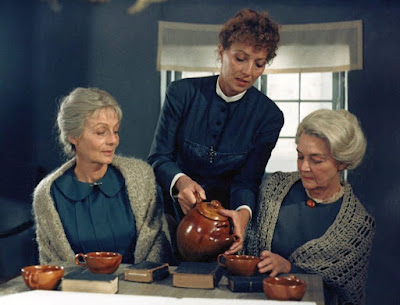 contemplative stance or presentation perspective, but rather that it induced in me a tendency to contemplate about life’s meaning throughout my watching of the film. Axel’s script was a close adaptation of Danish writer Isak Dinesen’s (the pen name of Karen Blixen) famous story “Babette's Feast” [1], which first appeared in Ladies' Home Journal magazine in 1950. Isak Dinesen, of course, is most renowned for her marvelous memoir Out of Africa (1937) concerning her experiences in British East Africa. The film Babette’s Feast won the Oscar for Best Foreign Language Film at the 1987 U.S. Academy Awards, and it has been highly regarded ever since by the critical community [2,3,4,5,6,7,8,9,10,11,12]. And also, in light of the theological aspects of this film’s story, it is interesting to note that Babette’s Feast is Pope Francis’s all-time favorite film [11].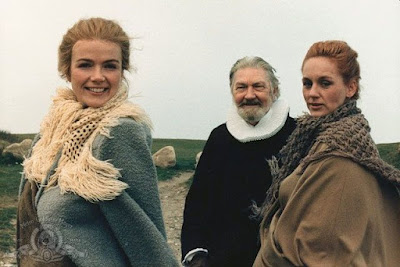
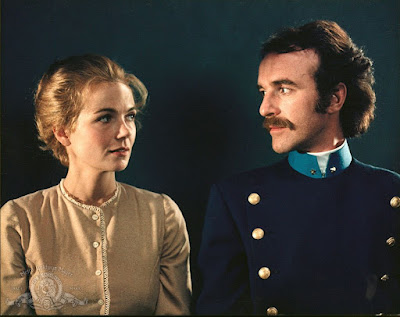
The film’s story covers three time periods, during which significant events took place for the two sisters, Martine and Philippa:
Period 3 - “the present”
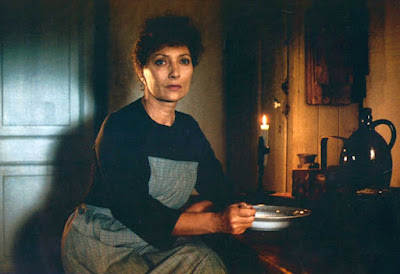
So now we come to “the present” time, and Babette has been working diligently for Martine and Philippa for fourteen years, and she has become a familiar background character to the dwindling number of people of the local parish that the sisters look after. One day, however, Babette receives a message from a friend in Paris who has been buying a lottery ticket every year for Babette that informs her that she, Babette, has just won the Paris lottery of 10,000 francs.
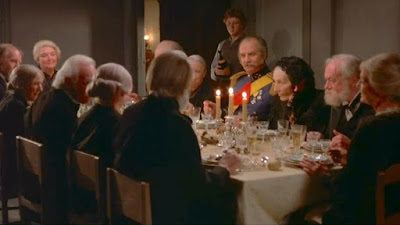
The film now devotes considerable time to showing Babette’s lavish preparations for the banquet. Babette imports all sorts of exotic ingredients, as well as elegant plates and cutlery. As the sisters and parishioners become aware of all these preparations, they begin to worry that it will be a sinful event, and they make a vow not to mention the food or express any appreciation at the dinner.
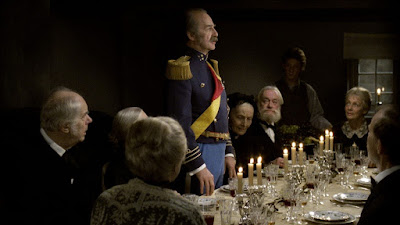
“There comes a time when your eyes are opened
And we come to realize that mercy is infinite.
We need only await it with confidence and receive it with gratitude.
Mercy imposes no conditions.
And, lo! - Everything we have chosen has been granted to us.
And everything we rejected has also been granted.
Yes, we even get back what we rejected.
For mercy and truth are met together.
And righteousness and bliss shall kiss one another.”
After the feast is over, the sisters assume that Babette will return to Paris., but Babette tells them that she used all of her 10,000 francs to pay for the expenses of putting on the feast and that she is not going away. She did it, because she wanted to give everything in her power to the world in which she had been living. This was, for her, the ultimate act of self-expression.
Although the basic story of Babette's Feast seems simple, the film has fascinated critics and won an Oscar. Some people are drawn to the numerous allusions in the film to Christian symbolism, including The Last Supper (Babette's feast offered dinner for 12 guests). But I think that the profundity of the film lies elsewhere. To me the film features four distinct outlooks on what we should seek in life, and these outlooks are personified by four separate personages:
 The two sisters, following their pastor father’s prescriptions, humbly
seek to adhere to the strict rules of evangelical Christianity.
Although they devote themselves to helping the enfeebled and
impoverished in their community, there is something limited and
mechanical about this policy
The two sisters, following their pastor father’s prescriptions, humbly
seek to adhere to the strict rules of evangelical Christianity.
Although they devote themselves to helping the enfeebled and
impoverished in their community, there is something limited and
mechanical about this policyWith regard to the first three of these perspectives, Tasha Robinson remarks [8]:
“The narrative is also about the emptiness of most pursuits: General Lorens is dissatisfied and confused after devoting his life to a spectacular career. The Puritans are bitter and judgmental after devoting their lives to religion. Martine and Filippa find satisfaction in devoting their lives to their father, but are left bereft after his death, watching the consensus he built crumble.”
And in this vein of multiple life perspectives, Mark Le Fanu further adds [9]:
“Thus there are two stories, at least, going on in the closing stages of the film. Babette is busy showing us that the artist is able to respond to adversity with self-denying style and generosity, while Löwenhielm, in his after-dinner speech to the guests, is demonstrating that our choices in life—even the bad ones—are all ultimately redeemable and beneficent. Somehow, these two positions meet; at a certain level, they are identical postulates. For if Löwenhielm never sees Babette (she remains in the kitchen, outside his range of vision), he guesses she’s there—invisible, like grace—for the simple reason that, years ago in Paris, he attended a similar feast, and there is only one person in the world who could have authored this one.”
Overall and despite its modest format, Babette's Feast is a very successful cinematic consideration of our ultimate goals in life. Of course, this topic has been the subject of countless philosophical treatises where text is used to express such abstract notions. It would seem to be even more difficult to try doing this if one is confined to using the physical visual imagery of film. Nevertheless, Jean Schuler feels that Babette's Feast has actually managed to accomplish what Kierkegaard thought to be beyond the realms of possibility [4]:
“Babette's Feast achieves what Kierkegaard treated as impossible: to make the hidden movements of faith visible. A film about goodness threatens to bore its audience; a film about holiness that manages to get it right would seem to be as impossible as roses blooming in December or sitting down to a banquet fit for kings in a Jutland cottage.”
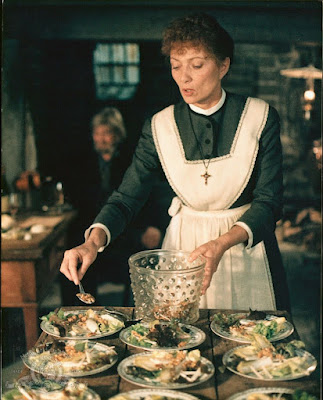
Perhaps it is best to summarize the essence of what they got right with this quote from Pope Francis, himself [13]:
“The most intense joys in life arise when we are able to elicit joy in others, as a foretaste of heaven. We can think of the lovely scene in the film Babette’s Feast, when the generous cook receives a grateful hug and praise: ‘Ah, how you will delight the angels!’ It is a joy and a great consolation to bring delight to others, to see them enjoying themselves. This joy, the fruit of fraternal love, is not that of the vain and self-centred, but of lovers who delight in the good of those whom they love, who give freely to them and thus bear good fruit”
★★★★
Notes:
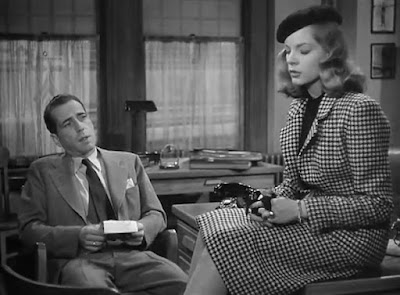 Raymond Chandler’s first novel, The Big Sleep (1939), which featured Chandler’s favorite fictional protagonist, private detective Philip Marlowe. In Hawks’s film version here, Marlowe is played by Humphrey Bogart, and this was one of the factors that made this film noir so popular – it turned out to be one of Bogart’s more famous roles. Another factor in the film’s popularity was the romantic pairing of Bogart (aged 44) with Lauren Bacall (aged 20), a combo that had already achieved significant traction with the public from Hawks’s earlier To Have and Have Not (1944). “Bogie and Bacall” were coupled offscreen, too, and they got married during this period.
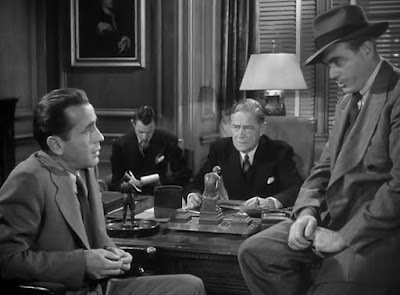 Not only did Faulkner, Brackett, and Furthman need to tone down the explicit sexuality (including homosexuality) in Chandler’s original account, they also had to understand and try to make some sense of Chandler’s tangled plot in the novel. One notable example of this difficulty occurred during the shooting of the film when Bogart and Hawks wanted to know who committed one of the seven key murders in the film [5]. That is, was Sternwood’s chauffeur murdered or was it a suicide? It bothered Bogart and Hawks so much that Hawks sent a telegram to Chandler to find out. But it turned out that Chandler didn’t know, either! As I said, Chandler was mainly concerned with atmosphere, not facts about who did what.
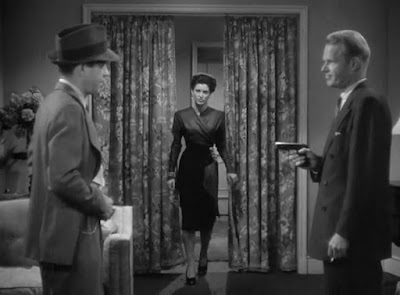 But things turn out to be not so simple as that. Marlowe soon learns that Carmen was being blackmailed by her phony creditor, whom Marlowe soon finds murdered. And Marlowe learns from Vivian that her younger sister Carmen has been blackmailed before by other mysterious gangsters and miscreants, who may or may not be involved in this current murder. Throughout all the various violent events that come along and the corpses that pile up, Marlowe tries to figure out what is going on. But he is always one step behind. However, along the way, Marlowe and Vivian (who also turns out to be a victim of blackmailing) gradually develop an attachment for each other.
Working from Chandler's original words and adding spins of their own, the writers (William Faulkner, Jules Furthman and Leigh Brackett) wrote one of the most quotable of screenplays: It's unusual to find yourself laughing in a movie not because something is funny but because it's so wickedly clever. (Marlowe on the "nymphy" kid sister: "She tried to sit in my lap while I was standing up.") Unlike modern crime movies which are loaded with action, "The Big Sleep" is heavy with dialogue--the characters talk and talk, just like in the Chandler novels; it's as if there's a competition to see who has the mostBut I don’t see things that way. An outstanding film cannot be just all clever talk; it has to have a compelling narrative, and The Big Sleep doesn’t have that. The story of this film is too loose-ended and contorted. So although the film has some entertaining moments (I did like the brief, separate interactions Marlowe had with Carmen (Martha Vickers) and Harry Jones (Elisha Cook, Jr.)), this is certainly not a great film noir.verbal style.
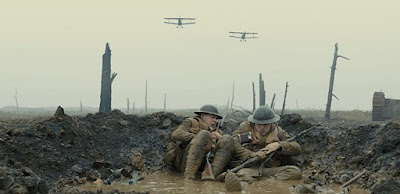 for 10 Oscars (U.S. Academy Awards), winning three of them, including the one for Best Cinematography. Indeed the cinematography is the most striking thing about this work, because the entire film has the appearance of consisting of just two camera shots. It’s my understanding that films comprising only a single take have been made before, but 1917 must surely be the most successful execution of that concept/scheme.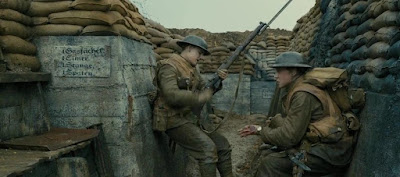
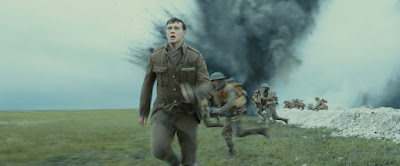
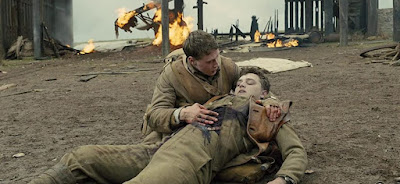 This is a shock to the viewer, because less than half-way through the film, one of the two protagonists is now gone. So Schofield now has to carry on alone.
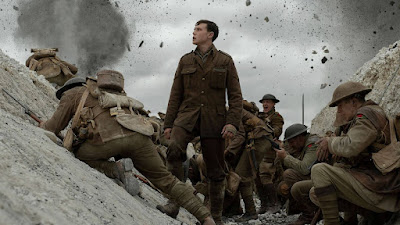 as a person in this tale. He is just an everyman who serves as a screen surrogate for the viewer so that he or she can have his or her own horrific experiences of life and combat in the trenches.


 Posts
Posts


