Showing posts with label soul and society. Show all posts

“What the Health” - Kip Andersen and Keegan Kuhn (2017)

What the Health (2017) is a documentary film written, produced, directed and edited by Kip Andersen and Keegan Kuhn, that takes a look at the effect of the animal agriculture industry (i.e. the meat and dairy industry) on human health. It can be considered to be a companion piece to an earlier film by Andersen and Keegan Kuhn, Cowspiracy: The Sustainability Secret (2014), which focussed on the impact of the animal agriculture industry on the environment.  Both films feature Kip Andersen as an investigative reporter talking to various spokespeople and lobbyists  in the animal agriculture industry, as well as figures from environmental organizations (like Greenpeace and The Sierra Club, in the case of Cowspiracy) and from human health organizations (such as The American Diabetes Association, in the case of What the Health).  Andersen also spoke onscreen with a number of doctors and investigative world experts, government officials, and others who are outside those specific organizations but who are impacted by the effects of meat and dairy industry food production.  And both films come to similar conclusions – the meat and dairy industry is fundamentally harmful to human welfare.
What the Health begins with Kip Andersen introducing himself and confessing that he is a recovering hypochondriac.  He used to compulsively follow public prescriptions from the meat and dairy industry, such as faithfully consuming three full glasses of cow’s milk every day (I used to do that, too).  Later in the film we are shown, in fact, that cow’s milk is nutritionally very different from human milk and is not really suited for human consumption.  This is an example lesson that almost everyone can relate to.

When Andersen reads that the World Health Organization (WHO) has recently determined that all processed meat is carcinogenic, he is shocked.  This means that, among other things, all ham, bacon, and sausages are carcinogenic.  He checks the web site of the American Cancer Society and is further disturbed to see that they not only ignore WHO’s announcement but that the American Cancer Society seems to explicitly endorse the eating of processed meat.  When he tries to contact the American Cancer Society about their policies on this issue, they brush him off and refuse his requests for an interview.  

Andersen further discovers that the commonly held view that diabetes can be attributed to, or at least worsened by, the consumption of sugar and carbohydrates is wrong.  In fact, according to  Dr. Garth Davis, one of the featured doctors in the film [1], the real consumption culprit for diabetes is actually eating red meat.

In this connection , there is a rather dramatic interview with Dr. Robert Ratner, the Chief Scientific and Medical Officer of the American Diabetes Association.  Dr. Ratner adamantly refuses to blame the meat and dairy industry for worsening the health of diabetics.  And when Andersen points out to him some peer-reviewed research articles that report finding a definite connection between meat and dairy consumption and worsened diabetic conditions, Ratner angrily shuts down the interview and leaves the room.  

One major reason why Dr. Ratner may have refused to discuss this issue is that his American Diabetes Association is receiving major sponsorship funding from the meat and dairy industry.  This meat-and-dairy industry sponsorship complicity (which was also mentioned in Cowspiracy) is additionally true of the American Cancer Society and the American Heart Association, and this can be confirmed by going to their respective websites.  These people in the health institutions refusing interviews about animal products may have been worried about jeopardizing a major source of their funding.

Of course, the discussion of this whole subject requires at least some consideration of the medical and pharmaceutical industries.  One major problem with medical school education is that nutrition is not a significant theme in medical school curricula.  I am not sure why this so, but perhaps nutrition is considered to have too-fuzzy boundaries and therefore to be outside the scope of “hard science”.  At any rate, doctors coming out of medical school are not trained to be knowledgeable about nutrition and thus are not knowledgeable about the relative merits of plant-based and animal-product-laced diets.  The clear benefits of following a plant-based diet are overlooked by most doctors.

Another, more general concern is that the medical industry appears to be more interested in treating patients long-term than in preventing illness in the first place.  This is also true of the  pharmaceutical industry.  Of course there are financial payoffs for following this path, but I doubt this is an explicit strategy on the part of these two industries.  Nevertheless, this is a problem, and as the film shows, there is a simple path to follow that would reduce the occurrences of many long-term illnesses and thereby address this problem – following a plant-based (vegan) diet.

In this connection the film shows several people suffering from long-term and supposedly (according to the medical advice these people were receiving) incurable health conditions.  To help alleviate their painful and debilitating symptoms, they were regularly taking a massive number of prescribed pills.  Then these people switched to vegan diets, and in a short time all their debilitating symptoms vanished.  They were cured, and they were able to stop taking all those pills.
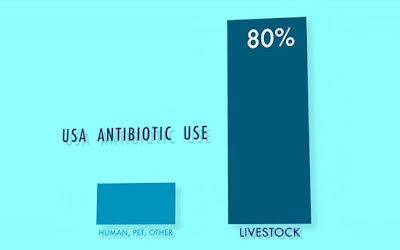
Expanding on these experiences and other evidence present in the film, the filmmakers of What the Health come out and explicitly recommend that, in order to have a healthy life, everyone should adopt a plant-based diet.  They discuss with medical experts who debunk the commonly-held notion that a plant-based diet will be short of protein.  In fact a plant-based diet provides plenty of protein, roughly just as much as a typical meaty diet.  And it is worth pointing out, as is mentioned in the film, that there is nothing sacred about the protein in meat – all protein originates from plants anyway.  Animals just recycle it.  

They then show a number of muscular athletes and bodybuilders who attest that their physical prowess is significantly enhanced by their vegan diets.              

Overall, What the Health is a well-made and usefully informative documentary that is well worth seeing.  Its message is more emphatically told than is that of its companion piece, Cowspiracy: The Sustainability Secret.  However, from a pure filmmaking perspective, I liked Cowspiracy a bit more, because What the Health has more continuous sequences of “talking heads” that would have benefited from some more brief insertions of context-setting commentary on the part of Kip Andersen that would have smoothed the pace.  Nevertheless, I recommend that you see What the Health and heed its advice [2].

½
 
Notes:
  1. Other prominent, supportive doctors featured in the film include:

  2.  See also my reviews of  

“Cowspiracy: The Sustainability Secret” - Kip Andersen and Keegan Kuhn (2014)

Cowspiracy: The Sustainability Secret (2014) is a documentary film written and directed by Kip Andersen and Keegan Kuhn that takes on the ambitious task of seeking to find a solution to the problem of greenhouse gas emissions that threaten our planet.  It follows the personal quest of Kip Andersen, who was inspired by watching Al Gore’s film An Inconvenient Truth (2006) to do something about our impending climate catastrophe.  So over the course of this film, the viewer watches onscreen protagonist Kip Andersen (Kuhn handled the camerawork) as he narrates his efforts to see what can be done.  
At first Andersen sets about changing his own lifestyle, believing that if everybody did this, then our problems would be solved.  So he gave up driving his car and took to bicycle riding, took shorter showers, and tried to conserve electricity.  But as he investigated further, he learned that these matters of personal behaviour are not where the problem lies.  For example, he discovered that 660 gallons of water are used in the production of a quarter-pound of beef for a hamburger – a figure that dwarfs whatever water savings that could be made by taking shorter showers.  

And in fact as Andersen investigated further, he learned that animal agriculture in general is the primary source of human-based environmental degradation.  There is evidence for this out there, but it is not prominently on display.  Andersen wanted to know why.  

One piece of evidence that probably a number of people have heard about is a 2006 United Nations Food and Agriculture Organization report, “Livestock's Long Shadow”, stating that raising animal livestock produces more greenhouse gas emissions than do all transportation vehicles [1]. Andersen found that the UN FAO assertion was supplemented by a 2009 World Watch Magazine report by Robert Goodland and Jeff Anhang claiming that livestock causes 51% of greenhouse gas emissions [2,3].  However, a number of lobbyists and supporters of the meat and dairy industry have taken great exception to this latter report, arguing that the 51% figure was a gross exaggeration and that its mention in Cowspiracy renders the film fraudulent.  It should be pointed out, though, that the calculation of greenhouse gas emissions from livestock production is a complicated matter, because one needs to include peripheral greenhouse gas sources, such as fossil fuel emissions from the transport of livestock and associated items (food, waste, etc.).  There is not always agreement on what must be included.  We must keep in mind that what we are interested in is the difference in total emissions from two different global situations – our current world and one in which no animal food products are produced.  In any case, it should be noted that no matter what calculation measures are used, they all agree that the total greenhouse gas emissions from animal food production are very high and significantly exceed the greenhouse gas emissions from those of all transportation vehicles [4].

One thing that shocked Andersen is that the primary U.S. environmental organizations, like Greenpeace and The Sierra Club, make no mention of the high environmental costs of animal food production on their web sites.  When Andersen tried to contact these organizations about this matter, they refused to discuss it with him – even when he made personal visits to the organizations to see if he could get their views on the subject.  For example, spokespeople for The Sierra Club simply dodged the issue (this is shown on film), while Greenpeace formally refused to talk to him.

It turns out that the major environmental organizations all receive funding and support from meat and dairy companies and lobbies. Andersen even shows meat and dairy industry logos on display on some environmental organization websites. Apparently the environmental organizations are unwilling to risk this funding by discussing animal agriculture impacts on the environment.  And  so they shut out speaking with inquisitors like Andersen.  

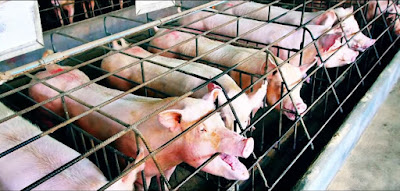
We also learn that both federal and state government agencies heavily subsidize the meat and dairy industry.  When Andersen tries to talk to California state government officials about the matter, they won’t talk about this issue.  So the animal agriculture industry seems to have a lot of economic clout. Cowspiracy does give some of their people a chance to speak – for example, Emily Meredith of the Animal Agriculture Alliance (a pro-livestock lobby), but their pro-livestock testimony seems weak to me.  For one thing, they have no answer for a basic issue with animal agriculture: the fact that no matter how nicely the animals are raised, these animals will all be killed well short of their natural lifespan.  No matter how we may try to ignore it, somebody has to do this killing.  We are graphically reminded of this terminating action when, towards the end of the film, we are shown closeups of a backyard farmer personally using his hatchet to chop the heads off of the ducks he has raised.  

As the film proceeds, Andersen and Kuhn take on wider, more global issues, and world experts  are interviewed on these matters.  For example, one issue is the dramatic depletion of the world fish population due to over-fishing and pollution.  Another issue concerns the imminent destruction of the Amazon rainforest due to human exploitation.  The program director of the Amazon Watch organization, Leila Salazar Lopez, tells us that the entire Amazon rainforest could be lost in just10 years.

Overall, Cowspiracy provides a fascinating and informative investigation of the impact of animal agriculture on the environment.  Kip Andersen’s investigative style is mild-mannered and genuinely exploratory.  He lets the pro-meat people have their chance to take the floor and defend their products.  As a result, the film has received a number of favourable reviews [5,6,7] – at least from those critics who don’t have a pro-meat axe to grind.  

But no matter what the advocates of animal agriculture may say, and no matter how much many of us love the taste of meat (I used to be one of those people, when I was a meat-eater), they don’t have an answer or suitable response to a simple fact pointed out by sustainability consultant Richard Oppenlander:

for any given area of land, you can produce 15 times more protein from plants than from animals. 
We must keep this in mind when we ponder what to do with animal agriculture in connection with such major issues as the world food crisis and global pollution.  Reducing animal agriculture (in fact preferably eliminating it) can save the planet.   

So I recommend that you watch Cowspiracy: The Sustainability Secret and take into consideration its message(s).  This film is both entertaining and informative.  However, one should bear in mind that there is one area of concern about animal agriculture that is not given a lot of attention in Cowspiracy, and that concerns the consequences and impact on one’s  personal health of consuming meat and dairy products.  Rest assured, though, that this was not a topic outside the purview of Andersen and Kuhn.  It was just an area of concern that in their minds deserved to have a whole film devoted to it.  And this is what they did when they made their subsequent documentary What the Health (2017), which is another film worth your consideration.
★★★★

Notes:

  1. “Livestock's Long Shadow”, Wikipedia, (15 March 2022).  
  2. Robert Goodland and Jeff Anhang, “Livestock and Climate Change”, WORLD WATCH MAGAZINE (2009), a well-fed world, (November 2009), . 
  3. Robert Goodland and Jeff Anhang, Jeff (Nov–Dec 2009). "Livestock and Climate Change: What if the key actors in climate change were pigs, chickens and cows?" (PDF). Worldwatch Magazine, Worldwatch Institute. pp. 10–19. S2CID 27218645. Archived from the original (PDF) on 2019-10-01. 
  4. Keegan Kuhn, “Response to Criticism of Cowspiracy Facts”, Cowspiracy, A.U.M. Films & Media, (n.d.).   
  5. Kate Irwin, “More meat, more problems in ‘Cowspiracy’”, The Daily Californian, (27 June 2014).    
  6. Chris Sosa, “Are Burgers Really Destroying the Planet? Kip Andersen Thinks So”, HuffPost, (19 August 2014; updated 6 December 2017).   
  7. Ward Pallotta, “Cowspiracy Exposes the Truth About Animal Agriculture”, EcoWatch, (10 October 2014).   

“Babette’s Feast” - Gabriel Axel (1987)

Babette’s Feast (Babettes Gæstebud, 1987), by Danish writer-director Gabriel Axel, is an intriguing film for me due to its contemplative quality.  By this I don’t mean that the film adopts a contemplative stance or presentation perspective, but rather that it induced in me a tendency to contemplate about life’s meaning throughout my watching of the film.  Axel’s script was a close adaptation of Danish writer Isak Dinesen’s (the pen name of Karen Blixen) famous story “Babette's Feast” [1], which first  appeared in Ladies' Home Journal magazine in 1950.  Isak Dinesen, of course, is most renowned for her marvelous memoir Out of Africa (1937) concerning her experiences in British East Africa.  The film Babette’s Feast won the Oscar for Best Foreign Language Film at the 1987 U.S. Academy Awards, and it has been highly regarded ever since by the critical community [2,3,4,5,6,7,8,9,10,11,12].  And also, in light of the theological aspects of this film’s story, it is interesting to note that Babette’s Feast is Pope Francis’s all-time favorite film [11].

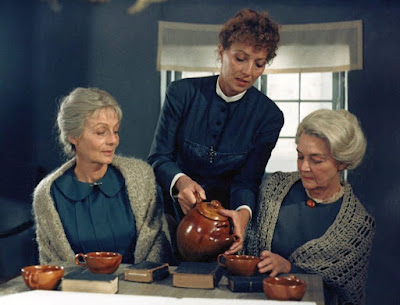
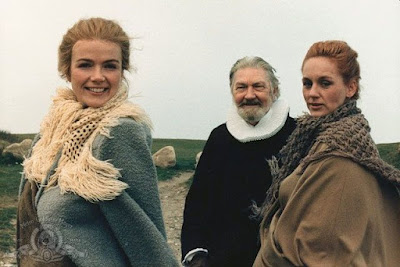
Babette’s Feast is set in Denmark in the latter part of the nineteenth century, and it concerns two elderly, unmarried sisters who have lived all their lives there in a remote village on the coast of Jutland.  The two sisters, Martine (played by Birgitte Federspiel) and Philippa (Bodil Kjer), were raised by their now-deceased father, who was a conservative pastor who led a Pietistic Lutheran ecclesiastical congregation in the village.  After their father’s passing, the two sisters continued with the leading of the aging and slowly dwindling congregation in accordance with their father’s strict standards.

The film’s story covers three time periods, during which significant events took place for the two sisters, Martine and Philippa:

  1. A period some 49 years before “the present” (“the present” takes place in the late 19ths-century), during which time some significant events take place for Martine and Philippa.
     
  2. A time 35 years later when a French woman refugee, Babette Hersant, comes to the village and begins working for the two sisters as their cook and maid.
     
  3. “The present”, when Babette prepares her special feast.
Period 1 - 49 years earlier than “the present”
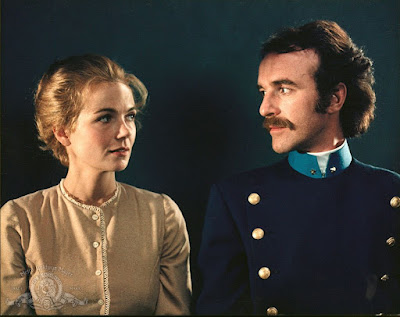
In an extended flashback we see the two daughters as late teenagers living under the strict but kindly guidance of their pastor father.  Both daughters are beautiful, but they are kept under wraps by their conservative father.  The only way to meet them in a social setting is to see them in Church.  One dashing young suitor is cavalry officer Lorens Löwenhielm (Gudmar Wivesson), whose recent rowdy behavior has caused his family to send him to the remote village to “cool off” at his aunt’s place. Lorens is quickly smitten by the beauty of Martine (in this section played by Vibeke Hastrup), but he doesn’t know how to approach the reserved girl.  After some fumbled attempts, Lorens realizes that his dreams of being with Martine are hopeless, and he decides to leave and devote himself to a professional career based on honor and glory.

A little later another visitor comes to the village, this time a famous French opera singer, Achille Papin (Jean-Philippe Lafont), who has come to get away from the Parisian hustle and bustle for a while.  He happens to hear Philippa (in this section played by Hanne Stensgaard) singing in church and is overwhelmed by the wondrous quality of her voice.  Achille manages to convince Philippa’s father to let him give her singing lessons so that he can make her into an operatic  superstar.  Achille wants to do this because of his lifetime devotion to artistic expression.  But, of course, he is also romantically attracted to Philippa.  However, Achille’s passionate and exuberantly affectionate style of personal interaction is too much for the demure Philippa, and she has to discontinue the lessons.  So Achille has to return to Paris unfulfilled.

Period 2 - 14 years earlier than “the present”
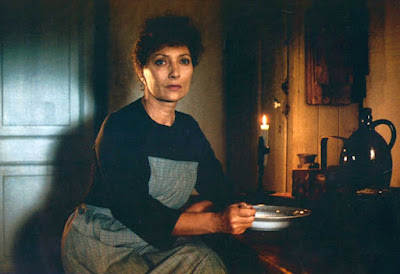
Time passes, and after their father’s death, Martine and Philippa have taken over running the local religious parish.  One day about 14 years prior to “the present”, a woman from France, Babette Hersant (Stéphane Audran), knocks on their door and bearing a letter of introduction from Achille Papin.  I should mention here that even though she first appears rather well into the piece,  Stéphane Audran is the real star of this film.  Note that the actress Audran had been the partner and wife of French filmmaker Claude Chabrol for more than twenty years and had starred in most of his films, including Les Cousins (1959) and La Rupture (1970).  In this film, although the initial focus is on the sisters Martine and Philippa,  Audran, as Babette, plays a pivotal, but enigmatic, character around whom the whole story hinges.

The letter of introduction explains that Babette is a refugee from the Paris Commune uprising of 1871 and that her husband and son had been killed in the conflict.  Fearing for her life, Babette has fled Paris, and Achille, recalling the kindness of the two Danish sisters, asks them to take her in.  The sisters explain to Babette that they have almost no money, but Babette tells them that she is willing to work for them for nothing as their cook and maid.  So the sisters take her in and begin patiently explaining to Babette how to make the simple, bland cuisine that they are used to.

Period 3 - “the present”
So now we come to “the present” time, and Babette has been working diligently for Martine and Philippa for fourteen years, and she has become a familiar background character to the dwindling number of people of the local parish that the sisters look after.  One day, however, Babette receives a message from a friend in Paris who has been buying a lottery ticket every year for Babette that informs her that she, Babette, has just won the Paris lottery of 10,000 francs.  

Everyone expects that, with civil society in Paris now calmed down, Babette will soon be returning to Paris, but Babette doesn’t say anything about this.  Instead, she indicates that she is going to prepare a grand French feast for Martine and Philippa and all the church parishioners on the occasion of the father pastor’s 100th birthday.  Noone knows quite what to expect about this feast, but it soon becomes apparent that it is going to be beyond the imaginations of any of the locals.

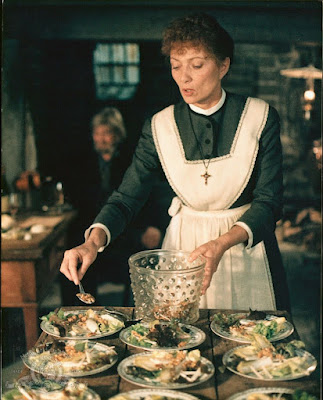
The film now devotes considerable time to showing Babette’s lavish preparations for the banquet.  Babette imports all sorts of exotic ingredients, as well as elegant plates and cutlery.  As the sisters and parishioners become aware of all these preparations, they begin to worry that it will be a sinful event, and they make a vow not to mention the food or express any appreciation at the dinner.

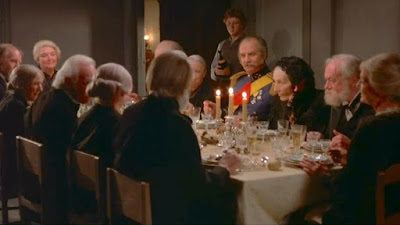
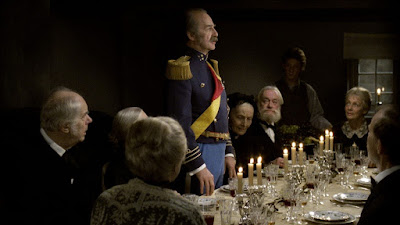
At the event, Martine’s long-ago admirer Lorens Löwenhielm, unexpectedly appears.  Lorens, who is now a famous general and is married to a lady of the royal court, has not seen Martine for forty-nine years, but he is in the village visiting his aunt, who is a church congregation parishioner.  As the other avowedly taciturn guests eat their delicious food and sip the elegant wine, their solemnity gradually fades away, and they warm up in conviviality.  Old offenses are forgiven, past grudges are mended, and almost-forgotten romantic feelings are rekindled.  But while all the other guests remain publicly silent about the feast, Lorens, who is familiar with fancy cuisine, stands up to make an after-dinner speech and toast. 

He remarks that he has tasted outstanding cuisine all over the world, but in his experience the food of this present meal is so good that it can only be matched by the food from one other place – a special café in Paris.  (The viewer will later learn that Babette was in fact the chef at that Parisian café.)  Then Lorens offers his toast, which is not so much about the food, but how the wonders of the feast has opened his eyes to the wonders of the world [11]:

    “There comes a time when your eyes are opened
    And we come to realize that mercy is infinite.
    We need only await it with confidence and receive it with gratitude.
    Mercy imposes no conditions.
    And, lo! - Everything we have chosen has been granted to us.
    And everything we rejected has also been granted.
    Yes, we even get back what we rejected.
    For mercy and truth are met together.
    And righteousness and bliss shall kiss one another.”

After the feast is over, the sisters assume that Babette will return to Paris., but Babette tells them that she used all of her 10,000 francs to pay for the expenses of putting on the feast and that she is not going away.  She did it, because she wanted to give everything in her power to the world in which she had been living.  This was, for her, the ultimate act of self-expression.

Although the basic story of Babette's Feast seems simple, the film has fascinated critics and won an Oscar.  Some people are drawn to the numerous allusions in the film to Christian symbolism, including The Last Supper (Babette's feast offered dinner for 12 guests).  But I think that the profundity of the film lies elsewhere.  To me the film features four distinct outlooks on what we should seek in life, and these outlooks are personified by four separate personages:

  • Martine and Philippa
    The two sisters, following their pastor father’s prescriptions, humbly seek to adhere to the strict rules of evangelical Christianity.  Although they devote themselves to helping the enfeebled and impoverished in their community, there is something limited and mechanical about this policy
     
  • Lorens Löwenhielm
    After Löwenhielm’s failed infatuation with Martine, he devoted himself to the attainment of personal glory and honors.  When he is seen in the latter part of the film, it is evident that he had attained what he had sought, but we get the feeling (something his closing toast confirms) that he senses that there is still something more to life than that.  
     
  • Achille Papin
    For Papin the ultimate achievement to be sought in life was ecstatic artistic expression in accordance with one’s own aesthetic gifts.  But this is a very personal mode of being and does not significantly involve the serious engagement with others or with a wider spectrum.
     
  • Babette
    Babette's mission was too use all her abilities in order to selflessly, even anonymously, bring joy to others.  And she did this through the wonders of food preparation and taste.  Her feast was her personal gift, not just to the parishioners, but to the world.

With regard to the first three of these perspectives, Tasha Robinson remarks [8]:

“The narrative is also about the emptiness of most pursuits: General Lorens is dissatisfied and confused after devoting his life to a spectacular career. The Puritans are bitter and judgmental after devoting their lives to religion. Martine and Filippa find satisfaction in devoting their lives to their father, but are left bereft after his death, watching the consensus he built crumble.” 

And in this vein of multiple life perspectives, Mark Le Fanu further adds [9]:

“Thus there are two stories, at least, going on in the closing stages of the film. Babette is busy showing us that the artist is able to respond to adversity with self-denying style and generosity, while Löwenhielm, in his after-dinner speech to the guests, is demonstrating that our choices in life—even the bad ones—are all ultimately redeemable and beneficent. Somehow, these two positions meet; at a certain level, they are identical postulates. For if Löwenhielm never sees Babette (she remains in the kitchen, outside his range of vision), he guesses she’s there—invisible, like grace—for the simple reason that, years ago in Paris, he attended a similar feast, and there is only one person in the world who could have authored this one.”

Overall and despite its modest format, Babette's Feast is a very successful cinematic consideration of our ultimate goals in life.  Of course, this topic has been the subject of countless philosophical treatises where text is used to express such abstract notions.  It would seem to be even more difficult to try doing this if one is confined to using the physical visual imagery of film.  Nevertheless, Jean Schuler feels that Babette's Feast has actually managed to accomplish what Kierkegaard thought to be beyond the realms of possibility [4]:

Babette's Feast achieves what Kierkegaard treated as impossible: to make the hidden movements of faith visible. A film about goodness threatens to bore its audience; a film about holiness that manages to get it right would seem to be as impossible as roses blooming in December or sitting down to a banquet fit for kings in a Jutland cottage.”

However, Gabriel Axel, with the help of Isak Dinesen’s story, Henning Kristiansen’s cinematography, and Stéphane Audran’s performance, did get it right.

Perhaps it is best to summarize the essence of what they got right with this quote from Pope Francis, himself [13]:

“The most intense joys in life arise when we are able to elicit joy in others, as a foretaste of heaven. We can think of the lovely scene in the film Babette’s Feast, when the generous cook receives a grateful hug and praise: ‘Ah, how you will delight the angels!’ It is a joy and a great consolation to bring delight to others, to see them enjoying themselves. This joy, the fruit of fraternal love, is not that of the vain and self-centred, but of lovers who delight in the good of those whom they love, who give freely to them and thus bear good fruit”

Notes:

  1.  “Babette's Feast”, Encyclopedia.com, (n.d.).   
  2. Desson Howe, “Babette’s Feast”, Washington Post, (8 April 1988).   
  3. Rita Kempley, “Babette’s Feast”, Washington Post, (8 April 1988).   
  4. Jean Schuler, “Kierkegaard at Babette's Feast: The Return to the Finite”, Journal of Religion and Film, (October 1997).   
  5. Wendy M. Wright,  "Babette's Feast: A Religious Film”, Journal of Religion and Film, (October 1997).   
  6. Peter Bradshaw, “Babette's Feast – review”, The Guardian, (13 Decembet 2012).   
  7. Nathaniel Thompson, “Babette’s Feast", Turner Classic Movies, (8 November 2013).    
  8. Tasha Robinson, “Babette’s Feast”, The Dissolve, (23 July 2013)..   
  9. Mark Le Fanu, “Babette’s Feast: ‘Mercy and Truth Have Met Together’”, The Criterion Collection, (22 July 2013).  
  10. Samuel Wigley, “Then and now: Babette’s Feast reviewed”, British Film Institute, (3 April 2014).   
  11. Philip Kosloski, “Why does Pope Francis want us to watch the movie ‘Babette’s Feast’?”, Aaleteia, (21 November 2016).   
  12. Ezio Vailati, “Babette's Feast”, Southern Illinois University Edwardsville, (n.d.).   
  13. Pope Francis, Amoris Laetitia: On Love in the Family, Our Sunday Visitor, (2016), p. 129.

“Fantastic Fungi” - Louie Schwartzberg (2019)

Fantastic Fungi (2019) is an entertaining documentary film that explores various aspects of  ubiquitous but often overlooked participants in our biosphere – fungi, and in particular, their usually above-ground fruiting components, mushrooms.  This film brings to the viewer’s attention the fact that fungi are absolutely crucial to the sustenance of life on earth. The film was directed and photographed by Louie Schwartzberg, whose demonstrated expertise in time-lapse cinematography and CGI (computer-generated imagery) is a spectacular feature of the film.  In fact the time-lapse imagery is so frequently occurring and dazzling that it may perhaps sometimes distract the viewer from some of the film’s other virtues.  

Fantastic Fungi was written by Mark Monroe (among whose earlier writing credits is the fascinating documentary The Cove (2009) [1]), and it was edited by Kevin Klauber and Annie Wilkes.  There are numerous voiceover narrations from the various talking heads in this documentary, but one special narrative element is provided by previously Oscar-winning actress Brie Larson, who serves here as the unseen metaphorical voice of the fungi kingdom.  I am not sure how well this particular narrative innovation works in this case, but it does provide an unusual twist to the presentation.  Another aspect of the production that deserves comment is the music by Adam Peters.  Unfortunately, I found much of the music to be littered with rumblings and  mostly distracting from the viewing experience.  In any case, the film has been largely well-received by a range of critics [2,3,4,5,6,7].

Although Fantastic Fungi rambles back and forth between various topics about fungi, we can say that the film covers roughly four general areas of interest:
  • The science of fungi
  • Fungi in ancient mythology
  • The impact of hallucinogenic drugs that have been derived from Fungi
  • Practical and medicinal uses of fungi
Throughout much of this journey, we are shepherded by Paul Stamets, a lifetime amateur mycology (the science of fungi) enthusiast.  Despite having limited formal training in mycology, Stamets’s passion for the subject and hands-on explorations have enabled him to make a number of discoveries and contributions to the area.  And as the film demonstrates, he is a rather glib communicator on the topic.  

1.  The Science of Fungi
In this topic area the viewer is given some interesting scientific information about fungi.  The expert narrators concerning this material are, for the most part, Michael Pollan and Eugenia Bone, who are food journalists, and Professor Suzanne Simard, who conducts research on fungi at the University of British Columbia.

Fungi are a primitive form of life that predates plants and animals.  Indeed the oldest fossil remains of life are those of fungi dating back 2.4 billion years ago.  And of course fungi are still prospering today, and there are now several million fungi species, more than six times the estimated number of plant species.  

A fascinating and most important structural component of fungi are the thin filamentary hyphae that exist mostly below ground and serve as the roots of the fungi.  They spread out into incredibly complex network structures that are known collectively as mycelia, and they can form even more complex mycorrhizal networks with plants that a mycelium network may connect to.  The expert commentators in the film liken the complexity of these network mycelium structures to that of the human brain, and it seems that these mycelium networks can facilitate the exchange of nutrients and information between the nodes (plants and/or fungi) that are interconnected in these networks.  For more information concerning how these mycorrhizal networks facilitate the essential vitality and harmony of nature, I recommend you see Suzanne Simard’s TED talk, "How trees talk to each other" [8].

2.  Fungi in Ancient Mythology
It seems that fungi have been known and cherished since very ancient times – even to ancient hominids that flourished before the appearance of Homo sapiens.  This was presumably due to the powerful mind-altering properties of some mushrooms.  The film has some commentary about this and refers to and shows some ancient temples in this regard.  

Reference is also made to the Stoned Ape Theory that was proposed by Terence McKenna in 1992, which advanced the idea that the movement from the early human species Homo erectus to the current species Homo sapiens was connected with the hypothesized increased consumption of psilocybin mushrooms (“magic mushrooms”) about 100,000 years ago.  This allegedly gave consumers of those mushroom improved acuity and cooperation capabilities that ultimately provided them with evolutionary advantages.  Thus, so this story goes, the consumption of magic mushrooms led to the emergence of Homo sapiens.

3.  Hallucinogenic Drugs
At the beginning of the 1970s, 15-year-old Paul Stamets became inspired by reading some writing by an advocate of alternative medicine, Dr. Andrew Weil, about altered states of consciousness.  This was when Timothy Leary, LSD, and other hallucinogenic drugs derived from mushrooms were in their heyday.  Consequently Stamets was eager to try out some psychedelic mushrooms.  So he consumed a whole bag of magic mushrooms, and the resulting experience that he had changed his life.  For one thing, it instantly cured his til-then lifelong stuttering problem.  In addition, it launched his unquenchable fascination with the mind-bending possibilities of fungi.  However, about this time there was a decades-long U.S. governmental suppression of psychedelic drug research (1970s - 2000), which hindered work in this field  by Stamets and others.  So Stamets started his own mushroom business and moved to Canada.  In some respects this film is intended to renew a wider scientific interest in this area, such as existed in the 1960s and 70s.

4.   Medicinal Uses of Fungi
A fascinating element of Fantastic Fungi is its discussion of some of the promising medicinal uses of fungi.  However, because of time constraints, only a smattering of this material can be offered.  A key item with respect to this topic is the fact that the human brain has neuroplasticity.  That is, the neuronal structure of the human brain can change and grow throughout the course of a person’s life.  But to facilitate this activity, the brain needs assistance to generate new neurological pathways.  And this is where mushroom-derived chemicals such as psilocybin can play an important role in the brain’s chemistry.  This is an ongoing topic of current research.

Overall, there is an important message we can take from Fantastic Fungi.  We learn that fungi are fundamental instruments for the regeneration of life, and that as Paul Stamets tells us, “the entire ecosystem is infused with fungi.”  Our reductive scientific models of the natural world have too often focussed on the individual entity or agent, and they have thereby overlooked the intertwined, multi-generational nature of life, in connection with which fungi play a fundamental role.  Indeed what is emphasized here in this film and the essential point we come away with, in fact, is how fungi underlie and facilitate a most crucial aspect of the world, something that Buddhist and other spiritual masters have long taught – the interconnectedness of all living beings.
★★★

Notes:
  1. The Film Sufi, “‘The Cove’ - Louie Psihoyos (2009)”, The Film Sufi, (26 July 2009).   
  2. Rex Reed, “Charming Documentary ‘Fantastic Fungi’ Explores the Miracle of Mushrooms”, Observer, (15 October 2019).   
  3. Matt Fagerholm, “Fantastic Fungi”, RogerEbert.com, (11 October 2019).  
  4. Jeannette Catsoulis,”‘Fantastic Fungi’ Review: The Magic of Mushrooms”, The New York Times, (10 October 2019).   
  5. Josh Kupecki, “Fantastic Fungi”, Austin Chronicle, (6 December 2019).   
  6. John Defore, “‘Fantastic Fungi’: Film Review”, The Hollywood Reporter, (8 October 2019).  
  7. Robert Abele “Review: Mushrooms are the new superheroes in documentary ‘Fantastic Fungi’”, Los Angeles Times, (24 October 2019).      
  8. Suzanne Simard, “How trees talk to each other”, TED, (31 August 2016).   

“Eat Drink Man Woman” - Ang Lee (1994)

Taiwan-born Ang Lee (pinyin: Li An) has been a highly successful film director whose versatility over the years has been demonstrated with productions undertaken across several different continents and with themes spanning multiple different genres and social contexts – for example: The Wedding Banquet (1993), Sense and Sensibility (1997), Crouching Tiger, Hidden Dragon (2000), Brokeback Mountain (2005), Lust, Caution (2007), and Life of Pi (2012).  But I think Lee’s greatest film was one of his earliest, Eat Drink Man Woman (1994).  This is a compelling work that, despite its Taiwanese/Chinese cultural context, is concerned generally with how romantic concerns can interact with family values, and so it can be appreciated by just about everyone [1,2,3,4,5,6].  

The film’s story about a master chef in Taipei and his three grownup daughters was scripted by Ang Lee, James Schamus, and Hui-Ling Wang.  And the film’s overall production values, including the acting, were excellent, but extra special praise should be singled out for the cinematography by Jong Lin and the film editing by Ang Lee and Tim Squyres.  In some respects it is the cinematography and film editing that help elevate this film to a truly high status.

The film opens with a detailed presentation of Lao (“Old”, an honorific in Chinese) Chu preparing an elaborate dinner for his three grownup daughters.  The daughters are unmarried and so live at Chu’s home, but they are often out attending to their own personal affairs.  However, Lao Chu expects, indeed demands, that they all unfailingly attend the Sunday dinner that he prepares for them every week, as a ritual and as a precious instrument for family bonding.  Chu has been a widower for the past sixteen years and has largely raised his three daughters during that time on his own.  And like many parents, he is concerned that his daughters, who are all exposed to modernist influences of contemporary Taiwanese society, will start drifting away.  So for Chu, the weekly Sunday dinner is crucial; but for the three daughters, the dinner is boring and almost a form of torture.

For the rest of the film, the viewer is treated to four parallel and interlaced narratives that trace the mostly separate and interpersonal concerns of Chu and his three daughters.  We soon discover  the following basic information about them.
  • Lao Chu (played by Sihung Lung) is an aging but famous chef in Taipai and is the master chef at a huge and important hotel in Taipei.  In fact it is widely said that Chu is Taipei’s finest chef, and he is generally used to being in command of those around him.  However Chu is now losing what is critical for a chef, his sense of taste.  So he has to rely on his old friend and fellow master chef Lao Wen (Jui Wang) to sample all his food concoctions to make sure they have been seasoned properly.
     
  • Jia-Jen (Kuei-Mei Yang), Lao Chu’s oldest daughter, is about 29-years old and works as a high school chemistry teacher.  She is sensitive and reserved and, compared to the other sisters, an upholder of traditional values.  In addition, she has recently become a devout conservative Christian.  Jia-Jen has a close woman friend, Liang Jin-Rong (Sylvia Chang), who was a former school classmate and with whom she often gets together to share concerns, such as Jin-Rong’s drawn-out divorce process.  Jia-Jen’s other friends, worried that she is getting old to find a marriage partner, try to help her in this area, but Jia-Jen shows no interest in dating anybody.  She still hasn’t gotten over a failed love interest when she was in college nine years ago.
     
  • Jia-Chien (Chien-Lien Wu) is the second-oldest daughter and quite different from Jia-Jen.  Unlike her attractive but quiet and modestly dressing older sister, Jia-Chen is glamorous and outgoing.  She is an energetic, rising executive for an airline company, and she is accustomed to expressing her opinions when she feels like it.  She is also the least tolerant of their father’s Sunday dinners and intends to move out of the home as soon as the new apartment she has purchased is ready.  On the romantic front, she is confidant and bold, e.g. she has a purely sexual relationship with a male friend, Raymond (Chit-Man Chan),  that involves no commitments from either party.  She treasures her independence.
     
  • Jia-Ning (Yu-Wen Wang), the youngest sister, is 20-years-old and works at a Wendy’s fast-food restaurant while attending college classes.  She is generally upbeat and usually deferent to her more opinionated older sisters.
So all four members of the Chu family, though different, are relatively well-balanced; and in accordance with family traditions, they are expected to share with each other what is happening in their respective lines when they get together on Sunday for dinner.  But over the course of this film, we see that all four develop romantic relationships concerning which they feel guarded about sharing with each other on Sundays.  And the presented subtlety of those guarded feelings is part of what makes this a great film.  

In this connection there is an early scene in which a Chu family Sunday dinner is interrupted by an emergency at Lao Chu’s posh hotel.  We learn that a big feast for an important gathering at the hotel is in preparation but due to some cooking hitches is evidently headed for disaster.  Lao Chu is summoned to rescue this desperate situation, and in a highly professional way he does indeed save the day – and, in the process, demonstrate his impressive culinary prowess.  Afterwards, Lao Chu and Lao Wen become somewhat inebriated and reflect on what they have learned over the courses of their long lives.  In a reflective moment of gloom, Lao Chu asks his friend,
“Eat drink man woman.  Food sex . . . Is that all there is?”
The rest of the film offers an answer to that question.

As the interlaced narratives of the four Chu family members unfold, the viewer learns about the evolving romantic relationships that develop for them. 
  • Jia-Jen is not looking to date anyone, but she has an accidental encounter with her school’s new volleyball coach, Ming-Dao (Chin-Cheng Lu), and further encounters stir an interest on Ming-Dao’s part,  Ming-Dao is naturally outgoing, and his interest shown is gradually reciprocated by the shy Jia-Jen.
     
  • Jia-Chien finds herself attracted to Li Kai (Winston Chao) a handsome and suave new manager at her airline company.  It looks like they are certain to become lovers, but at the last minute she learns that Li Kai was the man who broke Jia-Jen’s heart nine years ago.  So Jia-Chen has to call things off with Li Kai.  About this time Jia-Chen also learns that Raymond has chosen to break off his relationship with Jia-Chen and get married to another woman.  So now for the time being at least, Jia-Chen is bereft of lovers and “alone”.
     
  • Jia-Ning’s close friend and coworker at Wendy’s, Rachel (Yu Chen), appears to be in the process of dumping her heartbroken boyfriend Guo Lun (Chao-jung Chen), and knowing that Guo Lun will always be waiting for her outside of Wendy’s after work, she asks Jia-Ning to shoo the lovesick boy away.  But Jia-Ning’s sympathetic encounters with Guo Lun soon lead to a mutual attraction between the two.  It turns out later that Rachel was only toying with her boyfriend and didn’t want to lose him, but her turnaround is too late.
     
  • Lao Chu does not appear to be looking for any romantic liaisons, but his three daughters worry that he must do so or he will wind up lonely once the daughters eventually all leave home and attend to their private lives.  Lao Chu’s isolation is only worsened when his longtime friend and confidante, Lao Wen, suddenly dies of a heart attack.  But when the daughters learn that their friend Liang Jin-Rong’s widowed mother, Madame Liang (Ah-Lei Gua), has just returned to Taipei from overseas and is now sometimes socializing with Lao Chu, they optimistically assume that, even though the woman appears to be pushy and overbearing, she would be a suitable marriage partner for their father.  However, Lao Chu devotes most of his attention to affectionately spoiling Liang Jin-Rong’s young six-year-old daughter, Shan-Shan (Yu-Chien Tang), by secretly making the girl tasty lunches to take to school every day.  For Shan-Shan, Lao Chu is like a substitute daddy.
Finally, mostly at Sunday dinner confessions, the viewer learns how these relationships have turned out.  Jia-Ning announces that she is leaving home to marry her secret lover, Guo Lun, by whom she is already pregnant.  Jia-Jen marries Ming-Dao and even gets him to convert to Christianity.  

But most shocking of all is what happens with Lao Chu.  At a family dinner to which the Liang family (Madame Liang, Liang Jin-Rong, and Shan-Shan) have been invited, Lao Chu makes a marriage proposal not to the one everyone expects – Madame Liang, but to Jin-Rong, with whom Lao Chu has been having a secret affair.  This explains why Lao Chu has been showering Shan-Shan with paternal affection for awhile.  And it also means that the daughters will not be abandoning their father to loneliness.

So romantic love appears to have conquered all, and, in particular, to have overshadowed traditional family mores.  Is that the film’s final message?  Not entirely [6].  Jia-Chen, the most glamorous and attractive of the three sisters, was always the one who was least affected by traditional values.  She always found her father and his Sunday dinners insufferable, and she was the first daughter to announce her plans to move out of the family home.  But by the end of the film, she has changed.  She abandons her affair with Li Kai out of concerns for her older sister’s feelings.  And she declines a promotion from her airline company to be an overseas vice president, because she wants to stay closer to her family.  In the final scene she is shown cooking a meal for her father at the old home and showing hitherto unseen warmth for him.  So traditional family values now apparently have meaning for her.
 
Consequently we can say that what we have here is not just a battle between Modernism and Tradition or between East and West.  Overall, what makes this a great film is the display of subtle and complex interacting feelings presented by the main character actors.  My favorite performance was that of Kuei-Mei Yang as Jia-Jen, but they are all compelling, and you may have another favorite.

Also outstanding is the cinematography.  There are many emotive closeups that help convey the feelings in this story.  I would also like to call your attention to three extended tracking shots that I thought were very effective.  One is a two-minute shot showing an early conversation between Jia-Ning and Guo Lun.  A second is s 90-second shot of a conversation between Jia-Jen and Liang Jin Rong.  And a third sequence that lingers in my memory is a two-minute shot of Jia-Jen and Li Kai conversing while walking through a store.

So getting back to Lao Chu’s question that he asked early on in the film,
“Eat drink man woman.  Food sex . . . Is that all there is?”
We can say that the film’s response is,
“No, there is much more.  And it all comes from love in all its various guises and modes.”  
Love can be manifest in both traditional and modern circumstances.  The key thing is that, no  matter what the situation, love represents the most sincere and authentic aspects of who we are.  And this is what Ang Lee’s Eat Drink Man Woman puts on display for us.
★★★★

Notes:
  1. Hal Hinson, "‘Eat Drink Man Woman’", Washington Post (19 August 1994).   
  2. Desson Howe, "‘Eat Drink Man Woman’", Washington Post, (19 October 1994).   
  3. Marjorie Baumgarten, “Eat Drink Man Woman”, Austin Chronicle, (19 August 1994).  
  4. Janet Maslin, “FILM REVIEW; Avoiding Basic Human Desires, or Trying To”, “The New York Times”, (3 August 1994).   
  5. Norman N. Holland, “Ang Lee, ‘Eat Drink Man Woman’ (1994)”, A Sharper Focus, (n.d.).   
  6. David Sorfa, “Eat Drink Man Woman: Summary & Analysis”, Jotted Lines, (23 February 2020).   

“Wheel of Time” - Werner Herzog (2003)

Werner Herzog, one of the greatest filmmakers, is one of my favorites.  Over the course of his prolific career covering the direction of some twenty dramatic feature films and more than thirty documentary features, he has invariably cast his unique vision across a wide range of subject matter, much of it with an existentialist philosophy tinge.  Thus he often travels to remote locations to observe how people deal with the extreme conditions there.  This is what I find particularly fascinating about Herzog: he is a philosopher with a movie camera.  The Herzog film I will be discussing here, Wheel of Time (2003), which he wrote, directed, and narrated, is very explicitly aimed in this philosophical direction, because it is concerned with the passions and rituals of Buddhist monks.  The film featured cinematography by Peter Zeitlinger and film editing by Joe Bini, and as usual with Herzog films, one gets the feeling that a good part of the film’s story was composed in the editing room.  And also as usual with Herzog films, it was well-received by a range of critics [1,2,3,4,5].

The specific subject matter of the film concerns the elaborate Kalachakra Initiation ceremony for Tibetan Buddhists (note that ‘Kalachakra’ is a term in Vajrayana Buddhism that means "wheel of time") that is held every two or three years at a place chosen each time by the Dalai Lama.  This event typically attracts some 500,000 Tibetan initiates and pilgrims from all over Asia who wish to participate in the elaborate rituals over the course of ten days and ten nights.  On this occasion, in January 2002, the chosen place for the Kalachakra ceremonies is very special – Bodh Gaya in Bihar, India.  It was here some 2,500 years ago that Siddhartha Gautama spent seven weeks meditating under the Bodhi Tree (a sacred fig tree there) and reached enlightenment, thereby achieving the status of the Buddha.  Bodh Gaya is also the site of the associated Mahabodhi Temple.

The film begins with some physical shots of the Bodh Gaya area, and then it shows the many pilgrims arriving for the Kalachakra events.  Some of these pilgrims are so devout that they make their jouney to the Kalachakra event entirely on foot, and after every step or so they fully prostrate themselves in obeisance.  Herzog shows some of them reverentially following this practice over all sorts rough terrain, and the whole journey to their holy destination can take many months, even years.  These pilgrims are mostly poor people, but some of them at least bring pup tents in which they can sleep in the temple yards overnight.  The rest of them must just sleep outside in the open.  

The principal activities of the Kalachakra activities fall into three main categories:
  • Buddhist teachings and prayers conducted by lamas and monks,
     
  • The construction and display of the great Kalachakra Mandala, an elaborate symbolic design made out of colored sand that is an important artefact of Tibetan Buddhism [6,7], 
     
  • The closing initiation ceremonies for the aspirant Tibetan Buddhist monks.
Of these activities, a considerable amount of Wheel of Time screen time is devoted to showing the detailed construction of the Kalachakra Mandala.  This is made of loose, colored sand, the tiny individual granules of which must be so carefully placed  that they collectively form an incredibly intricate design.  This takes a number of sand artists manydays to complete. Once completed, the Kalachakra Mandala is seven feet in diameter and displays visual references to 722 deities.  Since the mandala is made only of loose sand, it must be protected from the approach of onlookers and even casual breezes which could disturb it, so it is walled off by a glass partitioning surrounding it.  

But after the mandala’s construction and display to the monks and pilgrims at the end of the usual Kalachakra ceremonies, all the sand of the entire mandala is collected and ritualistically thrown into the river, thereby symbolizing the utter ephemerality of existence.  
 
Just before the halfway point in the film, Herzog takes time out to go off on his own with his own camera and visit another sacred Buddhist site, Mount Kailash in western Tibet.  Thousands of pilgrims come to this 22,000 foot mountain at a specific time every year  (Herzog came in May 2002) to carry out a high-altitude circumnavigation of the peak, which they believe will bring them holy salvation.  The 52 km trek around the peak that the pilgrims take is at an altitude of 18,000 feet, and sadly every year, some pilgrims who are not appropriately acclimatized to these heights die from exhaustion.

At other points in the film we see brief clips of the Dalai Lama speaking in closeup on a few topics.  He is always relaxed and reasonable, and one his more interesting remarks was his comment that all religions carry the same message.  It would be good if more people felt that way.  The Dalai Lama is, of course, the star personage of the Kalachakra Initiation ceremonies, but unfortunately his health at this time was not good, and he was unable to carry out his required, full participation in the ceremonies.  This was naturally very disappointing to the hundreds of thousands of pilgrims who had come to Bodh Gaya, as well as to the Dalai Lama, himself.  But he promised to all the practitioners that he would come back there to see them all the following year.

The scene now shifts to another ten-day Kalachakra Initiation ceremony that was held later that year – in October 2002 in Graz, Austria.  This time the attendees are mostly European Buddhists, and the number of participants are in the thousands, rather than the hundreds of thousands.  And  now the Dalai Lama is healthy and fully participating.  Also present is famed Buddhist monk and communicator Matthieu Ricard, who often serves as the Dalai Lama’s translator.

One of the highlights of this section of the film is the showing and description of a Tibetan Buddhist monk and pilgrim, Takna Jingme Sangpo, who, partly thanks to international protests, had recently been released from prison in Tibet after being held there under cruel conditions by the Chinese overlords for 37 years.  Sangpo’s only crimes were apparently his public expression on a few occasions that he supported a “Free Tibet”.  Despite his extreme hardships, Sangpo, is now overjoyed that he now, finally has the opportunity to see the Dalai Lama in the flesh for the first time.

At this Kalachakra Initiation event in Graz, another elaborate Kalachakra Mandala is duly constructed out of colored sand and displayed.  And at the end of these ceremonies, a healthy Dalai Lama performs the ritual act of dispersing the collected mandala sand into the Mur river there.  

Overall, Herzog’s Wheel of Time does provide a lot of information about the Kalachakra ceremonies.  But what lingers most in my mind after watching it is something else that he has captured on film.  And that is the extraordinary religious fervor that you can see silently expressed on all the faces of the vast crowds of pilgrims shown.  These dedicated practitioners are not boisterous; they are not broadcasting. Instead, they are wholly devoted to their spiritual path of seeking total purity and enlightenment.  Herzog does not articulate or discuss this issue.  He directly shows it on a thousand faces.
★★★½

Notes:
  1. Walter Addiego, 'Wheel of Time', Film Clips, SFGATE, (22 July 2005).  
  2. Dennis Schwartz, “Wheel of Time”, Dennis Schwartz Movie Reviews, (n.d.).   
  3. Ed Howard, “11/8: Wheel of Time; The Flowers of St. Francis”, Only The Cinema, (8 November 2007).   
  4. Frederic and Mary Ann Brussat, “Wheel of Time”, Spirituality & Practice, (2005).   
  5. Stephen Holden, “With Herzog, Inside a World of Devotion”, The New York Times, (15 June 2005).      
  6. “Mandala”, Wikipedia, (15 June 2021).   
  7. “Sand mandala”, Wikipedia, (29 April 2021).