Showing posts with label ***. Show all posts

“The Big Sleep” - Howard Hawks (1946)

The Big Sleep (1946) is a famous film noir directed by Howard Hawks – in fact some people think it is the greatest of all films noir [1,2,3,4,5,6].  It is based on famous detective fiction writer Raymond Chandler’s first novel, The Big Sleep (1939), which featured Chandler’s favorite fictional protagonist, private detective Philip Marlowe.  In Hawks’s film version here, Marlowe is played by Humphrey Bogart, and this was one of the factors that made this film noir so popular – it turned out to be one of Bogart’s more famous roles.  Another factor in the film’s popularity was the romantic pairing of Bogart (aged 44) with Lauren Bacall (aged 20), a combo that had already achieved significant traction with the public from Hawks’s earlier To Have and Have Not (1944).  “Bogie and Bacall” were coupled offscreen, too, and they got married during this period.
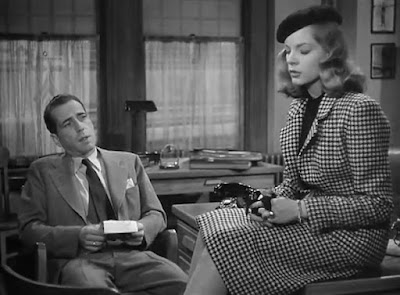
Despite the fame of this film, though, there are aspects of it that make the work problematical.  For one thing, the plot of The Big Sleep (both that of the film and the novel) is so convoluted that most viewers can’t keep track of it.  This is partly a consequence of Chandler’s practice of basing each of his novels on several of his earlier-published short stories, each of which had its own plot.  And anyway, plot was less important for Chandler than atmosphere and characterization.  It seems that he wanted more to create a sense of tension rather than to tell a story.  So the task was considerable for the esteemed screenwriters who worked on the film:
  • William Faulkner, a novelist and short story writer who won the 1949 Nobel Prize for Literature,
  • Leigh Brackett, who later scripted another famous film noir based on a Raymond Chandler novel, The Long Goodbye (1973), and
  • Jules Furthman, a prolific screenwriter whose vast repertoire includes the  scripting of seven of Josef von Sternberg’s films.
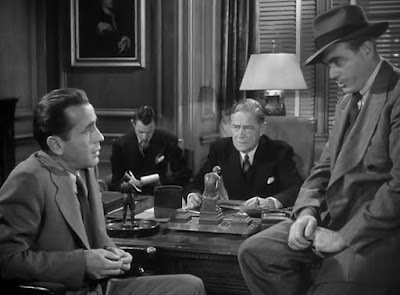
Not only did Faulkner, Brackett, and Furthman need to tone down the explicit sexuality (including homosexuality) in Chandler’s original account, they also had to understand and try to make some sense of Chandler’s tangled plot in the novel.  One notable example of this difficulty occurred during the shooting of the film when Bogart and Hawks wanted to know who committed one of the seven key murders in the film [5].  That is, was Sternwood’s chauffeur murdered or was it a suicide?  It bothered  Bogart and Hawks so much that Hawks sent a telegram to Chandler to find out.  But it turned out that Chandler didn’t know, either!  As I said, Chandler was mainly concerned with atmosphere, not facts about who did what.

The story, such as it is, of The Big Sleep begins with Los Angeles private detective Philip Marlowe (Humphrey Bogart) being summoned to the mansion of General Sternwood (Charles Waldron), a wealthy invalid with two wanton young daughters – the lewd and self-indulgent  Carmen (Martha Vickers) and the divorced Vivian Rutledge (Lauren Bacall).. Sternwood is concerned that Carmen is being threatened for the nonpayment of her gambling debts. Marlowe agrees to look into the matter.  
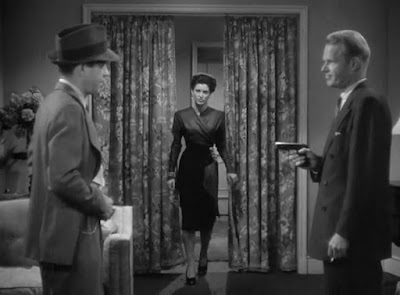
But things turn out to be not so simple as that.  Marlowe soon learns that Carmen was being blackmailed by her phony creditor, whom Marlowe soon finds murdered.  And Marlowe learns from Vivian that her younger sister Carmen has been blackmailed before by other mysterious gangsters and miscreants, who may or may not be involved in this current murder.  Throughout all the various violent events that come along and the corpses that pile up, Marlowe tries to figure out what is going on.  But he is always one step behind.  However, along the way, Marlowe and Vivian (who also turns out to be a victim of blackmailing) gradually develop an attachment for each other.

I won’t go over the plot details here, but I can say that in the end, things get somewhat resolved, although we do learn that Marlowe, Vivian, and Carmen each killed someone who was threatening them individually [2].  

So what is it that accounts for The Big Sleep’s popularity?  I don’t think it is the intricate plot, because the plot is too random and loose-ended.  Moreover, we don’t get much of a feeling for what motivates most of the events that transpire.  And I don’t think it is the “Bogie and Bacall” Mystique, either.  That relationship is very much in the background and never really occupies center stage.  

No, I think what accounts for The Big Sleep’s popularity is that the film is so heavily loaded with all the accoutrements of film noir stylistics.  There is a nonstop barrage of all the incidental elements that the aficionados of film noir look for and recognize when they encounter an instance of the genre – 
  • a dark, cynical, and obscure protagonist
  • attractive women with unclear pasts and ambiguous intentions
  • unexpected encounters with shady characters
  • unanticipated violence
  • cynical and innuendo-loaded wisecracks and dialogue
Thus film critic Roger Ebert loved the film precisely for these elements, as he remarked
[5]:
Working from Chandler's original words and adding spins of their own, the writers (William Faulkner, Jules Furthman and Leigh Brackett) wrote one of the most quotable of screenplays: It's unusual to find yourself laughing in a movie not because something is funny but because it's so wickedly clever. (Marlowe on the "nymphy" kid sister: "She tried to sit in my lap while I was standing up.") Unlike modern crime movies which are loaded with action, "The Big Sleep" is heavy with dialogue--the characters talk and talk, just like in the Chandler novels; it's as if there's a competition to see who has the most verbal style.
But I don’t see things that way.  An outstanding film cannot be just all clever talk; it has to have a compelling narrative, and The Big Sleep doesn’t have that.  The story of this film is too loose-ended and contorted.  So although the film has some entertaining moments (I did like the brief, separate interactions Marlowe had with Carmen (Martha Vickers) and Harry Jones (Elisha Cook, Jr.)), this is certainly not a great film noir.
★★★
 
Notes:
  1. Leonard Maltin (ed.), “The Big Sleep (1946)”, Leonard Maltin’s Classic Movie Guide, Plume, (2005), p. 47.  
  2. Tim Dirth. “The Big Sleep (1946)”, “Filmsite”, (n.d.).   
  3. Andrew Sarris, “Living the private-eye genre”, films in focus, The Village Voice” (8 November 1973).   
  4. Jeffrey M. Anderson, “I'd Like More”, The Big Sleep (1946), Combustible Celluloid, (n.d.).   
  5. Roger Ebert, “The Big Sleep”, Great Movies, RogerEbert.com, (22 June 1997).   
  6. Brian Cady, Margarita Landazuri, and Frank Miller, “The Big Sleep”, Turner Classic Movies, (17 February 2005).     

“Fantastic Fungi” - Louie Schwartzberg (2019)

Fantastic Fungi (2019) is an entertaining documentary film that explores various aspects of  ubiquitous but often overlooked participants in our biosphere – fungi, and in particular, their usually above-ground fruiting components, mushrooms.  This film brings to the viewer’s attention the fact that fungi are absolutely crucial to the sustenance of life on earth. The film was directed and photographed by Louie Schwartzberg, whose demonstrated expertise in time-lapse cinematography and CGI (computer-generated imagery) is a spectacular feature of the film.  In fact the time-lapse imagery is so frequently occurring and dazzling that it may perhaps sometimes distract the viewer from some of the film’s other virtues.  

Fantastic Fungi was written by Mark Monroe (among whose earlier writing credits is the fascinating documentary The Cove (2009) [1]), and it was edited by Kevin Klauber and Annie Wilkes.  There are numerous voiceover narrations from the various talking heads in this documentary, but one special narrative element is provided by previously Oscar-winning actress Brie Larson, who serves here as the unseen metaphorical voice of the fungi kingdom.  I am not sure how well this particular narrative innovation works in this case, but it does provide an unusual twist to the presentation.  Another aspect of the production that deserves comment is the music by Adam Peters.  Unfortunately, I found much of the music to be littered with rumblings and  mostly distracting from the viewing experience.  In any case, the film has been largely well-received by a range of critics [2,3,4,5,6,7].

Although Fantastic Fungi rambles back and forth between various topics about fungi, we can say that the film covers roughly four general areas of interest:
  • The science of fungi
  • Fungi in ancient mythology
  • The impact of hallucinogenic drugs that have been derived from Fungi
  • Practical and medicinal uses of fungi
Throughout much of this journey, we are shepherded by Paul Stamets, a lifetime amateur mycology (the science of fungi) enthusiast.  Despite having limited formal training in mycology, Stamets’s passion for the subject and hands-on explorations have enabled him to make a number of discoveries and contributions to the area.  And as the film demonstrates, he is a rather glib communicator on the topic.  

1.  The Science of Fungi
In this topic area the viewer is given some interesting scientific information about fungi.  The expert narrators concerning this material are, for the most part, Michael Pollan and Eugenia Bone, who are food journalists, and Professor Suzanne Simard, who conducts research on fungi at the University of British Columbia.

Fungi are a primitive form of life that predates plants and animals.  Indeed the oldest fossil remains of life are those of fungi dating back 2.4 billion years ago.  And of course fungi are still prospering today, and there are now several million fungi species, more than six times the estimated number of plant species.  

A fascinating and most important structural component of fungi are the thin filamentary hyphae that exist mostly below ground and serve as the roots of the fungi.  They spread out into incredibly complex network structures that are known collectively as mycelia, and they can form even more complex mycorrhizal networks with plants that a mycelium network may connect to.  The expert commentators in the film liken the complexity of these network mycelium structures to that of the human brain, and it seems that these mycelium networks can facilitate the exchange of nutrients and information between the nodes (plants and/or fungi) that are interconnected in these networks.  For more information concerning how these mycorrhizal networks facilitate the essential vitality and harmony of nature, I recommend you see Suzanne Simard’s TED talk, "How trees talk to each other" [8].

2.  Fungi in Ancient Mythology
It seems that fungi have been known and cherished since very ancient times – even to ancient hominids that flourished before the appearance of Homo sapiens.  This was presumably due to the powerful mind-altering properties of some mushrooms.  The film has some commentary about this and refers to and shows some ancient temples in this regard.  

Reference is also made to the Stoned Ape Theory that was proposed by Terence McKenna in 1992, which advanced the idea that the movement from the early human species Homo erectus to the current species Homo sapiens was connected with the hypothesized increased consumption of psilocybin mushrooms (“magic mushrooms”) about 100,000 years ago.  This allegedly gave consumers of those mushroom improved acuity and cooperation capabilities that ultimately provided them with evolutionary advantages.  Thus, so this story goes, the consumption of magic mushrooms led to the emergence of Homo sapiens.

3.  Hallucinogenic Drugs
At the beginning of the 1970s, 15-year-old Paul Stamets became inspired by reading some writing by an advocate of alternative medicine, Dr. Andrew Weil, about altered states of consciousness.  This was when Timothy Leary, LSD, and other hallucinogenic drugs derived from mushrooms were in their heyday.  Consequently Stamets was eager to try out some psychedelic mushrooms.  So he consumed a whole bag of magic mushrooms, and the resulting experience that he had changed his life.  For one thing, it instantly cured his til-then lifelong stuttering problem.  In addition, it launched his unquenchable fascination with the mind-bending possibilities of fungi.  However, about this time there was a decades-long U.S. governmental suppression of psychedelic drug research (1970s - 2000), which hindered work in this field  by Stamets and others.  So Stamets started his own mushroom business and moved to Canada.  In some respects this film is intended to renew a wider scientific interest in this area, such as existed in the 1960s and 70s.

4.   Medicinal Uses of Fungi
A fascinating element of Fantastic Fungi is its discussion of some of the promising medicinal uses of fungi.  However, because of time constraints, only a smattering of this material can be offered.  A key item with respect to this topic is the fact that the human brain has neuroplasticity.  That is, the neuronal structure of the human brain can change and grow throughout the course of a person’s life.  But to facilitate this activity, the brain needs assistance to generate new neurological pathways.  And this is where mushroom-derived chemicals such as psilocybin can play an important role in the brain’s chemistry.  This is an ongoing topic of current research.

Overall, there is an important message we can take from Fantastic Fungi.  We learn that fungi are fundamental instruments for the regeneration of life, and that as Paul Stamets tells us, “the entire ecosystem is infused with fungi.”  Our reductive scientific models of the natural world have too often focussed on the individual entity or agent, and they have thereby overlooked the intertwined, multi-generational nature of life, in connection with which fungi play a fundamental role.  Indeed what is emphasized here in this film and the essential point we come away with, in fact, is how fungi underlie and facilitate a most crucial aspect of the world, something that Buddhist and other spiritual masters have long taught – the interconnectedness of all living beings.
★★★

Notes:
  1. The Film Sufi, “‘The Cove’ - Louie Psihoyos (2009)”, The Film Sufi, (26 July 2009).   
  2. Rex Reed, “Charming Documentary ‘Fantastic Fungi’ Explores the Miracle of Mushrooms”, Observer, (15 October 2019).   
  3. Matt Fagerholm, “Fantastic Fungi”, RogerEbert.com, (11 October 2019).  
  4. Jeannette Catsoulis,”‘Fantastic Fungi’ Review: The Magic of Mushrooms”, The New York Times, (10 October 2019).   
  5. Josh Kupecki, “Fantastic Fungi”, Austin Chronicle, (6 December 2019).   
  6. John Defore, “‘Fantastic Fungi’: Film Review”, The Hollywood Reporter, (8 October 2019).  
  7. Robert Abele “Review: Mushrooms are the new superheroes in documentary ‘Fantastic Fungi’”, Los Angeles Times, (24 October 2019).      
  8. Suzanne Simard, “How trees talk to each other”, TED, (31 August 2016).   

“White Heat” - Raoul Walsh (1949)

White Heat (1949), starring James Cagney, is certainly regarded as one of the best gangster films ever made, and indeed some people rank it among the greatest films, period.  Time magazine listed it as one of 100 best films all time [1], and many film critics have heaped the film with praise [2,3,4,5,6,7,8,9,10,11].  Indeed, critic Vivaan Shah hailed White Heat as his all-time favourite film and the one film that changed his life [3].  

So what is so special about White Heat?  Overall, the production values were excellent but were characteristic of many top Warner Brothers’ films of this time.  The film was directed by veteran Raoul Walsh, with noirish cinematography by Sidney Hickox, film editing by Owen Marks, and emphatic screen music by Max Steiner.  However, as professionally performed as these elements were, they are probably not primarily responsible for the film’s lasting popularity.  More telling in this regard was probably (a) the film’s dark-laden script by Ivan Goff and Ben Roberts, which was based on a story by Virginia Kellogg, and (b) the memorably expressive acting of James Cagney.  This seemed to extend the film beyond the usual boundaries of a gangster movie or film noir and into the region of the horror genre.  For truly the character that Cagney plays in White Heat is something of a monster.

The story of White Heat is rather extended and moves through four somewhat twisted segments covering the nefarious activities of the criminal gang run by Arthur "Cody" Jarrett (played by James Cagney).  Over the course of this account, the viewer gets an increasingly extended picture of just how depraved is Cody Jarrett.  Along the way, there are two key themes that underlie what is going on:
  • Trust and Betrayal 
    As generally with film noir, loyalty and trust are key issues here.  There are several instances of betrayal – both of Cody and on the part of Cody – that occur in this film. 
     
  • Soulless Hi-Tech Surveillance
    Although Cody is ultimately a malevolent figure, he does stand as a lone protagonist struggling against several antagonists.  The most disturbing of these opponents is the machine-like operation of the government authorities which employ, for its day (1949), advanced technology to locate and encircle the fugitive Cody.  So we are continually presented with the metaphor of a lone individual struggling against a faceless machine.
These are more than just fascinating narrative elements; they identify profound issues that affect each and every one of us to this day.  In this regard, historian Yuval Noah Harari has argued that our entire civilized existence is based on our acceptance of common narratives that generate trust and facilitate cooperative operation crucial to the success of our society [12,13].  Moreover, Harari has argued that encroachments and disruptions arising from advanced computer technology represent existential threats to our entire way of life.

1.  The Train Robbery
At the outset, Cody Jarrett (James Cagney) and his gang ambush a train in the California mountains and rob a payroll of $360,000 [14] it was carrying.  The cruelty of Cody and his gang is immediately evident when we see them killing four innocent people during the robbery.  Afterwards the gang gather in a motel hideout, where Cody’s wife, Verna (Virginia Mayo) and his mother, “Ma” Jarrett (Margaret Wycherly), attend to them.  Ma Jarrett is criminally minded herself and is shown to be a gang co-conspirator.  Cody is also shown to be a secret sufferer of severe and temporarily disabling migraine headaches, which only Ma can soothe.  
There is a further display of Cody’s inherently cruel nature when the gang is about to depart from their temporary hideout and head off in separate directions.  Cody looks at one of the gang members who was severely injured during the train robbery and just sees him as a burden, so he orders another gang member to kill him.

2.  Motel Attack
Cody has committed a federal crime, and US federal investigator Philip Evans (John Archer) starts looking for evidence.  Using advanced technology, like fingerprints and walkie-talkie coordination, he traces Cody and his family to a Los Angeles motel.  But when he tries to arrest his suspect, Cody shoots him (but not lethally) and escapes.  Cody is now on the run and needs an airtight alibi.
                                       
3.  Cody’s Alibi Scheme and Escape
Cody decides to confess to a lesser crime committed on the same day as the train robbery in faraway Illinois by one of his associates.  He readily accepts the guilty verdict and begins serving his 1-to-3-year prison sentence.  However investigator Evans still thinks Cody is guilty of the train robbery and wants to track down the “fence” Cody has used to launder his stolen goods.   So Evans plants an undercover agent, Hank Fallon (Edmond O'Brien), operating under the name "Vic Pardo", in Cody’s Illinois prison cell in order to spy on Cody and uncover wanted information.

Meanwhile on the outside, Cody’s right-hand-man, "Big Ed" Somers (Steve Cochran), seeks to take over the gang and seduce Cody’s beautiful wife, Verna, too.  He tries to arrange to have Cody murdered in prison, but that attempt fails and only leads to Cody having more trust in Vic Pardo.

However, when Cody learns that Ma has been murdered (by Verna, we later learn), he goes berserk in the prison mess hall.  Cagney’s crazed outburst here is famous and has led critic Vivaan Shah to call it “the finest piece of acting ever filmed“ [3].  Cody is straitjacketed and taken to a special cell, but amazingly he manages to escape from the prison with Vic Pardo and some other cell-mates.

4.  The Chemical Plant Caper
On the outside now, Cody, wrongly assuming that Big Ed killed Ma, shoots and kills Big Ed.  Then he and the gang, now including the mistakenly trusted Pardo, start thinking about their next caper.  Here we finally meet the fence, Daniel Winston (Fred Clark), known as "The Trader", who advises them to steal the payroll from a chemical plant.  The plan is for the gang members to sneak into the walled-off plant by hiding inside an empty tanker truck that they have procured.  Pardo, however, manages to surreptitiously rig up some electronic signal-processing equipment inside the tanker so that the police can track the truck’s whereabouts by radar.

In the event, there is another grim display of faceless hi-tech surveillance, as the police, again using their walkie-talkies, trace and follow the gang’s truck to a big chemical plant.  Cody and his gang arrive first and manage to get into the payroll office, but the police come and storm the building.  A brutal shootout ensues, and most of Cody’s gang are killed.  But Cody, a heartless rogue to the end, climbs up on top of a huge gas storage tank and shoots his last remaining gang colleague, who was trying to surrender, in the back.  The final fiery shots show Cody engulfed in flames high atop the burning storage tank and shouting, "Made it, Ma! Top of the world!".  Truly he has found his home in Hell.

When we survey the whole of White Heat, we can identify many melodramatic scenes and situations that are colourfully depicted, but the question still remains – what is it that makes this film so popular?  Most compelling narratives, including those of the film noir and gangster genres, have a character with whom the viewer can have some empathetic concern.  The viewer identifies with this character’s problematic situation.  Is there such a figure in White Heat?
  • Certainly Cody Jarrett, even taking into account his debilitating migraine headaches (a plot element added to the original story), is a repellant character throughout the story.  There is nothing sympathetic about his character. 
     
  • His unfaithful wife, Verna, is a liar and cold-blooded murderer. 
     
  • Her lover, Big Ed, is a similarly malicious murderer. 
     
  • Hank Fallon, alias "Vic Pardo", is a government agent, but he, too, lies, betrays, and kills.
     
  • Phil Evans, the main government investigator, is as cold and faceless as the hi-tech equipment he relies on. 
     
  • Ma Jarrett, whose character was modelled after the real-life bank robber Ma Barker, is a sympathetic mom, but hers is a relatively peripheral character to the story.
So I don’t see any real sympathetic characters that the viewer can focus on in White Heat, and that is why I would say that this film seems to be not so much a film noir or a gangster movie and is instead more like a horror film or monster film.  

Nevertheless, there is something fascinating about the Cody Jarrett character.  He is not some demonic figure, like Hannibal Lecter in The Silence of the Lambs (1991), whose complex evil scheme the viewer tries to unwind.  Jarrett is relatively transparent in that respect.  Nor is the viewer privy to some sort of, maybe empathy-inducing, inchoate struggle on the part of the antagonist to be more human, as was the case of Frankenstein’s (1931) monster.  Rather, there is something intrinsically fascinating about Jarrett’s irrepressibly energetic personality, as portrayed by James Cagney.  Sometimes the viewer, when presented with a struggle between agency and mechanism, will almost instinctively be drawn into following the fate of the agent, no matter what its moral stature.

So the magnetic Cody Jarrett, afflicted by crippling migraines and surrounded by traitors and encircling law enforcers, never gives up and ultimately goes it alone.  It is, especially given the prevailing Hays Code at the time, an inevitably doomed ride.  But Cody keeps going, and he takes the viewer along with him.
★★★

Notes:
  1. Richard Corliss, “All-TIME 100 Movies”, TIME, (12 February 2005).      
  2. Bosley Crowther, “THE SCREEN IN REVIEW; James Cagney Back as Gangster in 'White Heat,' Thriller Now at the Strand”, The New York Times, (3 September 1949).   
  3. Vivaan Shah, “Raoul Walsh's 'White Heat': Cosmic Battleground”A Potpourri of Vestiges, (July 2018).   
  4. Michael E. Grost, “White Heat”, The Films of Raoul Walsh, (n.d.).    
  5. Jim Hemphill, “White Heat (1949)”, American Cinematographer, (July 2005).   
  6. Matt Zoller Seitz, “30 Minutes On: ‘White Heat’", RogerEbert.com, (24 January  2019).    
  7. Jeffrey M. Anderson, “White Heat (1949)”, Combustible Celluloid, (n.d.).   
  8. Brian Koller, “White Heat (1949), Grade: 85/100", filmsgraded.com, (26 November 2007).   
  9. Rob Nixon, “White Heat”, Turner Classic Movies, (27 February 2003).   
  10. Rob Nixon, “The Essentials - White Heat”, Turner Classic Movies, (2 February 2010).   
  11. Rob Nixon, “Behind the Camera - White Heat”, Turner Classic Movies, (2 February 2010).  
  12. Yuval Noah Harari, Sapiens: A Brief History of Humankind (London: Harvill Secker, 2014).
  13. Yuval Noah Harari, 21 Lessons for the 21st Century (London: Jonathan Cape, 2018).
  14. It would be worth more than ten times that amount today.

“Triumph of the Will” - Leni Riefenstahl (1935)

Triumph of the Will (Triumph des Willens, 1935) is a famous documentary film about the 6th Nazi Party Congress held in Nuremberg, Germany, in September 1934, when Adolph Hitler had just completed establishing dictatorial control over the whole country.  The film has been praised as perhaps the greatest documentary film ever made [1,2], but because of its controversial subject matter, it has also been condemned as a contemptible piece of propaganda [3]. For many observers, then, the question comes down to whether a piece of one-sided propaganda (which Triumph of the Will clearly is) can still be appreciated purely on aesthetic terms as a great work of art [4].  And that still leaves the question outstanding as to whether Triumph of the Will really is a great piece of propaganda.

Triumph of the Will was produced, directed, and co-written by Leni Riefenstahl, an interesting personage in her own right.  Born in 1902, Riefenstahl was a prominent dancer and movie star before she launched her career as a film director.  In 1932 she met Adolph Hitler, who was so impressed with the young woman that he soon offered her the opportunity to make propaganda films for his rising Nazi Party.  This she accepted to do, which led her to make several Nazi-sponsored films, the most famous of which are Triumph of the Will (1935) and Olympia (1938 – about the 1936 Summer Olympics in Berlin).  
 
For her first Nazi-commissioned production, Riefenstahl was asked to make a film of the 5th Nazi Rally in Nuremberg held in 1933, but she wasn’t given much time to prepare for this work.  The result was a modest, hour-long documentary, The Victory of Faith (Der Sieg des Glaubens, 1933) that soon disappeared from public view.  For Triumph of the Will, however, she had plenty of preparation time and resources to do what she wanted.  She was equipped with a crew of 172 people, operating and carrying out the lighting for 30 cameras and also providing aerial photography (it had an estimated shooting ratio of more than 30:1) [4,5].  In addition, the film was provided with a detailed, tradition-based orchestral score (background music is present through much of the film) by prominent composer Herbert Windt.  For its day, the film was an extravagant production.

Note that in many respects, the film was not just a passive recording of 6th Nazi Party Congress.  Instead, the rally and the film can be thought to have been planned and staged in conjunction with each other.  This notion is reinforced by Nazi Propaganda Minister Joseph Goebbels’s claim in 1933 about the strategic importance of social media [6]:
“Our way of taking power and using it would have been inconceivable without the radio and the airplane,”
(The airplane afforded Hitler the opportunity to travel rapidly about Germany, making fiery speeches.)  So we can presume that the Nazi leaders had a growing appreciation of the film medium and thought that a carefully planned and staged film could prove to be a valuable instrument for accruing power.  

As the film plays out, we see that it doesn’t cover meetings or discussions among the party leaders, but instead shows various public events that took place sequentially over several days during the Party Congress.  It opens with Hitler’s plane flying high in the sky over Nuremberg as he arrives for the congress.  He is met by a rapturous crowd hailing him with the Nazi straight-armed “Sieg Heil” victory salute.  It is said that there were more than 700,000 people who attended  this Nazi rally [5].  The scene then shifts to the evening, when there is shown a cheering rally held outside Hitler’s lodging.  

Relatively early on in the film, we get a display of the dramatic cinematographic style employed by Riefenstahl – extreme long shots showing massive crowds, which are intercut with tight closeups of individual participants.  There is also a liberal dosage of high-angle and low-angle shots (Hitler, himself, is usually shown from a low-angle perspective).  It is also interesting to see the large number of women among the cheering crowds (I intuitively think of Naziism as primarily a male-dominated phenomenon).  
In the morning of the next day of the party congress, the viewer is shown the large number of young people who have come to the congress and are camping outside.  They are shown getting up and preparing themselves for the day’s spectacle.  This is followed by various celebratory parades of local people marching through the city.  Later, indoors, there is shown brief excerpts of mostly-shouted speeches given by various Nazi leaders.

Then Hitler is shown reviewing the 52,000-strong worker corps (the Sturmabteilung, referred to as the SA).  No real reference is made here to the relatively recent (on June 30th) “Night of the Long Knives”), when much of the earlier SA leadership had been purged and murdered.  That was another example of Hitler’s rapid consolidation of power during this period.  That evening, after a torchlight parade, the new SA leader, Viktor Lutze, is shown giving a speech to the multitudes

The next day Hitler greets the official Hitler Youth group on the parade grounds.  This is followed by a particularly harsh and strident speech to this group, calling on his youthful listeners to toughen up.  This is probably the most interesting portion of the film, because, rather than serving up platitudes, it puts Hitler’s full ruthlessness on display.

On another day, Hitler is shown walking past some 150,000 SA and SS (Schutzstaffel) troops standing at attention while he lays a memorial wreath to honor the fallen German soldiers of World War I.  This is followed by Hitler’s closing speech, which is again belligerent and imperious.

So what are we to draw from this film?  What is its message?  The film’s essential message seems to me to be that the Nazi vision of a proper social state is one that operates like a well-oiled machine with all its parts operating synchronously in automatic response to the commands of its supreme leader.  The Führer, Hitler, is ordering all the workers to think of themselves as soldiers under his absolute command.  This mechanistic view of the state, where no consideration is given to individual autonomy or creativity, is emphasized throughout the film, with multiple images of various groups of people marching in unison or standing at rigid attention.  In order for this powerful state machine to operate effectively, absolute loyalty is required.  So loyalty is another significant theme in the film.

But these ideas are just presented as a sequence of images – there is no dynamic thrust, no narrative to what is on display.  Narrative in visual form, is, however, truly an essential virtue of film [7], and I have discussed this on many occasions.  So the lack of a real narrative is a fundamental, indeed fatal, weakness of Triumph of the Will.  The camera work is great, but that by itself is not enough.  In fact you might be surprised (as was critic Roger Ebert upon re-watching the film [2]) at how monotonous and boring the film is if you see it now.

Nevertheless, Triumph of the Will remains as an important document of the Nazi rise to power.  And it is not surprising that after the end of World War II, Leni Riefenstahl was imprisoned for some time by the victorious Allied Powers for being an instrument of Nazi criminality.  Riefenstahl, however, always steadfastly maintained her innocence on this matter and insisted that she was just passively recording the events of the Nazi Party Congress and not a Nazi co-conspirator.  She later even made the absurd claim that she was actually a practitioner of cinéma vérité.  I won’t delve further into this issue, but if you are interested, I recommend for your enjoyment Susan Sontag’s interesting and thoughtful article on this topic, “Fascinating Fascism” [1].

We are still left, though, with the basic question – is Triumph of the Will worth seeing now?  I would say it is, because the film’s subject matter is, perhaps surprisingly to some people, still of renewed significance today.  In the decades after World War II, many people came to believe that Hitler and Naziism were such anomalous embodiments of pure evil that they were beyond the scope of meaningful analysis.  In today’s more democratic world, they believe such a monstrous phenomenon could only appear again by means of military coercion.  

But sociopolitical evolution is more complicated than many people’s understanding.  Naziism was accepted by more German people than is commonly thought, as recent demographic analysis has shown [8].  Many middle-class Germans at the time dismissed Hitler’s overblown rhetoric as mere pablum for the masses and thought he might turn out to be a strong leader.  Similarly, when Ayatollah Khomeini returned to Iran in 1979, many educated Iranians thought that Khomeini’s stern rhetoric was mainly intended for the religiously conservative masses and that Khomeini was, in their view, more humane and not the ruthless autocrat that he turned out to be.

And at the present time, we see disturbing populists (such as Trump, Bolsonaro, Duterte, Erdogan, . . .) attracting surprisingly large portions of public support, despite their divisive  policies that restrict freedom and damage common-pool resources.  The public images of these newer demagogues seem to be as simple-minded as Hitler’s (and in fact some of them could perhaps turn out to be as pernicious as Hitler was).  So their presence today is a worrisome reminder of the ever-present dangers of fascist appeal.  Even in the face of the positive outcome in the recent U.S. presidential election, there are indications that a sizable segment of American society is susceptible and responsive to what I would say is neo-fascist propaganda [9,10].  Thus it is important for us to have a better understanding of how and why such visceral public imagery seems to derive public support among large sectors of the population for these ever-present divisive figures [1].  

In the final analysis, can we say that Triumph of the Will is a great movie?  I would say, no, it is not, given its narrative shortcomings.  Nevertheless, it is still an important document.  In this regard, it would probably be good for many of us to take a serious look at Triumph of the Will’s appeal to certain sectors of society and think what should be done to counter it.
★★★        

Notes:
  1. Susan Sontag, “Fascinating Fascism”, New York Review of Books, (6 February 1975).   
  2. Roger Ebert, “Propaganda über alles”, RogerEbert.com, (26 June 2008).    
  3. J. Hoberman, “‘Triumph of the Will’: Fascist Rants and the Hollywood Response”, The New York Times, (3 March 2016).    
  4. Eddie Cockrell, “Triumph of the Will”, Variety, (29 April 2001).   
  5. “Triumph of the Will”, Wikipedia, (26 December 2020).   
  6. Heidi Tworek, “A Lesson From 1930s Germany: Beware State Control of Social Media”, The Atlantic, (26 May 2019).  
  7. Christopher Vogler, The Writer’s Journey, 2nd Edition, Michael Wiese Productions (1998).
  8. Dan Simon, “Who Voted for Hitler?”, The Nation, (15 January 2021).  
  9. Anne Applebaum, “Coexistence Is the Only Option”, The Atlantic, (21 January  2021). 
  10. Josh Dawsey and Michael Scherer, “Trump jumps into a divisive battle over the Republican Party — with a threat to start a ‘MAGA Party’”, The Washington Post, (24 January 2021). 

“Hachi: A Dog's Tale” - Lasse Hallström (2009)

Hachi: A Dog’s Tale (2009) is a film about a dog and its close bond to its master, and it is based on a true story.  The original dog, Hachiko, lived in Japan from 1923 to 1935, and it became nationally famous there for its extraordinary loyalty to its master, even after the master had died [1].  The story of Hachiko’s life was subsequently made into a popular Japanese film, Hachiko Monogatari (1987) by Kaneto Shindô, and the present film that is under discussion, Hachi: A Dog’s Tale, is an Americanized retelling of this same story.  The account told in this film, which was well-received on its release in 2009 [2,3], concerns a lost puppy dog that is found and adopted by a kindly man and the ensuing loving relationship that develops between the two.

This film was directed by Lasse Hallström and scripted by Stephen P. Lindsey, with cinematography Ron Fortunato, film editing by Kristina Boden, and music by Jan A. P. Kaczmarek.  The film’s producer, who also had the lead human acting role in the film, was Richard Gere.  Gere has had a long personal involvement in Buddhism and general spiritual matters, and I believe in this connection that this background helped fuel his engagement in the telling of such a story that transcends ordinary materialistic and utilitarian considerations.  

On the production side of things, it is interesting to note that Hallström adopted the somewhat unusual narrative style of attempting to present part of this tale visually from the dog’s perspective, and this is not so easy to do in film form.  Presenting an animal’s perspective is probably more easily accomplished via textual presentation (think of Jack London’s The Call of the Wild (1903)), whereas a film presentation in this manner needs to show visually what the dog is seeing and experiencing, rather than just describe it in words.  Hallström chose to do this by showing, in an otherwise color-film, Hachiko’s point-of-view shots in black-and-white.  Now it is known that the color spectrum for dogs is somewhat different than that for humans, but dogs can see colors [4].  So the black-and-white POV shots are misleading and just something of a distraction for the viewer.  These shots don’t really invoke the viewer’s empathy, as far as I can see.

The story of the film is encased as a long flashback, and the film opens in Rhode Island with a grade-school boy Ronnie (played by Kevin DeCoste) telling his classroom about his ultimate hero – his grandfather’s dog named “Hachiko”.  Then we move into the proper flashback, beginning more than a decade earlier when Ronnie’s grandfather, Professor Parker Wilson (Richard Gere), was returning from a trip and encountered a wandering puppy dog in the train station.

Parker soon discovers that the puppy is a Japanese Akita breed and was sent from Japan to Rhode Island, but its damaged cage’s destination tag has been partially torn off and lost, so its rightful owner is unknown.  All he can guess is that the dog’s name is “Hachiko” (or “Hachi”, for short).  Not wanting to leave the dog at the local dog pound, where it will face likely extermination, Parker takes it home and continues his search for the rightful owner or, failing that, a willing adopter.

But Parker’s efforts to find a proper owner prove unsuccessful, and his wife Cate (Joan Allen), seeing how much her husband likes the little dog, reluctantly agrees that they can add a new member to their household.  
 
Parker soon enthusiastically gets down on all fours in an effort to show his new pet, Hachi, how to fetch, but he gets nowhere in his efforts.  Later, Ken (Cary-Hiroyuki Tagawa), a Japanese colleague at Parker’s college, tells him all about Akita dogs and that they can’t be taught to fetch.  I don’t believe it.  As a dog-lover, myself, I think any dog can be taught to fetch if one follows the right procedure [5].  This is something that Parker clearly doesn’t do properly in this film.

Anyway, time passes, and the next time we see Hachi, he has grown up to be an adult dog.  But  he and Parker are still affectionate companions.  Parker commutes to work by train, and every day he walks to the train station in the morning.  One day though, Hachi, not wanting to be without his master, follows Parker on his walk to the station.  Hachi is duly escorted home and confined in his yard, but he soon manages to escape and return to the train station, where he waits outside all day for Parker’s return at 5pm.  Parker tries to stifle this behavior, but he eventually gives in to Hachi’s determined loyalty.  It then becomes a regular practice for Hachi to walk with Parker every day to the station in the morning and then wait loyally outside for Parker’s return at 5pm.  

There are further colorful depictions of life in the Wilson household, including Hachi’s enthusiastic participation.  On one occasion, Hachi and Parker have a rude encounter with a wild skunk, and they both get “skunked” as a result.  We then see both Parker and Hachi together in the bathtub trying to cleanse themselves from the stink.  

One morning Hachi brings his rubber ball with him to the station and shows Parker that he knows how to fetch.  That same day, Parker dies of a stroke while lecturing to his class.  Hachi waits faithfully at the station all day and night for his beloved master, who is now gone forever.

After Parker’s funeral, Cate moves out of the family house, and Hachi is adopted by their  married daughter Andy (Sarah Roemer) and her husband Michael (Robbie Sublett), who take the dog to their house.  Hachi’s new home is not so close to the train station, but he still manages to escape from the yard and intelligently follow the train tracks to his familiar train station.  There Hachi assumes his usual position in front of the station to wait for Parker’s return.

Although Andy and Michael find Hachi there and bring him back to their home, Andy eventually recognizes Hachi’s fervent passion for his master, and she lets the dog out so he can rush back to the station.  From this point on, Hachi lives at the train station, sleeping under a boxcar on a rail siding and waiting all day for Parker outside the station.  Hachi gets food every day from the local train station master (Jason Alexander), a fast-food street vendor (Erick Avari), a local butcher, and others, so he is able to maintain his daily vigil indefinitely.

Eventually, Hachi’s faithful waiting for his master becomes famous, especially after a newspaper article is written about the dog.  The years go by, and Hachi becomes an old dog, but still he waits for Parker every day outside the train station.  About a decade after Parker’s death, Hachi has a vision of Parker returning to greet him, and the faithful canine passes away.

So ends Ronnie’s film-length saga about his hero, the loyal Hachi.  If you’re not into dogs, this tale might not offer much to you; but if you are a dog-lover, you are likely to have an appreciation for the almost ethereal devotion that dogs can have for their human masters.  Dogs are often more than just loving; they sometimes seem often to devote their very lives to their masters, whom they almost revere as gods.  For them, their love can be more important than life itself.  

And that is the point of this film.  Animals are typically characterized as just wild, ruthless beasts, and yet, in stark contrast to such an image, a dog can manifest a love so deep that it can serve as a model for all of us humans. This extraordinary feature of dogs has long been recognized.  Consider 13th-century Persian poet Jelaluddin Rumi’s poem “Love Dogs” (also quoted in Frederic and Mary Ann Brussat’s review of this film [2]), which pays tribute to the limitless love that a dog can feel [6]:

“Love Dogs” by Jelaluddin Rumi (translation by Coleman Barks)

        One night a man was crying Allah! Allah!
        His lips grew sweet with praising,
        until a cynic said, “So!
        I’ve heard you calling our, but have you ever
        gotten any response?”
        
        The man had no answer to that.
        He quit praying and fell into a confused sleep.
        He dreamed he saw Khidr, the guide of souls,
        in a thick, green foliage.
        
        “Why did you stop praising?” “Because
        I’ve never heard anything back.”
       
        “This longing you express
        is the return message.”
        
        The grief you cry out from
        draws you toward union.
        
        Your pure sadness
        that wants help
        is the secret cup.
        
        Listen to the moan of a dog for its master.
        That whining is the connection.
       
        There are love dogs
        no one knows the names of.
      
        Give your life
        to be one of them.

If you see Hachi: A Dog’s Tale, you will probably be moved to recollect your own experiences with a loving dog.
★★★
 

Notes:

  1. “Hachiko”, Wikipedia, (11 December 2020).   
  2. Frederic and Mary Ann Brussat, “Hachi: A Dog's Tale”, Spirituality & Practice, (n.d.). 
  3. Stefan S, “Hachiko: A Dog's Story”, (A Nutshell) Review, (24 January 2010).  
  4. Harriet Meyers, “Are Dogs Color Blind? Side-by-Side Views”, American Kennel Club, (29 August 2019).   
  5. Sassafras Lowrey, “How to Teach Your Dog to Fetch”, American Kennel Club, (11 August 2020).   
  6. Sunada Takagi, “‘Love Dogs’ by Rumi”, Mindful Purpose Coaching, (7 March 2011).    

“For Sama” - Waad Al-Kateab and Edward Watts (2019)

Documentary films about war-torn areas of the world are likely to draw attention, for awhile, but oftentimes their popularity is only temporary.  The situation on the ground soon changes, and people move on to watching other news.  However, For Sama (2019), a documentary of a young woman describing her experiences during the Battle of Aleppo [1] during the Syrian Civil War [2], is different and likely to experience sustained interest.  This film is so personal and offers such an immediate, closeup view of people and what is happening to them that the viewer is likely to feel personal involvement in what is shown.

Anyway, the Syrian Civil War (2011-now) has been so turbulent and complicated that a simple summary of what has transpired seems hardly possible.  With perhaps 500,000 people killed and millions of refugees, this conflict has been a never-ending nightmare for those living in the region [3].  And the numerous identities of the various shifting warring factions have been difficult to trace and keep up with over this time.  These include
  • The Syrian Government, supported by
    • Hezbollah
    • Shia militias 
    • Iranian agents
    • the Russian military
  • The Syrian opposition, including the Free Syrian Army
    • other Sunni groups, such as the Levant Front 
  • Other groups, with their own separate agendas
    • the al-Qaeda-affiliated al-Nusra Front
    • the Kurdish-led People's Protection Units
    • the Turkish-backed Free Syrian Army
    • . . .
The film For Sama doesn’t cover that wider perspective of this conflict and instead follows the personal experiences of a young woman, Waad Al-Kateab [4], who moved to Aleppo in 2009 to study economics at the university there and ultimately found herself immersed in the tumultuous Battle of Aleppo (2012-2016) [1] that soon emerged.  Over this period Waad took hundreds of hours of film footage, first with her mobile-phone camera and later with a digital camera.  After she and her family managed to escape with their lives from Syria and flee first to Turkey and then to England, Waad hooked up with documentary filmmaker Edward Watts to work on editing her accumulated footage into a feature-length documentary.  The resulting film was very well received [5,6,7,8,9], and it wound up winning the British Academy Film Award (BAFTA) for Best Documentary (it also received BAFTA nominations in three other categories) and also earning a U.S. Academy Award (Oscar) nomination for Best Documentary Feature. 

Certainly Waad Al-Kateab was in a special position to observe what was going on in Aleppo.  In connection with the “Arab Spring” of that time, she became a student activist in 2011, joining those opposed to the corruption of Assad family, which has ruthlessly ruled Syria for decades.  This was when she began recording events going on around her with her mobile-phone camera.  She soon refers to and photographs a friend, Hamza Al-Kateab, who is a medical doctor and also a dedicated activist member of the Syrian opposition.  Hamza is married at the time, but when his wife desperately wants to flee the rising violence in Aleppo, Hamza insists in staying to fight for his cause.  So the two of them separate, and Hamza remains alone in Aleppo.

Not long afterwards, Hamza and Waad fall in love and eventually get married in 2014.  Both Hamza and Waad want to stay in Aleppo and help the poor people who are suffering there.  Hamza’s heroic efforts to treat and help people who suffer from the effects of the Assad government’s chlorine gas, cluster bombs and barrel bombs attacks become a principal focus of the film.

During the period of this film, the Al-Kateabs are shown living in the rebel-held eastern portion of  Aleppo, which is continually under siege and facing attacks from government forces and their Russian allies.  As a result, the besieged rebel-held area is continually shrinking and suffering from basic shortages.  But thanks to the personal nature of Waad’s filming, we see happier moments, too.  There is the joyful wedding and reception of Waad and Hamza.  There are also scenes of kids attending school and of neighbour friends fondly playing with their young children.  And most importantly, there is the joyous footage showing the birth of Waad’s daughter, Sama, in 2016 and to whom this film is dedicated.

Now, the most straightforward way of presenting the events of this film would have been to do so along a linear chronological timescale.  But as the filmmakers were assembling their material, they could see that the narrative they were constructing was one showing continuous decline, as the besieging government forces closed in on the rebel-held area.   But even so, the life of the Al Kateabs was not one of relentless doom.  They were working continuously to save lives and hold out for freedom.  So the filmmakers chose to build something of a cinematic poem dedicated to Sama, featuring many flashbacks, even though Sama only appears chronologically late in the piece.  Thus Sama is shown at the beginning of the film, and the various flashbacks ensue.  Waad Al Kateab states in the film voiceover that she wanted to make this film for Sama so that when the child grew up, she could see it and understand why her mother chose to stay in Aleppo and help people during those harrowing times.  Nevertheless, I would say that this flashback-studded structure of the film has serious problems and often leaves the viewer even more disoriented than necessary.

There are some truly memorable events shown in the film, though, and I have already mentioned some of the happier ones, such as the wedding of Waad and Hamza.  Sadly memorable, too, is coverage of the deaths of young kids who were playing during a government air-strike.  And perhaps the most gripping moments are shots of a cesarean-section delivery of an apparently stillborn baby.  Frantic efforts at resuscitation appear to be fruitless, but finally, after hope has been all but abandoned, the baby lets out a cry of life.  And Waad captured it all with her camera.  

Eventually, in increasing efforts to demoralize the people and crush the will of the resistance, the Russian air force starts bombing hospitals and ambulances.  Finally, eight of the nine hospitals in east Aleppo are destroyed, and only Hamza’s hospital is still operating.  Then, when Hamza and Waad are momentarily away from their hospital, it, too, is destroyed in an air-strike that kills 53 people.  But that doesn’t stop Hamza.  He goes out and finds another building and sets up a makeshift hospital there so that he can keep carrying out his lifesaving medical care.  In this connection, Hamza mentions in the film that in their last twenty days in Aleppo in 2016, they received 6,000 wounded people and performed 890 operations. 

Finally, at the end of 2016, a coerced surrender was shabbily negotiated by the U N, and the Hamza and Waad  –  along with her hundreds of hours of camera footage and her daughter Sama – made their way out of Syria and eventually to England.

The story that Waad Al-Kateab tells in For Sama is unique and personal.  What we see are people we can relate to who are just trying to get on with their lives.  And the film also offers  a fresh perspective on the Syrian Civil War.  Western reportage has tended to oversimplify things by portraying the two combatting sides as equally flawed – a corrupt regime against extremist Islamic terrorists.  This superficial view has frustrated the Al-Kateabs, who acknowledge that although Islamic extremists did briefly try unsuccessfully try to take over the rebellion, nevertheless, the Al-Kateabs assert, the atrocities committed by their opponents, the ruthless Assad regime and their allies, have been far worse and more brutal [10,11].

Overall, we can only be impressed by the dedication and heroic self-sacrifice of Waad and Hamza Al-Kateab.  But the film For Sama has some weaknesses that must be recognized.  For one thing, and as I mentioned earlier, the flashback time structure to the film is confusing and basically doesn’t work.  We often don’t know where we are in terms of the basic sequence of events.  Nor is the basic time sequence of events replaced by some other clear-cut narrative structure to which we could relate.  Instead, we just seem to have a random sequence of scenes.  The many fade-outs and fade-ins help a little, but only so much.

Another problem concerns the chaotic camera work of Waad Al-Kateab.  There are too many wildly-shaky moving-camera shots down random corridors, and these shots are disorienting and contribute little to the story – other than to suggest hysteria.  But even if the filmmakers want to evoke hysteria, this is overdone in this film.

So in the end, even though I would give four stars to Waad and Hamza Al-Kateab for their heroic efforts, I can’t quite do that for this film.  Still, I think you will find it of interest.
★★★

Notes:
  1. “Battle of Aleppo (2012–2016)”, Wikipedia, (5 July 2020).   
  2. “Syrian civil war”, Wikipedia, (7 July 2020).   
  3. “Casualties of the Syrian Civil War”, Wikipedia, (3 July 2020).    
  4. “Waad Al-Kateab” is a pseudonym.
  5. Tomris Laffly, “For Sama”, RogerEbert.com, (25 July 2019).   
  6. Emily Zemler, “‘For Sama’ filmmaker captures the pain and destruction of war in Syria”, Los Angeles Times, (24 January 2020).   
  7. Eleanor Stanford, “After ‘For Sama,’ a Syrian Family Finds Refuge in London”, The New York Times, (20 November 2019).   
  8. Mark Kermode, “For Sama review – affecting chronicle of life in war-torn Aleppo”, The Guardian(15 September 2019).   
  9. Kate Kellaway, “‘My daughter was raised during the siege of Aleppo. I had to make a film for her’”, The Guardian, (11 December 2019).   
  10. Amy Goodman and Nermeen Shaikh, “‘It Is Not Just War. It Is Life’: Acclaimed Doc ‘For Sama’ Offers Rare Glimpse into War-Torn Syria”, Democracy Now!, (18 July 2019).   
  11. Amy Goodman and Nermeen Shaikh, “‘For Sama’ Documentary Compiles Five Years of Footage from Aleppo by Syrian Citizen Journalist”, Democracy Now!, (19 July 2019).   

“Letters to Father Jacob” - Klaus Härö (2009)

Letters to Father Jacob (Postia pappi Jaakobille, 2009), a film set in remote rural Finland, shows mostly the interactions of two isolated people who have trouble interacting with anyone.  Both of these people are very lonely and come to question whether their lives have any meaning; but circumstances have thrown them together.  You might think that, with such restrictions on interactions, it would be very difficult to make a film on this subject, but Finnish writer/director Klaus Härö and his crew do an admirable job [1,2,3,4].

The film, which is based on an original story by Jaana Makkonen, concerns a middle-aged woman, Leila Sten (played by Kaarina Hazard) who has just been pardoned after serving twelve years of a life-term prison sentence.  During her time in prison, Leila was never visited by a family member, and she never applied for temporary leave, either.  She is now a cold-hearted, taciturn misanthrope who barely responds to any efforts to communicate with her.  Since Leila is perhaps the key personage in this story, depicting her persona is crucial to the telling of this tale.  The cinematography (by Tuomo Hutri) and editing (by Samu Heikkilä) is critical to this effort, because a number of darkly-lit scenes opening with wide-angle master-shots are followed by slow conversations in closeup.  These conversations feature many nearly expressionless reaction shots on the part of Leila that subtly display her disdain and indifference concerning what is being said to her.

Anyway, now with nowhere to go on her release, Leila is offered a job working for an old priest in a remote parsonage; so she reluctantly takes it.  When she arrives at the rectory, Leila discovers that the old priest, Father Jacob Ljube (Heikki Nousiainen), is completely blind, and her job is to read intercessory letters that arrive every day beseeching Father Jacob to pray to God for the supplicant’s welfare.  For example, a woman living alone might write to Father Jacob that her dog has run away, and she asks him to pray to God that her dog would return to her.  Father Jacob assures Leila that
“It’s important that people know that none of God’s children are useless and forgotten.”
But Leila, an unrefined, stout, and sullen middle-aged woman, has no interest in these things or in the kindly Father Jacob.  Other than reading the daily letters, she barely says a word to him.  Leila does correctly guess, however, that Father Jacob was behind her getting a pardon from her life-term prison sentence.  When she tells him that, he responds by saying that
“I’m only an instrument of God’s mercy.”
So their boring life goes on, interrupted only by the brief daily visits of the letter carrier (Jukka Keinonen) bringing more intercessory letters to Father Jacob.  The letter carrier, however, grows suspicious of the dour former prison “lifer” living with Father Jacob and worries that she may bring harm to him.  When he sneaks inside one afternoon to investigate, he gets throttled by the robust Leila, and after that he is reluctant to come to the rectory [5].  And soon it doesn’t matter, because the flow of letters to Father Jacob finally falls to zero.

With no letters coming in, Father Jacob gets desperate, and so he dresses up in his formal religious garb and arranges for Leila to walk him over to the church so that he can conduct a scheduled wedding ceremony.  But noone shows up for the wedding, and Leila begins to realize that Jacob is descending into senility.  Father Jacob is starting to feel useless and asks Leila to guide him back home.  But Leila refuses and walks out of the church alone.  She is fed up.

Back at the rectory, Leila packs up her bag, steals some of Father Jacob’s money, and calls a taxi to come pick her up.  However, when the taxi arrives, the driver asks her where she wants to go, and Leila is speechless.  She realizes she doesn’t have anywhere on earth to go.  Now at the bottom of her despair, she goes back inside and prepares a rope with which to commit suicide.

The emotional tide of Letters to Father Jacob has reached its lowest ebb.  Our two protagonists are now in utter despair.  Father Jacob is lying on the church floor feeling abandoned by God and starts wondering if all his past intercessory prayers were just for the sake of his own ego.  And Leila is in the rectory grimly putting a noose around her neck. 

But then Father Jacob manages to find his way back to the rectory and unknowingly interrupts Leila’s suicide attempt.  This life-saving intervention induces a change in Leila, and she goes ahead and arranges for a fake letter-reading session to cheer up the feeling-abandoned Father Jacob.  She plans to make up and recite some intercessory requests in her head and pretend to read them to Father Jacob.  In the event, though, Leila begins thinking about her own past horrific transgressions, and she tearfully fabricates a request based on her own real, sinful past.  This is the first time that the perpetually scowling Leila shows feeling and sensitivity in her facial expression.  She concludes her message by wondering
“Who can forgive someone like me?”
Suspecting that this account is Leila’s own confession and probably her very first opening-up to God (or perhaps to anyone, for that matter), Father Jacob softly responds with
“What is impossible with men is possible with God.”
x
This heartfelt exchange proves to be salvational for both Leila and Father Jacob.  By reaching out to each other, they have set themselves back on benevolent, meaningful paths.  Depending upon your perspective, you could say this benevolence was achieved through either (a) the instrumentality of religion as a social toll or (b) their serving as instruments of God’s benignity.  In any case, direction has now been restored to their lives.

The ending of Letters to Father Jacob, which I will leave to you to see, is sad, but it is in keeping with the realistic tenor of this tale.  We don’t know what will happen to Leila, but now there is at least hope.

In any case, this is a thoughtful film that you might enjoy.
★★★

Notes:
  1. Betsy Sharkey, “Movie review: ‘Letters to Father Jacob’”, Los Angeles Times, (15 October 2010).   
  2. Jeannette Catsoulis “The Ex-Con and the Priest”, The New York Times, (7 October 2010).   
  3. Andrew Schenker, “Review: Letters to Father Jacob”, Slant Magazine, (3 October 2010).   
  4. Nathan Southern, “Letters to Father Jacob”, TV Guide, (n.d.).   
  5. A friend suggested to me that the letter carrier’s sneak-in visit to the rectory was actually an instance of the letter carrier’s efforts to replenish the dwindling flow of letters to the priest by stealing some already-delivered letters that Father Jacob stored under his bed.  By recycling old letters, the letter carrier could maintain the falsehood that the intercessory letters were not diminishing.  I doubt this interpretation was the case, but you can consider the possibility when you see the film.