Showing posts with label ***½. Show all posts

“What the Health” - Kip Andersen and Keegan Kuhn (2017)

What the Health (2017) is a documentary film written, produced, directed and edited by Kip Andersen and Keegan Kuhn, that takes a look at the effect of the animal agriculture industry (i.e. the meat and dairy industry) on human health. It can be considered to be a companion piece to an earlier film by Andersen and Keegan Kuhn, Cowspiracy: The Sustainability Secret (2014), which focussed on the impact of the animal agriculture industry on the environment.  Both films feature Kip Andersen as an investigative reporter talking to various spokespeople and lobbyists  in the animal agriculture industry, as well as figures from environmental organizations (like Greenpeace and The Sierra Club, in the case of Cowspiracy) and from human health organizations (such as The American Diabetes Association, in the case of What the Health).  Andersen also spoke onscreen with a number of doctors and investigative world experts, government officials, and others who are outside those specific organizations but who are impacted by the effects of meat and dairy industry food production.  And both films come to similar conclusions – the meat and dairy industry is fundamentally harmful to human welfare.

What the Health begins with Kip Andersen introducing himself and confessing that he is a recovering hypochondriac.  He used to compulsively follow public prescriptions from the meat and dairy industry, such as faithfully consuming three full glasses of cow’s milk every day (I used to do that, too).  Later in the film we are shown, in fact, that cow’s milk is nutritionally very different from human milk and is not really suited for human consumption.  This is an example lesson that almost everyone can relate to.

When Andersen reads that the World Health Organization (WHO) has recently determined that all processed meat is carcinogenic, he is shocked.  This means that, among other things, all ham, bacon, and sausages are carcinogenic.  He checks the web site of the American Cancer Society and is further disturbed to see that they not only ignore WHO’s announcement but that the American Cancer Society seems to explicitly endorse the eating of processed meat.  When he tries to contact the American Cancer Society about their policies on this issue, they brush him off and refuse his requests for an interview.  

Andersen further discovers that the commonly held view that diabetes can be attributed to, or at least worsened by, the consumption of sugar and carbohydrates is wrong.  In fact, according to  Dr. Garth Davis, one of the featured doctors in the film [1], the real consumption culprit for diabetes is actually eating red meat.

In this connection , there is a rather dramatic interview with Dr. Robert Ratner, the Chief Scientific and Medical Officer of the American Diabetes Association.  Dr. Ratner adamantly refuses to blame the meat and dairy industry for worsening the health of diabetics.  And when Andersen points out to him some peer-reviewed research articles that report finding a definite connection between meat and dairy consumption and worsened diabetic conditions, Ratner angrily shuts down the interview and leaves the room.  

One major reason why Dr. Ratner may have refused to discuss this issue is that his American Diabetes Association is receiving major sponsorship funding from the meat and dairy industry.  This meat-and-dairy industry sponsorship complicity (which was also mentioned in Cowspiracy) is additionally true of the American Cancer Society and the American Heart Association, and this can be confirmed by going to their respective websites.  These people in the health institutions refusing interviews about animal products may have been worried about jeopardizing a major source of their funding.

Of course, the discussion of this whole subject requires at least some consideration of the medical and pharmaceutical industries.  One major problem with medical school education is that nutrition is not a significant theme in medical school curricula.  I am not sure why this so, but perhaps nutrition is considered to have too-fuzzy boundaries and therefore to be outside the scope of “hard science”.  At any rate, doctors coming out of medical school are not trained to be knowledgeable about nutrition and thus are not knowledgeable about the relative merits of plant-based and animal-product-laced diets.  The clear benefits of following a plant-based diet are overlooked by most doctors.

Another, more general concern is that the medical industry appears to be more interested in treating patients long-term than in preventing illness in the first place.  This is also true of the  pharmaceutical industry.  Of course there are financial payoffs for following this path, but I doubt this is an explicit strategy on the part of these two industries.  Nevertheless, this is a problem, and as the film shows, there is a simple path to follow that would reduce the occurrences of many long-term illnesses and thereby address this problem – following a plant-based (vegan) diet.

In this connection the film shows several people suffering from long-term and supposedly (according to the medical advice these people were receiving) incurable health conditions.  To help alleviate their painful and debilitating symptoms, they were regularly taking a massive number of prescribed pills.  Then these people switched to vegan diets, and in a short time all their debilitating symptoms vanished.  They were cured, and they were able to stop taking all those pills.

Expanding on these experiences and other evidence present in the film, the filmmakers of What the Health come out and explicitly recommend that, in order to have a healthy life, everyone should adopt a plant-based diet.  They discuss with medical experts who debunk the commonly-held notion that a plant-based diet will be short of protein.  In fact a plant-based diet provides plenty of protein, roughly just as much as a typical meaty diet.  And it is worth pointing out, as is mentioned in the film, that there is nothing sacred about the protein in meat – all protein originates from plants anyway.  Animals just recycle it.  

They then show a number of muscular athletes and bodybuilders who attest that their physical prowess is significantly enhanced by their vegan diets.              

Overall, What the Health is a well-made and usefully informative documentary that is well worth seeing.  Its message is more emphatically told than is that of its companion piece, Cowspiracy: The Sustainability Secret.  However, from a pure filmmaking perspective, I liked Cowspiracy a bit more, because What the Health has more continuous sequences of “talking heads” that would have benefited from some more brief insertions of context-setting commentary on the part of Kip Andersen that would have smoothed the pace.  Nevertheless, I recommend that you see What the Health and heed its advice [2].

★★★½
 
Notes:
  1. Other prominent, supportive doctors featured in the film include:

  2.  See also my reviews of  

“Hit the Road” - Panah Panahi (2021)

Hit the Road (Jadde Khaki, 2021) is an Iranian film written and directed by Panah Panahi,  the son of masterful Iranian film auteur Jafar Panahi.  This is a “road movie” that has a special flavor to it, thanks, in part, to its Iranian context.

Although I customarily don’t spend much time discussing film production details, because such details can get in the way of  directly appreciating the film’s aesthetics and storyline, I sometimes make an exception for Iranian films.  That is because the Iranian government’s incessant incessant suppression of free expression in all media, including the film medium, makes it extremely difficult for creative filmmakers to express their ideas cinematically, and the reader may benefit from learning a few things about this background.  That is the reason why, for example, many good Iranian films are “road movies”.  It is sometimes only within the close confines of a road vehicle that the filmmaker has the privacy and freedom from spying eyes to be able to show genuine human interactions.  

And, of course, there is the matter of the Panahi family background.  Panah Panahi was born in 1984 and went to film school.  But most of what Panah learned ed about filmmaking came from watching both his famous father, Jafar Panahi, and his father’s equally famous mentor, the noted Cannes Film Festival Palme-d'Or-winner, Abbas Kiarostami, who often discussed their film projects with each other, with the young Panah sitting and watching in the background [1,2].  However, things became much more complicated when Jafar Panahi’s progressive attitudes and  film expression came under the critical scrutiny of the Iranian government, and in 2010 he was charged with producing propaganda against the government.  He was then sentenced to
“six years in prison and a 20-year ban on directing any movies, writing screenplays, giving interviews with Iranian or foreign media, or leaving the country except for medical treatment or making the Hajj pilgrimage” [3]. 
Since then Jafar Panahi’s activities have been severely restricted,, and he has more or less been under house arrest.  Nevertheless, he has somehow managed to continue to make some films, and his son Panah has continued trying to help in the background.  Eventually, Panah’s own contributions became more significant, and he was credited as the co-editor on his father’s recent film 3 Faces (2018).  

Note that both Jafar Panahi and Abbas Kiarostami have made some road movies.  Does that mean that Panah Panahi’s Hit the Road is a film like those of his mentors?  Yes and no.  Hit the Road has features of other Iranian road movies, but it has some of its own novel aspects, too.  

The film begins by showing a SUV parked along the side of a highway, and the viewer is not given any real background information as to what’s going on.  Instead the film employs the cinematic technique of “slow disclosure” to draw the viewer in to learning more about the situation.  The SUV has four people in it, evidently a family headed somewhere.  In the front is a twenty-something young man behind the wheel and a middle-aged woman in the front passengers’ seat.  In the backseat area is a middle-aged man with his leg in a cast that stretches out into the space between the two front seats.  Sitting next to this man in the backseat is a rambunctious and naughty six-or-seven-year-old boy, This family, the viewer will eventually surmise, is fleeing from some unspecified, dangerous situation in Tehran, probably brought about by the oppressive government of the Iranian Islamic Republic.  Indeed the young driver of the SUV has probably been conscripted into military service, which can in Iran be a very dangerous situation to be in..

So in this film the focus is primarily on the four contrasting members of the family in the SUV heading west out of Tehran:
  • The Mother (we are never told her name).   She is played by well-known actress Pantea Panahiha, and she is the most heartwarming person in the story.  She wants the best for her grumpy older son, but she has to hold her ground in the face of her family’s banter in the car.
     
  • The Father (known as Khosro) is played by Hasan Majuni.  He is an enigmatic, grouchy character, probably because he has had his foot in that caste four months.  But he sometimes quietly displays a warm heart, especially towards his mischievous young son sitting next to him in the back seat.
     
  • The young boy (nicknamed “Monkey the Second” by his Dad) is played by Rayan Sarlak and is an impish little boy constantly causing trouble.  But there is an innocence about him, too; for example when he occasionally kneels down by the roadside and prays to God.
     
  • The older brother (played by Amin Simiar) is known as Farid and is the taciturn young man behind the wheel of the vehicle.
     
  • In the very back of the SUV, is a pet dog, “Jessy”, who is apparently dying of a fatal condition.
As the family heads west in the SUV towards the Turkish border and hopeful refuge for Farid, we gradually learn amidst all the wisecracks along the way, that they have made great sacrifices to save the young man.  In order to get the money to pay off illegal, underground human-smugglers at the border, the family has sold their family house and car – the SUV they are driving is a borrowed vehicle.  All these details have to be kept away from the younger boy (the “2nd Monkey”), because he is such a young blabbermouth that he can’t be trusted with this information – he might give the game away if he converses with someone they meet along the way.  

So as the journey proceeds, the viewer is privy to two levels of concurrent inside-the-vehicle conversations — (1) the lightweight smart-alecky patter on the surface and (2) the guarded worry-laden remarks revealing concerns about constant surveillance threats and upcoming dangers.  These ingredients make the film special and have led it to receive accolades from the critical community [1,2,4,5,6,7,8,9,10,11].  As A.O. Scott of The New York Times remarked in this regard [4]:
“What makes Hit the Road so memorable and devastating is the way it explores normal life under duress. An unseen, oppressive force — presumably some aspect of the government that has harassed Panahi’s father for more than a decade and tried to prevent him from making films — imposes its will on them. That invisible cruelty makes the tenderness and good humor of this movie all the more precious, and almost unbearable.”
And as critic Tomris Laffly more generally commented [5]:
“Here, the details don’t matter as much as their heartbreaking consequences: the irreversibly burdened families unfairly torn away from their loved ones, and a society that carries those scars.”
Panahi achieves all this emotive filmmaking with the help of his excellent production staff.  This  included the always emotive music by Peyman Yazdanian (which also featured some diegetic pop music from pre-revolutionary times).  The cinematography by Amin Jafari and film editing by Amir Etminan and Ashkan Mehri, much of which was focused on activities inside the SUV, was excellently executed, included many long takes that were adroitly performed and that added to the intimacy of the goings on.  One highly imaginative sequence featured their visual rumination on 2001: A Space Odyssey (1968) (you will have to see the film to see how that fits into the storyline).  As critic Richard Brody of The New Yorker commented more generally [6]:
"[Panahi’s] visual compositions are essential elements of his world view, whether in a poised side-by-side image of Farid and his mother evoking ineffable love at a rest stop with a discussion of 2001: A Space Odyssey or an unbearable moment of separation that’s ingeniously filmed from hundreds of feet away, with heartbreaking reserve that nonetheless captures both its frantic energy and its poignant intimacy. Panahi’s visual correspondence of elisions and separations replicates the silences and mysteries that mark the characters’ own adventure.”
And so the family of four proceed along their stressful, doubt-laden path.  Although the outer structure of the story suggests one of event-filled adventure and danger, this is really a story about human relationships.  In fact it’s a story about love – family love.  You can watch Hit the Road to see what happens at the end of their journey and how things come out.
★★★½

Notes:
  1. Carlos Aguilar, “For Panah Panahi, Being the Son of an Iranian Auteur Wasn’t Entirely Helpful”, The New York Times, (22 April 2022).   
  2. Soheil Rezayazdi, “‘For Us Iranians, the Car Has Become a Second Home’: Panah Panahi on His Debut Feature, Hit the Road”, Filmmaker Magazine, (22 April 2022).   
  3. “Jafar Panahi”, Wikipedia, (1 April 2022).   
  4. A.O. Scott, “‘Hit the Road’ Review: Wheels Within Wheels”, The New York Times, (21 April 2022).   
  5. Tomris Laffly, “Hit the Road”, RogerEbert.com, (22 April 2022).   
  6. Richard Brody, “‘Hit the Road,”’Reviewed: A Mysterious and Thrilling Revelation from Iran”, The New Yorker, (18 April 2022).    
  7. Leigh Singer, “Hit the Road packs humour and heartbreak into an oddball Iranian family’s SUV”, Sight and Sound, (11 July 2021).   
  8. Scout Tafoya, “NYFF 2021: Hit the Road, Unclenching the Fists, The Girl and the Spider”, RogerEbert.com, (7 October 2021).   
  9. Jordan Mintzer, “‘Hit the Road’ (‘Jadde Khaki’): Film Review | Cannes 2021", The Hollywood Reporter, (12 July 2021).   
  10. Jessica Kiang, "‘Hit the Road’ Review: Several Stars Are Born in an Irresistible Iranian Road-Movie Debut”, Variety, (29 August 2021).    
  11. David Ehrlichm, “‘Hit the Road’ Review: An Iranian Family Makes a Run for the Border in Panah Panahi’s Unforgettable Debut”, IndieWire, {5 October 2021).    

“The Pianist” - Roman Polanski (2002)

The Pianist (2002), the story of a Polish concert pianist’s harrowing experiences during the German Nazi occupation of Warsaw in World War II, has been perhaps famed film director Roman Polanski’s most lauded work [1,2,3,4,5,6,7].  It won the Cannes Film Festival’s Palme d'Or, and it was nominated for seven U.S. Oscars, winning three of them (for Best Director, Best Adapted Screenplay, and Best Actor).  The film also won the British Academy of Film and Television Arts (BAFTA) Awards for Best Film and Best Direction, and it won seven French Césars (the French national film awards), including those for Best Picture, Best Director, and Best Actor.  In addition, the Internet Movie Database (IMDb) currently has The Pianist ranked 34th on its list of all-time greatest films [8].  So we are dealing here with a film that may be headed for status as a classic.  

The story of The Pianist is based on the experiences of a real person, Wladyslaw Szpilman, who was a young Jewish pianist living in Warsaw when the Nazis attacked and invaded the city in 1939.  In fact Ronald Harwood’s screenplay for the film was adapted from Szpilman’s personal memoir, Smierc Miasta. Pamietniki Wladyslawa Szpilmana 1939–1945 (Death of a City: Memoirs of Wladyslaw Szpilman 1939–1945), which first appeared in Polish in 1946.  A significant additional background feature that undoubtedly had further impact on the telling of this tale was Roman Polanski’s own personal experience as a young Jewish boy who somehow managed to escape from the Nazi Krakow Ghetto during the war.  On account of this background, The Pianist may be one of Polanski’s most personally felt film accounts.

The film begins in 1939 with Wladyslaw Szpilman (played by Adrien Brody) performing a piano piece on-the-air at a Warsaw radio station.  Just then the building is subject to a cannon fire attack by the invading German army.  Everyone flees except Szpilman, who continues playing on the piano.  But finally, with the cannon fire now destroying the wall of the studio Szpilman is in, he is forced to face reality and flee, himself.  This hesitancy here on the part of Szpilman to shift his focus and react to the threats around him will be a metaphor that is repeated throughout the story.

Szpilman belonged to a well-off Jewish family, and Jews had long been well-treated in Poland.  But the invading German army are shown to be almost uniformly ruthless and cruel – and they are particularly vicious towards Jews.  They seem to shoot and kill civilians on the street just out of whim – and then they laugh about it.  The people are powerless to respond.  Soon the Szpilman family is moved, along with all other Jews, to the walled-off and encapsulating Warsaw Ghetto.

In 1942 Szpilman and his family are to be transported to the Treblinka extermination camp when an acquaintance who is collaborating with the police recognizes Wladyslaw and pulls him away just as he is about to be forced into a departing train car.  In the subsequent confusion, Wladyslaw manages to escape and find a temporary hiding place in the city.  This is just one of the many out-of-the blue strokes of good fortune in the tale that save Wladyslaw from imminent annihilation.

Over the next few years Wladyslaw is compelled to move from one hastily-found hiding place to another just before he is about to be exposed to the authorities.  Sometimes he is helped by non-Jewish friends that he encounters, but most of the time he finds himself alone in abandoned buildings and without food.  During this time, he sometimes looks out through the window of his room to see activities of the failed Warsaw Ghetto Uprising (1943) and the Warsaw Uprising (1944), both of which are cruelly crushed by the Nazi authorities.  Ultimately, it appears that the whole city of Warsaw is destroyed.  And always the savagery of the German military is on full display.

Over the course of these years, the fugitive Wladyslaw has great difficulty finding any food in the abandoned buildings that he finds to hide in, and he is always on the brink of starvation.  So he becomes more and more emaciated.  It is said that the actor who played the part of Wladyslaw Szpilman, Adrien Brody, who was already slim, lost thirty pounds so that he could present a realistic emaciated physiognomy for this part of his role.  

Eventually while trying to open a can of pickles he has found, Wladyslaw is finally discovered by a German military officer. Captain Wilm Hosenfeld (Thomas Kretschmann).  When Wladyslaw tells the man that he is a pianist, the skeptical Hosenfeld demands that Wladyslaw demonstrate his prowess on a piano located in the apartment they find themselves in.  So Wladyslaw plays a Chopin piece for him, and that stirs the sympathies in Capt. Hosenfeld, who agrees to hide Wladyslaw in the attic and secretly supply him food on a regular basis.  In 1945 with the German army now retreating, Hosenfeld comes to Wladyslaw before departing and gives him his army overcoat to keep warm.  (This German military attire would later cause problems for Wladyslaw when the allied forces arrive.)  Note that Wilm Hosenfeld is just about the only German in the film who is presented sympathetically as a humane person.  

At the close of the film and with the war over, a formally-attired Wladyslaw is shown playing the piano with orchestral accompaniment at a posh recital hall.  For Wladyslaw, at least, life has regained its former beauty.  

Altogether, The Pianist is a polished and fascinating work, with excellent production values featuring the cinematography of Pawel Edelman and the film editing of Hervé de Luze.  The music includes a number of melodious pieces written by famed Polish classical composer Frederic Chopin.  And director Roman Polanski has gone to great lengths to conjure up an atmospheric setting that evokes the ravages of a war-torn city of that time.  In addition the acting of protagonist Adrien Brody as Wladyslaw Szpilman is particularly notable, because, even though he doesn’t have a lot of spoken dialogue lines to speak, he conveys the increasing angst of a man constantly faced with life-threatening circumstances. 

Nevertheless, and despite these undeniable virtues, I think The Pianist is not a great movie – it is a very good film, but not a great one.  The problem here is the absence of a compelling narrative structure to the events that are covered in the film.  For me the best films are those that portray the protagonist(s) engaged in some metaphorical “journey” for which they have some options concerning which “paths” they may choose to take.  I have remarked on this theme before, notably in connection with my review of Nomadland (2020) [9]:
“Almost all films (as well as dramas, stories, and novels) have a narrative that provides a structure for the events depicted.  The metastructure of these narratives is often characterized metaphorically as a journey.  There are one or more protagonists on such a 'journey' who are struggling to reach a desired 'destination', and there are usually other agents along the way who assist or stand in the way of progress.  Much has been written about the narrative-as-journey metaphor [10,11,12,13,14], notably the more formalized characterization of it known as the 'hero’s journey' [15] that was popularized by Joseph Campbell [16].”
In the story of The Pianist, however, our protagonist, Wladyslaw, is relatively passive.  Things just happen to him, and he is never shown to be in any situations where he can exercise any agency, where he can choose one among several optional “paths” to take.  All we see is a perpetual victim who manages to survive one catastrophic life-threatening situation after another mainly by pure luck.  Wladyslaw’s adversaries are cruel and, at bottom, inscrutable.  They are like dark, unfathomable forces beyond his and our comprehension.  All Wladyslaw can do is helplessly react and try to hide.  This character of a darkened world with more or less unfathomable adversaries has been seen in other Polanski films (e.g. Rosemary's Baby (1968) and Chinatown (1974)) and may be something of a pattern for him.

Of course, Polanski could have added some narrative elements to The Pianist that would have made Wladyslaw’s experiences more of an agency-oriented journey (if not a “hero’s journey”), but that would have compromised the historical authenticity of Wladyslaw’s tale.  What Polanski did do was insert a couple of narrative elements that were presumably intended to add some characterological depth to the Wladyslaw character.  One concerned a couple of sequences involving some flirtatious encounters Wladyslaw had with an attractive young woman, Dorota (Emilia Fox).  But these encounters don’t lead anywhere.  Another inserted narrative element was Wladyslaw’s aforementioned encounters with the taciturn German Captain Wilm Hosenfeld.  But while these encounters with Hosenfeld were among the most interesting human interactions in the film, they represented an isolated occurrence and failed to give us a feeling for the earlier parts of Wladyslaw’s quest.  So the two narrative insertions did not fulfill my desire for narrative material that would flesh out Wladyslaw’s mental journey.

Nevertheless, The Pianist does feature a meaningful and heartfelt message that is a key to the film and must not be overlooked – it is one that is concerned with a fundamental aspect of human nature.  Despite the vast differences that stretch across humanity with respect to language, education, abilities, customs, norms, and culture, there is something that we all share, and that is the capability to have a direct aesthetic experience in response to something we see or hear (or even taste) in the world.  An example might be something like seeing a beautiful flower or waterfall or hearing beautiful music.  These aesthetic experiences are immediate and intuitive, and they do not require cogitation or thinking about what is being experienced [17].  Thus they are universally available and open to everyone, regardless of one’s background.  This means that, despite their hugely discordant backgrounds, a Jewish musical artist like the pianist Wladyslaw Szpilman and a German Nazi military officer like Wilm Hosenfeld can share direct aesthetic experiences, such as the Chopin musical piece that Szpilman plays for Hosenfeld, experiences that offer opportunities for bonding and that can ultimately open the door to shared understanding.

This was the message that Szpilman and Polanski offered to the viewer – that even amidst the most horrific atrocity-filled conflicts, shared aesthetic experiences can offer an opening toward salvation.
★★★½

Notes:
  1. A. O. Scott, “FILM REVIEW; Surviving the Warsaw Ghetto Against Steep Odds”, The New York Times, (27 December 2002).         
  2. Peter Bradshaw, “The Pianist”, The Guardian, (24 January 2003 ).   
  3. Roger Ebert, “The Pianist”, RogerEbert.com, (3 January 2003).   
  4. David Edelstein, “The Sound and the Saved”, Slate, (27 December 2002).   
  5. Jeffrey M. Anderson, “The Pianist (2002)”, Combustible Celluloid, (n.d.).   
  6. Dennis Schwartz, “Pianist, The”, Dennis Schwartz Movie Reviews, (16 December 2002).   
  7. Duminica, “The Pianist, written by Ronald Harwood, based on the book by Wladyslaw Szpilman, 9 out of 10", Notes on Films, (16 July 2017).   
  8. “IMDb Top 250 Movies”, IMDb, (n.d.).  
  9. The Film Sufi, “''Nomadland’ - Chloé Zhao (2020)”, The Film Sufi, (30 September 2021).   
  10. Roger Schank and Gary Saul Morrison, Tell Me a Story: Narrative and Intelligence (Rethinking Theory),  (1990), Northwestern.
  11. Jerome Bruner, "The Narrative Construction of Reality", Critical Inquiry, 18:1, 1-21, (1991).
  12. Jerome Bruner, “The Narrative Construction of Reality”, Narrative Intelligence (2003), Michael Mateas and Phoebe Sengers (eds.), John Benjamin Publishing Co.
  13. Paul Ricoeur, Time and Narrative, vols. I- III, (1983-1985), University of Chicago Press. 
  14. Christopher Vogler, The Writer’s Journey, 2nd Edition, Michael Wiese Productions (1998).
  15. “Hero’s Journey”, Wikipedia, (17 September 2021).    
  16. Joseph Campbell, The Hero with a Thousand Faces, 1st edition, Bollingen Foundation (1949), 2nd edition, Princeton University Press (1990), 3rd edition, New World Library (2008).
  17. Eckhart Tolle, The Power of Now: A Guide to Spiritual Enlightenment, Chapter 5, New World Library, (2004).   

“1917” - Sam Mendes (2019)

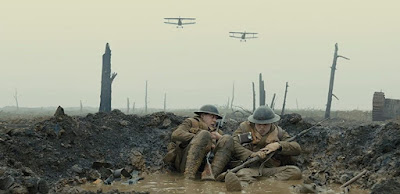
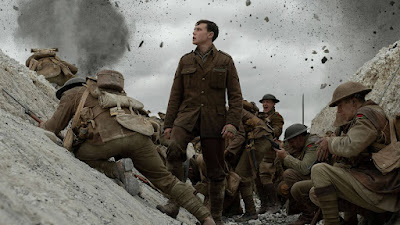
1917 (2019) is a British war drama set in the brutal trenches during the First World War.  Directed and co-written by Sam Mendes, the film has achieved wide popularity and was nominated for 10 Oscars (U.S. Academy Awards), winning three of them, including the one for Best Cinematography.  Indeed the cinematography is the most striking thing about this work, because the entire film has the appearance of consisting of just two camera shots.  It’s my understanding that films comprising only a single take have been made before, but 1917 must surely be the most successful execution of that concept/scheme.  

The story of 1917 concerns two British lance corporals, Will Schofield (played by George MacKay) and Tom Blake (Dean-Charles Chapman), who are charged with a critical and dangerous overnight mission.  With communication lines down, the task for them is to cross over “no man’s land” in front of their trenches in order to deliver a crucial message to another British battalion that would enable the recipient of that message to avert a German slaughter of British troops and save 1,600 lives.  The message, from General Erinmore (Colin Firth), is specifically directed to an officer of the other British battalion, Colonel Mackenzie (Benedict Cumberbatch), to call off an intended attack, because aerial reconnaissance has discovered that the German army has setup a trap and will annihilate the attacking forces.  

Blake is eager to carry out the dangerous assignment, because he wants to be a hero and because his brother is a member of the endangered battalion.  Schofield, however, is not enthusiastic at all.  He is a survivor of the devastating Battle of the Somme (300,000 deaths and over one million casualties) the year before, and he is familiar with the futility of war, but he agrees to go with Blake out of loyalty to his friend.  

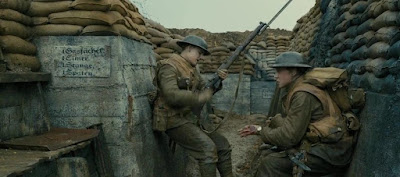
The film begins on the evening of April 6th, 1917, and the film’s first shot, which lasts about an hour, starts by showing the lance corporals Blake and Schofield tranquilly snoozing under a tree in what appears to be a peaceful, pastoral setting.  We are soon to see that their environment is anything but peaceful.  They are awakened and informed about their dangerous assignment, and as the camera continues to track them, they are shown walking overt to and in the front-line war trenches looking for the place to cross over into no man’s land, which due, to a recent German retreat, is believed to be temporarily safe to move through.  

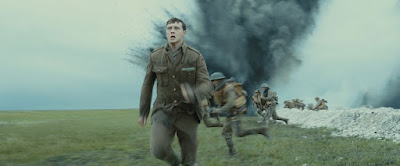
As the shot progresses, one becomes increasingly aware that this is one continuous take, but the camera movement is so carefully orchestrated and psychologically motivated that the continuity of the shot does not intrude on the viewer’s involvement in what happens (at least not for me).  (Actually, there are moments in the film where near-invisible camera cuts have likely been made, but the first hour of the film certainly looks like a single take.)  Some reviewers have found this single-take cinematography (by Oscar-winner Roger Deakins) to be gimmicky and artificial, and they have therefore panned the film (e.g. [1,2]).  But I, along with most reviewers (e.g.. [3,4]), found the visual flow of the film to be natural and compelling.  The camera moves, because it takes the watcher to a view that he or she is motivated to see.   
 
But this cinematography is more than just “natural”.  It establishes and maintains a moving aura of labyrinthine entanglement that visually evokes a dominating mood for the film.  The camera work makes one viscerally feel that Blake and Schofield find themselves in a relentless and continually evolving hell, which keeps presenting them with threatening surprises from which they must escape in order to carry out their crucial life-preserving mission.  So I would say this adroit cinematography constitutes the very soul of the film.

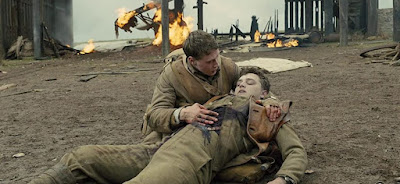
Further into this “first” shot we see Blake and Schofield in various bizarre and life-threatening situations out in no man’s land.  While the two of them are temporarily taking shelter in an abandoned farmhouse, they watch an aerial dogfight between a German plane and some Allied aircraft.  The German plane is shot down, and in flames it crashes into the farmhouse.  Blake and Schofield just barely get out of the way of the plane crash, and then they quickly manage to rescue the burned German pilot from his crashed plane.  But while Schofield is not looking, the pilot fatally stabs Blake.  Although Schofield shoots and kills the pilot, he is unable to save the life of his best friend, Blake.  This is a shock to the viewer, because less than half-way through the film, one of the two protagonists is now gone.  So Schofield now has to carry on alone.

After Schofield has more tense encounters, the film’s first shot finally comes to an end when he engages a German sniper in a gunfight that results in the death of the sniper and causes Schofield to lose consciousness.  
The “second” shot of the film begins later in the night, near dawn, when Schofield regains consciousness, and it continues with the same action-packed tenor as the first shot.  Schofield continues to have deadly encounters with the German combatants that he encounters.  At one point while fleeing his  pursuers, he jumps into a river and winds up getting swept over a high waterfall.  Eventually he manages to find and make his way to the British battalion under the command of Colonel Mackenzie that he has been seeking.  But precious time is running out, and Schofield still has to find Colonel Mackenzie’s trench and get him to call of his imminent attack.

Throughout this sinuous tale of Schofield’s struggles, we get a real, on-the-ground, feeling for what WWI trench warfare must have been like.  Although the story of 1917 is classed as fiction, it is based on tales that Sam Mendes heard when he was young from his grandfather about the latter’s experiences in WWI.  So Mendes apparently based this work on testimony that was as psychologically personal and authentic as he could find.  And the key feeling that prevails the work is one of entrapment.  It is  like an ongoing nightmare from which there seems to be no escape.  

There have been various esteemed cinematic efforts over the years, such as Lewis Milestone’s All Quiet on the Western Front (1930), that seek to convey a basic truth about war – namely that “war is hell”.  And these anti-war films almost invariably evoke a sense of alienation, usually by directly showing characters who are alienated.  We see clearly direct evidence that those characters are alienated.  But 1917, thanks to  its brilliant camera work, goes further and provides an even greater sense of immediacy.  We, the viewers, have the same visual experiences that the portrayed characters have and feel our own personal sense of alienation.  We never really know much about Schofield as a person in this tale.  He is just an everyman who serves as a screen surrogate for the viewer so that he or she can have his or her own horrific experiences of life and combat in the trenches.

For these reasons I recommend that you see 1917 so that you can, like Schofield, also experience the existentially challenging feelings conjured up by its amazing camera work.
★★★½

Notes:
  1. Peter Sobczynski, “1917", RogerEbert.com, (25 December 2019).   
  2. Manohla Dargis,“‘1917’ Review: Paths of Technical Glory”, The New York Times, (24 December 2019).   
  3. Philip Concannon, “1917 orchestrates World War I as a one-shot action ride”, Sight and Sound, (13 January 2021).   
  4. Richard Whittaker, “1917", The Austin Chronicle, (10 January 2020).    

“Nomadland” - Chloé Zhao (2020)

Nomadland (2020) is an award-winning drama whose approach to the realism of its subject matter is both original and also something that underlies the film’s themes.  This film is a story about “vandwellers” in America – people who live in campervans, RVs, mobile homes, or modified buses and have no fixed abode.  Although the film is a work of dramatic fiction, it is closely based on a nonfiction book that documents the lives of these wandering vandwellers, Nomadland: Surviving America in the Twenty-First Century (2017) by Jessica Bruder (in fact Jessica Bruder is credited as a “consulting producer” for the film).  Moreover, almost all of the people who appear in this film are real-life nomadic vandwellers with no prior acting experience.  They are just playing themselves.  

However, Nomadland is not an example of fly-on-the-wall cinema verite.  It is a carefully crafted drama, with masterful cinematography by Joshua James Richards and haunting sound-track music by Ludovico Einaudi.  Neither is it quite appropriate to categorize this film as another example of Italian neo-realism, because there are certain distinguishing aspects of this film that make it rather unique.  

For one thing the film was written, directed, edited and co-produced by Chinese-born American Chloé Zhao, and although Ms. Zhao received a film education at NYU film school, she brings her own original, externally-based eye to the aspects of American life that she writes and films about.  In the context of this film, she seems fascinated by a phenomenon of growing general alienation that is starting to emerge among many ordinary people in America.  And as this film shows, many people have no choice but to accept it.  

So alienation is clearly one important aspect of Nomadland, but there are also other thematic elements present, as well, and these all collectively contribute to reasons for why Zhao’s film has been so remarkably well-received.  On the awards front, Nomadland had almost a clean sweep.  The film won Oscars for Best Picture, Best Director, and Best Actress (and nominations in three other categories) at the 93rd U.S. Academy Awards.  It won the Golden Lion (best film) at the 2020 Venice Film Festival.  It was chosen as Best Film at the 74th British Academy Film Awards (BAFTAs).  And at the 78th Golden Globe Awards, it won an award for Best Motion Picture – Drama and an award for Best Director.  And among top film critics, Nomadland has been widely praised [1,2,3,4,5,6,7].

The meandering story of Nomadland is concerned with a sixtyish woman, Fern (played by award-winning actress Frances McDormand), who has just embarked on a new life as a nomadic vandweller.  She and her husband had worked for years at a gypsum plant in small company-town Empire, Nevada.  But now the gypsum company has shut down, and her husband has just died, leaving the childless Fern alone and with no means of support.  So she purchases a van and converts it into something she can live in while she travels about looking for work.  When asked if she is homeless, she responds with no, she is “houseless”.  

The entire film then focalizes exclusively on Fern as she travels about the western United States in search of odd jobs that she can use for support.  However, Fern is so laid-back and laconic that much of what we learn in the film about vandwellers comes not from Fern, but from the fellow vandwellers that she meets and interacts with.  And as I mentioned, virtually everyone Fern meets is a real-life vandwelling nomad.  Nevertheless, Frances McDormand’s pensive performance as Fern is crucial to the success of the film.  As the film proceeds, we want to know more about what Fern is thinking and feeling.

After Fern heads out on the road from the shutting down town of Empire, she secures a seasonal job at a massive Amazon fulfilment center (warehouse for third-party shipping).  Although the workers don’t appear to be mistreated, the sheer size of the operation makes everyone on the floor like a tiny cog in a gigantic machine.  This is a telling visual metaphor for the impending gig economy and streamlined supply chain that so many ordinary people are now facing.

One of Fern’s coworkers at the warehouse, Linda, convinces her to come to a meet-up for vandwellers in the Arizona desert.  The event is hosted by Bob Wells, a charismatic real-life nomad who seeks to organize cooperative support for his fellow vandwellers.  Although some  vandwellers are middle-class retirees who have embraced this way of life in order to fulfill their love for freedom and the open road, most of these people are like Fern – forced by poverty to live in a van.  At Wells’s meet-ups these people can share tricks and info about how to get by on the road.

Later Fern meets and becomes friends with a congenial elderly woman nomad, Swankie, from whom she learns more about survival under impecunious circumstances on the road.  Swankie also tells her that she, herself, has terminal cancer, but she wants to close out her life on the open road rather than in a hospital.

After the extended encounter with Swankie, Fern is shown working in the Black Hills, South Dakota, where she runs into Dave (David Strathairn, the only other actor in the film with significant professional acting experience), a mild-mannered elderly nomad she had seen earlier in Arizona.  They go on to meet on several further occasions, and Dave politely indicates to Fern that he is interested in having her stay with him in a long-term relationship.  But ultimately Fern resists the temptation and decides to stick to her life of independence on the open road.

There is also an occasion when Fern’s van has a serious breakdown, and she has to go ask her married sister in California for a loan in order to pay for the repairs.  When Fern goes to her sister’s upper-middle class home, we can see the contrast in the two sisters’ lifestyles; and we hope the encounter will shed some light on the taciturn Fern’s background.  But it becomes clear that the sister has always been as much in the dark about Fern’s thoughts and feelings as we viewers are now.  Anyway, the sister does loan the money to Fern, and the van gets fixed.

Fern has further encounters with Bob Wells and other van-dwelling nomads, before eventually returning for one last nostalgic visit to Empire, Nevada, which is by this time almost a ghost town.  Then at the end of the film, she heads back out on the road.

So overall, Nomadland is a bleak, moody film that effectively conveys inescapable feelings of loneliness and a sense of loss.  But there are three connected thematic elements in the film that linger in my mind and warrant further comment:
  • Is the Gig-Economy the Future of Labour?
  • What Role Does Narrative Play in Nomadland?
  • To What Degree is a Self Defined by Narrative?
These are not items really explicitly addressed in Nomadland, but they were tangentially evoked when I watched the film.

1.  Is the Gig-Economy the Future of Labour?

Watching Nomadland made me wonder whether the traditional nature of U.S. socioeconomic society is collapsing (and since the U.S. is at the forefront of social evolution, this applies eventually to everywhere else, too).  With management increasingly centralized and specific jobs increasingly objectified and compartmentalized, the labour environment is more and more moving towards a gig-economy.  For digital workers, this can mean more and more digital nomads – people who can perform their jobs from remote locations and can therefore live anywhere.  But for hands-on gig workers, such as those depicted in Nomadland, it means that anyone looking for work must travel to the site of the job location and secure the gig-job.  In other words, they have to be nomads.

The positive side to all this is that there are likely to be available jobs for itinerants.  But of course the downside is that the jobs are reduced to lowest-common-denominator specifications and are often low-skilled and low-paid.

Chloé Zhao doesn’t take up this general social issue and its ramifications at all in Nomadland.  But what she does show is the lifestyles of the nomads and their various ways of dealing with the inherent loneliness in “nomadland”.

2.  What Role Does Narrative Play in Nomadland?
Almost all films (as well as dramas, stories, and novels) have a narrative that provides a structure for the events depicted.  The metastructure of these narratives is often characterized metaphorically as a journey.  There are one or more protagonists on such a “journey” who are struggling to reach a desired “destination”, and there are usually other agents along the way who assist or stand in the way of progress.  Much has been written about the narrative-as-journey metaphor [8,9,10,11,12], notably the more formalized characterization of it known as the “hero’s journey” [13] that was popularized by Joseph Campbell [14].

In the present context concerning Nomadland, we don’t have to delve into the various narrative characterizations, because in this case, I don’t see that the film even has a narrative.  Although one might at first think Fern is on some sort of journey, neither the destination nor the overall scheme of that journey is ever specified.  We never know what the wandering Fern wants or is thinking.  All we get is a random sequence of scenes depicting haphazard encounters that have no clear outcome – at least no outcome with respect to a given quest.  We never really learn much about what goes on inside Fern’s head or indeed who she is.  But then maybe that is the point.  Fern’s lack of a narrative is what this film is about.

3.  To What Degree is a Self Defined by Narrative?
It is often claimed that we basically model all the people we meet in terms of the narratives we construct about them, and this is how we come to know and understand them [9,10,11].  We even think of ourselves in terms of the narratives constructed by ourselves and others about ourselves.  So is it really true; is that all there is to the self – the narrative that has been constructed to characterize it?  Are you and I just the stories we have constructed about ourselves?  There is dispute on that score.

Some philosophers, usually objectivists, maintain that, yes, that is all there is to the self – the narrative story (or stories) that provides a comprehensible, temporally-oriented scheme of who you are.  They argue further that any idea that there is some inner being constituting the true self is a self-deceptive hallucination.  The only existing selves, they insist, are the fabricated narratives that have long been constructed (since caveman days) to facilitate human interactions extended over time.

But there are other thinkers, both esteemed Western philosophers [15] and respected Eastern sages [16,17], who hold that there are really two essential aspects of the self:
  • an outer, worldly, narrative-based self 
  • an inner self that is founded on core-consciousness
According to this second, more nuanced scheme, it is the inner, core-consciousness-based self that is the true being that identifies who you are.  And this is the self-perspective that I find more natural, and I would guess that Chloé Zhao thinks this way, too.  It usually follows under this scheme that when a person’s inner core-consciousness gets the feeling that its constructed narrative-based self is somehow unfulfilling and leaves it disconnected from meaningful interactions in the world, it then feels alienated.  This sense of alienation can be difficult to articulate, but it lies as a root element of existentialist thinking, and it has been eloquently expressed by such writers as Albert Camus [18] and Jean-Paul Sartre [19], as well as in a number of memorable films [20].  And it is Fern’s alienation that is the artistic key to Nomadland.

As I mentioned, the film Nomadland doesn’t really seem to have its own narrative, and that comes down to the fact that the film’s main character, Fern, doesn’t appear to have a narrative-based self at all.  It’s not just an unsatisfactory narrative-based self, as it often is with some people; here in Fern’s case, it is a virtual narrative void.  She doesn’t appear to have had much meaningful interaction with her family when she was growing up.  And now that her husband has died and she has lost her longtime job and home, there is nothing left of her adult life on which to base her narrative self.  Her life is empty.  And that is what makes the film problematic.  Can a film succeed without being driven by a narrative journey?  In the case of Nomadland, I would say it more or less does succeed.   

Even though I am aligned with the philosophical position that the narrative self is not the most intrinsic aspect of the self, having only a severely diminished narrative-based self, like Fern, would be an existential problem.  And it is Fern’s existential problem that is on display in Nomadland.  We viewers want to know more about what Fern is thinking and feeling in response to her barren circumstances, but her contemplative reticence gives us little to chew on and leaves us wanting more.  Frances McDormand’s subtle, laid-back performance as Fern is crucial here.  We follow her gaze and guess about her feelings all the way, but our fascination persists.  And that is what lies at the heart of Nomadland.
★★★½

Notes:
  1. A.O. Scott, “‘Nomadland’ Review: The Unsettled Americans”, The New York Times, (18 February 2021, 26 April 2021).   
  2. Brian Tallerico, “Nomadland”, RogerEbert.com, (19 February 2021).   
  3. Beatrice Loayza, “Nomadland finds beauty on the rugged, ruthless open road”, Sight and Sound, British Film Institute, (28 April 2021).   
  4. MaryAnn Johanson, “Nomadland movie review: ain’t that America”, flick filosopher, (6 May 2021).   
  5. Murtaza Ali Khan, "’Nomadland’ Review: An inspiring tale of survival that presents the modern-day American West in a new light”, A Potpourri of Vestiges,, (4 April 2021).   
  6. Marjorie Baumgarten, “Nomadland”, The Austin Chronicle, (19 February 2021).   
  7. Chris Barsanti, “Review: ‘Nomadland’ Is a Sorrowful Lament for Lives on America’s Fringes", Slant Magazine, (12 September 2020).   
  8. Roger Schank and Gary Saul Morrison, Tell Me a Story: Narrative and Intelligence (Rethinking Theory),  (1990), Northwestern.
  9. Jerome Bruner, "The Narrative Construction of Reality", Critical Inquiry, 18:1, 1-21, (1991).
  10. Jerome Bruner, “The Narrative Construction of Reality”, Narrative Intelligence (2003), Michael Mateas and Phoebe Sengers (eds.), John Benjamin Publishing Co.
  11. Paul Ricoeur, Time and Narrative, vols. I- III, (1983-1985), University of Chicago Press. 
  12. Christopher Vogler, The Writer’s Journey, 2nd Edition, Michael Wiese Productions (1998).
  13. “Hero’s Journey”, Wikipedia, (17 September 2021).     
  14. Joseph Campbell, The Hero with a Thousand Faces, 1st edition, Bollingen Foundation (1949), 2nd edition, Princeton University Press (1990), 3rd edition, New World Library (2008).
  15. Dan Zahavi, "Self and Narrative: the Limits of Narrative Understanding", Narrative  and  Understanding  Persons, D. D. Hutto  (ed),  Royal  Institute  of  Philosophy Supplement 60, Cambridge University Press, pp. 179-201, (9 August 2007).  
  16. Paramahansa Yogananda, God Talks With Arjuna: The Bhagavad Gita, Self-Realization Fellowship, (1 September 2001).  
  17. Ching Hai, I Have Come to Take You Home: A Collection of Quotes and Spiritual Teachings from the Supreme Master Ching Hai, Sophie Lapaire and Pamela Millar (eds.), SMCHIA Publishing Co., (1 January 1995).   
  18. Albert Camus, The Stranger (L'Étranger), Gallimard, (1942).  
  19. Jean-Paul Sartre, Nausea (La Nausée), Éditions Gallimard, (1938).
  20. The Film Sufi, “Existentialism in Film 1", The Film Sufi, (15 July 2008).   

“Wheel of Time” - Werner Herzog (2003)

Werner Herzog, one of the greatest filmmakers, is one of my favorites.  Over the course of his prolific career covering the direction of some twenty dramatic feature films and more than thirty documentary features, he has invariably cast his unique vision across a wide range of subject matter, much of it with an existentialist philosophy tinge.  Thus he often travels to remote locations to observe how people deal with the extreme conditions there.  This is what I find particularly fascinating about Herzog: he is a philosopher with a movie camera.  The Herzog film I will be discussing here, Wheel of Time (2003), which he wrote, directed, and narrated, is very explicitly aimed in this philosophical direction, because it is concerned with the passions and rituals of Buddhist monks.  The film featured cinematography by Peter Zeitlinger and film editing by Joe Bini, and as usual with Herzog films, one gets the feeling that a good part of the film’s story was composed in the editing room.  And also as usual with Herzog films, it was well-received by a range of critics [1,2,3,4,5].

The specific subject matter of the film concerns the elaborate Kalachakra Initiation ceremony for Tibetan Buddhists (note that ‘Kalachakra’ is a term in Vajrayana Buddhism that means "wheel of time") that is held every two or three years at a place chosen each time by the Dalai Lama.  This event typically attracts some 500,000 Tibetan initiates and pilgrims from all over Asia who wish to participate in the elaborate rituals over the course of ten days and ten nights.  On this occasion, in January 2002, the chosen place for the Kalachakra ceremonies is very special – Bodh Gaya in Bihar, India.  It was here some 2,500 years ago that Siddhartha Gautama spent seven weeks meditating under the Bodhi Tree (a sacred fig tree there) and reached enlightenment, thereby achieving the status of the Buddha.  Bodh Gaya is also the site of the associated Mahabodhi Temple.

The film begins with some physical shots of the Bodh Gaya area, and then it shows the many pilgrims arriving for the Kalachakra events.  Some of these pilgrims are so devout that they make their jouney to the Kalachakra event entirely on foot, and after every step or so they fully prostrate themselves in obeisance.  Herzog shows some of them reverentially following this practice over all sorts rough terrain, and the whole journey to their holy destination can take many months, even years.  These pilgrims are mostly poor people, but some of them at least bring pup tents in which they can sleep in the temple yards overnight.  The rest of them must just sleep outside in the open.  

The principal activities of the Kalachakra activities fall into three main categories:
  • Buddhist teachings and prayers conducted by lamas and monks,
     
  • The construction and display of the great Kalachakra Mandala, an elaborate symbolic design made out of colored sand that is an important artefact of Tibetan Buddhism [6,7], 
     
  • The closing initiation ceremonies for the aspirant Tibetan Buddhist monks.
Of these activities, a considerable amount of Wheel of Time screen time is devoted to showing the detailed construction of the Kalachakra Mandala.  This is made of loose, colored sand, the tiny individual granules of which must be so carefully placed  that they collectively form an incredibly intricate design.  This takes a number of sand artists manydays to complete. Once completed, the Kalachakra Mandala is seven feet in diameter and displays visual references to 722 deities.  Since the mandala is made only of loose sand, it must be protected from the approach of onlookers and even casual breezes which could disturb it, so it is walled off by a glass partitioning surrounding it.  

But after the mandala’s construction and display to the monks and pilgrims at the end of the usual Kalachakra ceremonies, all the sand of the entire mandala is collected and ritualistically thrown into the river, thereby symbolizing the utter ephemerality of existence.  
 
Just before the halfway point in the film, Herzog takes time out to go off on his own with his own camera and visit another sacred Buddhist site, Mount Kailash in western Tibet.  Thousands of pilgrims come to this 22,000 foot mountain at a specific time every year  (Herzog came in May 2002) to carry out a high-altitude circumnavigation of the peak, which they believe will bring them holy salvation.  The 52 km trek around the peak that the pilgrims take is at an altitude of 18,000 feet, and sadly every year, some pilgrims who are not appropriately acclimatized to these heights die from exhaustion.

At other points in the film we see brief clips of the Dalai Lama speaking in closeup on a few topics.  He is always relaxed and reasonable, and one his more interesting remarks was his comment that all religions carry the same message.  It would be good if more people felt that way.  The Dalai Lama is, of course, the star personage of the Kalachakra Initiation ceremonies, but unfortunately his health at this time was not good, and he was unable to carry out his required, full participation in the ceremonies.  This was naturally very disappointing to the hundreds of thousands of pilgrims who had come to Bodh Gaya, as well as to the Dalai Lama, himself.  But he promised to all the practitioners that he would come back there to see them all the following year.

The scene now shifts to another ten-day Kalachakra Initiation ceremony that was held later that year – in October 2002 in Graz, Austria.  This time the attendees are mostly European Buddhists, and the number of participants are in the thousands, rather than the hundreds of thousands.  And  now the Dalai Lama is healthy and fully participating.  Also present is famed Buddhist monk and communicator Matthieu Ricard, who often serves as the Dalai Lama’s translator.

One of the highlights of this section of the film is the showing and description of a Tibetan Buddhist monk and pilgrim, Takna Jingme Sangpo, who, partly thanks to international protests, had recently been released from prison in Tibet after being held there under cruel conditions by the Chinese overlords for 37 years.  Sangpo’s only crimes were apparently his public expression on a few occasions that he supported a “Free Tibet”.  Despite his extreme hardships, Sangpo, is now overjoyed that he now, finally has the opportunity to see the Dalai Lama in the flesh for the first time.

At this Kalachakra Initiation event in Graz, another elaborate Kalachakra Mandala is duly constructed out of colored sand and displayed.  And at the end of these ceremonies, a healthy Dalai Lama performs the ritual act of dispersing the collected mandala sand into the Mur river there.  

Overall, Herzog’s Wheel of Time does provide a lot of information about the Kalachakra ceremonies.  But what lingers most in my mind after watching it is something else that he has captured on film.  And that is the extraordinary religious fervor that you can see silently expressed on all the faces of the vast crowds of pilgrims shown.  These dedicated practitioners are not boisterous; they are not broadcasting. Instead, they are wholly devoted to their spiritual path of seeking total purity and enlightenment.  Herzog does not articulate or discuss this issue.  He directly shows it on a thousand faces.
★★★½

Notes:
  1. Walter Addiego, 'Wheel of Time', Film Clips, SFGATE, (22 July 2005).  
  2. Dennis Schwartz, “Wheel of Time”, Dennis Schwartz Movie Reviews, (n.d.).   
  3. Ed Howard, “11/8: Wheel of Time; The Flowers of St. Francis”, Only The Cinema, (8 November 2007).   
  4. Frederic and Mary Ann Brussat, “Wheel of Time”, Spirituality & Practice, (2005).   
  5. Stephen Holden, “With Herzog, Inside a World of Devotion”, The New York Times, (15 June 2005).      
  6. “Mandala”, Wikipedia, (15 June 2021).   
  7. “Sand mandala”, Wikipedia, (29 April 2021).