Showing posts with label Nolan. Show all posts

“Interstellar” - Christopher Nolan (2014)


Christopher Nolan’s Interstellar (2014) is another mind-bending science fiction thriller – this time about astronauts searching for a new planet for human habitation in the not-too-distant future. The film was co-scripted with his brother Jonathon Nolan, who also had co-writing credits for Nolan’s earlier Memento (2000), The Prestige (2006), The Dark Knight (2008), and The Dark Knight Rises (2012). 

Here again, as with his Inception (2010), Nolan presents conventional action-adventure muscularity in a highly imaginative science-fiction-warped context.  And again Nolan apparently has a box-office bonanza on his hands.  From my perspective, though, there are problems with this film that make it unlikely to suit discerning tastes.

The story is somewhat complicated, but there are a couple of relatively straightforward elements that I will go over.

In the future, life on earth will apparently be run by peacenik socialists (probably the right-winger’s version of the apocalypse) who have eliminated war but have been unable to stop population growth and the depletion of natural resources.  To feed the human population, almost everyone is coerced into farming; but climate catastrophes and agrarian pestilence are now (at the start of the film) leading to looming disaster.

In this context we meet Cooper (played by Matthew McConaughey), an obstreperous Texan and former NASA test pilot who was forced into farming like everybody else. A widowed father, he lives on his mechanized farm with his father-in-law (John Lithgow) and his two children, one of whom, his 10-year-old daughter Murphy, thinks that she has received symbolic signals from a ghost. Though scoffing at the notion of ghosts, Cooper decodes these “messages” into geographic coordinates and seeks out their location, which is found to be a secret NASA research base led by the elderly Professor Brand (Michael Caine).


Cooper’s discovery of Brand’s secret laboratory and launching site turns out to be opportunistic, because Brand immediately recruits him to pilot NASA’s spaceship on a mission crucial to mankind’s survival.  The only way to save humanity, it seems, is to find another planet that is habitable and then transport everyone to go live there.  But the problem is: there are no known habitable planets within many light years of the Earth, and time for humanity is running out.  However, Brand and his researchers have discovered a “wormhole” near the planet Saturn that they believe has been conveniently placed there by benevolent aliens and which could provide a relativistic shortcut to other habitable planets. Three earlier missions had been sent out to that wormhole and may have found something on the other side, but there has been no communication with them since. Cooper’s mission is to find out if those earlier missions have found a good planet.  If a habitable planet can be found, then Brand has two alternative plans to save mankind:
  • Plan A.  Solve the problem of transporting all of humanity to that planet in a short space of time (remember, time is running out on Earth).  This apparently involves writing a lot of equations on the blackboard and looking for the “solution”.
  • Plan B. If Plan A doesn’t work, then send a few hundred frozen human embryos (presumably with a midwife or two for care giving) to the newly discovered planet.
Plan A is preferable, of course, since Plan B means that the existing human population on Earth would perish.
So Cooper sets out on the spacecraft Endurance with a crew that includes a geographer, a physicist, two English-speaking robots, and a pretty biologist and daughter of Professor Brand named Amelia (Anne Hathaway).  Everyone has a Ph.D and is a brilliant scientist, of course, except for the cowboy Cooper.  They reach the wormhole and learn how to trace the three previous missions, separately led by scientists Miller, Edmunds, and Mann.  First they head for Miller’s planet, but it orbits a powerful black hole whose gravitational field is so strong that it causes intense time dilatation – one hour on that planet corresponds to seven years back on Earth.  Cooper, Amelia, and the geographer leave the Endurance on a shuttle to visit Miller’s planet, but it turns out to be disastrous – the planet is uninhabitable, Miller is dead, the biologist is killed, and their few hours visit there means that 23 years have elapsed back on the Endurance and on Earth. 

This time shift turns out to be the key plot-element of the story: when Cooper and Amelia return to the Endurance, they are unchanged, but everyone else is 23 years older, including the now 50-ish physicist on the Endurance and the people on Earth. Cooper’s daughter Murphy (Jessica Chastain) back on Earth is now in her mid-30s and has become a theoretical physicist (of course) working in Professor Brand’s laboratory to further Plan A.  Just before Brand’s dies of old age, he confesses to her that he had long thought Plan A to be theoretically unachievable.  Murphy plows ahead anyway with her theoretical calculations, though, hoping to find a solution for Plan A.  So there are now two parallel threads of action: (a) Murphy on Earth working more or less hopelessly on Plan A and (b) Cooper and the Endurance out beyond the wormhole.


After some arguments between Cooper and Amelia, the Endurance is eventually directed to Mann’s planet, where Dr. Mann (Mat Damon) is still alive.  But this planet, too, proves to be uninhabitable, and the encounter with Mann ends in violence.  Eventually with the Endurance running low on fuel, it is sent back to Earth with Amelia, while Cooper and one of the intelligent robots separately navigate a small space shuttle into a black hole. Falling into the black hole, Cooper finds himself tumbling into an extra-dimensional space-time warp that enables him to connect with other points in space and time. Managing to connect with his 10-year-old daughter, Cooper, in an effort to save humanity, turns out to be the ghost who had earlier in the film sent Murphy messages.  He also sends the 33-year-old Murphy messages that eventually help her solve the problem of Plan A and rescue humanity.  So everyone gets saved thanks to Cooper and Murphy.
Over the course of Interstellar, the action moves along at a fast pace, but our ultimate satisfaction will depend on how the narrative evolves in a coherent fashion.  In most films there are two main narrative threads: an action thread involving some goal in the external world for the protagonist(s) and a narrative thread involving the evolution of one or more relationships.  In a science-fiction film the action thread is compounded by a scientific aspect that challenges the minds of the protagonists and the viewers. The filmmaker must present something that is scientifically imaginative but that is also scientifically plausible.  That’s what we have in Interstellar, too, but there are problems with this film along all of these lines.

In connection with the action thread, there are several issues.
  • The main idea of the action narrative is this Plan-A/Plan-B thing.  We get that basic outline OK, but the fundamental issue of Plan A is just passed off as some theoretical problem that must be solved by mathematical equations. The viewer is shown some equations on a blackboard, but there is no attempt at presenting a narrative trajectory about this. It’s just shown as a very hard, wonky problem that requires mathematical genius. Since Plan A is such a key aspect of the story, it leaves a big narrative hole in the film.
  • Gravity, particularly in connection with Coriolis “forces”, is always a problem in SciFi films set in outer space and I won’t be too strict on that score [1], but it still seems to be treated very casually in a film where gravity is an important issue. Nevertheless and despite the participation of physicist Kip Thorne in the production, there are some things that strike me as unrealistic.  When the astronauts on the other side of the wormhole are near a black hole and descend to Miller’s planet, they encounter such an intense gravitational field that it causes severe time dilatation, as described above. It seems to me that such an intense gravitational field would crush biological organisms and prevent normal biological processes.  But this is not addressed.
  • It also seems highly unrealistic that Professor Brand would immediately assign Cooper to pilot his spacecraft without any preparation.  It would seem to me that the complications associated with such a mission would require months of planning and training.  And if Brand knew that Cooper was a good choice, why didn’t he recruit him in the first place – Cooper showed up at Brand’s space laboratory on his own accord and somewhat by serendipity.
  • There are various narrative dead-ends in the story – narrative threads that are initiated and then dropped and forgotten.  For example at the beginning of the film, Cooper is interested in tracking drones launched by the Indian government that are flying over his farmland. He tries to commandeer these drones, but surely there should be something more significant to these events than merely making a toy for his 10-year-old daughter.
There are also problems with the relational narrative threads in the story.

  • The relationship between Cooper and his daughter, Murphy, which is presumably important, is never developed. Sure, Murphy always calls her, “Murph”, but that isn’t enough to establish an interesting relationship. And later in the story Murphy condemns and rejects her father for what she believes to be his commitment to Plan B. That’s not a very filial attitude to have toward’s one's parent if we are supposed to be looking at a meaningful relationship.
  • We are set up for a relationship to evolve between Cooper and Amelia Brand, but nothing much develops along these lines, either.  There is no chemistry, nothing interesting along the lines of personal interaction between these two characters.  At the end of the film, we are led to believe that Cooper will seek out Amelia, but we haven’t been given any reason or motivation to believe that this is interesting.
  • There is a presumed existing amorous relationship between Amelia and Edmunds, the astronaut who had gone on an earlier planet-exploration mission through the wormhole but had never returned.  But we never see Edmunds, and we are never given any information about what that relationship means to Amelia. This is another narrative hole in the story.
There is a potentially interesting relationship-narrative theme that could have been explored but was not.  It concerns one’s personal stance towards commitment to others.  It is curious that Professor Brand and others are wrathfully despised by some other people, such as Murphy and Amelia, for trying to work on Plan B.  If Plan A is really not feasible, is it so reprehensible to still strive to save humanity in some form?  In fact the film portrays four general ethical and empathic stances that one might take in life:

  • Selfish.  One is only concerned with his or her personal welfare. This could be attributed to Dr. Mann.  (Incidentally, I am not really a fan of Mat Damon, but I find that whenever he shows up in a movie, the story becomes more interesting – and this is the case in this film, too.)
  • Immediate close associates.  One strives primarily to help one’s family and loved ones.  This stance is taken by Amelia and Cooper.
  • Everyone.  One works on behalf of everyone living.  Murphy and Cooper seem to be concerned at this level.
  • Universal.  One works for the abstract, future benefit of people yet to be born. Professor Brand and Dr. Mann are concerned here.

These various empathic stances move from the personal to the abstract, and it is interesting that the women in this story occupy the middle layers, while the men are more associated with the more selfish and abstract.  A potentially interesting elaboration would have been the consideration of how the intelligent robots fit into this scheme (compare with Kubrick’s 2001: A Space Odyssey (1968)).  Anyway, this aspect of personal empathy is not really developed in Interstellar, while it was examined successfully in Terence Malick’s The Tree of Life (2011).  In Malick’s film there are also a number of narrative threads, but he manages to endow each of those elements with a dramatic vitality that is missing in Nolan’s film.

It seems that Nolan has established a pattern for his films since Memento and Insomnia (2002) that constitutes his formula for success – start with a budget of around $200 million, make a near 3-hour epic with a convoluted plot structure, and artificially elevate the tension with a blaring and jarring musical score by Hans Zimmer. This may work at the box office with a public satisfied with the short-term distractions of video games, but it doesn’t live up to the real potential of science fiction, which is to explore the mysterious unknown of human existence.  It has been my observation in the past that British authors and filmmakers have understood this element better than those from America.  Great science fiction evokes from us a sense of wonder, if not horror, about the horizons of our world.  But Britisher Nolan is the exception here and to my mind is more like an American.  His films are essentially mechanical exercises strewn with gameplay and present a mechanical/reductionist view of reality, but they miss out on that crucial element of mystery.
★★

Notes:
  1. Dave Van Domelen, “Frame Effects on Space Stations”, Kansas State University Physics Education Research Group, 13 January 2008.

“Memento” - Christopher Nolan (2000)

Memento (2000) was the film that vaulted Christopher Nolan to international attention, and despite subsequent successes, such as the Batman series (2005, 2008, & 2012) and Inception (2010), it remains his most significant work.  In fact from the outset Memento attracted a cult following because of its bizarre narrative structure.  Some people saw the nonlinear plot structure as a mere gimmick, while others felt it raised profound questions concerning personal identity, paranoia, and the nature of memory.

Nolan fashioned the screenplay from a short story, “Memento Mori”, written by his brother Jonathon, and it tells the story of a man’s personal quest to find and kill a man who raped and murdered his wife.  This is classic film noir material, but in an extreme form.  In a typical film noir:
  • The protagonist wishes to forget his past and has no long-term future.  
  • The “truth” is hard to find – the world is dark and obscure.
  • There are few people that the protagonist can trust.  Those with whom he associates may be dissembling and working against him.
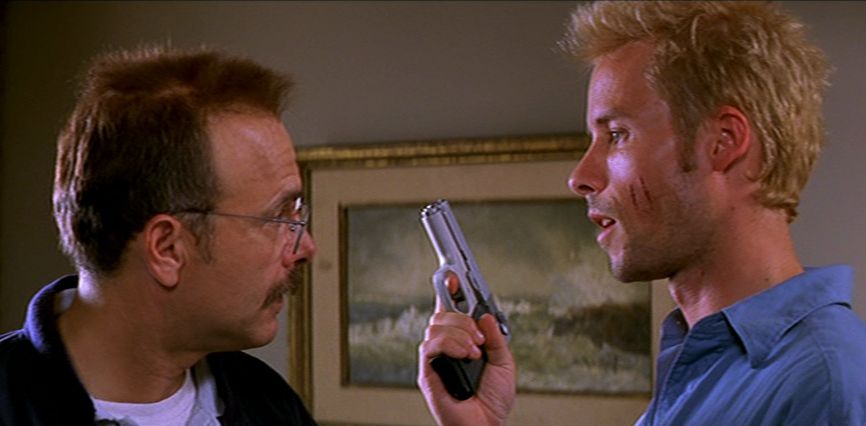
In Memento these problems are taken to the limit.  The protagonist, Leonard Shelby (Guy Pearce), suffers from short-term memory loss (anterograde amnesia), so the immediate past is lost to his mind. Consequently he continually must mentally construct his past and arrive at an up-to-date understanding what is “true” in the world.  This is confounded by the fact that since Shelby can’t remember recent things, people can lie to him and he will forget that they are liars. The film’s narrative structure attempts to put the viewer into Shelby’s mental framework by showing much of the story in reverse order.

Actually, the plot, which takes place over a couple of days, has a well-ordered structure.  There are 22 short scenes shown in color, each of which is separated by a brief scene shown in black-and-white. Although within each color scene events mostly take place in normal chronological order, the separated color scenes, themselves, are ordered in reverse chronological order – so that the last shots of a particular color scene will match the first shots of the preceding color scene that appeared to the viewer. The intervening black-and-white (b/w) scenes, however, are collectively ordered in normal chronological order. 

As with any film, the viewer must construct a fabula (the world model of what has happened) out of the syuzhet (the scenes as presented).  Usually, this involves simple "filling-in-the-blanks" sequences that the viewer assumes must have taken place off screen. But in the case ofMemento, the viewer has a far more arduous task of constructing the fabula.  After awhile, though, it becomes clear to the viewer that all the b/w scenes take place before the events shown in any of the color scenes. Following what now seems to be a convention, we can then label the color scenes as they would be ordered in a chronological sequence with alphabetic characters (A - V) and the b/w scenes similarly with numbers (1 - 22) [1,2]. Since scene 22 is merged with scene A, it is labeled “22/A”.  So the correct fabula ordering should be: (1, 2, . . 21, 22/A, B, C, . . V). However, since the color scenes are presented in the syuzhet in reversed order, then the ordering sequences of the scenes actually presented on film to the viewer is: (1,V,2,U,3,T, . . . 21,B,22/A).  Things are made even more complicated by the fact that within some of the  color and black-and-white scenes there are additional flashbacks (usually associated with periods before the rape incident when Leonard’s memory was intact). 

The film’s scene ordering puts the viewer in a position somewhat like that of the protagonist, Leonard Shelby.  With each color episode, neither the viewer nor Leonard has a recollection of what came before and must construct a fabula model based on what is presented here and now.  Leonard tries to deal with his problem of soon forgetting what happens by writing notes to himself and taking Polaroid snapshots of things around him.  Since he has learned to be distrustful of the ephemerality of any written artifacts (they could be lost or altered), he has the most important facts he wants to remember tattooed to his body. 

However, the viewer is involved in an additional task: with each color episode presented, the fabula model of the previously seen (and hence later in the story) scene may have to be reorganized in the viewer’s mind. Thus after seeing color scene F, the viewer must reinterpret what happened in scene G, which was presented earlier, but which comes later chronologically.  This memory reorganization option is something that the viewer has but not Leonard, because Leonard has no memory of these things to reorganize (although he can edit some of his notes).  It is all made more complicated by the fact that there are (at least) two unreliable characters feeding Leonard misinformation. A barmaid, Natalie (Carrie-Anne Moss) and a cop, Teddy (Joe Pantoliano), both lie to Leonard, knowing that he will soon forget their lies and that they can tell him completely different things later. So they use their lies to get Leonard to commit murders for their own nefarious purposes by making Leonard believe each time that their designated murder targets are really his wife’s killer.

All of this fabula construction may seem like just a teasing gameplay for the viewer, but it points to a philosophical theme that lies at the heart of the film.  Philosophers, notably John Locke, have argued that our very identity is based on our memories.  If all the memories in your mind were to be completely replaced by a different set of memories, then your essence as a person would be changed – you would fundamentally be a different person.  But other philosophers have argued differently, saying that all that really counts is psychological continuity.  If all your memories were to be gradually replaced, little by little, then you might not have any memories that you had ten years ago, but given the continuity of psychological existence, you would still be the same person [3].  Both of these theories are essentially Objectivist: there is an objective world out there that can be understood scientifically, and a person’s identity can be based on some objective measure associated with his or her memories (whether based on the static record or on connective continuity). 

Leonard Shelby in Memento is an Objectivist, too.  He believes that he can overcome his short-term memory problems by scientifically recording what is happening in the real world and updating his real-world model. As he says at one point, “I have to believe that when I close my eyes, the world’s still there.”  But there is another way of looking at the world, that I call “Interactionist”, which is based on a interactive narrative construction of reality. From this perspective, narrative construction is not just a useful tool, like a notebook; in fact it is an essential operation to our self-understanding. Cognitive scientists like Roger Schank [4]  and Jerome Bruner [5] have argued that narrative is a fundamental mode of the mind.  They base their ideas on the notion that the narrative form is inevitably the way we structure what has happened to others and to ourselves.  Of course, this introduces problems of authenticity.  The listeners of our story will interpret it and perhaps restructure it in their own minds so that it fits better with their own thinking and experiences.  Thus our story is likely to be passed on to others in an altered form.  This has given rise to a certain misconception that because narrative inevitably entails fabrication, we should be objective and just “stick to the facts”. Leonard is reminded by people around him of this problem of subjectivity:

“So you lie to yourself to be happy.  We all do it.” 
“You don’t want the truth.  You make up your own truth.”

But he doesn’t fall to this pessimism.  He feels he can find the objective truth.

Nevertheless, narrative construction is inescapable, and our understanding of what has happened around us, and even who we are, is inevitably structured into a narrative form [6].  These narratives, of course, are interlinked and embedded within higher-order narratives.  As we go about our daily lives, we are continually constructing new narratives and restructuring and rearranging existing, stored narratives in our minds to maintain a narrative representation of reality. 

This brings us to another problematic aspect of Memento’s narrative – its backstory.  These are the events that took place before the rape/murder of his wife, a period which Leonard is supposedly still ("now") able to remember perfectly well.  Throughout much of the black-and-white sequences of the film, Leonard is on the telephone talking to someone (Teddy, we later presume) about things that happened before the rape/murder.  He was an insurance investigator and had to evaluate the claim of a man, Sammy Jankis, who suffered from anterograde amnesia after a traumatic accident.  Leonard reports that at that time, he denied Jankis’s claim, because he believed that the problem Jankis was suffering from was psychological, not physical.  For the Objectivist Leonard, only physical problems are objectively real – psychological problems belong to a malleable world of conjecture and distortion.  In fact Leonard says that he has heard that people with anterograde amnesia might be able to inject false memories into their minds by means of some sort of repetitive “conditioning” process.  Given Leonard’s denial of the insurance claim, Sammy’s wife, Harriet, who suffered from diabetes, found living with Sammy's condition unbearable and decided to test whether Sammy was really faking it.  So she asked him to inject her with insulin every fifteen minutes.  If he were truly afflicted with anterograde amnesia, then he would keep forgetting his previous injections and give his wife a lethal overdose. This is indeed what happened, and Sammy Jankis unintentionally murdered his wife.

We viewers take this backstory to be true, because Leonard is presumably remembering things that are still intact in his long-term memory.  But by the end of the film, our fabula construction is thrown into disarray.  Although many things have been cleared up, we still have three possible theories about Leonard:

  1. Leonard’s wife was raped and killed, and Leonard suffered a traumatic blow to the head leaving him with anterograde amnesia.  He sets about trying to find his wife’s murderer with the dubious help of Teddy and Natalie.
  2. Leonard’s wife was raped, but not murdered.  Leonard still suffered the blow leading to anterograde amnesia.  He later killed his wife in the way told via the Sammy Jankis story. Leonard is then committed to an insane asylum but escapes prior to the beginning of the film. With repetitive-conditioning assistance from Teddy, Leonard makes up a false memory about Sammy Jankis and transfers the overdose murder account to Jankis and his wife.  He now (at the start of the film) “believes”  that his own wife was murdered in the rape event.
  3. Similar to theory 2, but Leonard is still in the insane asylum, and everything shown in the film is in Leonard’s imagination. In this connection there is a brief image of his wife examining his chest tattoo that reads, “I’VE DONE . . .” and that seems outside the realistic scope of what would be consistent with theories 1 and 2.
So at the end of the film, we realize that there is a third unreliable source of information: Leonard, himself.  Leonard knows that his mental condition will enable him to forget his own lies to himself, so he goes ahead and lies.

So how does all this work for us?  Are we doomed to have only the two following choices in understanding the world:
  • the hopelessly difficult task of constructing a scientific understanding of everything (which has been advocated by the Modernists, but which doesn’t work for Leonard)?
  • the untrustworthy path of relying on presumably prejudicial personal narrative testimony (which has been deemed hopelessly subjective by the Postmodernists)?
No, there is another alternative.  Remember that I said above that our own narratives are interlinked and embedded within higher-order narratives. These are the narratives that we share in our community of acquaintances.  Together, all these conjoined and overlapping narratives need to be made as consistent and comprehensible as possible.  We need to engage in a shared community of understanding, empathy, and practice.

Consider religion. There are many disparate narratives on this subject that people follow, some relatively objective, others based on personal revelations of varying degrees of authority or credibility.  Because the topic covers the most profound aspects of our conscious existence, we have been unable to come up with a single scientific model about the nature and meaning of our world. So we take into account and weigh multiple perspectives. There are inevitable contradictions when all our various schemes are lumped together, but we do not abandon the effort. Instead we are continually sharing, criticizing, and linking together these complicated narratives and trying to integrate them into something meaningful – even if it is not always perfectly consistent.

It is this third alternative, which involves compassion and the empathetic sharing of narratives, that helps make our existence meaningful.  Regrettably, this way or path is outside the  scope of Memento. Though the film is clever and skillfully executed, it is cold and lifeless; and despite its intricate plot structure, it doesn’t engage us at this level of empathetic and involved interaction. Memento bases its own model of identity on individual, static memory (Objectivism), not on narrative (Interactionism). In this connection Leonard is essentially a cipher; other than partially sharing his mental condition, we know nothing about him. Natalie and Teddy are more interesting, but nowhere in this bleak landscape is there a character with whom we can empathize. The film has taken noirish alienation a bit too far.


Notes:

  1. Andy Klein, “”Everything You Wanted to Know About ‘Memento’”, Salon, 29 June 2001, http://www.salon.com/2001/06/28/memento_analysis/.
  2. “Memento (film)”, Wikipedia, (accessed 31 March 2013), http://en.wikipedia.org/wiki/Memento_%28film%29.
  3. Basil Smith, “John Locke, Personal Identity and Memento”, (2006), Southern Humanities Review, vol 40, no. 4, pp. 313-326.
  4. Roger Schank and Gary Saul Morrison, Tell Me a Story: Narrative and Intelligence (Rethinking Theory)  (1990), Northwestern.
  5. Jerome Bruner, “The Narrative Construction of Reality”, in Narrative Intelligence (2003), Michael Mateas and Phoebe Sengers (eds.), John Benjamin Publishing Co.
  6. Paul Ricoeur, Time and Narrative, vols. I- III, (1983-1985), University of Chicago Press.

“The Dark Knight” - Christopher Nolan (2008)

The Dark Knight (2008) has been both a huge critical success and enormously popular at the box office, having earned more than $1 billion worldwide.  Directed and co-scripted by the still relatively youthful Christopher Nolan (Memento, 2000; The Prestige, 2006; and Inception, 2010), it is the second part of Nolan’s Batman trilogy, which began with Batman Begins (2005) and will conclude with the upcoming The Dark Knights Rises.  Normally a film with such a level of popularity, such as many of the films by Alfred Hitchcock, has a more or less universally compelling narrative that grips its breathless audience to see just how the story will unfold.  However, I don’t believe this is the case with The Dark Knight, so the secrets of its success must lie in other domains.

The Batman mythology has been continuously popular in the United States since its 1939 introduction in the comic book medium, and there have been numerous films and television series in the intervening years, notably Tim Burton’s noirish film Batman (1989) and the artistically crafted TV series Batman, the Animated Series (1992).  Part of this lasting popularity arises from the colorful villains that have been Batman’s nemeses – a set of twisted underworld characters with bizarre appearances and habits. This and the generally nocturnal underworld settings conjure up some elements of film noir, a brooding, existentialist genre where the principal characters have troubled, questionable backgrounds and no discernible futures.  Indeed both the 1989 Batman and Batman, the Animated Series were successful precisely because of their exaggerated exploitation of film noir atmospherics.  But The Dark Knight doesn’t have that kind of evocation, and I would not classify this film as a film noir. 

Returning to the subject of the Batman story’s characteristically colorful villains, I would say that one of the most disturbing (and hence fascinating) depictions in this realm was Jack Nicholson’s characterization of “The Joker” in the 1989 Batman – disturbing because although one would expect the The Joker to be absurdly ludicrous, one wouldn’t expect this villain to be so threatening.  Nicholson’s characterization of The Joker, though, evoked something very dark, almost apocalyptic behind that freakish smile.  In Nolan’s The Dark Knight, The Joker is again the malefactor, and I suspect that Nolan was inspired or influenced by that earlier work and intended to summon up similar shudders of horror that Nicholson had evoked.  But I don’t think he succeeded in that particular area of characterization, either.

Anyway, let’s consider the story of The Dark Knight, and what if has to offer.   Even though this is the second installment of a trilogy, the film should stand on its own as a narrative and not require the viewer to know everything about the previous Batman Begins.  There are five principal characters in this story.
  • Batman, who in everyday life is Bruce Wayne (played by Christian Bale).  Although we are basically familiar with this character from popular culture, the character of Bruce Wayne doesn’t have much definition in this film.  And when he is dressed up as Batman, he seems to be someone else altogether.
  • Harvey Dent (Aaron Eckart).  He is the Gotham City district attorney and Batman’s ally, although a romantic rival for the attentions of Rachel Dawes.  Dent is an idealistic type, but again, we have a comic-book level of depth to the characterization.  When a horrific event turns Dent into Two-Face, there seems to be no connection with his previous character. 
  • Rachel Dawes (Maggie Gyllenhaal).  Wayne’s childhood friend and now an assistant district attorney, Dawes represents the feminine pole of romantic attraction.  But in this film she doesn’t have much to do other than to dither for awhile between choosing Dent or Wayne.
  • The Joker (Heath Ledger).  Here is the dark force of chaos, but Nolan errs by giving The Joker too much screen time.  All that we can get out of this character is that he is sadistic and bent on nonstop destruction.  But the more we see of the slavering Heath Ledger, the more mundane and merely contemptible (as opposed to other-worldly demonic) he becomes.
  • Lieutenant Jim Gordon (Gary Oldman).  He is the good cop, and the only human and believable character in the story, thus making him, from my perspective, the real hero of this film instead of Batman. 
Although the story plays out primarily as an extended series of violent encounters between Batman and his enemies, one might partition these encounters into five general headings.
1. The Setup – some establishing sequences outlining the power balance that will dominate the rest of the film.
  • The Joker and his gang of thugs rob a bank.  Along the way, The Joker casually kills off all of his gang so that he doesn’t have to split up the loot.
  • Police lieutenant Jim Gordon and Batman decided to include new District Attorney Harvey Dent into their schemes to thwart the crime Mob of Gotham City, which is dominated by three gangsters: Gambol, Maroni, and The Chechen.
  • At a meeting of the Mob leaders, a Chinese Mob accountant, Lau, informs them that he had securely hidden their ill-gotten funds offshore in Hong Kong.  The Joker breaks into the meeting and offers to bump off Batman, but he is rebuffed. 
  • The Joker then kills Gambol and takes over his gang. 
  • Batman later captures Lau overseas and delivers him back to Gotham City.
Lau will soon be of no consequence, and one wonders why there was much interest in him in the first place.
2. The Joker’s Assault on the City 
The Joker wants the identity of Batman to be revealed and begins assassinating city officials.  First the police commissioner and an anti-crime judge are killed, with DA Dent the next named target. When The Joker tries to kill the mayor, Lt. Gordon saves him and pretends to be killed in the process.  Dent is whisked away in a police van, but with The Joker and his thugs in hot pursuit, there is a lengthy, violent gun battle on the city streets which eventuates in The Joker’s capture.

3. The Joker’s Assault on Batman’s Team
Even with The Joker in jail, he manages to have Dent and Rachel captured and scheduled to be blown up simultaneously in separate locations.   Batman makes an effort at rescuing, them, but Rachel is killed in the explosion at her location, and Dent has half of his face burned off, turning him into the psychopath, Two-Face.  Then The Joker uses more bombs to escape from the police jail.
4. The Joker Wild
With The Joker now loose, he unleashes further mayhem on the city by threatening to bomb a hospital.  The Joker goes on to visit the mutilated Dent/Two-Face in the city hospital and convinces him to go out and become a vengeful killer.  As The Joker departs the hospital he has it blown to pieces. 
Then The Joker has two city ferries rigged with radio-wired explosives such that each ferry can trigger the destruction of the other.  He instructs the passengers that unless one of the ferries chooses to annihilate its pair by midnight, he will have them both blown up.  However, Batman, aided by a massive sonar-fed supercomputer, finds The Joker and captures him in the nick of time.
5. Finale
Dent/Two-Face lures Gordon into a building and threatens to kill him and his family, depending on the outcome of coin tosses.  Batman arrives, and Dent shoots him; but Batman is protected by his high-tech suit and kills Dent.  Batman then decides to protect Dent’s clean public image by taking responsibility for Dent’s vengeful murders.  The film closes with a massive manhunt launched to capture the newly proclaimed public enemy: Batman
So The Dark Knight just consists of an extensive sequence of hyper-violent encounters between Batman and a sadistic maniac, The Joker.  But though there is lots of action,  there is little dramatic progression to this sequence.  Admittedly the violent sequences are staged with top-level special effects and are visually kinetic to the highest degree.  But the dramatic tension and buildup to these scenes is missing; so it’s more like a theme-park roller coaster ride than a drama. 

Looking further at the dramatic elements, there are additional problems.  The character dual between Batman and The Joker is less interesting than one might expect. 
  • Batman, at least when he has donned his Batman suit, appears to be a mindless growling brute.  He relies on high-tech equipment that has been supplied to him by Wayne Enterprises, but he himself seems to have no plan, no strategy.  He relies on brute force, and much of the time he just uses his fists to beat up the various villains that he encounters.
  • The Joker, in contrast, though he claims to have no plan and perhaps no overall strategy, certainly has detailed tactics.  He seems to be mentally one step ahead of Batman at every turn. 
As a moral tale, The Dark Knight is equally benighted.  It is true that Batman refuses to kill, but he is essentially an angry, emotional thug.  His adversary, The Joker, is also uninteresting, because his character is completely opaque and therefore unmotivated.  Too much screen time is wasted showing his slavering grimaces, which merely make him mundane.

In this vein, it interesting to compare and contrast two other films: Ridley Scott’s Alien (1979) and James Cameron’s narratively inferior Aliens (1986).  In Alien, the invasive monster is a rarely seen shape-shifter, which renders it all the more fearful.  As we watch Alien, our imaginations struggle to fathom the compass and scope of this monster, and therefore we become effectively paralyzed in fear.  In Cameron’s Aliens, however, the monster is a huge, noisy brute, but it lacks the mysterious cosmic dimensions of Scott’s monster.  Nolan makes the same mistake in The Dark Knight by showing too much of The Joker’s talking and whining and thereby trivializing him.

Indeed one might compare Christopher Nolan to both James Cameron and Steven Spielberg.  All of them are cinematic architects – they tend to craft vast, awe-inspiring cinematic environments that overwhelm the viewer with their oppressive intensity.  But these same directors often fail to craft the compelling narratives that are needed to operate inside those atmospheric environments and that can fire our imaginations.
★★½ 

“Inception” - Christopher Nolan (2010)

Inception (2010) currently has a user rating of 8.9 on the IMDB Web site, making it one of the highest-rated films in their comprehensive world database. By that reckoning one could argue that Inception is one of the best (or at least most popular) films of all time. Writer-director Christopher Nolan was already known for his reality-warping screen thrillers Memento (2000), The Prestige (2006), and The Dark Knight (2008), but Inception was hailed by his fans as his greatest achievement.

The sci-fi story of the film involves a high-tech “intellectual property” burglar, Cobb (Leonardo DiCaprio), who is skilled at stealing highly profitable ideas from people by invading their minds while they sleep. Early on we are shown situations where he can invade the dreams of other people and manipulate the dream so that he can grab what he wants; he can also go into a dream within a dream. This dream-within-a-dream scenario becomes the fundamental metaphor of the film.

After a failed intellectual heist, though, Cobb is offered a job by his most recent intended corporate victim to do something different: not to steal an idea, but to implant an idea into a rival’s brain which will lead to big financial returns for the sponsor of that intellectual “inception”. This idea-insertion operation is thought to be impossible, according to the conventional wisdom of dream burglars, but Cobb thinks he can do it and agrees to the contract. He then goes about assembling a high-tech team to carry out the intended implantation maneuver. In order to accomplish the desired operation, he claims, they will need to go down three levels – to a dream within a dream within a dream.

This may seem to be mentally mind-boggling, but actually the task of following the various dream penetrations in the rest of the film is relatively straightforward. The machinations of the dreamworks, however, are not straightforward, at all, although Nolan’s script blithely (and mindlessly) employs basically magical explanations whenever the script demands it. The vehicle for delivering these explanations to the viewer is for Cobb to recruit a young, innocent college girl, Ariadne, to serve as the dream “architect” for the team and for Cobb to explain things to her. She is told that since people can invade each other’s dreams, it means that dreams are essentially shared vehicles with multiple drivers. Whenever Ariadne sees something totally weird going on with the world, she is told, oh, that must be so-and-so’s dream “projection”. Each level of dreaming that one “descends” to (i.e. further descent into the dream-within-a-dream scenario) involves relative time distention by at least an order of magnitude – that is, what seems to take hours in the lower level only occupies minutes in the dream level immediately above it. Then we are told that the entire high-tech idea-implantation team assembled by Cobb and wandering around in the lower depths of dreamdom can magically ascend back to reality by synchronizing on some music that is collectively heard. Sounds easy, doesn’t it?

Things get more complicated, though, because of Cobb’s own hangups – he is haunted by his own nightmares of his deceased wife, Mal, who occasionally enters into the shared dreamscape and wreaks havoc. This is apparently due to Cobb’s personal feelings of guilt concerning her death and not due to any inherent malevolence on Mal’s part, since Mal is generally presented as a sympathetic character. Anyway, because of various unforseen events, Cobb and some members of his team must descend further into even lower dream levels than originally planned (ultimately to the fifth level), and, of course, that means that they are plunging into unknown and even more dangerous territory. At the end of the film, in fact, there is a suggestion that the entire film, including the final shots, may still have been taking place at some unspecified dream level. That is, perhaps Cobb’s world of professional idea thievery is just another dream, and there are actually (at least) six dream levels covered in the film.

While I recognize that suspension of disbelief is crucial to science fiction films (a number of which I do enjoy), the ad hoc and superficial, essentially magical, explanations in Inception don’t hold up. Claims that this film appeals to the imaginative intellect need to be buttressed by more than repeated references to ‘catharsis’ and having a character named “Ariadne”. I have remarked elsewhere about the folly of believing in "intellectual property" – that ideas are objective, material objects that can be stolen [1,2]. But I would be willing to set that objection aside for a fantasy film like this if there were something else in the story that tantalized the imagination.

One potential topic that could have been taken up with some payoff is the issue of Mal’s (Cobb’s wife’s) autonomy. Is she an autonomous spiritual being who has returned from some external spiritual domain to enter into Cobb’s own dreams? Or is she just a figment of Cobb’s guilt-ridden imagination? It would have been interesting to highlight the contrast between (a) a materialistic interpretation of Mal’s presence (which could be held by Cobb, the professional and mechanical idea thief) as a figment of Cobb’s imagination and (b) the alternate idea that Mal’s presence actually does represent an encounter with the still-living spirit of the deceased Mal. But this potentially interesting issue, one that does come into play in Solaris (1972, 2002), was not pursued or examined here. Inception has many of the external earmarks of an Expressionist film, but I wouldn't classify it as such, because it doesn't convey the expressionistic aesthetic impression.

There are other problems with Inception as well.
  • Throughout the film there are repeated violent encounters involving chase scenes with armed gunmen. These are all going on concurrently at several dream levels, with many people getting shot and killed, but there is little motivation for these scenes. Nolan is unable to build up any narrative motivation for these events, so they just seem to be pointless violence. It’s not even like playing an endless first-person shooter game (FPSG); instead, it’s like watching somebody else play an endless FPSG – the viewer feels little involvement in the action. The relentlessly pounding and one-dimensional background music by Hans Zimmer only makes things worse.
  • The presentation and acting is confused by a mixture of dramatic genres. It is as if the actors and actresses are not on the same page as to what kind of movie they are in. The relationship between Mal and Cobb is presented as a serious and emotional dramatic encounter. But this theme, as I suggested above, is only left hanging. On the other hand, Cobb’s “mission impossible” team of dream-manipulation technicians plays it very tongue-in-cheek. – it all seems like a joke. And then Ariadne, Cobb’s dream landscape architect, is very much the innocent young college girl.
So we have a confused dramatic mishmash of shootem-up violence, a dramatic love relationship, a cheeky heist movie, and a teenage coming-of-age story – and all going on at the same time. No wonder the actors seem confused (although DiCaprio, as Cobb, and Marion Cotillard, as Mal, do pretty well under the circumstances).

Admittedly there are some dazzling graphical effects, such as a downtown city environment rolling up over itself like a carpet, entire cities gradually crumbling to pieces, locomotives roaring down the middle of city streets, and fistfights in zero-gravity (or sometimes gravity is present, but the gravitational axis is shifting). But these effects need an effective story to make them interesting. As it is, the effects (apart from the gravity-shifting environment) seem to be “out there” – just part of some weird landscape and not part of the immediate, interactive environment. The viewer’s attention is distracted (and by means of that distraction perhaps somewhat engaged) throughout the film by the task of having to keep track of exactly which dream level the film is operating on at the moment; and so one keeps on watching intently for the almost three hours of action. But that distraction is not enough to make it all worthwhile (even if video game addicts seem to find that kind of distraction sufficient for their needs). Although Inception is promoted as a mind-bending intellectual feast for the college crowd, it seems to be only sophomoric.
★★

Notes:
  1. See: "'RiP: A Remix Manifesto' - Bret Gaylor (2009)", The Film Sufi, http://www.filmsufi.com/2009/08/rip-remix-manifesto-brett-gaylor-2009.html. 
  2. See: "'SiCKO' - Michael Moore (2007)", The Film Sufi, http://www.filmsufi.com/2010/02/sicko-michael-moore-2007.html.