Showing posts with label ****. Show all posts

“Cowspiracy: The Sustainability Secret” - Kip Andersen and Keegan Kuhn (2014)

Cowspiracy: The Sustainability Secret (2014) is a documentary film written and directed by Kip Andersen and Keegan Kuhn that takes on the ambitious task of seeking to find a solution to the problem of greenhouse gas emissions that threaten our planet.  It follows the personal quest of Kip Andersen, who was inspired by watching Al Gore’s film An Inconvenient Truth (2006) to do something about our impending climate catastrophe.  So over the course of this film, the viewer watches onscreen protagonist Kip Andersen (Kuhn handled the camerawork) as he narrates his efforts to see what can be done.  
At first Andersen sets about changing his own lifestyle, believing that if everybody did this, then our problems would be solved.  So he gave up driving his car and took to bicycle riding, took shorter showers, and tried to conserve electricity.  But as he investigated further, he learned that these matters of personal behaviour are not where the problem lies.  For example, he discovered that 660 gallons of water are used in the production of a quarter-pound of beef for a hamburger – a figure that dwarfs whatever water savings that could be made by taking shorter showers.  

And in fact as Andersen investigated further, he learned that animal agriculture in general is the primary source of human-based environmental degradation.  There is evidence for this out there, but it is not prominently on display.  Andersen wanted to know why.  

One piece of evidence that probably a number of people have heard about is a 2006 United Nations Food and Agriculture Organization report, “Livestock's Long Shadow”, stating that raising animal livestock produces more greenhouse gas emissions than do all transportation vehicles [1]. Andersen found that the UN FAO assertion was supplemented by a 2009 World Watch Magazine report by Robert Goodland and Jeff Anhang claiming that livestock causes 51% of greenhouse gas emissions [2,3].  However, a number of lobbyists and supporters of the meat and dairy industry have taken great exception to this latter report, arguing that the 51% figure was a gross exaggeration and that its mention in Cowspiracy renders the film fraudulent.  It should be pointed out, though, that the calculation of greenhouse gas emissions from livestock production is a complicated matter, because one needs to include peripheral greenhouse gas sources, such as fossil fuel emissions from the transport of livestock and associated items (food, waste, etc.).  There is not always agreement on what must be included.  We must keep in mind that what we are interested in is the difference in total emissions from two different global situations – our current world and one in which no animal food products are produced.  In any case, it should be noted that no matter what calculation measures are used, they all agree that the total greenhouse gas emissions from animal food production are very high and significantly exceed the greenhouse gas emissions from those of all transportation vehicles [4].

One thing that shocked Andersen is that the primary U.S. environmental organizations, like Greenpeace and The Sierra Club, make no mention of the high environmental costs of animal food production on their web sites.  When Andersen tried to contact these organizations about this matter, they refused to discuss it with him – even when he made personal visits to the organizations to see if he could get their views on the subject.  For example, spokespeople for The Sierra Club simply dodged the issue (this is shown on film), while Greenpeace formally refused to talk to him.

It turns out that the major environmental organizations all receive funding and support from meat and dairy companies and lobbies. Andersen even shows meat and dairy industry logos on display on some environmental organization websites. Apparently the environmental organizations are unwilling to risk this funding by discussing animal agriculture impacts on the environment.  And  so they shut out speaking with inquisitors like Andersen.  

We also learn that both federal and state government agencies heavily subsidize the meat and dairy industry.  When Andersen tries to talk to California state government officials about the matter, they won’t talk about this issue.  So the animal agriculture industry seems to have a lot of economic clout. Cowspiracy does give some of their people a chance to speak – for example, Emily Meredith of the Animal Agriculture Alliance (a pro-livestock lobby), but their pro-livestock testimony seems weak to me.  For one thing, they have no answer for a basic issue with animal agriculture: the fact that no matter how nicely the animals are raised, these animals will all be killed well short of their natural lifespan.  No matter how we may try to ignore it, somebody has to do this killing.  We are graphically reminded of this terminating action when, towards the end of the film, we are shown closeups of a backyard farmer personally using his hatchet to chop the heads off of the ducks he has raised.  

As the film proceeds, Andersen and Kuhn take on wider, more global issues, and world experts  are interviewed on these matters.  For example, one issue is the dramatic depletion of the world fish population due to over-fishing and pollution.  Another issue concerns the imminent destruction of the Amazon rainforest due to human exploitation.  The program director of the Amazon Watch organization, Leila Salazar Lopez, tells us that the entire Amazon rainforest could be lost in just10 years.

Overall, Cowspiracy provides a fascinating and informative investigation of the impact of animal agriculture on the environment.  Kip Andersen’s investigative style is mild-mannered and genuinely exploratory.  He lets the pro-meat people have their chance to take the floor and defend their products.  As a result, the film has received a number of favourable reviews [5,6,7] – at least from those critics who don’t have a pro-meat axe to grind.  

But no matter what the advocates of animal agriculture may say, and no matter how much many of us love the taste of meat (I used to be one of those people, when I was a meat-eater), they don’t have an answer or suitable response to a simple fact pointed out by sustainability consultant Richard Oppenlander:

for any given area of land, you can produce 15 times more protein from plants than from animals. 
We must keep this in mind when we ponder what to do with animal agriculture in connection with such major issues as the world food crisis and global pollution.  Reducing animal agriculture (in fact preferably eliminating it) can save the planet.   

So I recommend that you watch Cowspiracy: The Sustainability Secret and take into consideration its message(s).  This film is both entertaining and informative.  However, one should bear in mind that there is one area of concern about animal agriculture that is not given a lot of attention in Cowspiracy, and that concerns the consequences and impact on one’s  personal health of consuming meat and dairy products.  Rest assured, though, that this was not a topic outside the purview of Andersen and Kuhn.  It was just an area of concern that in their minds deserved to have a whole film devoted to it.  And this is what they did when they made their subsequent documentary What the Health (2017), which is another film worth your consideration.
★★★★

Notes:

  1. “Livestock's Long Shadow”, Wikipedia, (15 March 2022).  
  2. Robert Goodland and Jeff Anhang, “Livestock and Climate Change”, WORLD WATCH MAGAZINE (2009), a well-fed world, (November 2009), . 
  3. Robert Goodland and Jeff Anhang, Jeff (Nov–Dec 2009). "Livestock and Climate Change: What if the key actors in climate change were pigs, chickens and cows?" (PDF). Worldwatch Magazine, Worldwatch Institute. pp. 10–19. S2CID 27218645. Archived from the original (PDF) on 2019-10-01. 
  4. Keegan Kuhn, “Response to Criticism of Cowspiracy Facts”, Cowspiracy, A.U.M. Films & Media, (n.d.).   
  5. Kate Irwin, “More meat, more problems in ‘Cowspiracy’”, The Daily Californian, (27 June 2014).    
  6. Chris Sosa, “Are Burgers Really Destroying the Planet? Kip Andersen Thinks So”, HuffPost, (19 August 2014; updated 6 December 2017).   
  7. Ward Pallotta, “Cowspiracy Exposes the Truth About Animal Agriculture”, EcoWatch, (10 October 2014).   

“The Mask of Dimitrios” - Jean Negulesco (1944)

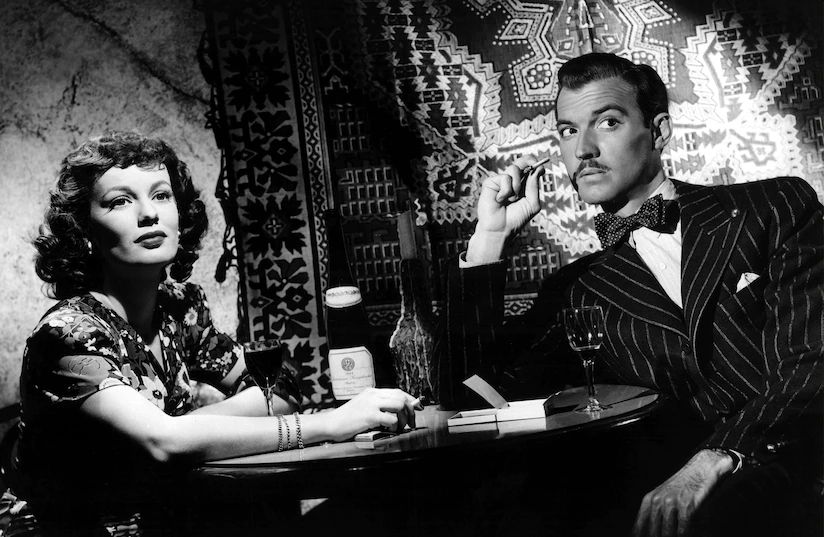
The Mask of Dimitrios (1944) is one of the classic films noir of the 1940s, and it stars two of the more colorful figures of that period, Sydney Greenstreet and Peter Lorre.  Only on this occasion, instead of playing shady and somewhat threatening supporting roles, they are cast as the stars of the film and represent the protagonists of the story.  Greenstreet and Lorre appeared together in nine famous films during this period – The Maltese Falcon (1941), Casablanca (1942), Background to Danger (1943), Passage to Marseille (1944), The Mask of Dimitrios (1944), The Conspirators (1944), Hollywood Canteen (1944), Three Strangers (1946), and The Verdict (1946) – but I would say that The Mask of Dimitrios features their greatest and most memorable performances.

Interestingly, despite their being cast here in The Mask of Dimitrios in the roles of the protagonists, Greenstreet and Lorre here retain their usual shady cinematic personae.  Lorre is his usual slimy self, and Greenstreet is characteristically abrupt and threatening, although he is here perpetually delivering his sanctimonious statement: "There's not enough kindness in the world".  Nevertheless, we are in film noir territory here, so it all fits together nicely.  Indeed, film scholar Keith Roysdon, who wrote an essay in praise of the Lorre-Greenstreet acting collaboration [1], commented:
“‘Mask of Dimitrios’ is . . . the peak of the Lorre and Greenstreet movies.”
The film was directed by the versatile Jean Negulesco, and it was based on the famous 1939 novel of the same name (aka in the U.S.: A Coffin for Dimitrios) by popular British author Eric Ambler.  The cinematography and editing was handled by Arthur Edeson and Frederick Richards, respectively; and while there are a number of distracting jump-cuts and camera-axis-crossing shots, the film’s overall appearance does very well conform to the dramatic visual panache of the dark urban film-noir underworld.  The film’s music was composed by the prolific Adolph Deutsch, who was also responsible for the music in The Maltese Falcon.  The result was a classic film noir in all its trappings.  And over the years, The Mask of Dimitrios has consistently drawn a number of appreciative reviews [1,2,3,4,5,6,7,8,9,10].  

The narrative of The Mask of Dimitrios is somewhat complicated by the retelling in flashback of several lengthy past episodes from the life of the nefarious Dimitrios Makropoulos (played by Zachary Scott in his first starring role).  Dimitrios, we will learn, is a liar, thief, murderer, spy, gangster, betrayer, and traitor.  The person interested in learning his story is a well-known detective story writer, Cornelius Leyden (Peter Lorre), who believes Dimitrios would make a good subject for his next book.  

The story begins in 1938 with Leyden visiting Istanbul.  At a social gathering Leyden meets a high-ranking police officer, Colonel Haki (Kurt Katch), who is a fan of Leyden’s writing.  Haki tells him about Dimitrios Makropoulos, whose dead body was recently washed up on the beach.  It is revealed that Dimitrios is known to have engaged in various criminal activities over the past sixteen years in a number of places – successively in Smyrna,, Athens, Sofia, Belgrade, and Paris.
The evil nature of Dimitrios intrigues Leyden, and he is allowed to see the corpse just before it is disposed of.  Afterwards, a stout gentleman, a Mr. Peters (Sydney Greenstreet), also comes to the morgue to see the corpse, but he arrives too late.

Intent on basing his next novel on Dimitrios, Leyden travels to Athens to dig up more info about  him, but he doesn’t find much.  So he heads to Sofia, where he is able to track down Irana Preveza (Faye Emerson), a former lover of Dimitrios fifteen years ago.  Telling him in flashback, she says Dimitrios was involved in an assassination attempt and left the country using money borrowed from Irana. But despite his promises, Dimitrios never returned the money.  When  Leyden returns to his hotel room, he finds a gun-wielding Mr. Peters has searched it and demanding to know why he is interested in Dimitrios. After the mysterious Peters becomes convinced of Leyden’s relatively innocent intentions, he proposes that the two of them work together and that there may be some unexplained financial reward that results from it.

So Peters puts Leyden in touch with the genteel but sinister Wladislaw Grodek (Victor Francen).  In a 20-minute flashback Grodek relates how he had hired Dimitrios to obtain some state secrets. Dimitrios manipulated Karel Bulic (Steven Geray), a minor Yugoslav government official, into gambling and losing a huge sum so that he could be pressured into stealing charts of some strategic minefields.  Bulic ultimately confesses to the authorities and then commits suicide, but Grodek just smirks when telling about it.  However, Dimitrios double-crossed Grodek by selling the stolen charts himself to the Italian government.

Still desirous of knowing more about Dimitrios, Leyden heads to the next known stop of the man’s iniquitous itinerary, Paris.  There he meets up again with the up-to-now secretive Peters, who Leyden has by this time learned used to be a member of Dimitrios's smuggling gang.  Peters now informs Leyden that the corpse he saw in the morgue in Istanbul was not that of Dimitrios, and he proves it by showing Leyden an identifying photograph of the of the man, not Dimitrios, who was killed in Istanbul.  Dimitrios, Peters informs Leyden, is still alive and is living under an assumed name in Paris.  Since Leyden is the only person who has seen the corpse and can confirm that it was not Dimitrios, he and Peters are now in a position to blackmail Dimitrios. Peters wants one million francs from Dimitrios for his silence, and Leyden agrees to go along.  

Peters knows how to get in touch with Dimitrios, and he arranges a secret meeting between himself, Dimitrios, and a suitably disguised Leyden.  At the meeting Peters issues to Dimitrios his demand for one million francs in cash, or he will reveal Dimitrios’s to the authorities via Leyden’s anonymized testimony.  Dimitrios grimly concedes that they have the goods on him and agrees to make the payment.

And so at a secretly arranged location, Peters and Leyden pickup a case filled with one million francs in cash.  Peters is exultant.

However, we are likely to doubt that Dimitrios will give up the ghost so quickly, and, sure enough, Dimitrios does have another play to make – and a violent one, too.  But you will have to watch the movie, yourself, to see how it all plays out in the end.

One might be tempted to wonder if there is any moral slant in The Mask of Dimitrios', although this is not often an issue in a film noir.  However, in this film, Leyden, the ever-fascinated observer of malevolent people, is presented with closeup, contrasting views of two often-congenial but ultimately pernicious antagonists going up against each other:
  • Dimitrios – He is a complete narcissist and only interested in his own utilitarian gain.  If he thinks he can gain from it and get away with it, he will lie to, cheat, murder, and/or betray any person he comes across.  Other people don’t count for him.
     
  • Peters – Although we know that he has been a member of a smuggling gang, Peters does care about other people.  That is why his slogan is "there's not enough kindness in the world".  But he cares about people in both positive and negative ways.  He can sometimes hate them and want to take revenge on them.  Indeed, he has spent a major part of his life engaged in a revenge campaign against Dimitrios.  For Peters, this revenge is even more important than the one million francs.
So Dimitrios and Peters are malicious, but in different ways.  Dimitrios is almost a cold-blooded self-serving robot, out only for his personal gain, whereas Peters does concern himself with other people but sometimes in a vengeful way.

I personally believe that we have all been placed in this world with the assigned goal of bringing joy to all the beings that we encounter while we are here.  And anger, hatred, and vengeance have no place in the carrying out of this mission (as you may have guessed from my reviews of other revenge-films).  Therefore Peters is no angel here.  And so Leyden must consider that aspect of his encounters with the people he has met in this story, too.  

At any rate, Sydney Greenstreet and Peter Lorre with their colorful personages, do an excellent job of raising these issues in The Mask of Dimitrios.  As for the overall moral slant of the film, perhaps it does just come down to the need for more kindness.  After all, the final words expressed in the film are Greenstreet’s:
"There's not enough kindness in the world."
★★★★

Notes:
  1. Keith Roysdon, “Peter Lorre and Sydney Greenstreet: Film Noir's Greatest Odd Couple”, CrimeReads, (30 April 2021).   
  2. Bosley Crowther, “THE SCREEN; The Mask of Dimitrios'”, The New York Times, (24 June 1944).  
  3. Walter E. Wilson, “The Mask of Dimitrios”, The Harvard Crimson, (28 October  1957).   
  4. “The Mask of Dimitrios Reviews”, TV Guide, (n.d.).     
  5. Orson DeWelles, “The Mask of Dimitrios (1944) with Peter Lorre and Sydney Greenstreet”, Classic Film Freak, (28 June 2011).   
  6. “Synopsis”, The Mask of Dimitrios, Turner Classic Movies, (n.d.).   
  7. James Steffin, “The Mask of Dimitrios”, Turner Classic Movies, (24 October  2003).   
  8. Dennis Schwartz, “Mask of Dimitrios, The”, Dennis Schwartz Movie Reviews (5 August 2019).   
  9. Leonard Quart, “FROM THE ARCHIVES: The Mask of Dimitrios”, Cineaste Magazine, Vol. XXXVIII, No. 4, (2013).   
  10. Glenn Erickson, “The Mask of Dimitrios”, DVD Savant, (20 June 2013).   

“Doctor Zhivago” - David Lean (1965)

Doctor Zhivago (1965) is an epic historical romantic drama directed by British film director David Lean.  Lean’s meticulous cinematic craftsmanship had already been manifested in his earlier prize-winning epics, The Bridge on the River Kwai (1957) and Lawrence of Arabia (1965); but here indeed in Doctor Zhivago the term “romantic epic” is a particularly definitive characterization of this film.  That is because it emphatically exemplifies many of the features that go into the making of a romantic epic film – (a) a dynamic and disruptive historical setting, (b) emphatically stylized principal characters, and (c) passionate, romantic relationships.  In these respects, the film that most closely comes to my mind for comparison with Doctor Zhivago is Gone with the Wind (1939).  And like that earlier classic romantic epic film, Doctor Zhivago was (generally) a success with the critics and with the public.  The film that David Lean fashioned here, with the help of Robert Bolt’s screenplay, Freddie Young’s cinematography, Norman Savage’s film editing (despite numerous jump-cuts), and the musical score by Maurice Jarre (who also wrote the haunting musical score for Sundays and Cybele (1962)), was a masterpiece; and it earned 10 Oscar (U.S. Academy Awards) nominations and winning five of them, as well as numerous other accolades.
 
The film Doctor Zhivago was based on Boris Pasternak’s Nobel-prize-winning novel of the same name that was published in 1957 and is about a Russian physician and poet who lived during the turbulent years of World War I and the subsequent Russian Communist Revolution of 1917 and the Russian Civil War.  Both the novel and the film take a skeptical view of the Communist Revolution, and so it was not surprising that the early distributions of both of these two works in the Soviet Union were suppressed.  And in addition, since both of them were made during the height of the U.S.-Russian Cold War, there was an inordinate amount of critical interest in the West in these political aspects of the story.  But we must remember that the film Doctor Zhivago was more than just a political saga about disruptive social conflict; rather, like Gone with the Wind, it was really about in-depth human feelings and experiences of some passionate people who lived inn the midst of this turmoil.

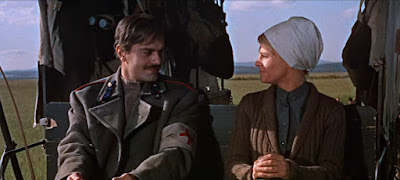
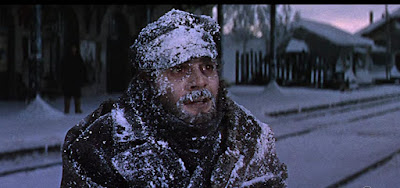
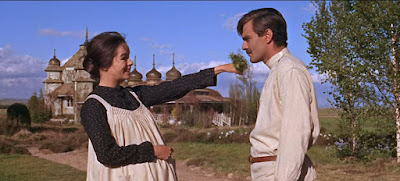
As mentioned, the story of this film concerns the experiences of a young Russian doctor, Yuri Zhivago, (played by Omar Sharif), during the early part of the 20th century.  When Yuri is a boy, his mother passes away, and he is taken in by family friends Alexander (Ralph Richardson) and Anna (Siobhán McKenna) Gromeko.  The Gromeko's have a daughter, Tonya (Geraldine Chaplin), and Yuri and Tonya soon become fast friends.  After a period of schooling in Paris, Tonya returns to Moscow, and Yuri and Tonya develop a mutual romantic attachment which leads to their becoming engaged to be married.  

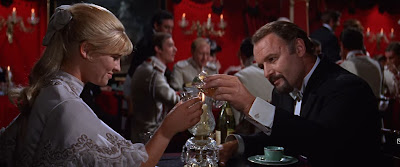
In an initially separate thread, beautiful 17-year-old Larissa ("Lara", and played by Julie Christie) is coercively seduced sexually by her own mother’s paramour, the cynical opportunist Victor Komarovsky (Rod Steiger).  When Lara’s mother learns of Komarovsky’s infidelity, she attempts suicide, and one of the doctors summoned to attend to the woman is Yuri Zhivago.  This is the first time that Yuri becomes aware of Lara.  Anyway, Lara’s real romantic interest is in a younger, idealistic political revolutionary, Pasha Antipov (Tom Courtenay), and the two of them eventually get married and have a child.


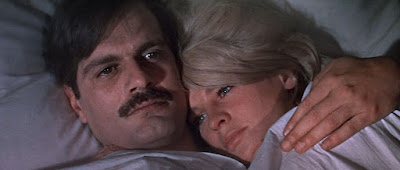
When World War I breaks out, the idealistic Pasha enlists in the military, but he is soon reported missing-in-action.  So Lara enlists as a military nurse in hopes of finding her husband.  Meanwhile Yuri Zhivago is drafted into the military to serve as a doctor.  When Yuri meets Lara out in the field, they join up to work together in a field hospital, where the two of them soon fall  in love.  This is the major romantic relationship of the story.  However, since both Yuri and Lara have spouses to whom they feel they should be faithful, they separate wistfully at the end of their term of service, and Yuri returns home.

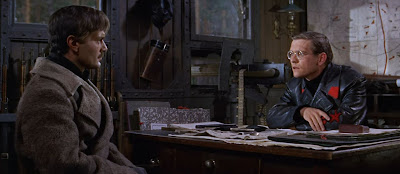
At this point, though. we are still in the early stages of a complex drama, and there is still much more to come.  The Russian Revolution and Civil War break out, and the whole society is further disrupted.  Because of Communist disapproval of his poetry, the Zhivagos take refuge at a Gromeko-owned home in the Ural Mountains.  In that area Yuri encounters Lara, and they resume their romantic passion for each other.  He also encounters Lara’s supposedly missing husband, Pasha Antipov, who now identifies himself by the name “Strelnikov” and has become a high Bolshevik commander.  When Pasha had been seen earlier, he had been an idealistic revolutionary, but skeptical of the communist Bolsheviks; however, now, as Strelnikov, he is seen to have become a dogmatic and ruthless Bolshevik fanatic.

Revolutionary turmoil has further disruptive effects on our characters.  Though Tonya manages to escape with her children to France, Yuri is captured by communist forces and impressed into field medical service.  After a couple of years of forced service, however, Yuri escapes from his captors and harrowingly makes his way back to Lara, whereupon they again resume their romantic affair.  

Later Komarovsky surprisingly shows up where Yuri and Lara are living, and this time, even more surprisingly, the normally opportunistic Komarovsky seeks to help someone other than himself.  He informs Lara that her estranged husband Strelnikov’s political enemies are out to kill him, and since her life is thereby endangered, too, he offers to facilitate her escape.  In the escape event, though, Lara and Yuri become separated again, this time for good.  And so it goes.

The whole story of Doctor Zhivago, which covers the full span of Yuri Zhivago’s life, from his boyhood to his death many years after the primary events I have described here, is encapsulated in a narrative framing device set in the 1940s that involves a high officer of the state police, Yevgraf Zhivago (Alec Guinness), who is Yuri Zhivago’s half-brother and who is looking for the lost daughter of Yuri and Lara.  Yevgraf finds a young woman, Tanya Komarova (Rita Tushingham), who was separated from her parents when she was a very small child and who may be the missing daughter.  To help prod Tanya’s memory, Yevgraf tells her the story of Yuri Zhivago’s life.  This narrative framing device has seemed artificial to some viewers, but I believe it contains a crucial hint as to what this film is ultimately about.  


Many critics have liked the film (e.g. [1,2,3,4,5,6]), although some of them did complain that the film’s running time, which comprises about three-and-a-quarter hours of screen time, is too long [5,6,7].  And there were some naysayers.  For example, notable critic Andrew Sarris was sarcastically critical of how he felt the film overlooked Pasternak’s original message [8].  And New York Times critic Bosley Crowther complained about what he felt was the film’s lack of depth [9].  But despite this range, none of the reviews that I encountered made much mention of what I think is the film’s ultimate message.

So what is this tale, ultimately about?  It seems up-front to be essentially a tale about the love between Yuri and Lara.  In this sense it is like Gone with the Wind, which despite its highly dramatic backdrop, is really a story about the romantic relationship between Scarlett O’Hara and Rhett Butler.  And also, similarly to the situation in Gone with the Wind (with its iconic characters like Scarlett O’Hara, Rhett Butler, Ashley Wilkes, and Melanie Hamilton), we have here in Doctor Zhivago several iconic characters:
  • Doctor Yuri Zhivago – the poetic humanist who sought the welfare of all concerned;
     
  • Lara – the passionate romantic who couldn’t help giving way to her feelings;
     
  • Komarovsky – the selfish opportunist who always sought to maximize his own utility;
     
  • Strelnikov (Pasha) – a person who dogmatically sought the establishment of an uncompromising political order that, even though it may trample the welfare and “rights” of many. was believed to be best for the society as a whole;
     
  • Tonya – the loyal, loving, and considerate wife.
This character breakdown, as well as the final spoken lines that close the narrative framing device, point us to what is Doctor Zhivago’s real message.  That message revolves around Yuri Zhivago’s character and what it represents as to the meaning of life.  What is it, after all, that makes human life so special, so different from that of the animals?  What is it that we should pursue and treasure?  We know that it must be more than just the acquisition of material comforts and the satisfaction of physical lusts, as was the practice of the ruthless utilitarian Komarovsky.  He was successful in his selfish pursuits, but he was little more than a clever animal.  We also know that it must go beyond the collectivist vision of someone like Strelnikov, who was also operating on the material plane, but at the same time suppressing the freedom of individuals.  As for love, as embodied by Lara and Tonya (and also by Yuri), we know that that is special, but it is often ephemeral and localized.  

But Yuri added something more, and that was his ability to see and appreciate all the beautiful experiential moments of human life that were happening around him all the time – and then to aesthetically express his feelings about those experiences by means of his poetry.  This was a “gift” that he presumably shared with Tanya Komarova, the girl who was probably Yuri’s daughter and who had a gift for music.

Life is beautiful all the time, but we too often neglect the constant flow of beautiful moments by our petty involvements in the mundane.  Our lives can be enhanced by being exposed to those people who have this gift for sharing their feelings about life’s beauty in aesthetic form.  This was the film Doctor Zhivago’s final message, and its final scene shows the gifts of Boris Pasternak and David Lean in displaying it.  As critic Powers remarked [1],
Doctor Zhivago is more than a masterful motion picture; it is a life experience.”

Notes:
  1. James Powers, “‘Doctor Zhivago’: THR’s 1965 Review”, The Hollywood Reporter, (23 December 1965).  
  2. “Cinema: To Russia with Love”, Time, (31 December 1965).   
  3. Arthur D. Murphy, "Film Reviews: Doctor Zhivago", Variety, (29 December 1965).   
  4. Roger Ebert, “Doctor Zhivago”, RogerEbert.com, (7 April 1995).   
  5. Philip K. Scheuer, "'Zhivago'---a Poetic Picture", Los Angeles Times, (24 December 1965).   
  6. Richard L. Coe, "Doctor Zhivago", The Washington Post, (4 February 1966).   
  7. Clifford Terry, “Acting Excellent, So Is Production in ‘Doctor Zhivago’”, Chicago Tribune, (28 January 1966 ).   
  8. Andrew Sarris, “films”, The Village Voice, (30 December 1965).  
  9. Bosley Crowther, “The Screen: David Lean’s ‘Doctor Zhivago’ Has Premiere, Adaptation of Pasternak Novel at the Capitol”, The New York Times, (23 December 1965).  
                                                                                                                                                                 

“Babette’s Feast” - Gabriel Axel (1987)

Babette’s Feast (Babettes Gæstebud, 1987), by Danish writer-director Gabriel Axel, is an intriguing film for me due to its contemplative quality.  By this I don’t mean that the film adopts a contemplative stance or presentation perspective, but rather that it induced in me a tendency to contemplate about life’s meaning throughout my watching of the film.  Axel’s script was a close adaptation of Danish writer Isak Dinesen’s (the pen name of Karen Blixen) famous story “Babette's Feast” [1], which first  appeared in Ladies' Home Journal magazine in 1950.  Isak Dinesen, of course, is most renowned for her marvelous memoir Out of Africa (1937) concerning her experiences in British East Africa.  The film Babette’s Feast won the Oscar for Best Foreign Language Film at the 1987 U.S. Academy Awards, and it has been highly regarded ever since by the critical community [2,3,4,5,6,7,8,9,10,11,12].  And also, in light of the theological aspects of this film’s story, it is interesting to note that Babette’s Feast is Pope Francis’s all-time favorite film [11].
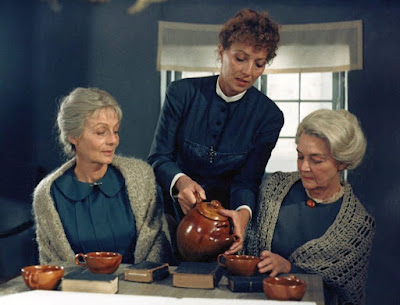
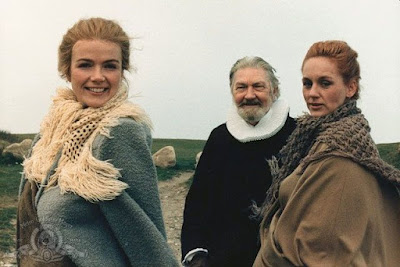
Babette’s Feast is set in Denmark in the latter part of the nineteenth century, and it concerns two elderly, unmarried sisters who have lived all their lives there in a remote village on the coast of Jutland.  The two sisters, Martine (played by Birgitte Federspiel) and Philippa (Bodil Kjer), were raised by their now-deceased father, who was a conservative pastor who led a Pietistic Lutheran ecclesiastical congregation in the village.  After their father’s passing, the two sisters continued with the leading of the aging and slowly dwindling congregation in accordance with their father’s strict standards.

The film’s story covers three time periods, during which significant events took place for the two sisters, Martine and Philippa:

  1. A period some 49 years before “the present” (“the present” takes place in the late 19ths-century), during which time some significant events take place for Martine and Philippa.
     
  2. A time 35 years later when a French woman refugee, Babette Hersant, comes to the village and begins working for the two sisters as their cook and maid.
     
  3. “The present”, when Babette prepares her special feast.
Period 1 - 49 years earlier than “the present”
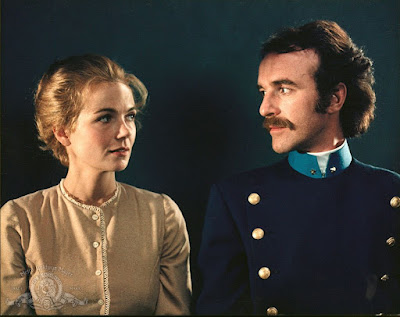
In an extended flashback we see the two daughters as late teenagers living under the strict but kindly guidance of their pastor father.  Both daughters are beautiful, but they are kept under wraps by their conservative father.  The only way to meet them in a social setting is to see them in Church.  One dashing young suitor is cavalry officer Lorens Löwenhielm (Gudmar Wivesson), whose recent rowdy behavior has caused his family to send him to the remote village to “cool off” at his aunt’s place. Lorens is quickly smitten by the beauty of Martine (in this section played by Vibeke Hastrup), but he doesn’t know how to approach the reserved girl.  After some fumbled attempts, Lorens realizes that his dreams of being with Martine are hopeless, and he decides to leave and devote himself to a professional career based on honor and glory.

A little later another visitor comes to the village, this time a famous French opera singer, Achille Papin (Jean-Philippe Lafont), who has come to get away from the Parisian hustle and bustle for a while.  He happens to hear Philippa (in this section played by Hanne Stensgaard) singing in church and is overwhelmed by the wondrous quality of her voice.  Achille manages to convince Philippa’s father to let him give her singing lessons so that he can make her into an operatic  superstar.  Achille wants to do this because of his lifetime devotion to artistic expression.  But, of course, he is also romantically attracted to Philippa.  However, Achille’s passionate and exuberantly affectionate style of personal interaction is too much for the demure Philippa, and she has to discontinue the lessons.  So Achille has to return to Paris unfulfilled.

Period 2 - 14 years earlier than “the present”
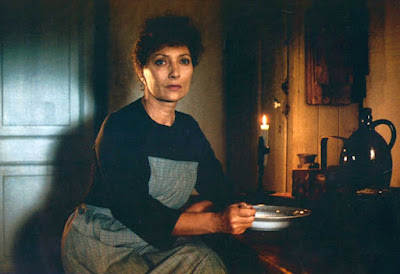
Time passes, and after their father’s death, Martine and Philippa have taken over running the local religious parish.  One day about 14 years prior to “the present”, a woman from France, Babette Hersant (Stéphane Audran), knocks on their door and bearing a letter of introduction from Achille Papin.  I should mention here that even though she first appears rather well into the piece,  Stéphane Audran is the real star of this film.  Note that the actress Audran had been the partner and wife of French filmmaker Claude Chabrol for more than twenty years and had starred in most of his films, including Les Cousins (1959) and La Rupture (1970).  In this film, although the initial focus is on the sisters Martine and Philippa,  Audran, as Babette, plays a pivotal, but enigmatic, character around whom the whole story hinges.

The letter of introduction explains that Babette is a refugee from the Paris Commune uprising of 1871 and that her husband and son had been killed in the conflict.  Fearing for her life, Babette has fled Paris, and Achille, recalling the kindness of the two Danish sisters, asks them to take her in.  The sisters explain to Babette that they have almost no money, but Babette tells them that she is willing to work for them for nothing as their cook and maid.  So the sisters take her in and begin patiently explaining to Babette how to make the simple, bland cuisine that they are used to.

Period 3 - “the present”
So now we come to “the present” time, and Babette has been working diligently for Martine and Philippa for fourteen years, and she has become a familiar background character to the dwindling number of people of the local parish that the sisters look after.  One day, however, Babette receives a message from a friend in Paris who has been buying a lottery ticket every year for Babette that informs her that she, Babette, has just won the Paris lottery of 10,000 francs.  

Everyone expects that, with civil society in Paris now calmed down, Babette will soon be returning to Paris, but Babette doesn’t say anything about this.  Instead, she indicates that she is going to prepare a grand French feast for Martine and Philippa and all the church parishioners on the occasion of the father pastor’s 100th birthday.  Noone knows quite what to expect about this feast, but it soon becomes apparent that it is going to be beyond the imaginations of any of the locals.

The film now devotes considerable time to showing Babette’s lavish preparations for the banquet.  Babette imports all sorts of exotic ingredients, as well as elegant plates and cutlery.  As the sisters and parishioners become aware of all these preparations, they begin to worry that it will be a sinful event, and they make a vow not to mention the food or express any appreciation at the dinner.

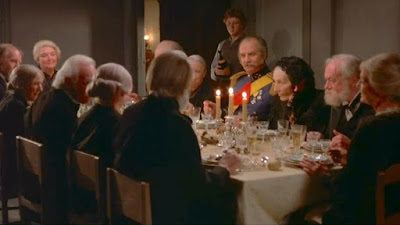
At the event, Martine’s long-ago admirer Lorens Löwenhielm, unexpectedly appears.  Lorens, who is now a famous general and is married to a lady of the royal court, has not seen Martine for forty-nine years, but he is in the village visiting his aunt, who is a church congregation parishioner.  As the other avowedly taciturn guests eat their delicious food and sip the elegant wine, their solemnity gradually fades away, and they warm up in conviviality.  Old offenses are forgiven, past grudges are mended, and almost-forgotten romantic feelings are rekindled.  But while all the other guests remain publicly silent about the feast, Lorens, who is familiar with fancy cuisine, stands up to make an after-dinner speech and toast. 
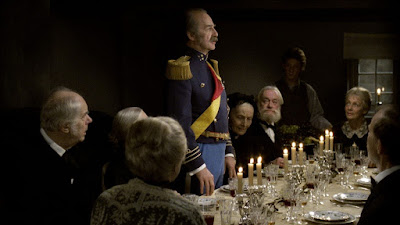
He remarks that he has tasted outstanding cuisine all over the world, but in his experience the food of this present meal is so good that it can only be matched by the food from one other place – a special café in Paris.  (The viewer will later learn that Babette was in fact the chef at that Parisian café.)  Then Lorens offers his toast, which is not so much about the food, but how the wonders of the feast has opened his eyes to the wonders of the world [11]:

    “There comes a time when your eyes are opened
    And we come to realize that mercy is infinite.
    We need only await it with confidence and receive it with gratitude.
    Mercy imposes no conditions.
    And, lo! - Everything we have chosen has been granted to us.
    And everything we rejected has also been granted.
    Yes, we even get back what we rejected.
    For mercy and truth are met together.
    And righteousness and bliss shall kiss one another.”

After the feast is over, the sisters assume that Babette will return to Paris., but Babette tells them that she used all of her 10,000 francs to pay for the expenses of putting on the feast and that she is not going away.  She did it, because she wanted to give everything in her power to the world in which she had been living.  This was, for her, the ultimate act of self-expression.

Although the basic story of Babette's Feast seems simple, the film has fascinated critics and won an Oscar.  Some people are drawn to the numerous allusions in the film to Christian symbolism, including The Last Supper (Babette's feast offered dinner for 12 guests).  But I think that the profundity of the film lies elsewhere.  To me the film features four distinct outlooks on what we should seek in life, and these outlooks are personified by four separate personages:

  • Martine and Philippa
    The two sisters, following their pastor father’s prescriptions, humbly seek to adhere to the strict rules of evangelical Christianity.  Although they devote themselves to helping the enfeebled and impoverished in their community, there is something limited and mechanical about this policy
     
  • Lorens Löwenhielm
    After Löwenhielm’s failed infatuation with Martine, he devoted himself to the attainment of personal glory and honors.  When he is seen in the latter part of the film, it is evident that he had attained what he had sought, but we get the feeling (something his closing toast confirms) that he senses that there is still something more to life than that.  
     
  • Achille Papin
    For Papin the ultimate achievement to be sought in life was ecstatic artistic expression in accordance with one’s own aesthetic gifts.  But this is a very personal mode of being and does not significantly involve the serious engagement with others or with a wider spectrum.
     
  • Babette
    Babette's mission was too use all her abilities in order to selflessly, even anonymously, bring joy to others.  And she did this through the wonders of food preparation and taste.  Her feast was her personal gift, not just to the parishioners, but to the world.

With regard to the first three of these perspectives, Tasha Robinson remarks [8]:

“The narrative is also about the emptiness of most pursuits: General Lorens is dissatisfied and confused after devoting his life to a spectacular career. The Puritans are bitter and judgmental after devoting their lives to religion. Martine and Filippa find satisfaction in devoting their lives to their father, but are left bereft after his death, watching the consensus he built crumble.” 

And in this vein of multiple life perspectives, Mark Le Fanu further adds [9]:

“Thus there are two stories, at least, going on in the closing stages of the film. Babette is busy showing us that the artist is able to respond to adversity with self-denying style and generosity, while Löwenhielm, in his after-dinner speech to the guests, is demonstrating that our choices in life—even the bad ones—are all ultimately redeemable and beneficent. Somehow, these two positions meet; at a certain level, they are identical postulates. For if Löwenhielm never sees Babette (she remains in the kitchen, outside his range of vision), he guesses she’s there—invisible, like grace—for the simple reason that, years ago in Paris, he attended a similar feast, and there is only one person in the world who could have authored this one.”

Overall and despite its modest format, Babette's Feast is a very successful cinematic consideration of our ultimate goals in life.  Of course, this topic has been the subject of countless philosophical treatises where text is used to express such abstract notions.  It would seem to be even more difficult to try doing this if one is confined to using the physical visual imagery of film.  Nevertheless, Jean Schuler feels that Babette's Feast has actually managed to accomplish what Kierkegaard thought to be beyond the realms of possibility [4]:

Babette's Feast achieves what Kierkegaard treated as impossible: to make the hidden movements of faith visible. A film about goodness threatens to bore its audience; a film about holiness that manages to get it right would seem to be as impossible as roses blooming in December or sitting down to a banquet fit for kings in a Jutland cottage.”
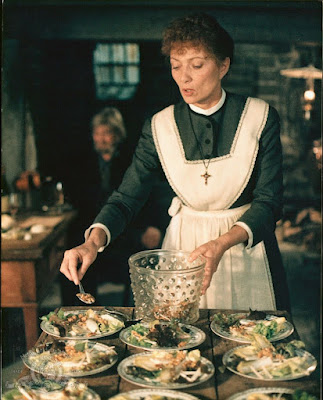
However, Gabriel Axel, with the help of Isak Dinesen’s story, Henning Kristiansen’s cinematography, and Stéphane Audran’s performance, did get it right.

Perhaps it is best to summarize the essence of what they got right with this quote from Pope Francis, himself [13]:

“The most intense joys in life arise when we are able to elicit joy in others, as a foretaste of heaven. We can think of the lovely scene in the film Babette’s Feast, when the generous cook receives a grateful hug and praise: ‘Ah, how you will delight the angels!’ It is a joy and a great consolation to bring delight to others, to see them enjoying themselves. This joy, the fruit of fraternal love, is not that of the vain and self-centred, but of lovers who delight in the good of those whom they love, who give freely to them and thus bear good fruit”

Notes:

  1.  “Babette's Feast”, Encyclopedia.com, (n.d.).   
  2. Desson Howe, “Babette’s Feast”, Washington Post, (8 April 1988).   
  3. Rita Kempley, “Babette’s Feast”, Washington Post, (8 April 1988).   
  4. Jean Schuler, “Kierkegaard at Babette's Feast: The Return to the Finite”, Journal of Religion and Film, (October 1997).   
  5. Wendy M. Wright,  "Babette's Feast: A Religious Film”, Journal of Religion and Film, (October 1997).   
  6. Peter Bradshaw, “Babette's Feast – review”, The Guardian, (13 Decembet 2012).   
  7. Nathaniel Thompson, “Babette’s Feast", Turner Classic Movies, (8 November 2013).    
  8. Tasha Robinson, “Babette’s Feast”, The Dissolve, (23 July 2013)..   
  9. Mark Le Fanu, “Babette’s Feast: ‘Mercy and Truth Have Met Together’”, The Criterion Collection, (22 July 2013).  
  10. Samuel Wigley, “Then and now: Babette’s Feast reviewed”, British Film Institute, (3 April 2014).   
  11. Philip Kosloski, “Why does Pope Francis want us to watch the movie ‘Babette’s Feast’?”, Aaleteia, (21 November 2016).   
  12. Ezio Vailati, “Babette's Feast”, Southern Illinois University Edwardsville, (n.d.).   
  13. Pope Francis, Amoris Laetitia: On Love in the Family, Our Sunday Visitor, (2016), p. 129.

“Persona” - Ingmar Bergman (1966)

Persona (1966), written and directed by Ingmar Bergman, is one of that great Swedish filmmaker’s most challenging films.  Many viewers and critics alike have found this film, mostly just showing two isolated women looking to interact with each other, to be largely incomprehensible, and they could not understand even what the film is about.  Their difficulties were exacerbated by the problems they had making out which key scenes in the film were supposed to be imaginary and which ones were supposed to be “real”.  Not surprisingly, Persona won few awards when it was released, and it has drawn heavy criticism from such leading critics as Andrew Sarris [1] and Jonathan Rosenbaum [2].

Nevertheless and despite the film’s supposed inscrutability, Persona’s novel and artistic treatment of fundamental aspects of personhood has gradually attracted an enthusiastic global following, and it is now regarded by many as Bergman’s masterpiece and as one of the greatest films ever made [3,4,5,6,7,8,9].  The British Film Institute's 2012 international poll of film critics ranked Persona as the 17th greatest film of all time [11], and its 2012 international poll of film directors ranked Persona as the 13th greatest film of all time [12].  But even though Persona has attracted a devoted following, there is still widespread disagreement about what it all means.  As a result, there have been several books and collections devoted to the film, and film scholar Thomas Elsaesser has suggested that Persona may be the most seriously written-about film ever [6].

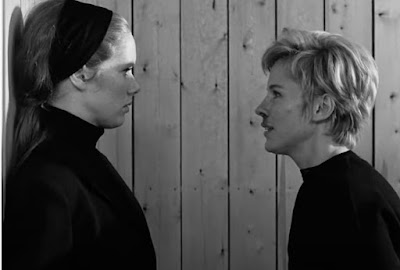
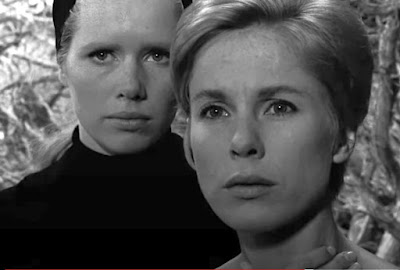
The film concerns two women, Elisabet Vogler (played Liv by Ullmann), who is a famous stage actress, and Alma (Bibi Andersson), who is a young nurse.  But before introducing these two personages, Bergman begins his film cryptically by showing an old film projector and then some disconnected images, including a slapstick silent-film sequence, a spider, a crucifixion, and a lamb being slaughtered.  Then we see a young boy waking up in a hospital cot and looking around, finally gazing on a large screen showing a blurry image of a woman’s face.

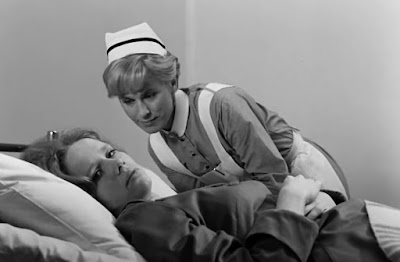
Then we are introduced to the two women, Elisabet and Alma.  In the middle of one of her stage performances, Elisabet suddenly and mysteriously became mute.  Her doctors subsequently determined that there is nothing physically wrong with Elisabet and that her now-total silence is the result of a stubborn decision on her part.  Elisabet’s psychiatrist doctor (played by Margaretha Krook) believes that Elisabet’s total withdrawal is due to a fanatic concern about her personal authenticity – Elisabet apparently doesn’t want to express anything that is not fundamentally true about herself, and so she is holding to her silence.  Consequently the doctor assigns nurse Alma to take Elisabet to the doctor’s remote island cottage and see if she can spend some relaxing time with the actress and help bring the woman out of her malaise.  

As I mentioned, it is argued by many (e.g. [5,6]) that the events shown in the film don’t add up to a single coherent story, thereby leaving viewers to construct their own stories out of the subsequent narrative shards that are presented.  These narrative shards can be grouped into six collections.

First “Conversation”
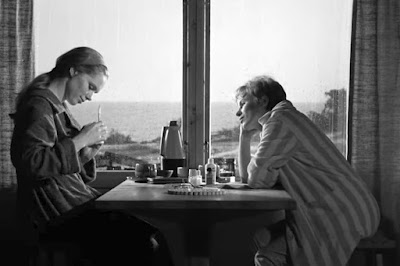
At the cottage, Alma tells her mute companion that she is happy to finally find someone to listen to her own babbling.  She begins talking about her current fiancé and also about her first romantic affair that was with an older man and that lasted five years.  

Then she tells a more detailed and sexually explicit story about a time when she was already involved with her fiancé and she went alone to the beach.  There she met another woman and the two of them engaged in some nude sunbathing.  Two young men then appeared, and Alma’s new woman friend uninhibitedly got them involved in a sex orgy.  Alma describes experiencing some intense orgasms, and film critic Roger Ebert commented that this was “the most real experience Alma has ever had” [4].  Later, however, Alma became pregnant and had an abortion, and she still feels guilty about this.  All this is told verbally, and there are no flashbacks here, as the mute Elisabet listens attentively.

Nighttime Encounter
It is becoming increasingly evident that Alma idolizes her patient, Elisabet, and wants to be like the famous star.  In the evening Alma thinks she hears Elisabet whispering to her to go to bed.  And then later at night, Alma wakes up to see (or perhaps dreams) Elisabet coming to her and embracing her tenderly.  In the morning, though, Allma asks Elisabet about these two incidents, and the woman silently denies that they occurred.

The Argument

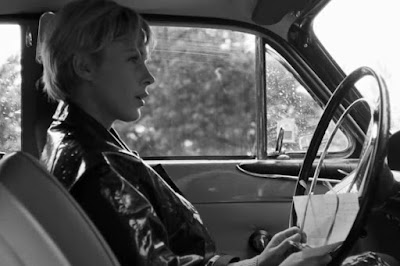
One day Alma drives to town to mail some letters they have written, and she notices that Elisabet's letter to her doctor is not sealed, so she proceeds to read it.  It is a patronizing letter that is dismissive of Alma and mentions the nurse's personal story about her beach orgy and abortion. Alma, of course, becomes angry and withdraws from her hitherto worshipful feelings about her patient.

At this point the film briefly breaks up with some artificial cinema edits like in the opening sequence, thereby reminding the viewers that they are just watching a movie.

When Alma returns home, she angrily confronts Elisabet and threatens to scald her with a pot of boiling water.  Frightened, Elisabet speaks out for the first and begs Alma not to do it.  Then Alma furiously goes on to tell her that she knows the woman is a very bad person.  Elisabet runs off, and when Alma, coming to her senses, chases after her and begs her for forgiveness, Elisabet refuses to forgive her.

Elisabet’s Husband Comes
One night, Alma hears a man outside calling for Elisabet, and it turns out to be Elisabet's husband (played by Gunnar Björnstrand).  The man seems to have bad eyesight, and he mistakes Alma for his wife.    Although Alma tells him he is mistaken, she very soon succumbs and assumes Elisabet's identity.  Alma and the husband then go on to have sex together while Elisabet, close by, silently watches.

Elisabet's Confession
Earlier, Elisabet had received a letter from her husband that contained a picture of her son, which she had proceeded to tear up.  Now Alma meets with Elisabet to talk about why Elisabet tore up the picture.  Elisabet proceeds to give her account, and we see her face, but her account is told in Alma’s voice.  The voice says that the only thing that Elisabet wanted that she did not have was motherhood, and so she became pregnant. However, she soon regretted her decision and tried to have a self-induced abortion, but she failed in this effort.  She wound up giving birth to a boy who she hoped would die and whom she has since always  despised.  Nevertheless her rejected son has always craved her love.

Strangely, this same story is then repeated word-for-word, only now showing Alma’s face telling the exact same story.

Ending
The film ends with Alma in a distressed state.  She adamantly asserts to Elisabet that she has her own identity that is very distinct from that of Elisabet.  She later finally manages to get Elisabet to say something – the word "nothing".  Then Alma packs up her things and gets on a bus to leave the cottage, which is accompanied by a shot showing  a modern film crew filming her.

So what can be said about the overall meaning of this odd, disjointed work?  As one watches it, it is possible to make out some key themes that resonate throughout:
  • Personal authenticity (and inauthenticity).  What is the true essence of a person and how is it revealed?  
  • Images of the face and the degree to which they can reveal or mask one’s true personhood.  
  • Touching with hands and the degree to which that can confirm the reality of what one sees.
  • The inadequacy of language for revealing the essential nature of experience.
  • The never-ending quest for the true meaning of life.
These various themes and metaphors in the film have elicited a range of commentary over the years, but the most interesting thoughts I have come across have been those of Susan Sontag, who wrote an insightful essay on Persona in 1967, soon after the film was released [5].  For example, on the issue of plot and how one might best construct a coherent narrative with what is shown in the film, Sontag doesn’t believe that Bergman ever had any intention offering a real plot [5]:
“Once it is conceived that the desire to ‘know’ may be (in part) systematically thwarted, the old expectations about plotting can no longer hold. At first, it may seem that a plot in the old sense is still there; only it’s being related at an oblique, uncomfortable angle, where vision is obscured. Eventually though it needs to be seen that the plot isn’t there at all in the old sense, and therefore that the point isn’t to tantalise but to involve the audience more directly in other matters, for instance in the very processes of ‘knowing’ and ‘seeing’.”
And on the interesting topic of what is Alma’s authentic self and to what degree does she move to find herself, Sontag has an interesting take.  She asserts that Alma and Elisabet can be considered to be two sides of one person [5]:
“It’s correct to speak of the film in terms of the fortunes of two characters named Elizabeth and Alma who are engaged in a desperate duel of identities. But it is no less true, or relevant, to treat Persona as what might be misleadingly called an allegory: as relating the duel between two mythical parts of a single ‘person’, the corrupted person who acts (Elizabeth) and the ingenuous soul (Alma) who founders in contact with corruption.”
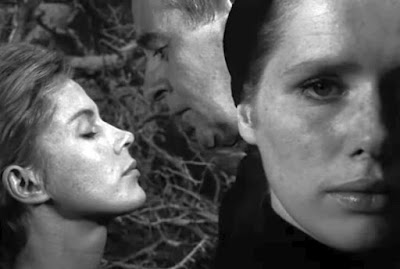
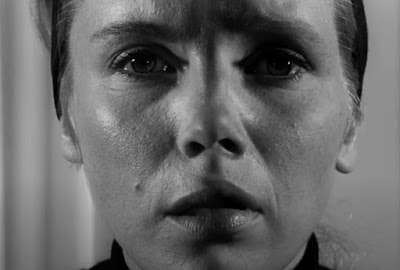
(Indeed, at one point Bergman shows a special image of a single face that consists of half of Elisabet’s face on one side and half of Alma’s face on the other side.)

Sontag’s comment here is,  to me, the most compelling interpretive observation on the film, and it fits well with several other expressionistic sequences of the film, too, such as (a) the nighttime encounter between Elisabet and  Alma, (b) Elisabet’s husband mistakenly taking Alma for his wife, and (c) the exact repetition of Elisabet’s confession, showing first Elisabet’s face and then Alma’s face, but each time spoken in Alma’s voice.

So Persona is a challenging and perplexing film, but it also has a fascinating focus, and I believe it is worthy of your interest.  
 

Notes:
  1. Andrew Sarris, “films”, The Village Voice, (23 March 1967).  
  2. Jonathan Rosenbaum, “Scenes From an Overrated Career”, The New York Times, (4 August 2007).   
  3. Roger Ebert, “Persona”, RogerEbert.com, (7 November 1967).   
  4. Roger Ebert, “Persona”, Great Movie, “RogerEbert.com”, (7 January 2001).   
  5. Susan Sontag, “Persona – Review by Susan Sontag”, Sight and Sound, (Autumn 1967).  
  6. Thomas Elsaesser, “The Persistence of Persona”, The Criterion Collection, (17 March 2016).   
  7. Chuck Bowen, “Blu-ray Review: Ingmar Bergman’s Persona on the Criterion Collection”, Slant Magazine, (21 March 2014).   
  8. Peter Bradshaw, “Persona review – Ingmar Bergman's enigmatic masterpiece still captivates”, The Guardian, (29 December 2017).   
  9. Acquarello, “Persona, 1966", Strictly Film School, (25 December 2017).   
  10. “Critics’ Top 100", Analysis: The Greatest Films of All Time 2012, Sight and Sound, British Film Institute, (2012).      
  11. “Directors’ Top 100", Analysis: The Greatest Films of All Time 2012, Sight and Sound, British Film Institute, (2012).