Showing posts with label Yazdanian. Show all posts

“Hit the Road” - Panah Panahi (2021)

Hit the Road (Jadde Khaki, 2021) is an Iranian film written and directed by Panah Panahi,  the son of masterful Iranian film auteur Jafar Panahi.  This is a “road movie” that has a special flavor to it, thanks, in part, to its Iranian context.
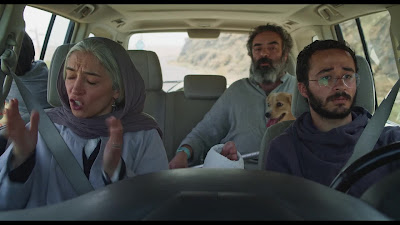
Although I customarily don’t spend much time discussing film production details, because such details can get in the way of  directly appreciating the film’s aesthetics and storyline, I sometimes make an exception for Iranian films.  That is because the Iranian government’s incessant incessant suppression of free expression in all media, including the film medium, makes it extremely difficult for creative filmmakers to express their ideas cinematically, and the reader may benefit from learning a few things about this background.  That is the reason why, for example, many good Iranian films are “road movies”.  It is sometimes only within the close confines of a road vehicle that the filmmaker has the privacy and freedom from spying eyes to be able to show genuine human interactions.  

And, of course, there is the matter of the Panahi family background.  Panah Panahi was born in 1984 and went to film school.  But most of what Panah learned ed about filmmaking came from watching both his famous father, Jafar Panahi, and his father’s equally famous mentor, the noted Cannes Film Festival Palme-d'Or-winner, Abbas Kiarostami, who often discussed their film projects with each other, with the young Panah sitting and watching in the background [1,2].  However, things became much more complicated when Jafar Panahi’s progressive attitudes and  film expression came under the critical scrutiny of the Iranian government, and in 2010 he was charged with producing propaganda against the government.  He was then sentenced to
“six years in prison and a 20-year ban on directing any movies, writing screenplays, giving interviews with Iranian or foreign media, or leaving the country except for medical treatment or making the Hajj pilgrimage” [3]. 
Since then Jafar Panahi’s activities have been severely restricted,, and he has more or less been under house arrest.  Nevertheless, he has somehow managed to continue to make some films, and his son Panah has continued trying to help in the background.  Eventually, Panah’s own contributions became more significant, and he was credited as the co-editor on his father’s recent film 3 Faces (2018).  

Note that both Jafar Panahi and Abbas Kiarostami have made some road movies.  Does that mean that Panah Panahi’s Hit the Road is a film like those of his mentors?  Yes and no.  Hit the Road has features of other Iranian road movies, but it has some of its own novel aspects, too.  

The film begins by showing a SUV parked along the side of a highway, and the viewer is not given any real background information as to what’s going on.  Instead the film employs the cinematic technique of “slow disclosure” to draw the viewer in to learning more about the situation.  The SUV has four people in it, evidently a family headed somewhere.  In the front is a twenty-something young man behind the wheel and a middle-aged woman in the front passengers’ seat.  In the backseat area is a middle-aged man with his leg in a cast that stretches out into the space between the two front seats.  Sitting next to this man in the backseat is a rambunctious and naughty six-or-seven-year-old boy, This family, the viewer will eventually surmise, is fleeing from some unspecified, dangerous situation in Tehran, probably brought about by the oppressive government of the Iranian Islamic Republic.  Indeed the young driver of the SUV has probably been conscripted into military service, which can in Iran be a very dangerous situation to be in..

So in this film the focus is primarily on the four contrasting members of the family in the SUV heading west out of Tehran:
  • The Mother (we are never told her name).   She is played by well-known actress Pantea Panahiha, and she is the most heartwarming person in the story.  She wants the best for her grumpy older son, but she has to hold her ground in the face of her family’s banter in the car.
     
  • The Father (known as Khosro) is played by Hasan Majuni.  He is an enigmatic, grouchy character, probably because he has had his foot in that caste four months.  But he sometimes quietly displays a warm heart, especially towards his mischievous young son sitting next to him in the back seat.
     
  • The young boy (nicknamed “Monkey the Second” by his Dad) is played by Rayan Sarlak and is an impish little boy constantly causing trouble.  But there is an innocence about him, too; for example when he occasionally kneels down by the roadside and prays to God.
     
  • The older brother (played by Amin Simiar) is known as Farid and is the taciturn young man behind the wheel of the vehicle.
     
  • In the very back of the SUV, is a pet dog, “Jessy”, who is apparently dying of a fatal condition.
As the family heads west in the SUV towards the Turkish border and hopeful refuge for Farid, we gradually learn amidst all the wisecracks along the way, that they have made great sacrifices to save the young man.  In order to get the money to pay off illegal, underground human-smugglers at the border, the family has sold their family house and car – the SUV they are driving is a borrowed vehicle.  All these details have to be kept away from the younger boy (the “2nd Monkey”), because he is such a young blabbermouth that he can’t be trusted with this information – he might give the game away if he converses with someone they meet along the way.  

So as the journey proceeds, the viewer is privy to two levels of concurrent inside-the-vehicle conversations — (1) the lightweight smart-alecky patter on the surface and (2) the guarded worry-laden remarks revealing concerns about constant surveillance threats and upcoming dangers.  These ingredients make the film special and have led it to receive accolades from the critical community [1,2,4,5,6,7,8,9,10,11].  As A.O. Scott of The New York Times remarked in this regard [4]:
“What makes Hit the Road so memorable and devastating is the way it explores normal life under duress. An unseen, oppressive force — presumably some aspect of the government that has harassed Panahi’s father for more than a decade and tried to prevent him from making films — imposes its will on them. That invisible cruelty makes the tenderness and good humor of this movie all the more precious, and almost unbearable.”
And as critic Tomris Laffly more generally commented [5]:
“Here, the details don’t matter as much as their heartbreaking consequences: the irreversibly burdened families unfairly torn away from their loved ones, and a society that carries those scars.”
Panahi achieves all this emotive filmmaking with the help of his excellent production staff.  This  included the always emotive music by Peyman Yazdanian (which also featured some diegetic pop music from pre-revolutionary times).  The cinematography by Amin Jafari and film editing by Amir Etminan and Ashkan Mehri, much of which was focused on activities inside the SUV, was excellently executed, included many long takes that were adroitly performed and that added to the intimacy of the goings on.  One highly imaginative sequence featured their visual rumination on 2001: A Space Odyssey (1968) (you will have to see the film to see how that fits into the storyline).  As critic Richard Brody of The New Yorker commented more generally [6]:
"[Panahi’s] visual compositions are essential elements of his world view, whether in a poised side-by-side image of Farid and his mother evoking ineffable love at a rest stop with a discussion of 2001: A Space Odyssey or an unbearable moment of separation that’s ingeniously filmed from hundreds of feet away, with heartbreaking reserve that nonetheless captures both its frantic energy and its poignant intimacy. Panahi’s visual correspondence of elisions and separations replicates the silences and mysteries that mark the characters’ own adventure.”
And so the family of four proceed along their stressful, doubt-laden path.  Although the outer structure of the story suggests one of event-filled adventure and danger, this is really a story about human relationships.  In fact it’s a story about love – family love.  You can watch Hit the Road to see what happens at the end of their journey and how things come out.
★★★½

Notes:
  1. Carlos Aguilar, “For Panah Panahi, Being the Son of an Iranian Auteur Wasn’t Entirely Helpful”, The New York Times, (22 April 2022).   
  2. Soheil Rezayazdi, “‘For Us Iranians, the Car Has Become a Second Home’: Panah Panahi on His Debut Feature, Hit the Road”, Filmmaker Magazine, (22 April 2022).   
  3. “Jafar Panahi”, Wikipedia, (1 April 2022).   
  4. A.O. Scott, “‘Hit the Road’ Review: Wheels Within Wheels”, The New York Times, (21 April 2022).   
  5. Tomris Laffly, “Hit the Road”, RogerEbert.com, (22 April 2022).   
  6. Richard Brody, “‘Hit the Road,”’Reviewed: A Mysterious and Thrilling Revelation from Iran”, The New Yorker, (18 April 2022).    
  7. Leigh Singer, “Hit the Road packs humour and heartbreak into an oddball Iranian family’s SUV”, Sight and Sound, (11 July 2021).   
  8. Scout Tafoya, “NYFF 2021: Hit the Road, Unclenching the Fists, The Girl and the Spider”, RogerEbert.com, (7 October 2021).   
  9. Jordan Mintzer, “‘Hit the Road’ (‘Jadde Khaki’): Film Review | Cannes 2021", The Hollywood Reporter, (12 July 2021).   
  10. Jessica Kiang, "‘Hit the Road’ Review: Several Stars Are Born in an Irresistible Iranian Road-Movie Debut”, Variety, (29 August 2021).    
  11. David Ehrlichm, “‘Hit the Road’ Review: An Iranian Family Makes a Run for the Border in Panah Panahi’s Unforgettable Debut”, IndieWire, {5 October 2021).    

"And Along Came a Spider" - Maziar Bahari (2003)


The word ‘evil’ comes up constantly in our social discourse  – not only in ordinary conversation but also in the remarks made by cultural and political leaders of high standing.  Although the word might be assumed to have a specifically religious connotation, it is commonly used by Western secular leaders, too, as philosopher John Gray observed [1]:
“When Barack Obama vows to destroy Isis’s ‘brand of evil’ and David Cameron declares that Isis is an ‘evil organisation’ that must be obliterated, they are echoing Tony Blair’s judgment of Saddam Hussein: ‘But the man’s uniquely evil, isn’t he?’“
And yet there is a widespread divergence concerning how that word is understood across society. Even among my own close associates, there are huge differences in terms of how we each interpret the word. This suggests a paradox: the word is used all the time, but there is little common agreement on what it means.  I would argue that this disparity of understanding about ‘evil’ is not just a trivial one concerning  the precise semantics of a single word, but points to significant cultural differences that have been at the root of many social problems.

In this context Maziar Bahari’s documentary film, And Along Came a Spider (Va Ankaboot Amad, 2003) [2], which on the surface is simply an account of an unrepentant serial killer in modern Iran, is actually much more profound than that – it is an interesting (and disturbing) exploration of how ‘evil’ is understood.

The subject of the documentary is Saeed Hanaei, a resident of Mashhad who carried out a secret campaign of personally murdering prostitutes.  From July 2000 to July 2001 Hanaei killed 16 prostitutes by luring them one-by-one into his apartment while his wife was out and then suffocating them and disposing of the bodies. Because of his procedure of inviting the prostitutes to his home, he was later likened by the press to a spider luring flies to its web and became known as the “spider killer”.

Bahari’s film is mostly “talking heads”, but he definitely got some interesting heads to talk to. In documentary filmmaking it is not so important what goes on behind the camera as what you have in front of the camera.  In this case Bahari, in collaboration with Iranian reporter Roya Karimi, managed to get exclusive and candid interviews with Hanaei, his family, and with relatives of some of the victims. The presentation is further enhanced by the haunting musical score by Payman Yazdanian. (He was listed as “Payman Yazdanian” in the closing credits, but I am assuming that this is Peyman Yazdanian, who composed evocative piano scores for The Wind Will Carry Us (Bad Ma-ra Khahad Bord, 1995), Going By (Az Kenar-e Ham Migozarim, 2001), The Deserted Station (Istgah-Matrouk, 2002), The Wind Carpet (Kaze no Jûtan, 2003), Crimson Gold (Talaye Sorkh, 2003), Friday’s Soldiers, (Sarbaz-haye Jome, 2004), and Fireworks Wednesday (Chaharshanbe Suri, 2006)).

The film mostly avoids any polemical or moralistic voiceover commentary and unobtrusively allows these people to speak for themselves.  It is left to the viewer to draw his or her own conclusions.  And depending on one’s moral perspective, each viewer might draw different conclusions concerning what is shown.

There is no real suspense concerning what is shown.  In the first eight minutes of this 53-minute film, the basic facts of the case are already laid before the viewer.  In fact even before the film’s titles are presented, we learn that Hanaei is a convicted murderer and proud of what he has done.  As the film proceeds, it shows that he decided to kill prostitutes after becoming enraged when a Mashhad taxi driver mistook his wife for a prostitute.  But although Hanaei confesses to Ms. Karimi that revenge was a motive for his deeds, he feels that his murders were in accordance with Islamic doctrine.  He felt that he was removing “pollution” from the world in alignment with the Prophet’s teachings.  In fact he mentions that he had lined up 80 more women to kill and would have carried out his plans if he hadn’t been apprehended by the law.

Mashhad, like most large international cities, has many prostitutes.  The film narrator mentions in voiceover that the Mashhad police had recorded knowledge of 5,000 prostitutes in the city.  In addition drug addiction, primarily with opium, is a major social issue in Iran.  I have seen estimates that six per cent of the adult population is addicted, but it wouldn’t surprise me if the true figure was considerably higher than that.  Opium smoking (as distinct from the more intense experiences associated with heroin addiction) has had a long tradition in Iran, and opium can be easily and inexpensively obtained if you ask the right people. The netherworlds of drug addiction and prostitution are connected, and the film mentions that 15 of Hanaei’s 16 victims had been previously incarcerated for prostitution and drug-related charges.  Hanaei says that 14 of his s16 victims were junkies.  As far as Hanaei was concerned, he was removing scum from the earth by performing his murders.

Still in the film’s first eight minutes, the attention quickly turns to Hanaei’s family.  Saeed’s brothers (those that are shown, anyway) feel that he did the right thing.  As one of them says, “but, frankly, a whore doesn’t have an ounce of humanity.”  Saeed's mother expresses similar sentiments. Saeed;s teenage son, Ali, expresses admiration for what his father has done and regards him as a hero.  He even suggests that he would like to emulate his father’s actions someday.  Similarly, Saeed’s wife, Fatemeh, who was unaware of the murders prior to his arrest, also admires him and says,
“When a woman rides on a motorbike with a man she doesn’t know at all, the punishment for this woman is nothing less than death.”
So early on, the most shocking aspects of this tale have been revealed. The remaining forty-five minutes do not reveal much that is new, but they penetrate further into this story, and I found them interesting, anyway. There is more discussion with Saeed in prison, who smilingly speaks of his earlier days and provides more detail concerning how he managed to carry out his murders always when his wife was out of the house. There are interviews with working-class people and shopkeepers, who express moral support for what Hanaei has done, although some felt that he went too far.

Interspersed among this material are comments from the victim side of this story.  One of them is an 18-year-old girl, Mahasti, who was never approached by Hanaei, but is presented as a typical young prostitute. She has been a prostitute for the past five years and is shown only in silhouette. She was forced into marriage when she was 10-years-old and then bullied by her husband into prostitution to support his drug dependence. Her testimony probably epitomizes the experiences of most prostitutes, who are themselves victims of a society that has left many of them impoverished and in servitude.

Also shown are two young daughters of another of Hanaei’s victims, and they sadly talk about their lives and the loss of their mother.

Finally the film comes to Hanaei’s arrest and trial.  The hardliners exonerated him, and one hardline newspaper asked its readers,
“Who is to be judged?  Those who seek to eradicate the sickness or those who stand at the root of the corruption?”
Saeed argues confidently in the court hearing that he was acting to remove what is spoken of in Islamic law as a “waste of blood”. The magistrate at the court, Hojatolislam Mansoori, acknowledge that the “waste of blood” notion was a valid concept for killing someone, but that Hanaei was not in the position to make the correct judgement. Hanaei is sentenced to death and hanged in 2002.

Although And Along Came a Spider tells the story of an implacable murderer, the real issue here is evil.  Depending on how your attitude about evil, you might see Saeed Hanaei as
  • a psychopath
  • a normal product of a corrupt culture
  • a possible product of any culture, since all current cultures have embedded within them the seeds to produce people like Saeed Hanaei
Of course there are many differing views about evil, but we can roughly partition them into three groups [3]:
  1. Evil derived from religion (religionists)
  2. Evil as an innate psychological concept (many modern secularists)
  3. Those who deny the semantic usefulness of the term evil (evil-skeptics)
1.  Evil According to Religionists
The idea of evil as a distinct force in the world (as opposed to just seeing evil as the absence of good) was most clearly articulated in religious form by two belief systems originating in Iran: Zoroastrianism and  Manicheanism. Both of the religions viewed evil as a powerful force, equal in power and opposed to good.  The world was seen as an eternal struggle between good and evil. These ideas were ultimately incorporated into the Abrahamic religions (e.g. Judaism, Christianity, and Islam, etc.), which are monotheistic and believe in an all-powerful creator of the universe.

But or course the concept of evil brought in serious philosophical problems for these monotheistic religions.  How could an all-powerful creator of the universe, who is supposed to represent everything that is good, allow evil to exist in His creation?  Theologians have struggled with this question for centuries, and about the only answer they have come up with has been that the Lord works in mysterious ways – it’s all too much for our finite brains to fathom.  Nevertheless, the concept of evil is used in these religions and applied to individuals.  A person, like Hitler, can be considered to be evil and a “waste of blood”.

2.  Evil According to Many Modern Secularists
As John Gray has pointed out, even in our modern secular world that is inspired by notions from Western scientific rationalism over the past three centuries,  the concept of evil is widely invoked [1]. Secular modernists, like the religionists, can focus on the individual, but they may not always use the word ‘evil’. Instead they dismiss a miscreant as a “psychopath” – essentially meaning a defective biological organism. Thus people like Hitler and Osama Bin Laden are sometimes said to have been psychopaths.  In many cases, however, the secular concept of evil is applied not to an individual, but to a whole cultural grouping, such as ISIS in the Middle East.

However, there is a significant distinction between modern secularists and religionists besides just naming.  For religionists someone is just evil, and that’s it – there are no degrees to evil. But secularists are often interested in the degree to which one might be evil.  For this task there are differences among them concerning how much relative weight ought to be given to the intention of the killer and the damaging consequences of the evil actions.  Recently Sam Harris and Noam Chomsky, two modern secularist academics, had a lengthy and rancorous exchange of emails over the course of which they discussed their respective moral orderings concerning evil [4]. To get an idea of where they stand, consider the  following two examples of murderers:
  • Killer1. He intends to kill his victims
  • Killer2. He has command of great destructive power and sometimes out of negligence kills victims as “collateral damage”.
For Harris, Killer1 is worse than Killer2, because he (or she) meant to kill his victims, while for Killer2 it was an accident.  For Harris, evil intention is the dominant consideration. For Chomsky, however, Killer2 is worse than Killer1, because at least Killer1 acknowledges that his victim was human and was a worthy adversary, whereas Killer2 regarded the victim like an ant that one might step on while walking down the sidewalk, i.e. non-human.  For Chomsky evil consequences are dominant, and those who disregard those consequences are more evil. Chomsky thus sees the malevolent actions of Western powers as being like Killer2, such as the 1998 bombing of the Al Shifa pharmaceutical plant in Sudan, which led to the collateral-damage deaths of tens of thousands of innocent Sudanese who suffered from the unavailability of needed medication.  The Western powers (the USA in this case) did not regard the lives of Sudanese as worth considering, because their primary concern was to destroy what they thought might be a plant site for the manufacture of chemical weapons.  For Harris, the 911 attack a few years later was much more evil, because the assailants wanted to kill as many people as possible.

In any case, both Harris and Chomsky see evil as arising from an evil culture.  In Harris’s case the evil culture is Islam, while in Chomsky’s case the evil culture is American Exceptionalism. If they looked at Saeed Hanaei’s actions, they would both probably focus on the evil social circumstances that led to his crimes, rather than on the evil inside his soul.

3.  Evil-Skepticism
A third attitudinal grouping about evil comprises those who feel that evil is a useless concept and ought to be dispensed with. As Todd Calder summarises [3]:
“Evil-skeptics give three main reasons to abandon the concept of evil: (1) the concept of evil involves unwarranted metaphysical commitments to dark spirits, the supernatural, or the devil; (2) the concept of evil is useless because it lacks explanatory power; and (3) the concept of evil can be harmful or dangerous when used in moral, political, and legal contexts, and so, it should not be used in those contexts, if at all.”
To say that someone is evil or is a psychopath is merely to label them with an opaque name, and it closes the door on further analysis.  Indeed, the field of psychiatry has often lived off the practice of merely naming a behavioural malady (such as schizophrenia, depression, ADHD, etc.) and considering that to be an adequate diagnostic understanding.  In this case, to call someone evil is to suggest that they are subhuman and not worthy of empathetic consideration.  It is evident in the film that this is how Saeed Hanaei thought; he considered the prostitutes to be despicably subhuman and even “worse than animals”.  So evil-skeptics suggest that the notion of evil, itself, leads to further harm.
                                              
It seems evident then that these three groupings would view Saeed Hanaei differently
  • Many religionists would consider Hanaei to be fundamentally evil, although some of them (the hardliners) might align themselves with Hanaei’s own arguments and consider him to have been doing God’s work by erasing those who are a “waste of blood”.
  • Many secular rationalists would likely dismiss Hanaei as a psychopath, although some would see him as a victim of an evil culture.  Note that Sam Harris’s focus on Islamic culture as generating evil is probably not balanced, and it is easily countered by examples from the US, such as Ted Bundy [5] and the My Lai Massacre [6,7].
  • Evil-skeptics are likely to suggest that the notion of evil merely causes further harm by legitimising cruelty on the part of individuals who lack empathy and compassion in their efforts to combat what they believe is evil, such as was the case with Saeed Hanaei. We need new and better social mechanisms to nurture more empathy and to guide those who have difficulties or deficiencies in feeling empathy.
Consider the following ladder of killing and where you might place yourself:
  1. Killing other humans for the purposes of satisfying one's own selfish material interests.
  2. Killing other humans for the purposes of personal revenge.
  3. Killing other humans in order to assist God in eliminating those who are a “waste of blood”.
  4. Killing other humans in wartime in order to serve one's own country’s interests.
  5. Killing and eating animals for pleasure (and because so many other people do it)

Most people would place themselves somewhere on this ladder (probably level 4 or level 5) and regard those who occupy positions higher up on the ladder to be evil.  But the killings performed at one level provide a foundation for moving up to the next level – Hanaei had served in the Iran-Iraq War and mentioned that his subsequent prostitute-killing campaign was merely a continuation of his holy-war-based actions to eliminate “corruption on earth” by killing enemy soldiers during the war.

Maybe in order to deal with the problem of evil, it is time for everyone to get off that ladder altogether. And Along Came a Spider closes not on the image of Hanaei being hanged, but on the smiling, wistful face of one of Hanaei’s victim’s daughters. There is no place for evil in that image.
★★★½ 

Notes:
  1. John Gray, “The Truth About Evil”, The Guardian, (21/10/2014).
  2. And Along Came a Spider is available on YouTube.  You can find a copy of the film here.
  3. Todd Calder, “The Concept of Evil”, Stanford Encyclopedia of Philosophy, (26/11/2013).
  4. Sam Harris and Noam Chomsky, “The Limits of Discourse”, Sam Harris, The Blog, (1 May 2015).
  5. “Ted Bundy”, Wikipedia, (15/5/2015).
  6. “My Lai Massacre”, Wikipedia (15/5/2015).
  7. Consider this example of malevolence carried out by a Western society on the Vietnamese village of My Lai (from Jonathon Glover, Humanity: A Moral History of the Twentieth Century, (1999), Yale Univ. Press, p. 58.):
    “Early in the morning the soldiers were landed in the village by helicopter. Many were firing as they spread out, killing both people and animals. There was no sign of the Vietcong battalion and no shot was fired at Charlie Company all day, but they carried on. They burnt down every house. They raped women and girls and then killed them. They stabbed some women in the vagina and disemboweled others, or cut off their hands or scalps. Pregnant women had their stomachs slashed open and were left to die. There were gang rapes and killings by shooting or with bayonets. There were mass executions. Dozens of people at a time, including old men, women and children, were machine-gunned in a ditch. In four hours nearly 500 villagers were killed.”

"The Deserted Station" - Alireza Raisian (2002)

Like a number of other contemporary Iranian works, The Deserted Station (Istgah-Matrouk, 2002), a film directed by Alireza Raisian, presents mundane events and circumstances that manage to evoke larger themes concerning the lives of the characters.  Reminiscent of earlier Italian films such as those by Michelangelo Antonioni, these Iranian films often involve an educated, urbanized protagonist for whom an encounter with ordinary people in the countryside elicits philosophical introspection about life's purposes.

In the case of The Deserted Station, the story concerns a young married couple driving across eastern Iran on their way to making a devotional visit to the Imam Reza shrine in Mashhad.  The film proceeds at a leisurely pace to acclimate the viewer to the slow pace and sense of isolation of the Iranian desert. In fact for the film's first six minutes, one only sees images of the desert road and the driver, who is always shown in a tight camera frame so that one can’t be sure if he there is anyone else in the car. Eventually one is able to see that there is a passenger, the driver's wife, who though never named, turns out to be the story's real protagonist. 

As they drive through the barren landscape of Semnan province during the early morning hours, the driver Mahmood, who is a professional photographer, wanders off the main road in pursuit of picturesque images to capture with his camera.  When a deer surprisingly bolts in front of their car on the road, Mahmood’s wild swerve to avoid hitting it causes a mechanical break down.  Suddenly in this desolate landscape they are in need of a repairman.  It turns out that the only evidence of nearby human habitation is a tiny mud-brick community inhabited almost exclusively by women and children.  The men of the area, we are told, have all gone off to find work in other locations, and there is now just one remaining able-bodied male: a solitary local herder, Feizollah, who somehow manages to embody most of the traditional male-supplied services that are needed in the village.  Not only is Feizollah the local handyman, he is also the only literate person, which means that if the fatherless children in the community are to get any education, he must be their teacher.

Feizollah tells Mahmood that he can repair their car, but the two of them will need to travel by motorcycle to the regional service town in order to buy a spare part.  This will take most of the day, so that in the meantime, Mahmood’s wife will have to look after the school children while the two men are gone.  We will eventually see that here are about twenty children of various ages in Feizollah’s school, about 80% of whom are boys – girls in this village apparently tend to get married off to other villages at a very early age.  Mahmood’s wife is hesitant she can take over the class so easily, but Mahmood assures her that she can do it and reminds her that she has taught classes before.

The key element underlying this narrative, which is something that takes some time to make itself fully evident, is that Mahmood’s wife is pregnant and that her two previous pregnancies ended as stillbirths.  She is consequently tormented by the traditional view that she cannot be a complete woman until she has become a mother, and her trip to Mashhad is evidently being undertaken in order to carry out religious rituals and to pray for the birth of a healthy baby.  So her encounters with the village children, who are largely parentless, naturally invoke her motherly instincts, what role she can play, and her concerns about what fate may have in store for these children.

The rest of the film meanders along in its own desultory fashion showing various classroom scenes with the children, which are intercut with scenes of Mahmood and Feizollah discussing aspects of the lifestyle of the region while riding together on the motorcycle across the desert.  This motorcycle conversation is very reminiscent of a similar scene in Abbas Kiarostami’s The Wind Will Carry Us (1999), which is not so surprising since The Deserted Station is based on a Kiarostami story, and he is also credited, along with Kambuzia Partovi (Café Transit, aka Border Café, 2005), for the script of The Deserted Station.  Another cinematic homage may have been associated with that of the elderly illiterate railroad switchman, who was the only other male besides Feizollah in the village.  The man’s stubborn repetitions a minimalist set of actions and phrases evoked the similar behaviour of the switchman of an earlier well-known (and over-praised) Iranian film, Still Life (Tabiate Bijan, 1974).

Gradually a philosophical metaphor begins to take shape.  This little village of parentless children becomes a microcosm for the great mass of humanity who seek to know what is “out there” and important.  The village teacher Feizollah is a practical man and at his own expense has devoted himself to teaching these children about the outside world.  He is understood to be knowledgeable concerning many things, and for a day at least, Mahmood’s wife has become his surrogate.  For these children, Feizollah, and now Mahmood's wife, are almost celestial beings who can provide guidance for their following.  But what should that guidance be?  In fact Mahmood’s wife knows quite a bit about the outside world that she could tell these children, but she begins to see that the some of the truly important aspects of life are right in front of us – right here and right now.  There is a scene where she is following Feizollah’s lesson plan and instructing the children about Christopher Columbus’s discovery of a new continent, facts which the children try to memorize.  But we have to ask ourselves, what can these children really understand about another continent when they know very little about even the next town?  Aren't there more essential things for them learn?

There are further metaphors evoked when the children run to a railroad siding where some abandoned passenger cars are rusting away – the "deserted station". They use the train cars for a purpose other than for transport – they begin playing a game of hide and seek. Seeing this, Mahmood’s wife becomes pensive as she wonders perhaps where the "train of life" is taking all of them.  One of the older boys wants to run away from the village in order to learn where those trains he sees, which always pass by their village without stopping, are going.  Mahmood’s wife understands his longing to know about ultimate destinations, and yet she also knows that this is something that perhaps can never be really known.  Thus she is torn: she wants to help these children, but how?  She can only comfort them and try to imbue in them more down-to-earth truths, such as that they should support each other and not tease anyone among them who is afraid.
                               
There are some other rather oblique socio-cultural references in the film that were not entirely clear to me, but that may suggest social commentary:
  • The appearance of the deer in the desert road was a highly unlikely and somewhat miraculous event for that region of Iran.  The matter-of-fact Feizollah seemed to have thought that such an appearance must have been illusion.  Did this have symbolic connotations?   
  • While on their motorcycle ride, Feizollah discusses his unsuccessful attempt to be elected to the Iranian parliament.  There may be some social commentary about the Iranian political process embedded in their remarks.
  • Also during their motorcycle trip, Mahmood remarks that on several occasions that day he has seen women being carted away on trucks by soldiers.  Feizollah seems oblivious to these sightings.  I am not sure what this discussion might mean other than to remind us that women in the Iranian countryside live very circumscribed lives.
Rather than resolve these issues at the end, The Deserted Station concludes by metaphorically presenting this state of hesitation and doubt. This ending seems quite artificial, but it is smoothed over by the sensitive dramatic portrayal on the part of Leila Hatami (Leila, 1996; Low Heights, 2002; A Separation”, 2011) as Mahmood’s wife, who generally sustains an appropriate contemplative mood throughout the film. In addition the music by Peyman Yazdian (The Wind Will Carry Us, 1999; The Wind Carpet, 2003; Crimson Gold, 2003; Friday's Soldiers, 2003; Fireworks Wednesday, 2006) is, as usual, effective in support of the film's reflective atmosphere.
★★★

"Friday’s Soldiers" - Masoud Kimiai (2004)

Friday’s Soldiers (Sarbaz-haye Jome, 2004), by well-known Iranian writer-director Masoud Kimiai (Gheisar, 1969; The Deer, 1974), offers another example of the popular revenge motif.  As is characteristic of the genre that helped make Clint Eastwood famous, much of the film depicts some gross and cruel injustices that are suffered by the protagonists, who then render a bone-crunching payback to the wicked perpetrators in the closing scenes.

This particular revenge story concerns the events around one particular weekend when some young Iranian soldiers get a weekend pass to visit the “outside”.  The story passes through five distinct stages: the introductory scene, three scenes that depict the poisonous state of their society, and finally the cathartic conclusion.
1. The Barracks.
We are introduced to three of the four principal protagonists in this scene.  Asef is a new recruit who chooses to install his belongings in the lower bunk of a bed, the upper bunk portion of which is occupied by Reza.  Reza resents the sent of Asef’s eau de Cologne (signifying Asef’s higher class status) and thuggishly challenges him.  A bloody fistfight ensues, after which the two are hauled before their gray-haired superior, the “sergeant”.  Despite the brutality of their fight, Reza and Asef dismiss the whole thing as a little macho-laden dustup, and soon they become friends.  Together with another conscripted soldier, Saeed, who wishes nothing more than to leave the army and the country altogether, they all decide to go on a weekend leave.  The sergeant also decides to join them, and they set off on their outing.  

2. Reza’s Place. 
Reza wishes to visit his ailing mother, but upon arrival he learns that she has already passed away and the mourning is already underway.  He learns that his elderly father had neglected and presumably antagonized the ailing mother by recently taking on a young sighe (temporary additional wife).  Reza’s sister has just murdered her abusive, drug-addicted husband and will face a cruel justice.  After the agony of much wailing and multiple revelations and recriminations, the four soldiers leave Reza’s residence and are joined by Reza’s brother. 

3. The Sergeant’s Place.  
The group now visits the sergeant’s home, where a young female family member is apparently suffering from epilepsy.  Asef watches the girl’s fit in horror and is evidently disturbed that the girl is likely doomed to be treated as a social embarrassment. 
4. Asef’s Place.  
After a stopover to observe Reza’s brother at a recording studio session, the group, now joined by Asef’s sister, Noghre, go to Asef’s luxurious family residence. The class difference separating Asef from his companions is clearly on display in this scene.  This sequence, the longest in the film, is centered around Noghre, a beautiful, educated woman who has recently descended into drug addiction.   Asef urges her to abandon drugs and return to a normal life, but she tells him that her drug addiction stems from despair over the murder of her beloved, a well-known professor famous for his knowledge of poetry and philosophy.  The professor was murdered, we eventually learn, by a jealous young gangster who lusted after the beautiful Noghre.  The depraved gangster then took advantage of the grief-stricken Noghre’s resulting weakness over her lover’s death and got her enmeshed her in drug addiction, his own professional specialty.  When our “Friday’s Soldiers” learn about this, they immediately commit themselves to taking revenge on the entire gang. 
5. Revenge at the Slaughterhouse. 
The four young men and the sergeant equip themselves with clubs and then get Noghre to guide them to the gang’s headquarters at the slaughterhouse.  As soon as they arrive, they start knocking heads, and the next two minutes of screen time show a blood-spattering melee, with the Friday’s Soldiers barely holding their own.  They eventually succeed in their mission, though, and they all head back to the barracks to get aid for seriously wounded Saeed.  However, the closing shots of the film show the soldiers’ return impeded by a political demonstration that is underway in the city, as the big city seems to swallow up the soldiers and their concerns as if they hold no significance.
Overall, Friday’s Soldiers has serious weaknesses, and yet there are some attractive features to it, too.  On the down side, the narrative lacks coherence, and the middle three acts to the film come across as random and disconnected.  The acting in the film also has serious limitations, with overwrought histrionics substituting for serious dramatics.  This difficulty is exacerbated by Iranian social custom, which is typically highly emotive in many social situations, such as during grieving periods after a family death.   Thus the emotional scene at Reza’s place, with all its crying and wailing, seems artificially overwrought, insincere, and unconvincing.

Despite the overall mess of the story, however, the over-the-top, impressionistic images presented here have their mysterious upside, too.  They turn the film into a weird impressionistic phantasmagoria that plays according to its own mad logic.  This is particularly effective in the lengthy fourth act, “Asef’s Place”, where Noghre’s half-crazed recounting of her tragic descent begins to take over the entire film.  Her story begins to infuse the film with an overall theme.  These soldiers, for various reasons dropouts from their particular social circumstances and from Iranian society as a whole, couldn’t deal with all the contradictions and dissatisfactions in their lives.  But once they hear Noghre’s story, they have had enough; they resolve to stay and fight for justice.

Although the word “Friday” in the title may merely suggest that this is the last day of their brief weekend pass, it can also can carry the connotation of the Islamic holy day, the day of peace and mercy.  These “Friday’s Soldiers” see a society around them that is in decay, and action must be taken to set it aright.  The expressionistic cinematography emphasizes their emotional turmoil by constantly inserting  reaction shots of the protagonists, as they watch and react to one horror after another.

Unfortunately, such a moral interpretation of Friday’s Soldiers is undercut by the final, violent action of revenge.  Thrashing and stomping on those who are judged to commit wrong will not solve the problems in society; it merely perpetuates the cycle of hatred and violent reaction. All revenge films suffer from this basic moral discrepancy.  Such violent "retribution" may supply some visceral satisfaction, but it is only a primitive, animalistic response.

One final word needs to be said, however, in appreciation of the haunting, moody musical score by Peyman Yazdanian, who also scored the music for The Wind Will Carry Us (1999), Going By (2001), and Fireworks Wednesday (2006).  It’s so good that it alone elevates my rating of the film by half a star.
★★½

"Going By" - Iraj Karimi (2001)

Going By (Az Kenar-e Ham Migozarim, 2001) was the debut feature of writer-director Iraj Karimi, whose previous contributions were in the areas of short works, documentaries, and  film criticism.  It tells a fragmented story of four disconnected groups of people travelling by car from Tehran to the northern part of Iran.  The four groups traveling northward are
  • A man and his young son of about eight or nine years of age.  The son appears healthy, but we are told that he will soon die of the same strain of cancer that killed his mother two years earlier.
  • A man driving a hearse, with a passenger who is a peasant man in his forties.  Their cargo in the back of the hearse is the corpse of the passenger’s 92-year-old father.
  • Two women in another car.  The driver is a young widow whose husband recently died of cancer one month earlier.  The passenger was the dead husband’s lover and was unknown to the widow prior to her unwelcome appearance at the recent funeral.
  • A father and his two sons, one about 8 or 9, and the other in his late teens.  The father is concerned about the life prospects of both sons.  The younger one has just recently failed his year in school, and the older one has aspirations towards the not-very lucrative career of a film critic (Karimi’s original profession).
As the film proceeds, the viewer is naturally motivated to see what may connect the four groups. This takes time, though, because there is the oft-used technique of slow disclosure at work here, where significant pieces of information are only revealed in tantalizing bits and pieces during the lengthy car journeys (the film mostly consists of dialogue among the excursionists).

Given the serious life issues associated with the four groups and the likelihood that the journey will be a driving metaphor of the narrative, one looks for kind of allegorical overtones that often appear in serious Iranian films.  Indeed there appear to be affinities between this film and those of Abbas Kiarostami, for example, The Wind Will Carry Us (1999), which also depicts travelers on something of a spiritual quest.  This connection is likely no accident, given the fact that writer-director Karimi wrote a book about Kiarostami, (Abbas Kiarostami, the Realist Filmmaker).

In fact in the early stages of the film, we see a film crew at work photographing a scene involving that same hearse (one of the four vehicles to be followed for the remainder of the film).  At this point the viewer may wonder if he or she is about to see the sort of reflexive narrative that Kiarostami sometimes uses to show the filmmaker at work making the very film that one is watching.  In this case, though, this filmmaking depicted early on in Going By appears to be part of the fictive story and not a direct diegetic reference to Karimi’s own filmmaking.  Nevertheless, Karimi’s narrative does seem to try to maintain a certain ambiguity about the narrative process throughout, with reflexive insinuations scattered all the way along.  There are continual references to filmmaking and film criticism in the story, and there are several discussions among the participants concerning the differences between realism and fantasy in both art and films.

There are also some clearly symbolic gestures in the film.  For example, an elderly man with a tire is occasionally seen along the side of the road, and he is sometimes seen attempting to hitchhike with it to some unknown destination.  At other time he is seen rolling the tire down the run and running along rapidly behind it.  Perhaps he represents the never-ending and mindless flow of time that drives us towards our fatal destinies, but one is only left to draw his or her own conclusions about what it all means.  In addition, the hearse driver serves as something of a Greek chorus in connection with the film’s assumed themes of fate and death.  At one point the driver philosophically remarks that there is a significant difference between the professions of acting and driving a hearse.  Acting, he says, inherently involves a degree of love and dedication; while hearse-driving is just a job.  This suggests that unless we are somehow passionately and lovingly involved in life, we are, each of us, just doing the routine "job" of driving our own hearse (that is, our own body), towards our own eventual funeral.  This, for me, was the one moment of revelation in the film.

With those various philosophical allusions and intimations always present, there is promising material here, but unfortunately, Going By doesn’t live up to its promising expectations.  There are a number of serious weaknesses. 
  • For one thing the acting in the film has some serious limitations and inconsistencies.  Only the boisterous hearse-driver seems to project a real character.  The other actors seem woefully inadequate to the dramatic demands of their roles, which may reflect Karimi’s inexperience.  Other film directors who have used amateur and first-time actors have evidently restrained the narrative demands made on the performers so that the acting stayed within believable bounds.  But this was not the case for the players in Going By, many of whom are dealing with bereavement and other serious emotional concerns, and this leads to a disappointing dramatic result.  There are also some noticeable technical inconsistencies with lighting and editing continuity in the film.  These rough edges are unfortunately made more conspicuous by the explicit discussions in the film by some of the characters about techniques of sound dubbing, back-projection, and realism, which call attention to the technical details of the production.
  • Of greater concern is the fact that each of the four groups should have its own narrative direction and movement.  But this doesn’t happen.  Each of those groups just drifts along aimlessly.  The man with the doomed son seems distracted, occasionally showing interest in his son or the young widow, and at other times drifting away into his own world.  The father-and-two-sons subnarrative is just a long argument littered with scatological dialogue. The hearse-driver subnarrative is not a subnarrative at all and goes nowhere.  Only the subnarrative of the two women shows some movement, but it’s all rather quizzical.  Why are we prevented from seeing the dead husband’s paramour for almost half of the film (she is frequently just out of frame)?  Why does the young widow run away and abandon her car to the paramour at the end of the film?
  • The four groups do finally come together at a road café on their journey to the north.  But though there is some teasing interaction among the travellers, there are no serious connections made.  There had been a discussion along the way about the difference between landscape painting and portraiture, and this is explicitly brought to our attention at the café, but whatever point Karimi seems to be making on that score was lost on me. 
At the end of Going By, there has been no resolution made at the narrative level or at the thematic level.  It all just comes to an inconclusive ending when the final credits roll on the screen.
★★

"The Wind Will Carry Us" - by Abbas Kiarostami (1999)

Many Iranian filmmakers, reflecting the general inclinations of their Persian culture, make movies with distinctly philosophical themes and undertones. Their films often explicitly confront issues of life, death, and the meaning of existence. Abbas Kiarostami belongs to this grouping, but his films have attracted an additional interest among the more cerebral film-goers and critics, thanks to his distinctive, reflexive style of filmmaking. The fascination lies in the way his films explicitly call attention to the manner in which the world is depicted on film and, by extension, to the way reality is understood by all of us. This adds a further dimension to the philosophical inquiry: under examination is not only the meaning of life but also the phenomenological nature of experienced reality. But this kind of intellectualizing about cinematic reality has the danger of being overly schematic – which is precisely the mode of engagement that Kiarostami would seem to be wanting to overcome. The problem is that the narrative possibilities of film are examined explicitly in these exercises, but they are not exploited in the cinema-viewing experience. Another cinematic exploration precisely along these lines, but one of Kiarostami’s most successful efforts to establish a narrative context and still engage in his thematic inquiries, was The Wind Will Carry Us (Bād Mā-rā Khāhad Bord, 1999). The film, written and directed by Kiarostami and shot with nonprofessional actors, features evocative cinematography of the Iranian countryside by Mahmoud Kalari, who has also worked on Leila (1996), The Pear Tree (Derakhte Golabi, 1998), The Willow Tree (Beed-e Majnoon, 2005), and Offside (2006). The assistant director was Bahman Ghobadi, who would soon emerge as a first-rate director in his own right and would further propel images of Kurdistan to worldwide audiences.

The story of The Wind Will Carry Us begins with long shots of a car passing along winding roads through the Iranian countryside, while the passengers engage in idle conversation about their itinerary. The film narrative technique of slow disclosure, wherein a setting is established and the viewer is forced to piece together a narrative backstory on the basis of slowly revealed contextual clues, is used here, but Kiarostami pushes this to an extreme. It takes a considerable amount of time before the viewer can piece together what the point of this journey is all about. Eventually, it is revealed (but only obscurely) that the travellers are headed for a remote village some 700 kilometres from Tehran, carved into the side of a mountain in Kurdistan. Their task is to record a traditional funeral ceremony that is anticipated will take place following the death of a very old village woman who is expected to die very soon. Since there are three men in the team driving to the village, the assumption is that this is to be a documentary film about the event, although no cinematic equipment is ever seen in the film, only the still camera of the principal character, Behzad. Funerals are held quickly after death in Iran, so the camera crew has to be on the spot and ready at the time of death.

When the men reach the village, they are greeted by a young schoolboy, Farzad, who has been assigned by the local contact to be their guide. Behzad immediately asks Farzad about the condition of the old woman, Mrs. Malek. It becomes apparent that the sooner this woman dies and the ceremony is held, the sooner the men can complete their mission and return to Tehran. But the woman isn’t quite ready to die, and the men have to cool their heels in the village until she does.

As the film proceeds, it gradually becomes clear that Kiarostami’s story is not really going to be about the pageantry of a death ceremony or the filming of it, but about what Behzad sees and what is on his mind. So Behzad has to wait, and time passes. While idling around, Behzad pokes about the village, talking to Farzad, drinking tea at a local tea house, and looking for some milk to add to his tea. Periodically he is interrupted by cell-phone calls from his impatient producer, Mrs. Godzari, back in Tehran. In order to get adequate reception for the call, Behzad has to jump into his truck and drive up to the top of a local hill where the cemetery is located. On these phone-call occasions at the hilltop, Behzad befriends a ditch digger, Yossef, and has some conversations with him. Yossef, imbued with the characteristic Iranian traditions of courtesy and hospitality, invites Behzad to get some milk from his “woman”, Zeynab (perhaps his betrothed), in the village. So Behzad seeks her out, and he converses with the young lady as she milks a cow in a darkened stall in order to provide him with some milk. Little by little, Behzad is getting involved with the village and its life. Eventually, a cataclysmic event occurs – Yossef is trapped when the tunnel that he has been digging caves in. Behzad rushes to the village and recruits rescuers and summons a doctor to save the ditch digger.

After Yossef is saved, Behzad accompanies the doctor on the back of his motorcycle to a larger town in order to get some medicine for Yossef. Along the way they have a signal conversation about what is important in life. Behzad asks the doctor what inflicts Mrs. Malek, to which the doctor replies, simply, “old age!” There is no recovery from old age, the doctor reminds him, but he says there is something worse than old age – death. Behzad remarks that some people assert that after one dies, one goes to a better place. But the doctor points out that noone has ever come back to verify such tales; it is better to get the most of this world, the one in which we are alive. He then quotes a quatrain from Omar Khayyam’s Rubaiyait:
They tell me the other world is as beautiful as a houri from heaven!
Yet I say that the juice of the vine is better.
Prefer the present to those fine promises.
Even a drum sounds melodious from afar.
When old Mrs. Malek finally does die at the end of the film, Behzad has lost interest in the funeral ceremony. He is more interested in photographing all the women of the village marching towards the ceremony.

Kiarostami employs some accentuated stylistic techniques in the film that steer the viewer in the direction he wants:

1. Slow disclosure. As already mentioned, slow-disclosure is extended throughout the film. The viewer only gets little scraps of information from time to time that reveal some of the goings-on in the village. This works, because Kiarostami has given us one key narrative target for Behzad: the impending death of old Mrs. Malek. This narrative element is what makes The Wind Will Carry Us one of Kiarostami’s most effective film experiences. As we scrutinize all the details for more information about her, we pick up other nuances along the way.

2. Behzad’s Reactions. Films commonly use point-of-view shots, followed by reaction shots of the onscreen observer in order to depict the dialectic of observation. But in The Wind Will Carry Us, we are given mostly reaction shots, without seeing clearly what is going on and what is being observed. Many presumably significant characters are never seen, or at least their faces are never seen, even in conversation. These include
  • Mrs. Malek and her family
  • Behzad’s two film crew companions,
  • The schoolboy Farzad’s father
  • The ditch digger, Yossef,
  • Yossef’s woman, Zeynab
  • The producer, Mrs. Godzari
When Behzad converses with some of the these people, the camera focusses on Behzad’s reactions to what they say. Behzad is different from everyone around him – not only is he the only clean-shaven one, he is the inquisitive one, the seeker.

3. The Watchers Watched. Behzad is an observer, a watcher, and we, the viewers, are observing him as he watches others. In addition, three village people who are shown in full face are, in one way or another, observers, themselves. These are the only people in the film that we really get to see, besides Behzad.
  • The elderly lady who operates the tea house is an outspoken critic on all that goes around her. She admonishes Behzad for expressing surprise at seeing a woman serve him in a commercial setting, criticises her husband, and rebukes drivers who park their noisy and air-polluting cars near her shop.
  • Farzad’s schoolteacher, who has a conversation with Behzad about the local funeral ceremony, sees things critically. For him the funeral ceremony is not a colorful pageant but a dysfunctional mechanism of the local economy. People use it merely to demonstrate their loyalty to the local landlords and bosses. The ceremony from his perspective is not an expression of spirituality, but simply an opportunity for expressions of fealty to the local “warlords”.
  • Farzad is an observer, too. He’s studying hard at school (and so far, according to his marks, not doing very well) in his efforts to learn more about the world. He innocently reports what he sees and what he hears.
4. Symbols.
  • Clean-shaven. Behzad’s bespectacled and clean-shaven face clearly differentiates him from the other adult males of the area – he is from the more educated, elite portion of society. And this is accentuated by the several scenes showing him in the act of shaving. The villagers respectfully address him as “Engineer”, thereby giving him the appellation of someone presumably technically trained and capable. But the village doctor reminds him not to exaggerate these differences, but to plunge into the whirlpool of life.
  • Elevation. Behzad is constantly going up to the hilltop, where there is a cemetery, to communicate with the outside. This might suggest our rituals to find heavenly messages. But this communication turns out to be fruitless. His most effective observations and interactions are in the downward (and down-to-earth) direction, particularly when he communicates downward with Yossef in the ditch and when he converses with Zeynab in the stall.
  • Light and Dark. The people with whom Behazd interacts best, Yossef and Zeynab, are surrounded by darkness, but he is nevertheless reaching out to them and having sincere and meaningful interactions. This idea is highlighted in the title-evoking poem by Forough Farrokhzād listed below.
On the whole, The Wind Will Carry Us is a mission of discovery for Behzad. Little by little, Behzad, the observer and watcher, gradually becomes more enmeshed in the life of the village and feels the need to take action in order to save Yossef. He comes to realize the truth in the doctor’s recommendation that the vital present, not in the ceremonies and treatises on death and the afterlife, is where to find God. And it is with Zeynab that he makes an uncertain contact when he recites to her a poem by the famous 20th century woman poet, Forough Farrokhzād.
In my night, so brief, alas
The wind is about to meet the leaves.
My night so brief is filled with devastating anguish
Hark! Do you hear the whisper of the shadows?
This happiness feels foreign to me.
I am accustomed to despair.
Hark! Do you hear the whisper of the shadows?
There, in the night, something is happening
The moon is red and anxious.
And, clinging to this roof
That could collapse at any moment,
The clouds, like a crowd of mourning women,
Await the birth of the rain.
One second, and then nothing.
Behind this window,
The night trembles
And the earth stops spinning.
Behind this window, a stranger
Worries about me and you.
You in your greenery,
Lay your hands – those burning memories –
On my loving hands.
And entrust your lips, replete with life’s warmth,
To the touch of my loving lips
The wind will carry us!
It is true those are only words, but they point in the right direction: towards life, love, and the present wonder of existence. And as Behzad points out to the 16-year-old Zeynab, it is not necessary to be a scholar in order to write and appreciate words like those in that poem. Forough had only a 9th-grade education, but she published her first volume of poetry at the age of twenty and went on to become one of Iran’s great modern poets before her tragic early death.
★★★½