Showing posts with label Expressionist. Show all posts

“The Mask of Dimitrios” - Jean Negulesco (1944)

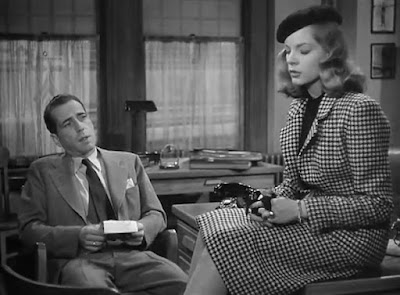
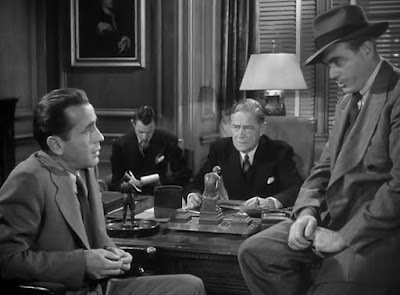
The Mask of Dimitrios (1944) is one of the classic films noir of the 1940s, and it stars two of the more colorful figures of that period, Sydney Greenstreet and Peter Lorre.  Only on this occasion, instead of playing shady and somewhat threatening supporting roles, they are cast as the stars of the film and represent the protagonists of the story.  Greenstreet and Lorre appeared together in nine famous films during this period – The Maltese Falcon (1941), Casablanca (1942), Background to Danger (1943), Passage to Marseille (1944), The Mask of Dimitrios (1944), The Conspirators (1944), Hollywood Canteen (1944), Three Strangers (1946), and The Verdict (1946) – but I would say that The Mask of Dimitrios features their greatest and most memorable performances.

Interestingly, despite their being cast here in The Mask of Dimitrios in the roles of the protagonists, Greenstreet and Lorre here retain their usual shady cinematic personae.  Lorre is his usual slimy self, and Greenstreet is characteristically abrupt and threatening, although he is here perpetually delivering his sanctimonious statement: "There's not enough kindness in the world".  Nevertheless, we are in film noir territory here, so it all fits together nicely.  Indeed, film scholar Keith Roysdon, who wrote an essay in praise of the Lorre-Greenstreet acting collaboration [1], commented:
“‘Mask of Dimitrios’ is . . . the peak of the Lorre and Greenstreet movies.”
The film was directed by the versatile Jean Negulesco, and it was based on the famous 1939 novel of the same name (aka in the U.S.: A Coffin for Dimitrios) by popular British author Eric Ambler.  The cinematography and editing was handled by Arthur Edeson and Frederick Richards, respectively; and while there are a number of distracting jump-cuts and camera-axis-crossing shots, the film’s overall appearance does very well conform to the dramatic visual panache of the dark urban film-noir underworld.  The film’s music was composed by the prolific Adolph Deutsch, who was also responsible for the music in The Maltese Falcon.  The result was a classic film noir in all its trappings.  And over the years, The Mask of Dimitrios has consistently drawn a number of appreciative reviews [1,2,3,4,5,6,7,8,9,10].  
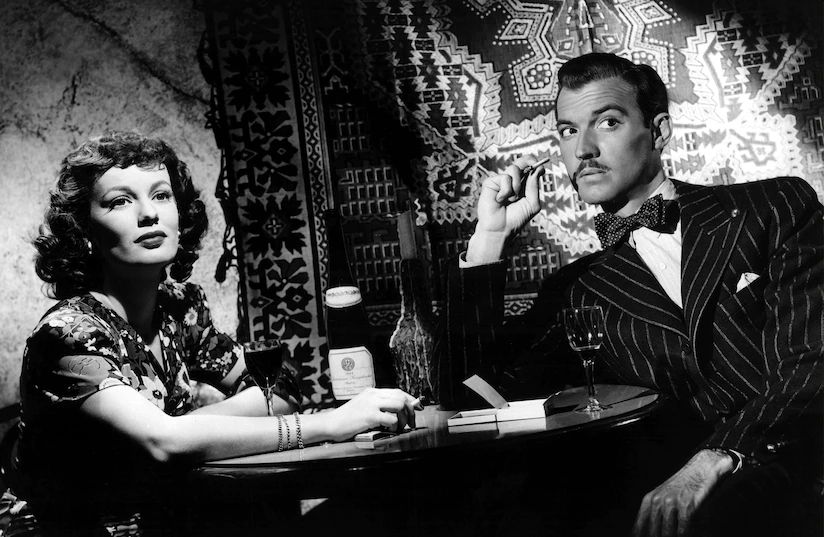
The narrative of The Mask of Dimitrios is somewhat complicated by the retelling in flashback of several lengthy past episodes from the life of the nefarious Dimitrios Makropoulos (played by Zachary Scott in his first starring role).  Dimitrios, we will learn, is a liar, thief, murderer, spy, gangster, betrayer, and traitor.  The person interested in learning his story is a well-known detective story writer, Cornelius Leyden (Peter Lorre), who believes Dimitrios would make a good subject for his next book.  

The story begins in 1938 with Leyden visiting Istanbul.  At a social gathering Leyden meets a high-ranking police officer, Colonel Haki (Kurt Katch), who is a fan of Leyden’s writing.  Haki tells him about Dimitrios Makropoulos, whose dead body was recently washed up on the beach.  It is revealed that Dimitrios is known to have engaged in various criminal activities over the past sixteen years in a number of places – successively in Smyrna,, Athens, Sofia, Belgrade, and Paris.
The evil nature of Dimitrios intrigues Leyden, and he is allowed to see the corpse just before it is disposed of.  Afterwards, a stout gentleman, a Mr. Peters (Sydney Greenstreet), also comes to the morgue to see the corpse, but he arrives too late.

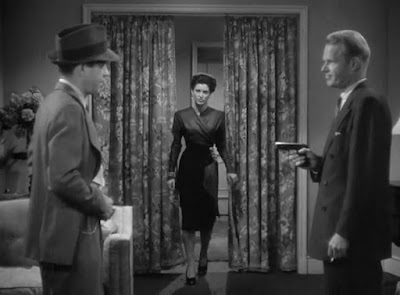
Intent on basing his next novel on Dimitrios, Leyden travels to Athens to dig up more info about  him, but he doesn’t find much.  So he heads to Sofia, where he is able to track down Irana Preveza (Faye Emerson), a former lover of Dimitrios fifteen years ago.  Telling him in flashback, she says Dimitrios was involved in an assassination attempt and left the country using money borrowed from Irana. But despite his promises, Dimitrios never returned the money.  When  Leyden returns to his hotel room, he finds a gun-wielding Mr. Peters has searched it and demanding to know why he is interested in Dimitrios. After the mysterious Peters becomes convinced of Leyden’s relatively innocent intentions, he proposes that the two of them work together and that there may be some unexplained financial reward that results from it.

So Peters puts Leyden in touch with the genteel but sinister Wladislaw Grodek (Victor Francen).  In a 20-minute flashback Grodek relates how he had hired Dimitrios to obtain some state secrets. Dimitrios manipulated Karel Bulic (Steven Geray), a minor Yugoslav government official, into gambling and losing a huge sum so that he could be pressured into stealing charts of some strategic minefields.  Bulic ultimately confesses to the authorities and then commits suicide, but Grodek just smirks when telling about it.  However, Dimitrios double-crossed Grodek by selling the stolen charts himself to the Italian government.

Still desirous of knowing more about Dimitrios, Leyden heads to the next known stop of the man’s iniquitous itinerary, Paris.  There he meets up again with the up-to-now secretive Peters, who Leyden has by this time learned used to be a member of Dimitrios's smuggling gang.  Peters now informs Leyden that the corpse he saw in the morgue in Istanbul was not that of Dimitrios, and he proves it by showing Leyden an identifying photograph of the of the man, not Dimitrios, who was killed in Istanbul.  Dimitrios, Peters informs Leyden, is still alive and is living under an assumed name in Paris.  Since Leyden is the only person who has seen the corpse and can confirm that it was not Dimitrios, he and Peters are now in a position to blackmail Dimitrios. Peters wants one million francs from Dimitrios for his silence, and Leyden agrees to go along.  

Peters knows how to get in touch with Dimitrios, and he arranges a secret meeting between himself, Dimitrios, and a suitably disguised Leyden.  At the meeting Peters issues to Dimitrios his demand for one million francs in cash, or he will reveal Dimitrios’s to the authorities via Leyden’s anonymized testimony.  Dimitrios grimly concedes that they have the goods on him and agrees to make the payment.

And so at a secretly arranged location, Peters and Leyden pickup a case filled with one million francs in cash.  Peters is exultant.

However, we are likely to doubt that Dimitrios will give up the ghost so quickly, and, sure enough, Dimitrios does have another play to make – and a violent one, too.  But you will have to watch the movie, yourself, to see how it all plays out in the end.

One might be tempted to wonder if there is any moral slant in The Mask of Dimitrios', although this is not often an issue in a film noir.  However, in this film, Leyden, the ever-fascinated observer of malevolent people, is presented with closeup, contrasting views of two often-congenial but ultimately pernicious antagonists going up against each other:
  • Dimitrios – He is a complete narcissist and only interested in his own utilitarian gain.  If he thinks he can gain from it and get away with it, he will lie to, cheat, murder, and/or betray any person he comes across.  Other people don’t count for him.
     
  • Peters – Although we know that he has been a member of a smuggling gang, Peters does care about other people.  That is why his slogan is "there's not enough kindness in the world".  But he cares about people in both positive and negative ways.  He can sometimes hate them and want to take revenge on them.  Indeed, he has spent a major part of his life engaged in a revenge campaign against Dimitrios.  For Peters, this revenge is even more important than the one million francs.
So Dimitrios and Peters are malicious, but in different ways.  Dimitrios is almost a cold-blooded self-serving robot, out only for his personal gain, whereas Peters does concern himself with other people but sometimes in a vengeful way.

I personally believe that we have all been placed in this world with the assigned goal of bringing joy to all the beings that we encounter while we are here.  And anger, hatred, and vengeance have no place in the carrying out of this mission (as you may have guessed from my reviews of other revenge-films).  Therefore Peters is no angel here.  And so Leyden must consider that aspect of his encounters with the people he has met in this story, too.  

At any rate, Sydney Greenstreet and Peter Lorre with their colorful personages, do an excellent job of raising these issues in The Mask of Dimitrios.  As for the overall moral slant of the film, perhaps it does just come down to the need for more kindness.  After all, the final words expressed in the film are Greenstreet’s:
"There's not enough kindness in the world."
★★★★

Notes:
  1. Keith Roysdon, “Peter Lorre and Sydney Greenstreet: Film Noir's Greatest Odd Couple”, CrimeReads, (30 April 2021).   
  2. Bosley Crowther, “THE SCREEN; The Mask of Dimitrios'”, The New York Times, (24 June 1944).  
  3. Walter E. Wilson, “The Mask of Dimitrios”, The Harvard Crimson, (28 October  1957).   
  4. “The Mask of Dimitrios Reviews”, TV Guide, (n.d.).     
  5. Orson DeWelles, “The Mask of Dimitrios (1944) with Peter Lorre and Sydney Greenstreet”, Classic Film Freak, (28 June 2011).   
  6. “Synopsis”, The Mask of Dimitrios, Turner Classic Movies, (n.d.).   
  7. James Steffin, “The Mask of Dimitrios”, Turner Classic Movies, (24 October  2003).   
  8. Dennis Schwartz, “Mask of Dimitrios, The”, Dennis Schwartz Movie Reviews (5 August 2019).   
  9. Leonard Quart, “FROM THE ARCHIVES: The Mask of Dimitrios”, Cineaste Magazine, Vol. XXXVIII, No. 4, (2013).   
  10. Glenn Erickson, “The Mask of Dimitrios”, DVD Savant, (20 June 2013).   

“The Big Sleep” - Howard Hawks (1946)

The Big Sleep (1946) is a famous film noir directed by Howard Hawks – in fact some people think it is the greatest of all films noir [1,2,3,4,5,6].  It is based on famous detective fiction writer Raymond Chandler’s first novel, The Big Sleep (1939), which featured Chandler’s favorite fictional protagonist, private detective Philip Marlowe.  In Hawks’s film version here, Marlowe is played by Humphrey Bogart, and this was one of the factors that made this film noir so popular – it turned out to be one of Bogart’s more famous roles.  Another factor in the film’s popularity was the romantic pairing of Bogart (aged 44) with Lauren Bacall (aged 20), a combo that had already achieved significant traction with the public from Hawks’s earlier To Have and Have Not (1944).  “Bogie and Bacall” were coupled offscreen, too, and they got married during this period.

Despite the fame of this film, though, there are aspects of it that make the work problematical.  For one thing, the plot of The Big Sleep (both that of the film and the novel) is so convoluted that most viewers can’t keep track of it.  This is partly a consequence of Chandler’s practice of basing each of his novels on several of his earlier-published short stories, each of which had its own plot.  And anyway, plot was less important for Chandler than atmosphere and characterization.  It seems that he wanted more to create a sense of tension rather than to tell a story.  So the task was considerable for the esteemed screenwriters who worked on the film:
  • William Faulkner, a novelist and short story writer who won the 1949 Nobel Prize for Literature,
  • Leigh Brackett, who later scripted another famous film noir based on a Raymond Chandler novel, The Long Goodbye (1973), and
  • Jules Furthman, a prolific screenwriter whose vast repertoire includes the  scripting of seven of Josef von Sternberg’s films.
Not only did Faulkner, Brackett, and Furthman need to tone down the explicit sexuality (including homosexuality) in Chandler’s original account, they also had to understand and try to make some sense of Chandler’s tangled plot in the novel.  One notable example of this difficulty occurred during the shooting of the film when Bogart and Hawks wanted to know who committed one of the seven key murders in the film [5].  That is, was Sternwood’s chauffeur murdered or was it a suicide?  It bothered  Bogart and Hawks so much that Hawks sent a telegram to Chandler to find out.  But it turned out that Chandler didn’t know, either!  As I said, Chandler was mainly concerned with atmosphere, not facts about who did what.

The story, such as it is, of The Big Sleep begins with Los Angeles private detective Philip Marlowe (Humphrey Bogart) being summoned to the mansion of General Sternwood (Charles Waldron), a wealthy invalid with two wanton young daughters – the lewd and self-indulgent  Carmen (Martha Vickers) and the divorced Vivian Rutledge (Lauren Bacall).. Sternwood is concerned that Carmen is being threatened for the nonpayment of her gambling debts. Marlowe agrees to look into the matter.  

But things turn out to be not so simple as that.  Marlowe soon learns that Carmen was being blackmailed by her phony creditor, whom Marlowe soon finds murdered.  And Marlowe learns from Vivian that her younger sister Carmen has been blackmailed before by other mysterious gangsters and miscreants, who may or may not be involved in this current murder.  Throughout all the various violent events that come along and the corpses that pile up, Marlowe tries to figure out what is going on.  But he is always one step behind.  However, along the way, Marlowe and Vivian (who also turns out to be a victim of blackmailing) gradually develop an attachment for each other.

I won’t go over the plot details here, but I can say that in the end, things get somewhat resolved, although we do learn that Marlowe, Vivian, and Carmen each killed someone who was threatening them individually [2].  

So what is it that accounts for The Big Sleep’s popularity?  I don’t think it is the intricate plot, because the plot is too random and loose-ended.  Moreover, we don’t get much of a feeling for what motivates most of the events that transpire.  And I don’t think it is the “Bogie and Bacall” Mystique, either.  That relationship is very much in the background and never really occupies center stage.  

No, I think what accounts for The Big Sleep’s popularity is that the film is so heavily loaded with all the accoutrements of film noir stylistics.  There is a nonstop barrage of all the incidental elements that the aficionados of film noir look for and recognize when they encounter an instance of the genre – 
  • a dark, cynical, and obscure protagonist
  • attractive women with unclear pasts and ambiguous intentions
  • unexpected encounters with shady characters
  • unanticipated violence
  • cynical and innuendo-loaded wisecracks and dialogue
Thus film critic Roger Ebert loved the film precisely for these elements, as he remarked
[5]:
Working from Chandler's original words and adding spins of their own, the writers (William Faulkner, Jules Furthman and Leigh Brackett) wrote one of the most quotable of screenplays: It's unusual to find yourself laughing in a movie not because something is funny but because it's so wickedly clever. (Marlowe on the "nymphy" kid sister: "She tried to sit in my lap while I was standing up.") Unlike modern crime movies which are loaded with action, "The Big Sleep" is heavy with dialogue--the characters talk and talk, just like in the Chandler novels; it's as if there's a competition to see who has the most verbal style.
But I don’t see things that way.  An outstanding film cannot be just all clever talk; it has to have a compelling narrative, and The Big Sleep doesn’t have that.  The story of this film is too loose-ended and contorted.  So although the film has some entertaining moments (I did like the brief, separate interactions Marlowe had with Carmen (Martha Vickers) and Harry Jones (Elisha Cook, Jr.)), this is certainly not a great film noir.
★★★
 
Notes:
  1. Leonard Maltin (ed.), “The Big Sleep (1946)”, Leonard Maltin’s Classic Movie Guide, Plume, (2005), p. 47.  
  2. Tim Dirth. “The Big Sleep (1946)”, “Filmsite”, (n.d.).   
  3. Andrew Sarris, “Living the private-eye genre”, films in focus, The Village Voice” (8 November 1973).   
  4. Jeffrey M. Anderson, “I'd Like More”, The Big Sleep (1946), Combustible Celluloid, (n.d.).   
  5. Roger Ebert, “The Big Sleep”, Great Movies, RogerEbert.com, (22 June 1997).   
  6. Brian Cady, Margarita Landazuri, and Frank Miller, “The Big Sleep”, Turner Classic Movies, (17 February 2005).     

“Aguirre, the Wrath of God” - Werner Herzog (1972)

Werner Herzog, one of the most versatile and creative film directors, has had a remarkably successful career spanning across a number of genres over more than fifty years.  However, I would say one of his greatest works came relatively early on in his career, with his third fiction feature film, Aguirre, the Wrath of God (Aguirre, der Zorn Gottes, 1972).  This is a historical drama set in 16th century Peru and concerns the activities of some Spanish conquistadors in search of the legendary city of gold, El Dorado [1].  But the film’s subject matter stretches far beyond its overt topic of Spanish conquistadors in South America and extends off into vistas relating to Herzog’s characteristically gloomy view of human existence as a whole.  

You might think that such a film focussed on a pessimistic view of humanity would not attain widespread popularity, but Herzog’s unique cinematic vision led to the fashioning of one of the all-time great films.  Upon its release, ,Aguirre, the Wrath of God quickly acquired cult status, and it is said to have directly influenced subsequent important works, such as Francis Ford Coppola's Apocalypse Now (1979) and Terrence Malick's The New World (2005).  And over the years, the critical appreciation of the film has only grown [2,3,4,5,6,7].

Actually, the making of Aguirre, the Wrath of God has acquired a somewhat legendary status in its own right [5,6,7].  Herzog took a small film crew to shoot on location in Peru.  But the harsh, life-threatening shooting conditions in the Amazon rainforest and Herzog’s customary extemporaneous shooting style (he often made things up as he went along, which meant that the film had to be shot in narrative sequence) made things almost impossible for the frazzled crew.  In addition, there was the further matter of working with hot-headed lead actor Klaus Kinski, who was characteristically stubborn and maniacally volatile.  Nevertheless, Herzog somehow got a brilliant performance out of Kinski, and in fact this film was the first of five Herzog-Kinski collaborations.  (How Herzog managed to work with the temperamental Kinski over the years is covered in some detail in Herzog’s later documentary film My Best Fiend (1999)).  

Despite these trying and dangerous production conditions, however, the resulting film that Herzog and his team produced was masterful all across the board.  The acting from a diverse collection of actors was excellent, and the cinematography was superb.  Indeed the cinematography fashioned by Herzog and cinematographer Thomas Mauch plays a key thematic role in the film.  Equipped only with a 35mm camera Herzog had stolen from the Munich Film School, they managed to convey the dense imagery of the Amazon rainforest as a symbol of the oppressive and entangling nature of man’s unfeeling natural environment.  Thus Nature, itself, was rendered to be a cruel player/antagonist in this story.  Moreover, because of Herzog’s extemporaneous filming style, skilled post-production work in the editing room on the part of Beate Mainka-Jellinghaus was undoubtedly crucial to the film’s smooth narrative flow.

The story of Aguirre, the Wrath of God is based on a real historical figure, Spanish conquistador Lope de Aguirre (1510-1561), who was active in Spanish colonialist activities in South America during the 16th century.  However, Herzog massaged various facts and events from that era to come up with his own, more streamlined storyline that has many fictional elements.  In particular in Herzog’s version, several separate historical sequences of events have been combined into a single expedition.  So in this (Herzog’s) story, Aguirre is part of an expedition undertaken by Hernando Pizarro, (one of the famous conquistador Pizarro brothers), who,  after the conquest of the Inca empire, led an expedition of several hundred Spanish soldiers over the Andes mountains in order to go down the Amazon river in search of the fabled city of El Dorado.  But, as I mentioned, Herzog’s refashioned story is not so much one concerned with historical accuracy as it is one constructed instead to evoke Herzog’s grim vision.  In fact the expedition depicted here in Aguirre, the Wrath of God can be considered to be Herzog’s vivid nightmare of a willful descent into Hell.

The narrative of Aguirre, the Wrath of God can be viewed as made up of three unequally lengthed sections.  

1.  Descent into the Maelstrom
In 1560 Gonzalo Pizarro (played by Alejandro Repullés) leads several hundred armored Spanish conquistadors and a similar number of Indigenous slaves down a steep mountain path in the Andes towards the Amazon River.  They have heard that somewhere along that river is their hoped-for destination, the legendary city of El Dorado.  The heavily forested path is so steep and narrow that it seems almost impossible for them to make the journey, themselves, not to  mention transport their cannons and provisions, too.  How Herzog and Thomas Mauch managed to film this harrowing sequence must have been a story in itself.  As the single-file descent, which includes equipment accidents and injuries, proceeds, it almost looks as if Mother Nature is enshrouding her new captives in green leafy burial garments.  

When they reach the river, Pizarro, assessing that their slow progress has left them very low on provisions, decides to have a group of forty men take four constructed rafts and go on an advanced scouting mission down the river.  If they don’t return within a week, they will be presumed lost, and the rest of the party will travel back up over the mountains to their main fortress.  For this scouting mission, Pizarro selects Pedro de Ursúa (Ruy Guerra) as the commander and Lope de Aguirre (Klaus Kinski) as second-in-command.   Also assigned are Fernando de Guzmán (Peter Berling) as a royalty representative and Brother Gaspar de Carvajal (Del Negro) to bring religion to the natives.  And accompanying them, surprisingly, will be Ursúa's fiancé, Doña Inés (Helena Rojo) and Aguirre's 15-year-old  daughter, Flores (Cecilia Rivera).

2.  The Ursúa-led Mission
The scouting mission sets off, but one of the four rafts gets stuck in an eddy and is unable to get free.  The others of the group stop and make camp, but they are unable to help their comrades trapped in the whirling eddy.  Then overnight the men on this trapped raft are mysteriously shot and killed. Ursúa wants the dead bodies to be brought back to camp for proper burial, but Aguirre, not wanting to be delayed, conspires to have the raft and bodies destroyed by cannon fire.  Up to now Aguirre’s presence has been relatively minor, but from hereon we see his malevolence coming to the fore.

During the night, the river rises and sweeps away the remaining rafts.  Ursúa has now had enough and orders the end of the scouting mission and that they should all return to Pizarro's group.  But the greedy Aguirre doesn’t accept this and leads a mutiny against Ursúa.  Aguirre gains support among the men for his mutiny by pointing out that Cortes conquered Mexico and achieved wealth and power by staging a mutiny.  When Ursúa tries to thwart the mutiny, he is shot, but not fatally, and Aguirre takes over as the leader.  Inés proceeds to care for the seriously wounded Ursúa.  When she appeals to Brother Carvajal to intercede against Aguirre’s rebellious takeover, he cynically informs her that the Church has always backed the strong.

3.   Aguirre Takes Over
Aguirre has the soldiers elect the indolent Fernando de Guzmán (because the man is a royal ornament) as the new leader of the expedition, and then goes even further and has Guzmán identified as the new imperial emperor.  But of course the swaggering Aguirre is the real man in charge.  In fact the very way that Aguirre swaggers and struts, as performed by Kinski, seems to be an  instrument of control in itself.

Aguirre orders a new, larger raft to be built, and his deranged descent into Hell continues.  With precious food supplies running out as they drift downstream, greed, jealousy, and eventually madness begin to take over.  When their raft is approached peacefully by an inquiring Indigenous couple in a canoe, Brother Carvajal has the visitors killed for allegedly insulting God.  The sight of the portly Guzmán gorging himself on their scant food supplies leads to some of the men to secretly kill their new “emperor”.  To the real man in control, Aguirre, this hardly matters.  He simply declares himself to be the new emperor, and he orders Ursúa, whose life up to this point  had been preserved by Guzmán, taken ashore and hanged.  

But the isolation of he group continues, and their attempts to engage with the Indigenous people gets nowhere.  Apart from that one friendly but ill-fated approach by the native couple in a canoe, these people are basically invisible to the invading conquistadors.  But their presence is felt by occasional salvos of lethal arrows that are frequently directed at them from behind bushes and trees.  Gradually, Aguirre’s people are getting picked off one-by-one by an invisible mortal force.

And as crazed desperation sets in, the starving men begin to wonder what is a hallucination and what is real.  Are these silent deadly arrows appearing suddenly from out of nowhere real, or are they imaginary?  At one point they all stare in amazement at a large wooden ship perched in the highest branches of a tall tree.  (To many viewers, this weird image will seem to be an eery foreshadowing of the later Herzog-Kinski movie Fitzcarraldo (1982)).

Eventually everyone besides Aguirre on the slowly drifting raft is dead, even Aguirre’s teenage daughter, Flores, towards whom he had incestuous urges and whom he wanted to make his queen.  The movie ends with the crazed figure Aguirre continuing to rant and rave his mad dreams of power, with the only ones available to hear being a band of monkeys who have boarded the raft.


These closing images of self-destructive greed and madness are so powerful that they linger in the minds of many viewers long after seeing the film.  In fact it is the visual images, rather than dialogues, that are the cinematic keys to Herzog’s greatness.  As mentioned, Herzog tends to make up the spoken words on the fly during the shooting of his films.  The focus of his narrative imagination is the stream of visuals that he has in his mind.  Even principal actor Klaus Kinski, in the role of Aguirre, doesn’t have that many lines to speak in the film.  The key to Kinski’s performance is his physical posturing throughout the film.  Kinski is constantly shown leaning at an angle, but not usually holding onto anything for support.  This leaning posture is suggestive of someone engaged in momentary pondering just prior to some firm, impending negative action.  Thus Aguirre’s visual imagery suggests a man always on the verge of something emphatically contrary.  And that threatening imagery is what we remember about him.

So what is Herzog’s message in Aguirre, the Wrath of God?  I would say it is based on two relatively somber themes that have long underlain his work:
  • His concern that so much of European (i.e. Western) civilization has been based on greed and selfish utilitarianism.  This egoistic focus has fuelled exploitative Western imperialism and colonialism across the globe and continues to this day.  It was this that drove Aguirre’s desire to go to any lengths to find and plunder the legendary city of El Dorado.
     
  • His glum recognition that the natural world, i.e. “Nature”, is devoid of the human values of beauty and harmony that we sometimes attribute to it.
In support of my assertions here, I offer the following quotations from some of my reviews of other Herzog films.
  • From Lessons of Darkness (1992) [8]:
     
    “The demonic forces that lurk inside the hearts of men seem to be beyond civilized understanding or rational control.  These issues of cruelty and madness are as elemental as fire, itself . . .“
     
  • From Heart of Glass (1976) [9]:
       
    Man’s efforts to understand the universe and build a humane civilization are doomed to failure in the face of his own depravity and the incomprehensibly vastness of great Nature. The universe is infinite and brutal, unmindful and unaffected by our puny efforts to find truth and beauty. Our so-called civilisation has tried to tame nature, but it is based on reductionist mechanism and increasingly drives us further away from any chance of harmony within it. “
     
  • And from Herzog, himself, (from my review of Into the Inferno (2016) [10]):

    “I don’t see [the jungle] so much erotic. I see it more full of obscenity. It’s just – Nature here is vile and base. I wouldn’t see anything erotical here. I would see fornication and asphyxiation and choking and fighting for survival and growing and just rotting away. Of course, there’s a lot of misery. But it is the same misery that is all around us. The trees here are in misery, and the birds are in misery. I don’t think they sing. They just screech in pain.” [11]
       
    and
     
    “There is a harmony [in nature] . . . it is a harmony of overwhelming and collective murder.” [12]
So I would say that Herzog’s two rather pessimistic notions have been present throughout his work.  And in Aguirre, the Wrath of God, both of these sentiments are on full display and symbolically facing each other – Aguirre, the self-centered and exploitative European, is fighting a losing battle with an even more unfeeling and exploitative force: Nature, itself.  Indeed these two notions have probably been no more vividly and aesthetically expressed than here in Aguirre, the Wrath of God.
★★★★

Notes:
  1. “El Dorado”, Wikipedia, (27 August 2021).  
  2. Peter Bradshaw, “Aguirre, the Wrath of God”, The Guardian, (17 August 2001).   
  3. Peter Bradshaw, “Aguirre, the Wrath of God - review”, The Guardian, (6 June 2013).    
  4. Fernando F. Croce, “Aguirre, the Wrath of God (Werner Herzog / West Germany, 1972): (Aguirre, der Zorn Gottes)”, Cinepassion.org, (n.d.).   
  5. Jeffrey M. Anderson, “Aguirre, the Wrath of God (1972), Herzog's Mad Journey”, Combustible Celluloid, (1999?).   
  6. Bruce Bennett, “An Infamous Mutiny, A Descent Into Madness”, The New York Sun, (20 October 2006).   
  7. Roger Ebert, “Aguirre, the Wrath of God”, RogerEbert.com, (4 April 1999)..   
  8. The Film Sufi, “‘Lessons of Darkness’ - Werner Herzog (1992)”, The Film Sufi, (30 May 2010).   
  9. The Film Sufi, “‘Heart of Glass’ - Werner Herzog (1976)”, The Film Sufi, (6 September 2008).   
  10. The Film Sufi, “‘Into the Inferno’ - Werner Herzog (2016)”, The Film Sufi, (11 November 2019).   
  11. Werner Herzog, “24 Wonderfully Bonkers Werner Herzog Quotes”, (Compiled by Nico Lang), Thought Catalog, (24 April 2013).   
  12. from Les Blank’s film, Burden of Dreams (1982), which is about the shooting of Herzog’s Fitzcarraldo (1982).

“Black Orpheus” - Marcel Camus (1959)

Black Orpheus (Orfeu Negro, 1959) is a wondrous film with a rich range of thematic features – romance, tragedy, music, dancing, life in Brazilian pardo favelas (poor, mixed-race neighbourhoods), and the evocation of a Greek mythological legend.  Each of these layers of Black Orpheus adds further richness to what is ultimately a spectacle of sensuality and passion. And it is for this reason that Black Orpheus seems to be relatively beyond routine comparison with other films.  

The film was directed and co-scripted (with Jacques Viot) by Frenchman Marcel Camus, but it was shot in Brazil with an almost exclusively Brazilian cast of nonprofessional actors and released in Brazilian Portuguese.  It was based on Vinicius de Moraes’s Brazilian stage play Orfeu da Conceição (1956), which, itself, was a modernization of the ancient Greek legend of Orpheus and Eurydice.

In that legend, Orpheus, the son of the god Apollo and an irresistible lyre player, falls madly in love with and marries the beautiful nymph Eurydice.  However, shortly after their marriage, Eurydice is bitten by a poisonous snake (an incarnated symbol of death) and dies.  Orpheus is inconsolable and decides to try and descend to Hades, the underworld, to see his beloved.  With his magical lyre-playing, Orpheus secures permission from the gods to escort Eurydice back to the world of the living, but with one condition: while walking out from the dark underworld, Eurydice must follow behind Orpheus, and he must not look at her before they come out into the light.  In the event, however, Orpheus cannot resist the temptation to turn and look at her, and he loses her forever.

In this modernization of that Greek legend, the setting is Rio de Janeiro during their famous Carnaval festival, which is held just before the Lent period prior to Easter and which features massive displays of singing and dancing.  The Brazilian Carnaval very much forms the colorful backdrop to this story, and the film’s excellent production values reflect and reinforce the festive  mood summoned by this festival.  In particular, both the cinematography by Jean Bourgoin and the film editing by Andrée Feix are very effective in this regard.  But even more special attention should be directed to the music by Luiz Bonfá and Antônio Carlos Jobim.  I especially liked two songs composed by Luiz Bonfá,  "Manhã de Carnaval" [1] and  "Samba de Orfeu", that were so good that their presence could even have been accentuated in the film.  They still ring in my memory.

The story of Black Orpheus has three main sections to it.

1.  Orpheus and Eurydice meet
In the beginning of the film, Eurydice (played by Marpessa Dawn) arrives in Rio de Janeiro looking for the home of her cousin Serafina (Léa Garcia).  She takes the trolley north to the end of the line, where the tram driver Orfeu (“Orpheus”, Breno Mello) notices his tram’s lone occupant and introduces her to station master Hermes (Alexandro Constantino), who gives her directions to Serafina’s home area up in a favela in the surrounding hills.  

After she departs, Orfeu is then shown with his possessive fiancé, Mira (Lourdes de Oliveira).  Mira is glamorous but very jealous about any women with whom Orfeu associates, especially since Orfeu can be clearly seen to be something of a playboy.  Then Orfeu goes back alone to his own hut that is in the same favela and next door to where Serafina happens to live.  There he is greeted by two neighbour boys, Benedito (Jorge Dos Santos) and Zeca (Aurino Cassiano), who love Orfeu’s guitar playing and who believe Orfeu's story that his entrancing                 guitar music makes the sun rise every morning.  Orfeu then plays and sings for them the beautiful song “Manhã de Carnaval”.

Meanwhile Eurydice has found Serafina’s hut and has been explaining to why she has come to Rio.  It is not for the Carnaval, but to escape and hide from a mysterious stalker who she thinks is trying to kill her.  Afterwards, both Eurydice and Orfeu are delighted to discover that they are next door neighbors.

2.  Carnaval Dancing 
It turns out that Orfeu, Mira, and Serafina are all skilled samba dancers and will have prominent roles in the Carnaval street dancing coming up.  Eurydice is a good dancer, too.  At a rehearsal coordinated by Orfeu, the many participants all dance madly to the rhythmic music, and this is beautifully shown by the coordinated cinematography of so many dancing feet, including one breathtaking shot lasting 50 seconds.  However, during these festivities Eurydice’s silent pursuer, dressed in a skeleton costume, shows up and threatens Eurydice.  Orfeu comes and chases away this stranger (Adhemar da Silva), whom we shall call “Death”, and Orfeu protectively allows her to stay at his place for the night.  In the process, Orfeu and Eurydice fall in love.

Later at the Carnaval festivities, Serafina gives her own dance costume and mask to Eurydice so that the girl can dance with Orfeu without Mira knowing.  But Mira manages to discover this chicanery and rips off Eurydice’s mask and attacks her.  Eurydice runs away both from the uncontrollably vengeful Mira and also Death, who had been looking for her.  Eventually Eurydice, hoping to find refuge with Hermes, makes it to the now dark and deserted end-of-the-line tram station, with Death in hot pursuit.  Orfeu has been following the two of them, and when he shows up, he tries to find the hiding Eurydice by going to the switchboard and throwing on the master power switch.  But Eurydice has been holding onto a live wire, and she is instantly electrocuted.  Death then confronts Orfeu and tells him, "she's mine now," before knocking him out cold.

3.  Looking for Eurydice 
When Orfeu comes to, he is informed that Eurydice is dead, but he can’t accept it.  He rushes off to the hospital and then to the Bureau of Missing Persons, but to  no avail.  A sympathetic janitor at the latter office takes Orfeu to his Macumba cult religion ritual, where a symbolic, song-filled rite is conducted.  During the ritual, Orfeu is urged to sing out, and when he does so, he hears from behind him Eurydice’s voice clearly calling to him.  She warns him not to turn around or he will lose her forever.  But unable to suppress his desire to see his beloved, Orfeu turns anyway and looks to see the voice calling him is coming from an old woman sitting behind him.  Eurydice is gone.

Still grieving, Orfeu goes to the city morgue and retrieves Eurydice's body, which he carries away in his arms back toward his home in the cliff-lined hills.  When he nears his home, he sees that it has been set on fire, and an enraged Mira is running toward him.  A rock she throws at him strikes him in the head and knocks him over the cliff to his death.  Although Mira was Orfeu’s legitimate fiancé, by this point she had become the film’s symbol of vengeance and oppression.

In the final scene the next morning, Benedito retrieves Orfeu’s guitar and urges Zeca to play it like Orfeu in order to make the sun rise.  Zeca plays, and the sun rises as the children dance around joyfully.

These closing images reinforce the theme that reverberates all through the film – that the ephemeral raptures of love and life are best experienced by immersing ourselves in the songs and dances that embody those joys. These songs and dances give us the opportunity to rapturously express ourselves in ways that words can never accommodate.  This is what the revelrous dancing of Carnaval is intended to evoke.  So the delirious dancing sequences shown in Black Orpheus are not only bewitching; they are also an intrinsic part of its story in visual and musical form.  

However, despite the many thematic dimensions of Black Orpheus, there have been some critics who have wanted the film to take on additional, more socially oriented, aspects.  These have included 
  • The nature and ongoing causes of poverty of favelas in Rio de Janeiro
  • The extent of racial discrimination in Rio de Janeiro and in Brazil overall
  • The lasting effects of European colonization and exploitation on Brazilian life
  • The degree to which there is exact adherence to the original Greek myth of Orpheus and Eurydice (concerning which there are in fact several different versions [2]).
The more vehement of the film’s naysayers went further and complained about the film’s “simplified and sanitized portrayal of happy-go-lucky dark-skinned people just dancing and making merry, oblivious to the systemic corruption and injustice that keeps them living in squalid run-down shacks” [3].  But I don’t go along with such judgements.

While all of the above issues may be of interest in the appropriate context, it is not necessary that every film that is set in a Rio favela or touches on a Greek myth must specifically address those issues.  Black Orpheus can stand on its own merits.  And in my view, those merits are clearly evident for all to see.  Moreover, the overwhelming majority of critics and viewers over the years have felt the same way (e.g. [4,5,6,7,8 ]).  More formally and industry-wide, Black Orpheus was awarded the Palme d'Or at the 1959 Cannes Film Festival, the 1960 U. S. Academy Award (Oscar) for Best Foreign Language Film, and the 1960 Golden Globe Award for Best Foreign Film.

So I recommend you just enjoy the film’s samba-driven narrative that is driven by the vivid rhythmic theatrics of its four iconic figures – Orfeu, Eurydice, Mira, and Death.
★★★★

Notes:
  1. “Manhã de Carnaval”, Wikipedia, (14 July 2021).   
  2. “Orpheus and Eurydice”, Wikipedia, (30 July 2021).   
  3. David Blakeslee, “Black Orpheus (1959) - #48", Criterion Reflections, (10 May 2011).   
  4. Bosley Crowther, “Screen: Legend Retold; 'Black Orpheus' Bows at the Plaza”, The New York Times, (22 December 1959). 
  5. David Ehrenstein, “Black Orpheus”, “The Criterion Collection”, (7 June 1999).   
  6. James Bowman, “The Great Illusion of Carnaval”, The New York Sun, (24 February 2006).   
  7. Michael Atkinson, “Black Orpheus: Dancing in the Streets”, The Criterion Collection, (18 August 2010).   
  8. Glenn Heath Jr., “DVD Review: Marcel Camus’s Black Orpheus on the Criterion Collection”, Slant Magazine, (18 August 2010).  

“The Crowd” - King Vidor (1928)

The Crowd (1928) is not only one of the greatest silent movies, it quite simply stands, in my view, as one of the greatest of all films ever made, period.  Conceived and directed by famous filmmaker King Vidor, the film covers the joys and woes of an ordinary young couple trying to make a go of it in a teaming metropolis full of similar people all seeking to stand out from “the crowd”.  This may sound like a fairly simplistic narrative scheme for a film, and in fact some people, like the early reviewer in Variety found the film boring [1].  And even today, The Crowd does not usually come first to the minds of most people thinking of great silent films.  But Vidor and his production team took this basic idea and fashioned a truly noteworthy work.  And over the years, reviewers who have had a chance to see The Crowd have consistently heaped praise on this masterpiece [2,3,4,5,6,7,8].

Vidor had recently made his famous antiwar hit, The Big Parade (1925), which was concerned with the more spectacular theme of the devastating impact of The Great War (World War 1), the horrors of which still reverberated in the world’s consciousness; and so his producers at MGM Studios were hoping for another blockbuster like that from Vidor.  The outline for The Crowd seemed very tame by comparison, and they were not so enthusiastic about the new project.  But given Vidor’s track record at the box office, they went ahead with it anyway and provided relatively big-budget funding.  And when we watch the film, we can see that the screenplay by King Vidor and John V. A. Weaver, the cinematography (which features some remarkable moving-camera shots) by Henry Sharp, the film editing by Hugh Wynn, along with Vidor’s direction, are all first-rate.

One measure of the breadth and polish of The Crowd's production team is the fact the film is considered to feature both Expressionist and Neorealist elements to it (it is even said that Italian Neorealist master Vittorio de Sica was inspired in his own work by The Crowd)  [2,7,8] – these are two contrasting aesthetic approaches that seem almost at odds with each other.  Neorealism suggests the raw,  objective reality of the street [9,10], while Expressionism “seeks to represent the external world as a reflection of the inner feelings of the author” [11].  Somehow Vidor managed his production to effectively invoke both of these evocative perspectives to great effect at various points along the way.

Mention should also be made of the key acting performances of the dramatis personae in the film.  While most of the secondary performers display the exaggerated countenances and theatrics common to the silent era, the two main actors gave remarkably nuanced performances.   James Murray, a relatively unknown actor, played the role of John Sims, the film’s principal protagonist, and Murray’s sensitive, natural portrayal of that character is a key ingredient to the film’s success.  Murray’s expressive and moving performance in this film should have shot him to stardom, but unfortunately that is not how it played out for him.  Murray’s persistent alcoholism ruined his career and led him downhill to vagrancy.  In 1936 his body was found in the Hudson River, a possible suicide.  

Eleanor Boardman played the part of the female protagonist, Mary Sims, and her performance was also outstanding.  Boardman, who was King Vidor’s wife at the time, was a well-known actress used to playing glamorous roles.  But here in The Crowd she plays an ordinary, plain housewife, and in the process gives the greatest screen performance of her career.  I particularly liked her meaningful looks of anticipation, which subtly conveyed more about her mental state than any dialogue subtitles could do.  

The story of The Crowd, as I mentioned, concerns what happens to an ordinary American couple in pursuit of success.  In fact the male protagonist, who was born on the 4th of July, is an exemplar of one who chases after the “American Dream”.  In this regard, most young American children are told that, however ordinary their circumstances may be, any of them could grow up someday to be U.S. President – like Abraham Lincoln.  So the film resonates particularly with American audiences.  As we follow John Sims’s pursuit of his dream, the film passes through approximately three stages.

1.  Formative Years
When John Sims is born on the 4th of July, 1900 (making him a “Yankee Doodle Dandy” and a symbolic representative of the “American Century”), his father expresses the conviction that his newborn son will amount to something.  And John carries that hope with him throughout his boyhood.  At the age of 21, John goes to seek his fortune in New York City and gets a routine desk job working for an insurance company.  The moving camera shots showing the huge, faceless skyscraper, on one of the floors of which is the insurance company’s vast open-plan office is justly famous for its expressionistic feeling.  It is here that we first see the grownup John Sims (played by James Murray) as one of a countless number of white-collar robots, which evokes, for me, imaginative images of Herman Melville’s story "Bartleby, the Scrivener”.

Bert (Bert Roach), a colleague of John’s in the huge open-plan office, sets up a blind double-date for the two of them to take two young women to the Coney Island amusement park.  On the bus on the way to the park, John spots a juggling sandwichman on the street and, turning to his date Mary (Eleanor Boardman), derisively dismisses the man as a poor sap.  

Very soon John and Mary fall in love and get married.  On their honeymoon to Niagara Falls, they take a sleeper-car train  and have their first conjugal bed experience, a scene that is deftly and amusingly handled by Vidor and his crew.  

2.  Scenes from a Marriage
In the second phase of the film, the niggling frustrations of the young married couple are brought to the fore.  John is ambitious, but he is just another nameless cog in a vast office machine.  On Christmas Eve he comes home late and drunk, standing up Mary’s family, who had come over for a visit.  Mary is always forgiving, but her husband’s constant complaining at home begins to take its toll.  She contemplates leaving him, but just then she becomes aware that she is pregnant, and that brings them back to matrimonial bliss.       

A son is born to Mary, and a few years later they are blessed with a daughter.  However, John’s low job status and failure to gain a promotion continue to be a source of frustration.  When John wins a $500 prize for an ad slogan competition, it seems that things might be finally looking up, but that only leads to an unfortunate accident that kills their young daughter.  

John is now so frustrated and depressed that he loses interest in his boring office work, and finally, in a fit of temper, he angrily resigns from his job.  

3.  Getting Desperate
Our suddenly unemployed protagonist is now constantly looking for work. But the low-paying jobs that John does find are either too boring or ones from which he quickly gets sacked.  So his jobless status goes on and on.  And he is still constantly complaining.  Mary, who takes on some home sewing work to help make ends meet, is losing her patience, and she chides her husband with the query:
“Are you sure it’s always somebody else . . . . and not you?”
Although John is essentially an innocent and well-meaning guy, he becomes more and more depressed about who he really is.  It’s not surprising then to see that when Mary’s two pompous brothers come around to grudgingly offer John a job, he angrily rejects such an offer of “charity”.  Finally fed up with her husband’s deadbeat stagnation, Mary throws him out of the house.

Now outside and at his wit’s end, John contemplates suicide.  But when he is just about to throw himself off a bridge, he encounters his cheerful five-year-old son, who loyally assures  him that he wants to grow up to be just like his dad.  This loving gesture raises John’s spirits, and he vows to keep on going towards his goal.

John gets a street job as a juggling advertising sandwich man – the very same job he had mockingly ridiculed when he had seen it from the bus on his early trip to Coney Island.  Only now, John embraces the job with enthusiasm.  He heads back home to tell Mary about his new job  in the hopes that she will forgive him.

But when John arrives home, he sees that Mary is packing up to go live with her family (her mother and two brothers).  Mary is adamant about leaving, but John manages to convince her to at least accept his invitation to take their young son and go with him to a vaudeville show for which he has purchased three tickets.  

The final shots of the film show John and Mary sitting in the vaudeville show audience and joining them all in uproarious laughter as they watch the slapstick antics being performed onstage.

This somewhat enigmatic ending is a key to The Crowd’s greatness.  We don’t know what the future will bring to John and Mary, but we do know that John is a member of “the crowd” of humanity and he seems to have finally embraced that fact.  The film implicitly urges the viewer to embrace that fact, too.  Indeed, underlying the American Dream is the idea that we are all members of “the crowd”.  The studio was worried about the ambiguity of this ending and ordered seven alternative happy-ending finales to be filmed and tested on preview audiences.  But none of them could have matched Vidor’s original ending, the one that was finally released and what we see today.                               
 
Overall, The Crowd is not to be seen only as a historical relic.  It continues to this day to be a great cinematic narrative and a moving viewing experience.  
★★★★
 
Notes:
  1. “The Crowd”, Variety, (22 February 1928).   
  2. Mordaunt Hall, “THE SCREEN; Don Juans of the Deep”, The New York Times, (20 February 1928). 
  3. Margarita Landazuri, “The Crowd”, San Francisco Silent Film Festival, (2003).   
  4. Fernando F. Croce. “Film Review: The Crowd”, Slant, (25 February 2007).   
  5. Dennis Schwartz, “CROWD, THE”, Dennis Schwartz Movie Reviews, (23 May 2007).   
  6. Mick LaSalle, “FILM REVIEW -- Vidor's Silent `Crowd' Still an Urban Masterpiece”, SFGATE, (8 November 1995, updated: 4 February 2012).   
  7. Tim Dirks, “The Crowd (1928)”, filmsite, (n.d.).   
  8. Bruce Hodsdon, “The Crowd”, Senses of Cinema, (August 2013).   
  9. The Film Sufi, “Aesthetics of Two Neorealist Films: 'Open City" and "Paisan'”, The Film Sufi, (18 November 2008).
  10. The Film Sufi, “Subjective Realism in the Italian Film”, The Film Sufi, (13 January 2009).
  11. The Film Sufi, “Expressionism in Film”, The Film Sufi, (28 June 2008).   

“Farewell, My Lovely” - Dick Richards (1975)

The 1975 film Farewell, My Lovely stands today as a classic film noir, even though it was made a number of years after the period (1940s and 1950s) in which the bulk of the films we associate with that genre were made.  For that reason, this version of Farewell, My Lovely is sometimes labelled a “neo-noir” film.  But in contrast with other, contemporaneous neo-noir films, like The Long Goodbye (1973) [1], which tended to feature updated perspectives and stylistics, the 1975 Farewell, My Lovely very much stuck with the traditional film noir style and themes.  These themes, as I have outlined elsewhere [2,3], consistently revolve around fatalism (most characters feel trapped in a dark world stacked against them), elusive truth (everyone dissembles and lies), and loyalty (because the main characters are solo operators, they always search for someone they can trust).

One aspect of Farewell, My Lovely, in particular, that helps lock it into the film noir genre is that it is based on a detective novel by Raymond Chandler, many of whose works (e.g. The Big Sleep (1939), Farewell, My Lovely (1940), The Lady in the Lake (1943),  and The Long Goodbye (1953)) served as the narrative bases for atmospheric films noir.  Chandler’s original Farewell, My Lovely (1940) was particularly famous, and it was adapted three times for major motion pictures – The Falcon Takes Over (1942), Murder, My Sweet, (1944), and the present film under discussion, Farewell, My Lovely (1975).  The protagonist in all these hard-boiled Chandler stories is the same – tough, chain-smoking private eye Philip Marlowe, and there is something of a mystique surrounding this cynical, but reflective, character.  This attracted major Hollywood stars to play this character, for example Humphrey Bogart for The Big Sleep (1946).  Here in Farewell, My Lovely it was Robert Mitchum, who, despite his age (57), gave an iconic performance of Marlowe.  

One aspect of Chandler’s Marlowe stories, though, that, despite their popularity, makes them difficult to adapt for film is their tortuous and sometimes contradictory plots; and Farewell, My Lovely was no exception.  So film screenwriters adapting these stories often make changes to them in order to move things along more smoothly for a two-hour film.  In consequence, I am told, a number of film critics and Chandler fans have objected to these changes and have dwelt on them in their reviews.  They also complain that the 57-year-old Mitchum was too old to play Marlowe.  Not having read the original Chandler stories, though, I am not one to object to such changes, and I accept critic Roger Ebert’s assurance that the script changes in Farewell, My Lovely were minor and acceptable [4].  And anyway, even as it stands, the story of the film is still convoluted,  and any simplifications that were made were probably needed.  

In any case, what helps make Farewell, My Lovely a compelling work is the expressionistic noirish atmosphere that pervades the film throughout.  Despite the fact that film director Dick Richards did not apparently have much experience with film noir stylistics, he and his team for this film combined to put together a classic that has been well received over the years [5,6,7,8,9].  In particular the cinematography by John A. Alonzo, featuring relentless moody low-angle imagery, as well as  the film editing by Joel Cox and Walter Thompson are perfectly attuned.  Even though it’s all presented in color, the visual style matches closely with the film-noir aesthetics of the 1940s.  And the 1940-style big-band music by David Shire is also evocative of the 1940s setting.

The story of Farewell, My Lovely is set in 1941 Los Angeles and told mostly as an extended flashback.  Because of the flashback format, the viewer is treated all the way along to the reflective and cynically philosophical commentary from the novel by the principle character, private detective Philip Marlowe.  But it is a vicious tale.  Over the course of this story, there will be seven major characters murdered, as well as numerous gun-wielding henchmen killed in shootouts.

At the outset, detective Marlowe (played by Robert Mitchum) is hired by ex-prizefighter and convicted bank robber Moose Malloy (Jack O'Halloran) to find his old girlfriend Velma, whom he has not seen in the past seven years that he has been in prison.  Marlowe and Malloy go to a nightclub where Velma used to work, and the thuggish Malloy kills the nightclub owner while cross-examining him, after which Malloy goes into hiding.  Meanwhile Marlowe separately connects with two old friends of Velma,  Tommy Ray (Walter McGinn) and Jessie Florian (colorfully played by Sylvia Miles).  Both of them promise to help, but both of them turn out to be liars, and both of them will be eventually murdered.

Then out of the blue, a somewhat bizarre man named Marriott (John O'Leary) hires Marlowe to help him pay a ransom in order to recover some stolen precious jade jewellery.  At the payoff point, though, Marlowe is knocked out and Marriott is found murdered.  At this point there doesn’t seem to be anything connecting this operation and the Malloy-Velma concern.

Marlowe decides to find out what lies behind Marriott’s murder, and his investigations lead him to a wealthy judge, Baxter Grayle (Jim Thompson), who is famous for his large jade jewellery  collection.  When Marlowe visits the elderly Judge Grayle, he is introduced to his much younger and glamorous wife Helen (Charlotte Rampling), who tells Marlowe that she knew Marriott and that she wants him to investigate his murder (which he is already doing).  

Afterwards and just to make things more confusing, a seemingly diversionary segment shows Marlowe being drugged and abducted to a whorehouse run by a notorious madam, Kate Murtagh (Frances Amthor).  There Marlowe discovers two things – (1) the dead body of Tommy Ray and (2) that Amthor seems to be familiar with Moose Malloy.  A confusing melee unrelated to Marlowe then develops which leads to Amthor’s death and enables Marlowe to make his escape from the premises.

Later Helen Grayle telephones Marlowe and tells him she wants to meet him at an upcoming party.  At the swanky party Marlowe sees Helen and is also introduced to gangster Laird Brunette (Anthony Zerbe), who hires Marlowe to arrange a meeting with Malloy.  So now the Malloy and Marriott threads are starting to link up.

Later Marlowe talks to Jessie Florian again, and she tells him that she has been in touch with Velma and that Velma wants to secretly meet up with Malloy.  Marlowe hooks up again with Malloy, and through clandestine telephone communications via Jessie Florian, Malloy and Velma arrange to meet at an obscure motel.  But when Marlowe and Malloy go to the secret rendezvous point, they are ambushed by two gunmen.  Marlowe manages to shoot and kill the two gunmen, and he and Malloy escape.  So evidently the meeting was a setup for murder.  But who is behind this?  Are Jessie and Velma part of this, or are they just a pawns?

After Jessie Florian is found murdered, Marlowe concludes that Jessie must haves just been used by some other malefactor to carry out some dirty deed, and he thinks gangster Brunette must be involved.  So Marlowe and Malloy arrange to sneak onto Brunette’s gambling yacht and see what they can find out.  When they confront Brunette, Helen Grayle surprisingly shows up, and Moose Malloy gets a look at her for the first time.  He recognizes the woman as his long lost Velma, whom he hasn’t seen for seven years.  This is the big, shocking revelation of the film – Helen and Velma are the same person!  It then becomes apparent that she had married Baxter Grayle without the judge knowing about her background of prostitution in Amthor’s brothel.  

Thus it seems that Velma had been arranging, via Brunette’s thugs, for the deaths of anyone who might reveal her salacious past.  But Moose Malloy is still madly in love with Velma and still ready to do anything she tells him to do.  She tells him not to listen to Marlowe’s accusations and to kill him instead.  A double-crossing gunfire exchange breaks out, and it winds up with Velma shooting and killing Moose, followed by Marlowe, in self defence, shooting and killing Velma.  Then the police, who had been trailing Marlowe and Malloy, arrive on the yacht and take control, and Brunette is presumably arrested.

So in this grim tale, are their any sympathetic characters presented besides Marlowe?  Most of those who are bumped off are colorfully eccentric, but they are deceitful and self-obsessed and so not sympathetic characters.  This reduces their interest to the viewer.  The person most likely to be considered a protagonist is the brutish Moose Malloy, who is madly in love with Velma, come what may.  But Moose is so rough he can kill people without thinking.  No, it’s not the existence of sympathetic characters that colors this canvas, but rather the entire nightmarish (and noirish) psychological landscape that Marlowe finds himself in.  This feeling of being hopelessly immersed in a bleak, dispiriting world of losers is something that Marlowe seems to share with his law-enforcement counterpart, Lt. Nulty (John Ireland), and in this respect Nulty and Marlowe seem to share a guarded respect for each other.

In this context it is worth mentioning the rather dismissive general attitude towards colored (i.e. black) people and colored neighbourhoods in the film.  This is not a major theme in the story, but most of the white people seem to dismiss colored people as just belonging to a lower sector of humanity, perhaps a much more common attitude in 1941 America than today.  So it is telling that at the very end of the film, Marlowe, depressed that despite his efforts he has been unable to stop the murderous mayhem, decides to try one last act of benevolence in this arena.  He takes the $2,000 that the gangster Brunette had earlier given him to help track down Moose Malloy and goes to the home of the deceased Tommy Ray, a white man married to a black woman, and gives the money to their mulatto young son.  Maybe that will help the boy, who will be facing a prejudicial society, find a good path in the future.
         
So returning to the issue of the film’s interesting character, it is Marlowe, himself.  The film is carried by Robert Mitchum’s reflective, world-weary demeanor.  Despite his age, Mitchum is perfect for this role.  He portrays a man who is not idealistic but is trying to contribute (for his small fee) a little order to a disordered world.  His dramatic persona is what makes Farewell, My Lovely a compelling watch.
★★★½
 
Notes:
  1. The Film Sufi, “‘The Long Goodbye’ - Robert Altman (1973)”, The Film Sufi. (4 March 2021).   
  2. The Film Sufi, “Film Noir”, The Film Sufi, (11 August 2008).   
  3. The Film Sufi, “‘Le Doulos’ - Jean-Pierre Melville (1963)”, The Film Sufi, (27 February 2009).   
  4. Roger Ebert, “Farewell, My Lovely”, RogerEbert.com, (1975).   
  5. Richard Eder, “Screen: Detective Yarn: Mitchum Is Marlowe in New Version of Chandler's 'Farewell My Lovely'”, The New York Times, (14 August 1975).   
  6. Molly Haskell, “Iconographic Wrinkles”, The Village Voice, (25 August 1975).   
  7. Frederic and Mary Ann Brussat, “Farewell, My Lovely”, Spirituality & Practice, (n.d.).   
  8. Dennis Schwartz, “FAREWELL MY LOVELY”, Ozus’ World Movie Reviews, (n.d.).   
  9. Raquel Stecher, “Farewell, My Lovely”, Turner Classic Movies, (2 January 2020).