Showing posts with label documentary. Show all posts

“What the Health” - Kip Andersen and Keegan Kuhn (2017)

What the Health (2017) is a documentary film written, produced, directed and edited by Kip Andersen and Keegan Kuhn, that takes a look at the effect of the animal agriculture industry (i.e. the meat and dairy industry) on human health. It can be considered to be a companion piece to an earlier film by Andersen and Keegan Kuhn, Cowspiracy: The Sustainability Secret (2014), which focussed on the impact of the animal agriculture industry on the environment.  Both films feature Kip Andersen as an investigative reporter talking to various spokespeople and lobbyists  in the animal agriculture industry, as well as figures from environmental organizations (like Greenpeace and The Sierra Club, in the case of Cowspiracy) and from human health organizations (such as The American Diabetes Association, in the case of What the Health).  Andersen also spoke onscreen with a number of doctors and investigative world experts, government officials, and others who are outside those specific organizations but who are impacted by the effects of meat and dairy industry food production.  And both films come to similar conclusions – the meat and dairy industry is fundamentally harmful to human welfare.
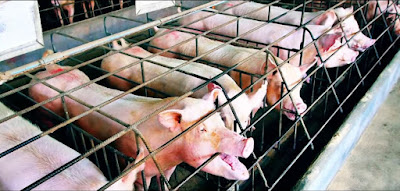
What the Health begins with Kip Andersen introducing himself and confessing that he is a recovering hypochondriac.  He used to compulsively follow public prescriptions from the meat and dairy industry, such as faithfully consuming three full glasses of cow’s milk every day (I used to do that, too).  Later in the film we are shown, in fact, that cow’s milk is nutritionally very different from human milk and is not really suited for human consumption.  This is an example lesson that almost everyone can relate to.

When Andersen reads that the World Health Organization (WHO) has recently determined that all processed meat is carcinogenic, he is shocked.  This means that, among other things, all ham, bacon, and sausages are carcinogenic.  He checks the web site of the American Cancer Society and is further disturbed to see that they not only ignore WHO’s announcement but that the American Cancer Society seems to explicitly endorse the eating of processed meat.  When he tries to contact the American Cancer Society about their policies on this issue, they brush him off and refuse his requests for an interview.  

Andersen further discovers that the commonly held view that diabetes can be attributed to, or at least worsened by, the consumption of sugar and carbohydrates is wrong.  In fact, according to  Dr. Garth Davis, one of the featured doctors in the film [1], the real consumption culprit for diabetes is actually eating red meat.

In this connection , there is a rather dramatic interview with Dr. Robert Ratner, the Chief Scientific and Medical Officer of the American Diabetes Association.  Dr. Ratner adamantly refuses to blame the meat and dairy industry for worsening the health of diabetics.  And when Andersen points out to him some peer-reviewed research articles that report finding a definite connection between meat and dairy consumption and worsened diabetic conditions, Ratner angrily shuts down the interview and leaves the room.  

One major reason why Dr. Ratner may have refused to discuss this issue is that his American Diabetes Association is receiving major sponsorship funding from the meat and dairy industry.  This meat-and-dairy industry sponsorship complicity (which was also mentioned in Cowspiracy) is additionally true of the American Cancer Society and the American Heart Association, and this can be confirmed by going to their respective websites.  These people in the health institutions refusing interviews about animal products may have been worried about jeopardizing a major source of their funding.

Of course, the discussion of this whole subject requires at least some consideration of the medical and pharmaceutical industries.  One major problem with medical school education is that nutrition is not a significant theme in medical school curricula.  I am not sure why this so, but perhaps nutrition is considered to have too-fuzzy boundaries and therefore to be outside the scope of “hard science”.  At any rate, doctors coming out of medical school are not trained to be knowledgeable about nutrition and thus are not knowledgeable about the relative merits of plant-based and animal-product-laced diets.  The clear benefits of following a plant-based diet are overlooked by most doctors.

Another, more general concern is that the medical industry appears to be more interested in treating patients long-term than in preventing illness in the first place.  This is also true of the  pharmaceutical industry.  Of course there are financial payoffs for following this path, but I doubt this is an explicit strategy on the part of these two industries.  Nevertheless, this is a problem, and as the film shows, there is a simple path to follow that would reduce the occurrences of many long-term illnesses and thereby address this problem – following a plant-based (vegan) diet.

In this connection the film shows several people suffering from long-term and supposedly (according to the medical advice these people were receiving) incurable health conditions.  To help alleviate their painful and debilitating symptoms, they were regularly taking a massive number of prescribed pills.  Then these people switched to vegan diets, and in a short time all their debilitating symptoms vanished.  They were cured, and they were able to stop taking all those pills.
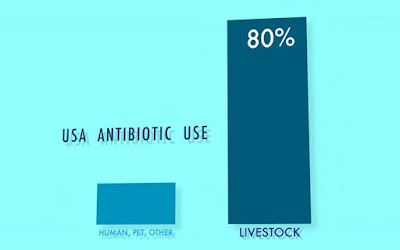
Expanding on these experiences and other evidence present in the film, the filmmakers of What the Health come out and explicitly recommend that, in order to have a healthy life, everyone should adopt a plant-based diet.  They discuss with medical experts who debunk the commonly-held notion that a plant-based diet will be short of protein.  In fact a plant-based diet provides plenty of protein, roughly just as much as a typical meaty diet.  And it is worth pointing out, as is mentioned in the film, that there is nothing sacred about the protein in meat – all protein originates from plants anyway.  Animals just recycle it.  

They then show a number of muscular athletes and bodybuilders who attest that their physical prowess is significantly enhanced by their vegan diets.              

Overall, What the Health is a well-made and usefully informative documentary that is well worth seeing.  Its message is more emphatically told than is that of its companion piece, Cowspiracy: The Sustainability Secret.  However, from a pure filmmaking perspective, I liked Cowspiracy a bit more, because What the Health has more continuous sequences of “talking heads” that would have benefited from some more brief insertions of context-setting commentary on the part of Kip Andersen that would have smoothed the pace.  Nevertheless, I recommend that you see What the Health and heed its advice [2].

★★★½
 
Notes:
  1. Other prominent, supportive doctors featured in the film include:

  2.  See also my reviews of  

“Cowspiracy: The Sustainability Secret” - Kip Andersen and Keegan Kuhn (2014)

Cowspiracy: The Sustainability Secret (2014) is a documentary film written and directed by Kip Andersen and Keegan Kuhn that takes on the ambitious task of seeking to find a solution to the problem of greenhouse gas emissions that threaten our planet.  It follows the personal quest of Kip Andersen, who was inspired by watching Al Gore’s film An Inconvenient Truth (2006) to do something about our impending climate catastrophe.  So over the course of this film, the viewer watches onscreen protagonist Kip Andersen (Kuhn handled the camerawork) as he narrates his efforts to see what can be done.  
At first Andersen sets about changing his own lifestyle, believing that if everybody did this, then our problems would be solved.  So he gave up driving his car and took to bicycle riding, took shorter showers, and tried to conserve electricity.  But as he investigated further, he learned that these matters of personal behaviour are not where the problem lies.  For example, he discovered that 660 gallons of water are used in the production of a quarter-pound of beef for a hamburger – a figure that dwarfs whatever water savings that could be made by taking shorter showers.  

And in fact as Andersen investigated further, he learned that animal agriculture in general is the primary source of human-based environmental degradation.  There is evidence for this out there, but it is not prominently on display.  Andersen wanted to know why.  

One piece of evidence that probably a number of people have heard about is a 2006 United Nations Food and Agriculture Organization report, “Livestock's Long Shadow”, stating that raising animal livestock produces more greenhouse gas emissions than do all transportation vehicles [1]. Andersen found that the UN FAO assertion was supplemented by a 2009 World Watch Magazine report by Robert Goodland and Jeff Anhang claiming that livestock causes 51% of greenhouse gas emissions [2,3].  However, a number of lobbyists and supporters of the meat and dairy industry have taken great exception to this latter report, arguing that the 51% figure was a gross exaggeration and that its mention in Cowspiracy renders the film fraudulent.  It should be pointed out, though, that the calculation of greenhouse gas emissions from livestock production is a complicated matter, because one needs to include peripheral greenhouse gas sources, such as fossil fuel emissions from the transport of livestock and associated items (food, waste, etc.).  There is not always agreement on what must be included.  We must keep in mind that what we are interested in is the difference in total emissions from two different global situations – our current world and one in which no animal food products are produced.  In any case, it should be noted that no matter what calculation measures are used, they all agree that the total greenhouse gas emissions from animal food production are very high and significantly exceed the greenhouse gas emissions from those of all transportation vehicles [4].

One thing that shocked Andersen is that the primary U.S. environmental organizations, like Greenpeace and The Sierra Club, make no mention of the high environmental costs of animal food production on their web sites.  When Andersen tried to contact these organizations about this matter, they refused to discuss it with him – even when he made personal visits to the organizations to see if he could get their views on the subject.  For example, spokespeople for The Sierra Club simply dodged the issue (this is shown on film), while Greenpeace formally refused to talk to him.

It turns out that the major environmental organizations all receive funding and support from meat and dairy companies and lobbies. Andersen even shows meat and dairy industry logos on display on some environmental organization websites. Apparently the environmental organizations are unwilling to risk this funding by discussing animal agriculture impacts on the environment.  And  so they shut out speaking with inquisitors like Andersen.  

We also learn that both federal and state government agencies heavily subsidize the meat and dairy industry.  When Andersen tries to talk to California state government officials about the matter, they won’t talk about this issue.  So the animal agriculture industry seems to have a lot of economic clout. Cowspiracy does give some of their people a chance to speak – for example, Emily Meredith of the Animal Agriculture Alliance (a pro-livestock lobby), but their pro-livestock testimony seems weak to me.  For one thing, they have no answer for a basic issue with animal agriculture: the fact that no matter how nicely the animals are raised, these animals will all be killed well short of their natural lifespan.  No matter how we may try to ignore it, somebody has to do this killing.  We are graphically reminded of this terminating action when, towards the end of the film, we are shown closeups of a backyard farmer personally using his hatchet to chop the heads off of the ducks he has raised.  

As the film proceeds, Andersen and Kuhn take on wider, more global issues, and world experts  are interviewed on these matters.  For example, one issue is the dramatic depletion of the world fish population due to over-fishing and pollution.  Another issue concerns the imminent destruction of the Amazon rainforest due to human exploitation.  The program director of the Amazon Watch organization, Leila Salazar Lopez, tells us that the entire Amazon rainforest could be lost in just10 years.

Overall, Cowspiracy provides a fascinating and informative investigation of the impact of animal agriculture on the environment.  Kip Andersen’s investigative style is mild-mannered and genuinely exploratory.  He lets the pro-meat people have their chance to take the floor and defend their products.  As a result, the film has received a number of favourable reviews [5,6,7] – at least from those critics who don’t have a pro-meat axe to grind.  

But no matter what the advocates of animal agriculture may say, and no matter how much many of us love the taste of meat (I used to be one of those people, when I was a meat-eater), they don’t have an answer or suitable response to a simple fact pointed out by sustainability consultant Richard Oppenlander:

for any given area of land, you can produce 15 times more protein from plants than from animals. 
We must keep this in mind when we ponder what to do with animal agriculture in connection with such major issues as the world food crisis and global pollution.  Reducing animal agriculture (in fact preferably eliminating it) can save the planet.   

So I recommend that you watch Cowspiracy: The Sustainability Secret and take into consideration its message(s).  This film is both entertaining and informative.  However, one should bear in mind that there is one area of concern about animal agriculture that is not given a lot of attention in Cowspiracy, and that concerns the consequences and impact on one’s  personal health of consuming meat and dairy products.  Rest assured, though, that this was not a topic outside the purview of Andersen and Kuhn.  It was just an area of concern that in their minds deserved to have a whole film devoted to it.  And this is what they did when they made their subsequent documentary What the Health (2017), which is another film worth your consideration.
★★★★

Notes:

  1. “Livestock's Long Shadow”, Wikipedia, (15 March 2022).  
  2. Robert Goodland and Jeff Anhang, “Livestock and Climate Change”, WORLD WATCH MAGAZINE (2009), a well-fed world, (November 2009), . 
  3. Robert Goodland and Jeff Anhang, Jeff (Nov–Dec 2009). "Livestock and Climate Change: What if the key actors in climate change were pigs, chickens and cows?" (PDF). Worldwatch Magazine, Worldwatch Institute. pp. 10–19. S2CID 27218645. Archived from the original (PDF) on 2019-10-01. 
  4. Keegan Kuhn, “Response to Criticism of Cowspiracy Facts”, Cowspiracy, A.U.M. Films & Media, (n.d.).   
  5. Kate Irwin, “More meat, more problems in ‘Cowspiracy’”, The Daily Californian, (27 June 2014).    
  6. Chris Sosa, “Are Burgers Really Destroying the Planet? Kip Andersen Thinks So”, HuffPost, (19 August 2014; updated 6 December 2017).   
  7. Ward Pallotta, “Cowspiracy Exposes the Truth About Animal Agriculture”, EcoWatch, (10 October 2014).   

“Fantastic Fungi” - Louie Schwartzberg (2019)

Fantastic Fungi (2019) is an entertaining documentary film that explores various aspects of  ubiquitous but often overlooked participants in our biosphere – fungi, and in particular, their usually above-ground fruiting components, mushrooms.  This film brings to the viewer’s attention the fact that fungi are absolutely crucial to the sustenance of life on earth. The film was directed and photographed by Louie Schwartzberg, whose demonstrated expertise in time-lapse cinematography and CGI (computer-generated imagery) is a spectacular feature of the film.  In fact the time-lapse imagery is so frequently occurring and dazzling that it may perhaps sometimes distract the viewer from some of the film’s other virtues.  

Fantastic Fungi was written by Mark Monroe (among whose earlier writing credits is the fascinating documentary The Cove (2009) [1]), and it was edited by Kevin Klauber and Annie Wilkes.  There are numerous voiceover narrations from the various talking heads in this documentary, but one special narrative element is provided by previously Oscar-winning actress Brie Larson, who serves here as the unseen metaphorical voice of the fungi kingdom.  I am not sure how well this particular narrative innovation works in this case, but it does provide an unusual twist to the presentation.  Another aspect of the production that deserves comment is the music by Adam Peters.  Unfortunately, I found much of the music to be littered with rumblings and  mostly distracting from the viewing experience.  In any case, the film has been largely well-received by a range of critics [2,3,4,5,6,7].

Although Fantastic Fungi rambles back and forth between various topics about fungi, we can say that the film covers roughly four general areas of interest:
  • The science of fungi
  • Fungi in ancient mythology
  • The impact of hallucinogenic drugs that have been derived from Fungi
  • Practical and medicinal uses of fungi
Throughout much of this journey, we are shepherded by Paul Stamets, a lifetime amateur mycology (the science of fungi) enthusiast.  Despite having limited formal training in mycology, Stamets’s passion for the subject and hands-on explorations have enabled him to make a number of discoveries and contributions to the area.  And as the film demonstrates, he is a rather glib communicator on the topic.  

1.  The Science of Fungi
In this topic area the viewer is given some interesting scientific information about fungi.  The expert narrators concerning this material are, for the most part, Michael Pollan and Eugenia Bone, who are food journalists, and Professor Suzanne Simard, who conducts research on fungi at the University of British Columbia.

Fungi are a primitive form of life that predates plants and animals.  Indeed the oldest fossil remains of life are those of fungi dating back 2.4 billion years ago.  And of course fungi are still prospering today, and there are now several million fungi species, more than six times the estimated number of plant species.  

A fascinating and most important structural component of fungi are the thin filamentary hyphae that exist mostly below ground and serve as the roots of the fungi.  They spread out into incredibly complex network structures that are known collectively as mycelia, and they can form even more complex mycorrhizal networks with plants that a mycelium network may connect to.  The expert commentators in the film liken the complexity of these network mycelium structures to that of the human brain, and it seems that these mycelium networks can facilitate the exchange of nutrients and information between the nodes (plants and/or fungi) that are interconnected in these networks.  For more information concerning how these mycorrhizal networks facilitate the essential vitality and harmony of nature, I recommend you see Suzanne Simard’s TED talk, "How trees talk to each other" [8].

2.  Fungi in Ancient Mythology
It seems that fungi have been known and cherished since very ancient times – even to ancient hominids that flourished before the appearance of Homo sapiens.  This was presumably due to the powerful mind-altering properties of some mushrooms.  The film has some commentary about this and refers to and shows some ancient temples in this regard.  

Reference is also made to the Stoned Ape Theory that was proposed by Terence McKenna in 1992, which advanced the idea that the movement from the early human species Homo erectus to the current species Homo sapiens was connected with the hypothesized increased consumption of psilocybin mushrooms (“magic mushrooms”) about 100,000 years ago.  This allegedly gave consumers of those mushroom improved acuity and cooperation capabilities that ultimately provided them with evolutionary advantages.  Thus, so this story goes, the consumption of magic mushrooms led to the emergence of Homo sapiens.

3.  Hallucinogenic Drugs
At the beginning of the 1970s, 15-year-old Paul Stamets became inspired by reading some writing by an advocate of alternative medicine, Dr. Andrew Weil, about altered states of consciousness.  This was when Timothy Leary, LSD, and other hallucinogenic drugs derived from mushrooms were in their heyday.  Consequently Stamets was eager to try out some psychedelic mushrooms.  So he consumed a whole bag of magic mushrooms, and the resulting experience that he had changed his life.  For one thing, it instantly cured his til-then lifelong stuttering problem.  In addition, it launched his unquenchable fascination with the mind-bending possibilities of fungi.  However, about this time there was a decades-long U.S. governmental suppression of psychedelic drug research (1970s - 2000), which hindered work in this field  by Stamets and others.  So Stamets started his own mushroom business and moved to Canada.  In some respects this film is intended to renew a wider scientific interest in this area, such as existed in the 1960s and 70s.

4.   Medicinal Uses of Fungi
A fascinating element of Fantastic Fungi is its discussion of some of the promising medicinal uses of fungi.  However, because of time constraints, only a smattering of this material can be offered.  A key item with respect to this topic is the fact that the human brain has neuroplasticity.  That is, the neuronal structure of the human brain can change and grow throughout the course of a person’s life.  But to facilitate this activity, the brain needs assistance to generate new neurological pathways.  And this is where mushroom-derived chemicals such as psilocybin can play an important role in the brain’s chemistry.  This is an ongoing topic of current research.

Overall, there is an important message we can take from Fantastic Fungi.  We learn that fungi are fundamental instruments for the regeneration of life, and that as Paul Stamets tells us, “the entire ecosystem is infused with fungi.”  Our reductive scientific models of the natural world have too often focussed on the individual entity or agent, and they have thereby overlooked the intertwined, multi-generational nature of life, in connection with which fungi play a fundamental role.  Indeed what is emphasized here in this film and the essential point we come away with, in fact, is how fungi underlie and facilitate a most crucial aspect of the world, something that Buddhist and other spiritual masters have long taught – the interconnectedness of all living beings.
★★★

Notes:
  1. The Film Sufi, “‘The Cove’ - Louie Psihoyos (2009)”, The Film Sufi, (26 July 2009).   
  2. Rex Reed, “Charming Documentary ‘Fantastic Fungi’ Explores the Miracle of Mushrooms”, Observer, (15 October 2019).   
  3. Matt Fagerholm, “Fantastic Fungi”, RogerEbert.com, (11 October 2019).  
  4. Jeannette Catsoulis,”‘Fantastic Fungi’ Review: The Magic of Mushrooms”, The New York Times, (10 October 2019).   
  5. Josh Kupecki, “Fantastic Fungi”, Austin Chronicle, (6 December 2019).   
  6. John Defore, “‘Fantastic Fungi’: Film Review”, The Hollywood Reporter, (8 October 2019).  
  7. Robert Abele “Review: Mushrooms are the new superheroes in documentary ‘Fantastic Fungi’”, Los Angeles Times, (24 October 2019).      
  8. Suzanne Simard, “How trees talk to each other”, TED, (31 August 2016).   

“Wheel of Time” - Werner Herzog (2003)

Werner Herzog, one of the greatest filmmakers, is one of my favorites.  Over the course of his prolific career covering the direction of some twenty dramatic feature films and more than thirty documentary features, he has invariably cast his unique vision across a wide range of subject matter, much of it with an existentialist philosophy tinge.  Thus he often travels to remote locations to observe how people deal with the extreme conditions there.  This is what I find particularly fascinating about Herzog: he is a philosopher with a movie camera.  The Herzog film I will be discussing here, Wheel of Time (2003), which he wrote, directed, and narrated, is very explicitly aimed in this philosophical direction, because it is concerned with the passions and rituals of Buddhist monks.  The film featured cinematography by Peter Zeitlinger and film editing by Joe Bini, and as usual with Herzog films, one gets the feeling that a good part of the film’s story was composed in the editing room.  And also as usual with Herzog films, it was well-received by a range of critics [1,2,3,4,5].

The specific subject matter of the film concerns the elaborate Kalachakra Initiation ceremony for Tibetan Buddhists (note that ‘Kalachakra’ is a term in Vajrayana Buddhism that means "wheel of time") that is held every two or three years at a place chosen each time by the Dalai Lama.  This event typically attracts some 500,000 Tibetan initiates and pilgrims from all over Asia who wish to participate in the elaborate rituals over the course of ten days and ten nights.  On this occasion, in January 2002, the chosen place for the Kalachakra ceremonies is very special – Bodh Gaya in Bihar, India.  It was here some 2,500 years ago that Siddhartha Gautama spent seven weeks meditating under the Bodhi Tree (a sacred fig tree there) and reached enlightenment, thereby achieving the status of the Buddha.  Bodh Gaya is also the site of the associated Mahabodhi Temple.

The film begins with some physical shots of the Bodh Gaya area, and then it shows the many pilgrims arriving for the Kalachakra events.  Some of these pilgrims are so devout that they make their jouney to the Kalachakra event entirely on foot, and after every step or so they fully prostrate themselves in obeisance.  Herzog shows some of them reverentially following this practice over all sorts rough terrain, and the whole journey to their holy destination can take many months, even years.  These pilgrims are mostly poor people, but some of them at least bring pup tents in which they can sleep in the temple yards overnight.  The rest of them must just sleep outside in the open.  

The principal activities of the Kalachakra activities fall into three main categories:
  • Buddhist teachings and prayers conducted by lamas and monks,
     
  • The construction and display of the great Kalachakra Mandala, an elaborate symbolic design made out of colored sand that is an important artefact of Tibetan Buddhism [6,7], 
     
  • The closing initiation ceremonies for the aspirant Tibetan Buddhist monks.
Of these activities, a considerable amount of Wheel of Time screen time is devoted to showing the detailed construction of the Kalachakra Mandala.  This is made of loose, colored sand, the tiny individual granules of which must be so carefully placed  that they collectively form an incredibly intricate design.  This takes a number of sand artists manydays to complete. Once completed, the Kalachakra Mandala is seven feet in diameter and displays visual references to 722 deities.  Since the mandala is made only of loose sand, it must be protected from the approach of onlookers and even casual breezes which could disturb it, so it is walled off by a glass partitioning surrounding it.  

But after the mandala’s construction and display to the monks and pilgrims at the end of the usual Kalachakra ceremonies, all the sand of the entire mandala is collected and ritualistically thrown into the river, thereby symbolizing the utter ephemerality of existence.  
 
Just before the halfway point in the film, Herzog takes time out to go off on his own with his own camera and visit another sacred Buddhist site, Mount Kailash in western Tibet.  Thousands of pilgrims come to this 22,000 foot mountain at a specific time every year  (Herzog came in May 2002) to carry out a high-altitude circumnavigation of the peak, which they believe will bring them holy salvation.  The 52 km trek around the peak that the pilgrims take is at an altitude of 18,000 feet, and sadly every year, some pilgrims who are not appropriately acclimatized to these heights die from exhaustion.

At other points in the film we see brief clips of the Dalai Lama speaking in closeup on a few topics.  He is always relaxed and reasonable, and one his more interesting remarks was his comment that all religions carry the same message.  It would be good if more people felt that way.  The Dalai Lama is, of course, the star personage of the Kalachakra Initiation ceremonies, but unfortunately his health at this time was not good, and he was unable to carry out his required, full participation in the ceremonies.  This was naturally very disappointing to the hundreds of thousands of pilgrims who had come to Bodh Gaya, as well as to the Dalai Lama, himself.  But he promised to all the practitioners that he would come back there to see them all the following year.

The scene now shifts to another ten-day Kalachakra Initiation ceremony that was held later that year – in October 2002 in Graz, Austria.  This time the attendees are mostly European Buddhists, and the number of participants are in the thousands, rather than the hundreds of thousands.  And  now the Dalai Lama is healthy and fully participating.  Also present is famed Buddhist monk and communicator Matthieu Ricard, who often serves as the Dalai Lama’s translator.

One of the highlights of this section of the film is the showing and description of a Tibetan Buddhist monk and pilgrim, Takna Jingme Sangpo, who, partly thanks to international protests, had recently been released from prison in Tibet after being held there under cruel conditions by the Chinese overlords for 37 years.  Sangpo’s only crimes were apparently his public expression on a few occasions that he supported a “Free Tibet”.  Despite his extreme hardships, Sangpo, is now overjoyed that he now, finally has the opportunity to see the Dalai Lama in the flesh for the first time.

At this Kalachakra Initiation event in Graz, another elaborate Kalachakra Mandala is duly constructed out of colored sand and displayed.  And at the end of these ceremonies, a healthy Dalai Lama performs the ritual act of dispersing the collected mandala sand into the Mur river there.  

Overall, Herzog’s Wheel of Time does provide a lot of information about the Kalachakra ceremonies.  But what lingers most in my mind after watching it is something else that he has captured on film.  And that is the extraordinary religious fervor that you can see silently expressed on all the faces of the vast crowds of pilgrims shown.  These dedicated practitioners are not boisterous; they are not broadcasting. Instead, they are wholly devoted to their spiritual path of seeking total purity and enlightenment.  Herzog does not articulate or discuss this issue.  He directly shows it on a thousand faces.
★★★½

Notes:
  1. Walter Addiego, 'Wheel of Time', Film Clips, SFGATE, (22 July 2005).  
  2. Dennis Schwartz, “Wheel of Time”, Dennis Schwartz Movie Reviews, (n.d.).   
  3. Ed Howard, “11/8: Wheel of Time; The Flowers of St. Francis”, Only The Cinema, (8 November 2007).   
  4. Frederic and Mary Ann Brussat, “Wheel of Time”, Spirituality & Practice, (2005).   
  5. Stephen Holden, “With Herzog, Inside a World of Devotion”, The New York Times, (15 June 2005).      
  6. “Mandala”, Wikipedia, (15 June 2021).   
  7. “Sand mandala”, Wikipedia, (29 April 2021).   

“Triumph of the Will” - Leni Riefenstahl (1935)

Triumph of the Will (Triumph des Willens, 1935) is a famous documentary film about the 6th Nazi Party Congress held in Nuremberg, Germany, in September 1934, when Adolph Hitler had just completed establishing dictatorial control over the whole country.  The film has been praised as perhaps the greatest documentary film ever made [1,2], but because of its controversial subject matter, it has also been condemned as a contemptible piece of propaganda [3]. For many observers, then, the question comes down to whether a piece of one-sided propaganda (which Triumph of the Will clearly is) can still be appreciated purely on aesthetic terms as a great work of art [4].  And that still leaves the question outstanding as to whether Triumph of the Will really is a great piece of propaganda.

Triumph of the Will was produced, directed, and co-written by Leni Riefenstahl, an interesting personage in her own right.  Born in 1902, Riefenstahl was a prominent dancer and movie star before she launched her career as a film director.  In 1932 she met Adolph Hitler, who was so impressed with the young woman that he soon offered her the opportunity to make propaganda films for his rising Nazi Party.  This she accepted to do, which led her to make several Nazi-sponsored films, the most famous of which are Triumph of the Will (1935) and Olympia (1938 – about the 1936 Summer Olympics in Berlin).  
 
For her first Nazi-commissioned production, Riefenstahl was asked to make a film of the 5th Nazi Rally in Nuremberg held in 1933, but she wasn’t given much time to prepare for this work.  The result was a modest, hour-long documentary, The Victory of Faith (Der Sieg des Glaubens, 1933) that soon disappeared from public view.  For Triumph of the Will, however, she had plenty of preparation time and resources to do what she wanted.  She was equipped with a crew of 172 people, operating and carrying out the lighting for 30 cameras and also providing aerial photography (it had an estimated shooting ratio of more than 30:1) [4,5].  In addition, the film was provided with a detailed, tradition-based orchestral score (background music is present through much of the film) by prominent composer Herbert Windt.  For its day, the film was an extravagant production.

Note that in many respects, the film was not just a passive recording of 6th Nazi Party Congress.  Instead, the rally and the film can be thought to have been planned and staged in conjunction with each other.  This notion is reinforced by Nazi Propaganda Minister Joseph Goebbels’s claim in 1933 about the strategic importance of social media [6]:
“Our way of taking power and using it would have been inconceivable without the radio and the airplane,”
(The airplane afforded Hitler the opportunity to travel rapidly about Germany, making fiery speeches.)  So we can presume that the Nazi leaders had a growing appreciation of the film medium and thought that a carefully planned and staged film could prove to be a valuable instrument for accruing power.  

As the film plays out, we see that it doesn’t cover meetings or discussions among the party leaders, but instead shows various public events that took place sequentially over several days during the Party Congress.  It opens with Hitler’s plane flying high in the sky over Nuremberg as he arrives for the congress.  He is met by a rapturous crowd hailing him with the Nazi straight-armed “Sieg Heil” victory salute.  It is said that there were more than 700,000 people who attended  this Nazi rally [5].  The scene then shifts to the evening, when there is shown a cheering rally held outside Hitler’s lodging.  

Relatively early on in the film, we get a display of the dramatic cinematographic style employed by Riefenstahl – extreme long shots showing massive crowds, which are intercut with tight closeups of individual participants.  There is also a liberal dosage of high-angle and low-angle shots (Hitler, himself, is usually shown from a low-angle perspective).  It is also interesting to see the large number of women among the cheering crowds (I intuitively think of Naziism as primarily a male-dominated phenomenon).  
In the morning of the next day of the party congress, the viewer is shown the large number of young people who have come to the congress and are camping outside.  They are shown getting up and preparing themselves for the day’s spectacle.  This is followed by various celebratory parades of local people marching through the city.  Later, indoors, there is shown brief excerpts of mostly-shouted speeches given by various Nazi leaders.

Then Hitler is shown reviewing the 52,000-strong worker corps (the Sturmabteilung, referred to as the SA).  No real reference is made here to the relatively recent (on June 30th) “Night of the Long Knives”), when much of the earlier SA leadership had been purged and murdered.  That was another example of Hitler’s rapid consolidation of power during this period.  That evening, after a torchlight parade, the new SA leader, Viktor Lutze, is shown giving a speech to the multitudes

The next day Hitler greets the official Hitler Youth group on the parade grounds.  This is followed by a particularly harsh and strident speech to this group, calling on his youthful listeners to toughen up.  This is probably the most interesting portion of the film, because, rather than serving up platitudes, it puts Hitler’s full ruthlessness on display.

On another day, Hitler is shown walking past some 150,000 SA and SS (Schutzstaffel) troops standing at attention while he lays a memorial wreath to honor the fallen German soldiers of World War I.  This is followed by Hitler’s closing speech, which is again belligerent and imperious.

So what are we to draw from this film?  What is its message?  The film’s essential message seems to me to be that the Nazi vision of a proper social state is one that operates like a well-oiled machine with all its parts operating synchronously in automatic response to the commands of its supreme leader.  The Führer, Hitler, is ordering all the workers to think of themselves as soldiers under his absolute command.  This mechanistic view of the state, where no consideration is given to individual autonomy or creativity, is emphasized throughout the film, with multiple images of various groups of people marching in unison or standing at rigid attention.  In order for this powerful state machine to operate effectively, absolute loyalty is required.  So loyalty is another significant theme in the film.

But these ideas are just presented as a sequence of images – there is no dynamic thrust, no narrative to what is on display.  Narrative in visual form, is, however, truly an essential virtue of film [7], and I have discussed this on many occasions.  So the lack of a real narrative is a fundamental, indeed fatal, weakness of Triumph of the Will.  The camera work is great, but that by itself is not enough.  In fact you might be surprised (as was critic Roger Ebert upon re-watching the film [2]) at how monotonous and boring the film is if you see it now.

Nevertheless, Triumph of the Will remains as an important document of the Nazi rise to power.  And it is not surprising that after the end of World War II, Leni Riefenstahl was imprisoned for some time by the victorious Allied Powers for being an instrument of Nazi criminality.  Riefenstahl, however, always steadfastly maintained her innocence on this matter and insisted that she was just passively recording the events of the Nazi Party Congress and not a Nazi co-conspirator.  She later even made the absurd claim that she was actually a practitioner of cinéma vérité.  I won’t delve further into this issue, but if you are interested, I recommend for your enjoyment Susan Sontag’s interesting and thoughtful article on this topic, “Fascinating Fascism” [1].

We are still left, though, with the basic question – is Triumph of the Will worth seeing now?  I would say it is, because the film’s subject matter is, perhaps surprisingly to some people, still of renewed significance today.  In the decades after World War II, many people came to believe that Hitler and Naziism were such anomalous embodiments of pure evil that they were beyond the scope of meaningful analysis.  In today’s more democratic world, they believe such a monstrous phenomenon could only appear again by means of military coercion.  

But sociopolitical evolution is more complicated than many people’s understanding.  Naziism was accepted by more German people than is commonly thought, as recent demographic analysis has shown [8].  Many middle-class Germans at the time dismissed Hitler’s overblown rhetoric as mere pablum for the masses and thought he might turn out to be a strong leader.  Similarly, when Ayatollah Khomeini returned to Iran in 1979, many educated Iranians thought that Khomeini’s stern rhetoric was mainly intended for the religiously conservative masses and that Khomeini was, in their view, more humane and not the ruthless autocrat that he turned out to be.

And at the present time, we see disturbing populists (such as Trump, Bolsonaro, Duterte, Erdogan, . . .) attracting surprisingly large portions of public support, despite their divisive  policies that restrict freedom and damage common-pool resources.  The public images of these newer demagogues seem to be as simple-minded as Hitler’s (and in fact some of them could perhaps turn out to be as pernicious as Hitler was).  So their presence today is a worrisome reminder of the ever-present dangers of fascist appeal.  Even in the face of the positive outcome in the recent U.S. presidential election, there are indications that a sizable segment of American society is susceptible and responsive to what I would say is neo-fascist propaganda [9,10].  Thus it is important for us to have a better understanding of how and why such visceral public imagery seems to derive public support among large sectors of the population for these ever-present divisive figures [1].  

In the final analysis, can we say that Triumph of the Will is a great movie?  I would say, no, it is not, given its narrative shortcomings.  Nevertheless, it is still an important document.  In this regard, it would probably be good for many of us to take a serious look at Triumph of the Will’s appeal to certain sectors of society and think what should be done to counter it.
★★★        

Notes:
  1. Susan Sontag, “Fascinating Fascism”, New York Review of Books, (6 February 1975).   
  2. Roger Ebert, “Propaganda über alles”, RogerEbert.com, (26 June 2008).    
  3. J. Hoberman, “‘Triumph of the Will’: Fascist Rants and the Hollywood Response”, The New York Times, (3 March 2016).    
  4. Eddie Cockrell, “Triumph of the Will”, Variety, (29 April 2001).   
  5. “Triumph of the Will”, Wikipedia, (26 December 2020).   
  6. Heidi Tworek, “A Lesson From 1930s Germany: Beware State Control of Social Media”, The Atlantic, (26 May 2019).  
  7. Christopher Vogler, The Writer’s Journey, 2nd Edition, Michael Wiese Productions (1998).
  8. Dan Simon, “Who Voted for Hitler?”, The Nation, (15 January 2021).  
  9. Anne Applebaum, “Coexistence Is the Only Option”, The Atlantic, (21 January  2021). 
  10. Josh Dawsey and Michael Scherer, “Trump jumps into a divisive battle over the Republican Party — with a threat to start a ‘MAGA Party’”, The Washington Post, (24 January 2021). 

“Amongst White Clouds” - Edward A. Burger (2005), “Hermits” - He Shiping (2015), & “Searching for Monks in China with Red Pine” - Jack Estes (mid-1990s?)

Bill Porter (aka “Red Pine”, his pen name) is an American writer and translator known for his works describing his travels through China and documenting spiritual practices there, particularly that of Daoism and Buddhism.  His best-known work is Road to Heaven: Encounters with Chinese Hermits (1993) [1], and in this article I wish to discuss three documentary films that were inspired by that book and that provided further elaboration of its fascinating subject matter.

As a young student, Porter had dabbled in several academic disciplines before enrolling as a graduate student in anthropology at Columbia University in New York.  But there in New York he encountered Buddhism and began receiving instructions on meditation.  He eventually became so fascinated with Buddhist practice that in 1972, after two years of study, he dropped out of school and moved to a monastery in Taiwan in order to more fully engage in Buddhism [2,3].

In Taiwan, Porter met his future wife, Ku Lien Chang, and learned Chinese well enough that he could begin translating some of the classic Chinese teachings into English.  This was the beginning of Porter’s career as an outstanding translator of Chinese poetry and classic works.  In the process, Porter became fascinated with the spiritual practices associated with these classic teachings, particularly the practices of devout Chinese hermits that he had heard about, and he wondered if there were still any spiritual hermits is present-day China.  However, his interests in going into mainland China to investigate this issue further were blocked for some time by restrictive Chinese policies toward Taiwanese (including Porter’s wife) entry into China.  Eventually these restrictions were relaxed in 1987, and Porter finally first traveled to China in 1989 in order to see if he could find some authentic Chinese hermits.  

Finding hermits out in the wild, of course, is not an easy task, because the hermit does not want to be found – he or she has gone out into the wilderness in order to be alone and completely isolated from the distractions and concerns of society.  They seek to ignore the past and the future and just focus on the now in order to connect with all of conscious and subconscious reality.  Nevertheless, thanks to both some diligence and luck, Porter did manage to find some hermits meditating in caves in the Zhongnan Mountains near Xian.  These mountains have a rugged terrain and a suitable geographic location that has made them appropriate for many hermits seeking meditative isolation.  Because Porter was fluent in Chinese and presented himself as a fellow spiritual seeker, he was able to approach and converse with a number of these hermits, and their conversations make up the principal material contained in his book Road to Heaven.  

A key aspect of these conversations in Road to Heaven is that they do not much concern theological principals or abstract ideas, but are instead focused on the mundane, everyday practice of the hermits.  This gives the reader a unique opportunity to get a feel for what the daily life of the hermit is all about, and this is why I strongly recommend that you read the book, yourself.

So what did these hermits believe in?  Their source belief systems were several ancient traditions which, despite their varying origins, had a certain degree of commonality – Daoism, Zen (in Chinese “Chan”) Buddhism, and Pure Land Buddhism.  In all cases there is an interest in turning the mind away from reflection and thinking about things and, instead, getting it to embrace all of experience.  As a result, these three spiritual practices historically got along harmoniously in China, and the hermits Porter encountered were usually followers of one of them, or sometimes even a mixture of them.  

But although these hermit practices have coexisted harmoniously, they have sometimes had difficulties gaining acceptance in the wider compass of Chinese society.  This is perhaps due to a general suspicion of religious practices on the part of governmental authorities that can be traced back to the horrific experiences of the Taiping Rebellion (1850-1864).  This was the civil war between the Qing Dynasty rulers and the Taiping Heavenly Kingdom, a cultish offshoot of Christianity that had theocratic ambitions, and this disruption was one of the most devastating conflicts in world history [4] – Chinese society was eviscerated during this period, and the struggles resulted in the deaths of tens of millions of people (some estimates are as high as 70 million deaths [4]).  As a result, there has since been a concern that subsequent religious fervor of any kind might get out of hand.  

And, of course, the later Chinese Communist Revolution (1945-1949), which led to the installation of an officially atheistic government, put further anti-religious pressures on Chinese society.  In this connection, the rejection of religion and traditional Chinese cultural practices was also an underlying motivation behind the Cultural Revolution (1965-1976), the depredations of which led not only to intense suppression of traditional practices, but also to the destruction of a great many Daoist and Buddhist monasteries and architecturally symbolic stupas.  All of these disruptive phenomena and anti-religious social policies undoubtedly put further pressures on would-be spiritual practitioners to isolate themselves in the wilderness as hermits.  

And so all of these effects add further to our respect for the humble hermits.  However, in addition to reading about conversations and commentary describing everyday hermit life in Porter’s book, it can be nice to get visual imagery showing these people and their environments.  And this is where three documentary films related to Road to Heaven can contribute:

All three of these films involve trips to the Zhongnan Mountains in search of the hermits Porter had interviewed for his book, and all three films are currently available for watching on YouTube.    

Searching for Monks in China with Red Pine was produced and directed by Jack Estes and shows Porter visiting hermits sometime in the mid-1990s.  The film is narrated, presumably by Estes, throughout, but it also includes commentary by Porter, as well as the interactions he has with the various people he meets in China.

Amongst White Clouds was written and directed by Edward A. Burger, a convert to Zen Buddhism who was inspired by reading Porter’s Road to Heaven to come to China and study under a Zen monk for four years.  This film does not show Porter directly, but it is very much influenced by Porter’s work.  It traces Burger’s journey through the Zhongnan Mountains looking for and talking to hermits that he meets [8].  Although the film is a bit marred by some too-brief subtitles of translated comments from Chinese speakers, nevertheless, this is an interesting film that is accompanied by some contemplative background music, and it is worth seeing.

Hermits is a film written, directed, and filmed by He Shiping, Fu Peng, and Zhou Chengyu that shows Porter’s visit to the Zhongnan Mountains twenty-five years after his first visit in 1989.  This film is particularly interesting, in part because it shows more of Porter and more details of his encounters with hermits, some of whom he had seen twenty-five years earlier [2].  The vérité virtues of the film can be traced back to the film’s interesting “Director Statement” [2,9]:

Director Statement – 13 Commandments

It took us 3 years and 14 trips to Zhongnan Mountains to accomplish this documentary. It was difficult to communicate with the hermits. Our requests for interview were mostly rejected, but when some of them agreed, we got the precious opportunities. Due to our humbleness, sincereness and patience, about ten hermits finally agreed to be filmed and might be willing to have further communication with us. Unfortunately, our author/leading character--Bill Porter was only allowed to stay in China for a short while this time. However, with three years’ hard work and preparation, we’re quite ready for the revisit.

1. Zen. Everything moves except the camera position. The dynamic state of men, wind, water, birds, grass and trees contrasts with the static state of the camera. No zoom shots, no pans and tilts, no dolly or crane shots. The balance of composition is pursued, with the steady scenes to reveal inner peace and quietness.

2. Humility. For shooting the hermits, we adopt only low angle and the static camera position. The camera should be no higher than the cameramen’s heads when they are shooting on their knees. We do our best to avoid the disrespectful high angle shots, and while shooting the conversations between Bill Porter and the hermits, the cameramen step back or leave the scene once the camera is set and rolling.

3. Moderation. We use mainly medium shots for shooting characters instead of close-ups, so as to avoid the dramatic effects. The frames of interior shots and exterior shots of dialogues are limited to one zhang (c. 3.333 meters) wide, symbolizing Fang Zhang (square zhang, or 11 1/9 m2), as in “The room of one square zhang can contain all.” in Vimalakirti Sutra. Static camera position is required for the scenes of people sitting in meditation, apprehending the doctrines, practicing martial arts, living, etc. Following shot or other kinds of moving camera shots are prevented.

4. Selection. The unnecessary gorgeous scenery is left out. Just the simple life of the hermits is filmed. This documentary is to show both the elegant, poetic, leisurely and carefree aspects, and the impoverished, choice-less, agonizing, and sometimes dirty sides of the hermits’ life.

5. Micro-Budget. Total cost is under $92k(€65k). To reveal a way of low budget life, we adopt a way of low budget shooting. Instead of professional movie cameras, we shoot the whole documentary with Canon EOS 5D Mark II, using only prime lens and telephoto lens.

6. Keeping it natural. Absolutely no props, setting, or artificial lighting are added. Everything you see is the actual living condition of the hermits.

7. Simplicity. During post-production, no special effects -- fade-in, fade-out, dissolve or blank screen -- are added. Scenes are directly connected by the footages of Bill Porter’s journey.   

8. Silence. There may be awkward situations when the hermits refuse to let our crews in, or are not willing to talk with us, which, however, lead to precious scenes that definitely need to be captured. Moreover, we let such shots last, in order to brew interesting and profound impression.

9. Slowness. Slowness is the rhythm of the hermits’ life, and the style of this documentary. Bill Porter is required to speak slowly, as he’s thinking. The hermits talk slowly, with pauses, or even sit in silence from time to time. In addition, streams in the documentary are slow and soft ripple instead of water pouring down.

10. Vitality. We do not peruse intentional vitality so as to get rid of the tediousness. In fact, the spontaneous self-mockery and movement are of vivid eastern wisdom and humor. Besides, Bill Porter’s body language is vivid enough.

11. Quietness. No score. No narration. Only the hermits and Bill Porter’s sound recorded on location, with occasional birds’ chirping, dogs’ barking and water babbling.

12. Freedom. We did not direct any of Bill Porter’s topics.

13. Fast. After going into the mountain, our crews were forbidden to have alcoholic drinks, meats, scallion, or garlic.

As I watched these three films, I was struck by how humble and austere were the living circumstances of the hermits that were visited.  Porter had to climb up very steep, barely visible trails and cliffs to get to the hidden, often hand-excavated, caves where the hermits lived.  The hermits would grow their own food, and they would only every month or so make the arduous climb down mountain peak to a local village in order to buy some meager supplies.  And yet the hermits that Porter would meet (at least the ones that are shown) were extraordinarily hospitable and would invariably offer him a meal from what little they had.  One thing that surprised me in all this was the number of women hermits that Porter met in his searches.  These nuns would usually look after themselves in the same way that the male hermits would.  There seemed to be no gender discrimination in these outlying quarters.

Overall, over the course of the book and the three films, one can only have respect and admiration for Porter’s remarkable perseverance, as well his general understanding and sensitivity towards his subject matter.  But my greatest appreciation is for the hermits, themselves, many of whom are in their seventies and have been living as hermits for fifty years.  They are truly humble, compassionate, and dedicated spiritual seekers.  We can see that they are not cutting themselves off from the world, but are instead seeking to embrace all of it with love.
 ★★★★ 

Notes:

  1. Red Pine (William Porter), Road to Heaven: Encounters with Chinese Hermits, Mercury House, (1993)
  2. H. E. Tsem Rinpoche, “Hermit – A Profound Documentary by Bill Porter”, TsemRinpoche.Com, (21 August 2018).    
  3. Robin Dudley, “'Red Pine' talks translation, fluff and writing”, The Leader, (18 October 2016).
  4. “Taiping Rebellion”, Wikipedia, (2 January 2021).   
  5. Jack Estes, Searching for Monks in China with Red Pine”, (“Hermits1" on Youtube), (mid-1990s?, posted on YouTube on 19 June 2018).      
  6. Edward A. Burger, Amongst White Clouds (Documentary - 2005 - Zen), (2005, posted on YouTube on 27 March 2018).      
  7. He Shiping, Fu Peng, and Zhou Chengyu, Hermits, (Chinese monks / Documentary Movies 1080p), (2015, posted on  YouTube 9 May 2020).    
  8. Marwood Larson-Harris, "Amongst White Clouds", Journal of Religion & Film: Vol. 12 : Iss. 2, Article 7,  (October 2008).    
  9. “Hermits (87min_1080p)”, FilmFreeway, (14 January 2015).     

“Yogis of Tibet” - Jeffrey Pill (2002)

Yogis of Tibet (2002) is a little-seen documentary film that certainly deserves more attention.  The film, which is currently available on YouTube, offers a unique portrayal of Tibetan Buddhist Yoga as presented directly to the camera by a number of revered Buddhist lamas and yogis in their own words [1,2].  What makes this testimony special is that until now, certain esoteric yogic practises, such as some of the arcane aspects of Tibetan Yoga, have for centuries been carefully secreted from the general public and have only been made available to dedicated monks and novitiates.  The concern had always been that if attempts are made to share the deep wisdom of yoga in only a casual or limited manner (such as only expressing concepts and overlooking the wisdom and spiritual awareness that comes from dedicated practice), this will only result in bastardized forms of the true discipline.  Indeed, undertaking some of the advanced yogic practises without proper training can be dangerous.  

So it was always forbidden for Tibetan Yogis to speak openly about the nature of their religious practises.  Instead, the holy practises were carefully passed down only by authenticated monks to dedicated trainees, in master-to-pupil fashion.  But recently things have changed.  The Tibetan Holocaust, which was begun in 1950 and was perpetrated on Tibetan society by the Chinese government, resulted in the decimation of the population and the destruction of almost all the Buddhist monasteries and sacred documents in the country [3].  (Note that a form of this kind of ethnic holocaust appears to be being tragically recommitted today in connection with the suppression of the Muslim Uyghur community in Northwest China [4].)  So now a number of Tibetan Yogis are fearful that their sacred traditions will disappear and be lost forever, unless they are made available to a wider audience.  It was in response to these concerns that the film Yogis of Tibet was made.

The film was directed by Jeffrey Pill, written and edited by Barbara King, narrated by Jeffrey Gibson, and it was produced by Phil and Jo Borack.  And it features a distinguished cast of Tibetan yogis who give accounts of their spiritual practices.  Among these dedicated practitioners are:

  • The Dalai Lama (Tenzin Gyatso, His Holiness the 14th Dalai Lama)
  • His Holiness Chetsang Rinpoche
  • His Eminence Drubwang Konchok Norbu Rinpoche 
  • His Eminence Garchen Rinpoche
  • Venerable Nupa Rinpoche
  • His Eminence Choje Togden Rinpoche   
  • Ani Konchok Khandro (a yogini)
  • Chenga Rinpoche 
  • Drupon Sonam Rinpoche 
  • Lamchen Gyalpo Rinpoche 
  • Drupon Samten Rinpoche 
  • Dorje Lobun Tenzin  
  • Venerable Nupa Rinpoche
  • Geshe Yeshi Chophel

The film does not start with much background on yoga or Buddhism, both of which have such varied and complex histories that it would take too long to cover much of that material.  Instead, it begins by taking a look at Tibet’s incredibly harsh and forbidding mountainous environment, in which survival is difficult and life is fragile.  These relentlessly difficult circumstances have likely been an important factor in helping turn the people who live there inwards, towards spiritual succour.  

An important development in Tibetan history was the arrival in the eighth century CE of Padmasambhava, who brought Buddhist teachings to Tibet.  These teachings were then combined with aspects of the native Bon religion of Tibet in order to produce the unique hybrid form of  Buddhism that came to characterize Tibetan Buddhism.  One of those special aspects of Tibetan Buddhism is that, rather than restricting itself to austere rituals divorced from other aspects of culture, it has embraced both science and the arts.  In fact for Tibetan Buddhists, their religion is a natural science; but it is a science with a wider compass than Western natural science, because their discipline includes consciousness and the human soul.  Tibetan yogis also differ from Hindu yogis in many respects – for example, Tibetan yogis believe in the reincarnation of their lamas.

And so as a result, this Tibetan religion became so enmeshed in the common culture of the people that customarily about one out of six young Tibetan men would enter into Buddhist monkhood and receive sustenance support by alms from the general public.  However, as I mentioned, in 1950 this seemingly idyllic spiritual society came to a crashing end when the Chinese Communist government invaded Tibet to take over the country.  With the intent of plundering the country and eliminating its religion, the Chinese perpetrated a human and cultural genocide of horrific proportions.  Over the ensuing years, which included the disruptions associated with the Cultural Revolution, about one million Tibetans were killed or died of starvation, which was about one-sixth of the entire Tibetan population [3].  Moreover, many other Tibetans were subjected to torture and long periods of confinement.  As for the cultural genocide, almost all of the 6,000 Tibetan monasteries were destroyed by the Chinese, and almost all of the Tibetan Buddhist sacred documents were burned.

Some Tibetans did manage to escape from the carnage, including Dilgo Khyentse Rinpoche [5,6], who found refuge in Bhutan, and The Dalai Lama, who escaped to Dharamshala, India, where he helped set up a center for Tibetan refugees.  And most of these Tibetan escapees were other  Buddhists of various persuasions.  But the focus of this particular film under discussion is primarily on practitioners of the Drikung Kagyu lineage of Tibetan Buddhism.  The overall Kagyu school is one of the major Tibetan Buddhism schools, and one of their key historical figures is Milarepa [7].  The particular Drikung Kagyu line of yogis are known to have an especially high degree of rigour to their regimen, and we must be thankful that they saw fit to reveal and show explicitly some of their long-guarded practises to the producers of Yogis of Tibet.

One special treat in the film is the rare chance to see Milarepa’s original meditation cave near the remote Lapchi Gang valley, which that famous yogi used during the 11th century and which took some arduous efforts on the part of a cameraman to access.  There in the cave, two yogis on retreat, Nupa Rinpoche and Geshe Yeshi Chophel, are shown and interviewed.

Another feature is the extended interview of the revered elderly yogi His Eminence Drubwang Konchok Norbu Rinpoche, who says that he has spent so many years in isolated meditation that he is now able to see his past life incarnations.  In this connection, he discusses some aspects of the Tibetan Buddhist concept of bardo, which refers to the transition “gaps” between one life experience and another [8].  As an elderly yogi, Drubwang Konchok Norbu Rinpoche was starting to make preparations for his departure from incarnate life when the Dalai Lama interceded and asked him to live longer in order to pass on his valuable teachings to others.  So Drubwang Rinpoche assented to this request.

There are also more detailed depictions of some other Tibetan yogic practises.  One concerns the Tantric meditation practise of Tummo, which is used for the remarkable generation of one’s bodily heat without using any external heat-generating instruments.

Another interesting practise demonstrated is the Trul Khor practise.  This amazingly strenuous  yogic exercise, which is intended to awaken the kundalini power within the body, is given a full five-and-a-half-minute demonstration for the camera by Chenga Rinpoche.

There are further claims of paranormal yogic powers, such as alleged control on the part of an advanced yogi over the form of his coming reincarnation, but, of course, these cannot be demonstrated.  More compelling is the commentary by several yogis concerning their unremitting commitment to compassion.  Even those who endured the most severe atrocities of the Tibetan Genocide have maintained complete compassion for the perpetrators of these atrocities and have no feelings of hatred or revenge.  These yogis feel that the bad things that have happened to them are the result of their own bad karma that they, themselves, generated in past incarnations by committing sinful acts.  For now, they feel that their salvation – and in fact the salvation of all living beings – lies in the direction of meditation.  And this should be a meditation that focusses on loving compassion for all beings.  

At the end of the film, the narrator comments that the Chinese Communist effort to obliterate Tibetan Buddhism certainly backfired.  Rather than snuff out the ancient Buddhist practises, these supposed acts of annihilation have helped spread them to a wider world at large.  In 1949 the Dalai Lama was not so well-known internationally; but today, after his escape from the Tibetan massacre, he is one of the most famous and admired figures in the world.  And his teachings and those of other associated Buddhist monks are now reaching a worldwide audience.  In addition, thanks to such efforts as the making of Yogis of Tibet, even the more arcane yogic practises of Tibetan Buddhism are coming to a wider light.

All in all, Yogis of Tibet is a interesting watch, and I recommend it to you.  However, there is a heavy emphasis in this film, and in most other accounts of Tibetan yogis, on the rigours associated with a practitioner's austere withdrawal from the world.  In this regard, I feel sure they are recommending a withdrawal from the mundane and self-dominated circumstances of our everyday experience.  But I don’t think the yoga masters demand a total withdrawal from all aspects of the world.  In fact, I believe their recommendation of withdrawal from the everyday world is made with the ultimate intention of achieving a blissful and compassion-filled union with the entire, incredibly rich world of which we, and all other beings, are essential cooperating parts [8,9].  Indeed, this suggests to me that the goal of achieving the feeling of compassion and love for all beings is a crucial aspect of the Tibetan yogic way of life.  Although this is briefly mentioned in the film, I would have liked to have seen more coverage of and testimony on this vital topic from the enlightened yogis who are shown in this fascinating film.
★★★½ 

Notes:

  1. Frederic and Mary Ann Brussat, “The Yogis of Tibet: A Film for Posterity”, Spirituality and Practice, (n.d.).  
  2. Georg Feuerstein, “Yogis of Tibet (video)”, Traditional Yoga Studies, (6 July 2011).   
  3. Maura Moynihan, “Genocide in Tibet”, The Washington Post, (25 January 1998).   
  4. Peter Apps, “China’s Uyghur detention camps may be the largest mass incarceration since the Holocaust”, The New Statesman, (21 March 2019).   
  5. The Film Sufi, “'Brilliant Moon: Glimpses of Dilgo Khyentse Rinpoche' - Neten Chokling (2010)", The Film Sufi, (6 October 2018).   
  6. The Film Sufi, “'Journey to Enlightenment' - Matthieu Ricard (1995)", The Film Sufi, (7 July 2019).  
  7. The Film Sufi, “'Milarepa' - Neten Chokling (2006)”, The Film Sufi, (28 June 2018).   
  8. Yongey Mingyur Rinpoche and Helen Tworkov, In Love with the World: What a Buddhist Monk Can Teach You About Living from Nearly Dying, Bluebird, (2019).
  9. Paramahansa Yogananda, Wine of the Mystic : The Rubaiyat of Omar Khayyam,  Self-Realization Fellowship, (1996).