Showing posts with label Iranian. Show all posts

“Hit the Road” - Panah Panahi (2021)

Hit the Road (Jadde Khaki, 2021) is an Iranian film written and directed by Panah Panahi,  the son of masterful Iranian film auteur Jafar Panahi.  This is a “road movie” that has a special flavor to it, thanks, in part, to its Iranian context.
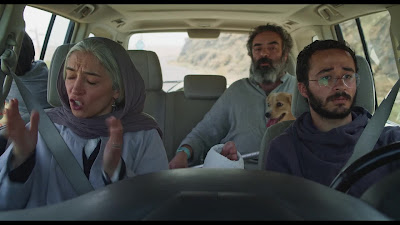
Although I customarily don’t spend much time discussing film production details, because such details can get in the way of  directly appreciating the film’s aesthetics and storyline, I sometimes make an exception for Iranian films.  That is because the Iranian government’s incessant incessant suppression of free expression in all media, including the film medium, makes it extremely difficult for creative filmmakers to express their ideas cinematically, and the reader may benefit from learning a few things about this background.  That is the reason why, for example, many good Iranian films are “road movies”.  It is sometimes only within the close confines of a road vehicle that the filmmaker has the privacy and freedom from spying eyes to be able to show genuine human interactions.  

And, of course, there is the matter of the Panahi family background.  Panah Panahi was born in 1984 and went to film school.  But most of what Panah learned ed about filmmaking came from watching both his famous father, Jafar Panahi, and his father’s equally famous mentor, the noted Cannes Film Festival Palme-d'Or-winner, Abbas Kiarostami, who often discussed their film projects with each other, with the young Panah sitting and watching in the background [1,2].  However, things became much more complicated when Jafar Panahi’s progressive attitudes and  film expression came under the critical scrutiny of the Iranian government, and in 2010 he was charged with producing propaganda against the government.  He was then sentenced to
“six years in prison and a 20-year ban on directing any movies, writing screenplays, giving interviews with Iranian or foreign media, or leaving the country except for medical treatment or making the Hajj pilgrimage” [3]. 
Since then Jafar Panahi’s activities have been severely restricted,, and he has more or less been under house arrest.  Nevertheless, he has somehow managed to continue to make some films, and his son Panah has continued trying to help in the background.  Eventually, Panah’s own contributions became more significant, and he was credited as the co-editor on his father’s recent film 3 Faces (2018).  

Note that both Jafar Panahi and Abbas Kiarostami have made some road movies.  Does that mean that Panah Panahi’s Hit the Road is a film like those of his mentors?  Yes and no.  Hit the Road has features of other Iranian road movies, but it has some of its own novel aspects, too.  

The film begins by showing a SUV parked along the side of a highway, and the viewer is not given any real background information as to what’s going on.  Instead the film employs the cinematic technique of “slow disclosure” to draw the viewer in to learning more about the situation.  The SUV has four people in it, evidently a family headed somewhere.  In the front is a twenty-something young man behind the wheel and a middle-aged woman in the front passengers’ seat.  In the backseat area is a middle-aged man with his leg in a cast that stretches out into the space between the two front seats.  Sitting next to this man in the backseat is a rambunctious and naughty six-or-seven-year-old boy, This family, the viewer will eventually surmise, is fleeing from some unspecified, dangerous situation in Tehran, probably brought about by the oppressive government of the Iranian Islamic Republic.  Indeed the young driver of the SUV has probably been conscripted into military service, which can in Iran be a very dangerous situation to be in..

So in this film the focus is primarily on the four contrasting members of the family in the SUV heading west out of Tehran:
  • The Mother (we are never told her name).   She is played by well-known actress Pantea Panahiha, and she is the most heartwarming person in the story.  She wants the best for her grumpy older son, but she has to hold her ground in the face of her family’s banter in the car.
     
  • The Father (known as Khosro) is played by Hasan Majuni.  He is an enigmatic, grouchy character, probably because he has had his foot in that caste four months.  But he sometimes quietly displays a warm heart, especially towards his mischievous young son sitting next to him in the back seat.
     
  • The young boy (nicknamed “Monkey the Second” by his Dad) is played by Rayan Sarlak and is an impish little boy constantly causing trouble.  But there is an innocence about him, too; for example when he occasionally kneels down by the roadside and prays to God.
     
  • The older brother (played by Amin Simiar) is known as Farid and is the taciturn young man behind the wheel of the vehicle.
     
  • In the very back of the SUV, is a pet dog, “Jessy”, who is apparently dying of a fatal condition.
As the family heads west in the SUV towards the Turkish border and hopeful refuge for Farid, we gradually learn amidst all the wisecracks along the way, that they have made great sacrifices to save the young man.  In order to get the money to pay off illegal, underground human-smugglers at the border, the family has sold their family house and car – the SUV they are driving is a borrowed vehicle.  All these details have to be kept away from the younger boy (the “2nd Monkey”), because he is such a young blabbermouth that he can’t be trusted with this information – he might give the game away if he converses with someone they meet along the way.  

So as the journey proceeds, the viewer is privy to two levels of concurrent inside-the-vehicle conversations — (1) the lightweight smart-alecky patter on the surface and (2) the guarded worry-laden remarks revealing concerns about constant surveillance threats and upcoming dangers.  These ingredients make the film special and have led it to receive accolades from the critical community [1,2,4,5,6,7,8,9,10,11].  As A.O. Scott of The New York Times remarked in this regard [4]:
“What makes Hit the Road so memorable and devastating is the way it explores normal life under duress. An unseen, oppressive force — presumably some aspect of the government that has harassed Panahi’s father for more than a decade and tried to prevent him from making films — imposes its will on them. That invisible cruelty makes the tenderness and good humor of this movie all the more precious, and almost unbearable.”
And as critic Tomris Laffly more generally commented [5]:
“Here, the details don’t matter as much as their heartbreaking consequences: the irreversibly burdened families unfairly torn away from their loved ones, and a society that carries those scars.”
Panahi achieves all this emotive filmmaking with the help of his excellent production staff.  This  included the always emotive music by Peyman Yazdanian (which also featured some diegetic pop music from pre-revolutionary times).  The cinematography by Amin Jafari and film editing by Amir Etminan and Ashkan Mehri, much of which was focused on activities inside the SUV, was excellently executed, included many long takes that were adroitly performed and that added to the intimacy of the goings on.  One highly imaginative sequence featured their visual rumination on 2001: A Space Odyssey (1968) (you will have to see the film to see how that fits into the storyline).  As critic Richard Brody of The New Yorker commented more generally [6]:
"[Panahi’s] visual compositions are essential elements of his world view, whether in a poised side-by-side image of Farid and his mother evoking ineffable love at a rest stop with a discussion of 2001: A Space Odyssey or an unbearable moment of separation that’s ingeniously filmed from hundreds of feet away, with heartbreaking reserve that nonetheless captures both its frantic energy and its poignant intimacy. Panahi’s visual correspondence of elisions and separations replicates the silences and mysteries that mark the characters’ own adventure.”
And so the family of four proceed along their stressful, doubt-laden path.  Although the outer structure of the story suggests one of event-filled adventure and danger, this is really a story about human relationships.  In fact it’s a story about love – family love.  You can watch Hit the Road to see what happens at the end of their journey and how things come out.
★★★½

Notes:
  1. Carlos Aguilar, “For Panah Panahi, Being the Son of an Iranian Auteur Wasn’t Entirely Helpful”, The New York Times, (22 April 2022).   
  2. Soheil Rezayazdi, “‘For Us Iranians, the Car Has Become a Second Home’: Panah Panahi on His Debut Feature, Hit the Road”, Filmmaker Magazine, (22 April 2022).   
  3. “Jafar Panahi”, Wikipedia, (1 April 2022).   
  4. A.O. Scott, “‘Hit the Road’ Review: Wheels Within Wheels”, The New York Times, (21 April 2022).   
  5. Tomris Laffly, “Hit the Road”, RogerEbert.com, (22 April 2022).   
  6. Richard Brody, “‘Hit the Road,”’Reviewed: A Mysterious and Thrilling Revelation from Iran”, The New Yorker, (18 April 2022).    
  7. Leigh Singer, “Hit the Road packs humour and heartbreak into an oddball Iranian family’s SUV”, Sight and Sound, (11 July 2021).   
  8. Scout Tafoya, “NYFF 2021: Hit the Road, Unclenching the Fists, The Girl and the Spider”, RogerEbert.com, (7 October 2021).   
  9. Jordan Mintzer, “‘Hit the Road’ (‘Jadde Khaki’): Film Review | Cannes 2021", The Hollywood Reporter, (12 July 2021).   
  10. Jessica Kiang, "‘Hit the Road’ Review: Several Stars Are Born in an Irresistible Iranian Road-Movie Debut”, Variety, (29 August 2021).    
  11. David Ehrlichm, “‘Hit the Road’ Review: An Iranian Family Makes a Run for the Border in Panah Panahi’s Unforgettable Debut”, IndieWire, {5 October 2021).    

“Marmoulak” - Kamal Tabrizi (2004)

Marmoulak (The Lizard, 2004) is a popular Iranian film that has been interpreted in somewhat different ways by different people.  Many people have seen it as a comedy, even a farce, but I considerate it to be a profound existential and social satire, more along the lines of Voltaire’s Candide (1759) or Antoine de Saint-Exupéry’s The Little Prince (1943).  Indeed, explicit reference to de Saint-Exupéry’s famous novella is made in this story. 

The film concerns a prison convict who escapes by masquerading as an Islamic mullah and the ensuing complications that arise from his disguise.  Commercially released in Iran in 2004, the film was an instant smash hit with critics and at the box office [1,2].  But after concerns about the film were expressed by members of the Islamic clergy, the government banned the film after only three weeks.  The clerical critics were evidently concerned that the religion was being laughed at, but I would say that, on the contrary, the film offers a sympathetic portrait of how religious principles can enter into the lives of all types of people.  In fact some observers have connected this film’s message with the thinking of noted Iranian Islamic and Sufi thinker Abdolkarim  Soroush [3].

Nevertheless, Marmoulak is not just any narrowly-focused art house fare [3]. The film has excellent production values with a commercial-film cinematic pallette covering a spectrum of social activities.  It was directed by Kamal Tabrizi, written by Peyman Ghasem Khani, and with cinematography by Hamid Khozouie; and it features an outstanding acting performance by Parviz Parastui in the lead role.  (Parastui  would soon also appear in Border Café (Café Transit, 2005) and The Willow Tree (Beed-e Majnoon, 2005)).

The story of the film traces the actions of and what happens to Reza Meshgali, aka “Marmoulak”, which is the Farsi word for ‘Lizard’.  Reza has been given that nickname on account of his uncanny ability to climb high brick walls unaided, like a lizard.  However, note that in Farsi the term‘marmoulak’ is also used metaphorically to refer to a chameleon, which is a particular type of lizard that changes its skin color in order to adapt to its surroundings.  And in this story our Reza, The Lizard (played by Parviz Parastui) does seem to be a chameleon at various times when he alters his identity as the changing circumstances demand. 

Actually, confused labeling is a thematic undertone in this story.  On several occasions people get lost looking for an address, because street names and numbering have unaccountably been changed by the local authorities.  In addition, although in most stories or dramas, the creators are careful to make sure each character has a distinct name, in this story, in contrast, there are several people named Reza, the confusion concerning which is part of the plot.

However, the most basic theme concerns religious interpretation.  Over the course of Marmoulak’s narrative, the viewer is exposed to two distinct and contrasting ways of interpreting Islam (or virtually any religion, for that matter) [4]:
  1. Literal Rule Following – Adherence to rigid laws and associated sanctified text.  This adherence to traditional rules takes no account of context and the human feelings associated with any circumstantial context. 
     
  2. Loving Compassion – Adoption of the intrinsic and heartfelt directive to love and come to the aid of those in one’s surroundings in contextually appropriate ways. This is suggested in the film by the phrase, “there are as many ways to reach God as there are people.”
Associated with each of these two contrasting interpretations of the sacred teachings is a distinctive approach for leading others to the higher realms of being:
  • Literal Rule Following –> Punishment – the path to salvation is a forced march
     
  • Loving Compassion –> Taming (as outlined by the fox in de Saint-Exupéry’s The Little Prince)
In this story, Reza, The Lizard, gradually and intuitively discovers the right path to follow.  In this connection, I will identify below (with “CA-#”) some moments in the narrative when Reza seems to take a step further in his progression towards compassionate altruism.

The story of Marmoulak plays out over the course of five acts.

1.  Reza, The Lizard, in Prison
Reza Meshgali, a small-time thief, has been sentenced to life imprisonment for armed robbery and is brought before the heartless prison warden Mojaver (played by Bahram Ebrahimi).  Mojaver is committed to spiritual restitution by imposing punishment, so we can see he follows the Literal Rule Following path.  He immediately sends Reza to a week of solitary confinement in order to help straighten him out. 

Later, when Reza is out of solitary and has a chance to wander in the prison courtyard, he rescues a pigeon caught in the barbed wire atop the prison wall by using his marmoulak skill to scale the wall and save the pigeon.  When Mojaver sees this, he reassigns Reza to another week of solitary confinement.  All of this “restitutional” punishment depresses Reza and makes him suicidal, an attempt for which lands him in the prison infirmary.

In the infirmary bed next to his, Reza finds not a prisoner, but a temporarily-ill mullah, Hajji Reza Ahmadi (played by Shahrokh Foroutanian, who also appeared in Going By (Az Kenar-e Ham Migozarim, 2001)).  Mullah Reza is not a sanctimonious preacher, but a sympathetic member of the working class.  He tells Reza, The Lizard, that there is no single path to God – “there are as many ways to reach God as there are people.”  Then he reads to him a passage from de Saint-Exupéry’s The Little Prince, where the fox tells the little prince to tame him.  When the prince asks the fox what that means, the fox responds that it means, “make me love you”.

Then Hajji Reza goes to take a shower, leaving on the bed his clerical garb, which Reza, The Lizard, opportunistically dons and uses as a disguise to escape from the prison. 

2.  On the Way to the Border Town
Reza’s goal is to escape to Turkey, so after stealing some money from a private taxi, he meets with an outlaw friend who tells him to travel to a border town and hook up with a Mahmoud Montazedi, who is a passport forger.  So, still wearing his mullah garb, Reza, who now calls himself “Hajji Reza”, boards a train headed for the border town.

In his private train car Reza is joined by two ladies, one of whom, Faezeh (Rana Azadvar), is young and pretty.  Reza, still the selfish nihilist at this pont, is instantly attracted.  The other woman is Faezeh’s mother, and she explains how she recently arranged for her daughter’s divorce from her thuggish and abusive husband.
  
On the long train ride Reza also meets some government officials who are impressed with having a hajji on their train and arrange for Reza to conduct a prayer session for the passengers at one stopover.  This is a scary proposition for Reza, but he somehow manages to fumble his way through it.

Upon arrival in the border town, Reza presumably hopes to disappear into the town, but he is unexpectedly met by some religious enthusiasts who have been excitedly awaiting the arrival of their new village mullah, who, by happenstance, is named “Hajji Reza”.  They usher him to their mosque, which hasn’t had a fully qualified mullah for a year.  At the mosque Reza happens to see a mute young boy staring at him.  This mute boy is seen on subsequent occasions throughout the film, and he seems to be a symbol of nonjudgemtal innocence.

Meanwhile back at the prison in Tehran, Mojaver is shown to be extremely upset over Reza’s escape.

3.  Reza, the Village Mullah 
Originally hoping to quickly grab his fake passport and disappear across the border, Reza now has the public eye upon him and finds himself forced to attend to the ritual duties of the mosque’s mullah.  Compelled to give a sermon to the assembled congregation, Reza tells all of them what he had just learned from the mullah he had met in prison (CA-1):
There are as many ways to reach God as there are people – even for the prisoner.
The listeners are inspired by this message, particularly two earnest young parishioners Gholamali (Hossein Soleiman) and Mojtaba (Cyrus Hemati).  They pepper Reza with all sorts of odd questions concerning Islamic ritual, such as 
  • How often does one pray at the North Pole, where a day lasts six months?
     
  • How should astronauts in outer space pray?
Reza uses his own intuition to give answers to these questions (CA-2 and CA-3), and the parishioners are further convinced of Reza’s divine enlightenment.  However, Reza stills has a ways to go.  After he sees Faezeh’s ex-husband, Javad Delangiz,  robbing a food store, his old habits cause him to urge the store owner to respond to this sort of thing with violence. 

Then after some difficulties, Reza makes it to Mahmoud Montazedi’s home where his grieving mother (Farideh Sepah Mansour ) informs him that her son has been imprisoned and that the fake passport is unavailable. 

4.  A Village Transformed
However, Reza’s idolizers, Gholamali and Mojtaba, have been surreptitiously tracking Reza’s evening meanderings in the poor village areas and wrongly impute these to be secretive acts of charity on the part of the mullah.  When these activities are reported to the other parishioners, they are even more convinced of Reza’s saintliness, and they all tearfully come to Reza’s quarters to provide him alms to give to the poor.

Meanwhile Mojaver, tracking Reza, has come to the border town, although he doesn’t know that Reza, unrecognizable in his clerical garb, is now the village mullah.

Reza, for his part, continues spreading his own version of the Word.  Walking through the park one day, he comes upon Gholamali talking alone with a single young woman.  Gholamali immediately expresses shame for this “sin”.  But Reza scoffs at such assumptions of guilt, telling the young man (CA-4),
“if He [God] were against these things, he wouldn’t give us the tools for mischief”. 
And later when he comes home, Reza learns that Javad Delangiz has been abusing Faezeh again, and he goes to Delangiz’s locked home to query him.  With a crowd of worshipful villagers looking on, Reza uses his marmoulak skills again to scale the wall of the home and confront Delangiz.  When Delangiz proves to be belligerent, Reza knocks him out cold with a professional head-butt.  When the man comes to, he realizes that he has met his match, and he instantly becomes a total convert, renouncing crime and now following the religious path.

However, Reza, still trying to escape the country, finds another person, a woman named Ozra, in the poor quarter who can make him a fake passport.  But just before she is about to do it, she receives alms from the former criminal Delangiz, and she, too, is moved to renounce illegal activities.  In fact Reza’s sermons at the mosque are now jam-packed with listeners, since shadier characters from the criminal underworld, influenced by  Delangiz’s conversion, are coming, too.

But now a power-hungry member of the upper class, Engineer Shojayi, hears about Hajji Reza’s renown and wants to use him to support his candidacy for parliament.  In this connection he forcibly ushers Reza to the local prison so that he can host a sermon by Reza to the prisoners there.  When the tremulous Reza assumes the pulpit, he is shocked to see Mojaver in the audience and is also moved to be asked to pass on wisdom to people of his own kind, i.e. prisoners.  Tearfully, he tells them (CA-5):
  • The gates of prison may be closed to you, but God’s gates are always open.
  • God doesn’t only belong to good people.
  • It is only God who doesn’t look at people differently.
  • We have to do something to tame people.  Taming means creating love.
  • Man is worthy of honor for his soul and humanity.  Beautiful attire does not reflect his worth.
  • I hope all of you will be released from here very soon and that you can find your path.  Please pray for me to find a path, as well
We now see that Reza’s forced assumption of piety has led to his own conversion, too. 

Afterwards, Reza and Shojayi are taken to a discussion room with prison officials, where the suspicious Mojaver, still not fully recognizing Reza, praises him for his eloquence.  But during this meeting, Reza overhears a loudspeaker announcement that prisoner Mahmoud Montazedi has been summoned to go the visitor’s room.  Reza quickly excuses himself from the discussion room to go to the toilet.  At the visitor’s room Reza learns from Montazedi that his mother does indeed have the fake passport for him and that he should go back to her and properly identify himself this time as Reza, The Lizard.

5.  Reza’s Exit
Reza goes back to Mahmoud Montazedi’s mother and collects the fake passport.  Then he goes to the border crossing, but he is told it is temporarily closed for a few hours, so he returns to town.  Back in the village, he comes upon Faezeh carrying some heavy shopping bags, and he offers to carry them for her to her home.  She gratefully accepts his offer, and she invites him for tea at her home, where she will be alone.  Reza is tempted by this offer, but he refuses it and gets the reformed Delangiz to carry her bags instead (CA-6).

But at the police station, Mojaver gets official word that the real Hajji Reza meant for this village had recently passed away, and that is why the villagers had mistakenly assumed that Reza, The Lizard, was their mullah when he arrived at the train station wearing clerical garb.  Mojaver also learns that Mahmoud Montazedi has testified that Reza was not armed during the crime they had committed together, and so Reza’s prison sentence should be reduced.  So Mojaver goes ahead and confronts Reza and has him taken into custody.
   
Before they are all to depart in the police car, Reza sees the mute boy one last time.  He hands over to the boy his clerical clothes, and he tells him they are helpful for taming people.   Reza adds further that it is good for people to become tamed (CA-7), and the boy responds softly, but audibly, in the affirmative.  Yes, he understands – and we do, too.

As the police car with Reza aboard drives off into the town, the final shot shows the mosque congregation listening to holy singing and being dimly aware of the background sound of the car being driven away.


Marmoulak is a well-crafted drama with excellent, nuanced acting performances, particularly on the part of Parviz Parastui in the title role.  An interesting narrative theme featured in the film is that of mistaken identity.  Reza’s masquerade as a mullah sometimes gets him out of trouble, but it also leads to some lost connections (such as with Mahmoud Montazedi’s mother and with city taxi cabs).  But in this case the mistaken identity also helps lead to the dissimulator taking on the virtues of his disguised role.

But at a deeper level, the film gives the viewer a beautifully dramatized depiction of the contrast between two distinctly different paths toward existential enlightenment:
  • rule-following driven by punishment and 
  • compassionate love driven by “taming”.
Mojaver espoused the former path, but Reza, The Lizard, found his way along the second path.  And Reza’s path was just one example of the unlimited number of ways of reaching compassionate spiritual fulfillment.  But all those many ways involve taming – adapting to the circumstances in order to generate and respond to love.  And this capacity for love is intrinsic to humanity and not some external notion that needs to be injected into inherently sinful human beings [5].  Religion, in its most benevolent form, can help us (tame us) to invoke that loving feeling that is appropriate for each of us.  This is what Marmoulak is showing us.  So Marmoulak does not make fun of religion; rather, the film shows an example of religion serving as a vehicle for evoking our intrinsic instincts for altruistic love. 
★★★★

Notes:
  1. Deborah Young, “The Lizard”, Variety (16 May 2004).  x 
  2. Jonathan Curiel, “FILM CLIPS / Also opening today”, SFGate, (6 August 2004).    
  3. William Brown, “There are as many paths to the time-image as there are films in the world’: Deleuze and “The Lizard”“, Chapter 5, Deleuze and Film (Deleuze Connections), (ed. by David Martin-Jones and William Brown), Edinburgh University Press, (2012), pp. 88-103.      
  4. The Film Sufi, "The Two Religions", The Film Sufi, (30 May 2015).
  5. Matthieu Ricard, Altruism: The Power of Compassion to Change Yourself and the World, Little, Brown and Company, (2013; English translation by Charlotte and Sam Gordon, 2015).

“The Lovers’ Wind” - Albert Lamorisse (1978)

French filmmaker Albert Lamorisse’s The Lovers’ Wind (Le Vent des Amoureux, in Farsi: Badeh Sabah; 1978) is a dreamlike documentary film that scans Iran’s stunningly variegated landscape of both natural and manmade wonders.  Although this is a documentary film, the perspective taken here, somewhat like that of Lamorisse’s earlier short masterpiece The Red Balloon (Le Ballon Rouge, 1956), is that of an ethereal, mystical narrator/observer.  In this case the narrator is the personification of the wind up in the sky, who dreamily marvels at the various scenes he overlooks and sometimes affects.  But our narrator is not the only wind in the sky.  He is the gentle northwest Badeh Sabah (“Lovers’ Wind”), with an aesthetic disposition unlike most of his more blustery and destructive siblings, such as the Badeh Div (“Devil Wind”) and the Badeh Sorkh (“Crimson Wind”).

Lamorisse, the multi-talented producer, director, and writer for this film, was by this time famous for his innovative accomplishments.  This even included his invention in 1957 of the popular and sophisticated strategy board game, Risk, which features the possibility of multi-player alliances among the competing players in search of global conquest.  In the filmmaking sphere, he invented a steady-camera mounting system for helicopters, called “helivison”, which helped support his lifelong fascination for filming aerial subjects, as well as for filming ground-level subjects from the air.

So thanks to his unique aerial documentary capabilities, Lamorisse was commissioned in 1968 by the Iranian Ministry of Art and Culture to make a film celebrating Iran’s magnificent culture, from ancient times up to the present, that would feature his patented aerial photography [1].  After all, Iranian culture, notably its art, poetry, and architecture, has long been a critical contributor to the world.  And owing to its key geopolitical position in connection to the world’s trade routes across Eurasia, Iran’s cultural and economic innovations have spread far and wide across the globe [2].  In addition, Iran’s varied physical landscape features many beautiful elements that are worth calling attention to.

Lamorisse completed much of the shooting for the film in 1969, most of which (about 85 per cent) featured aerial cinematography, accordance with his own poetic view of what the film should be about.  However the advisors of Iranian Shah Mohammad Reza Pahlavi felt that Lamorisse’s results to that point had not sufficiently covered recent, more modernistic, accomplishments of the shah’s government.  So they insisted that Lamorisse come back and shoot more material featuring modern industrial developments, particularly the huge Karaj Dam northwest of Tehran.  This would entail more aerial cinematography near the dam, and Lamorisse had concerns about the dangers of flying a helicopter in the vicinity of the high-tension wires connected to the dam (earlier he had had nightmares that he would someday drown in the waters of the Caspian Sea).  The shah’s government persisted with their demands, however, and promised to provide Lamorisse with the shah’s personal helicopter pilot; and finally Lamorisse reluctantly agreed to come back in 1970 for the reshooting [1,3]. 

As it turned out, Lamorisse’s forebodings proved to be correct – during the reshoot his helicopter became entangled in the Karaj dam’s high-tension wires, and he and the helicopter pilot fell to  their untimely deaths.  Albert Lamorisse’s widow, Claude, and his son, Pascal (who as a six-year-old boy had been the star of The Red Balloon), both of whom had been working as assistants on this film’s production, ultimately took up the task of editing and completing the film in accordance with Albert’s original notes.  Finally in 1978 the completed film, in French, was released, and  it soon received a 1979 US Oscar nomination for Best Documentary Feature.
The Lovers’ Wind that we have today is certainly a gripping presentation of Albert Lamorisse’s original haunting vision of Iran.  Narrated eloquently by Manouchehr Anvar, who supervised the original French script’s translations into English and Farsi (Persian) versions, and with Guy Tabary’s expressive cinematography and Hosein Dehlavi’s evocative music, the completed work is a masterpiece.  It has finally and thankfully even been shown in 2016 to great acclaim in the country that embodies the film’s subject matter, Iran [4].

As already mentioned, The Lovers’ Wind pays tribute to Iran by showing the country’s fascinating features from the perspective of the wind.  Wind mythology is a feature of all ancient cultures, and winds are variously thought to metaphorically represent disruption, fate, and the forces of change [5].  In the case here we have a unique wind, Badeh Sabah, who looks down with fascination on the changing terrain he surveys.  This aerial perspective is afforded by Lamorisse’s helivision, which due to its front-of-the-helicopter camera mounting (previous helicopter camera mountings looked straight down), enabled a “wind’s-eye-view” of the landscape over which the wind was moving.  This facilitated long, sweeping camera shots from the overhead wind’s perspective as it blew over the land.

The roving narrative of The Lovers’ Wind passes through several stages as it progresses.

1.  Badeh Sabah and His Brothers
At the outset we are introduced to Badeh Sabah, a gentle northwest wind, as we see a dust storm swirling from his perspective.  But as he looks down at the terrain over which he is moving, he shows fascination with the traditional mud-brick human settlements that he encounters in the Iranian countryside.  In particular, he shows interest in manmade badgirs (“wind catchers”), which are traditional Iranian architectural structures for directing wind currents for ventilation purposes [6].  Then he talks about how he has learned to push rain clouds around in order to irrigate the land.  This nurturing approach is in contrast to Badeh Sabah’s bullying and destructive brother winds, such as Badeh Div (“Devil Wind”) and Badeh Sorkh (“Crimson Wind”), who like to wreak havoc on the world. 

As Badeh Sabah comes across windswept, abandoned ruins of ancient Iranian societies, which are now just the playthings of his nihilistic brothers, he contemplates, as he views them, the eternal presence of nomad societies, which never disappear.  Nomads just keep moving and living off the natural land and never stop reappearing.

Then he comes across the ruins of Persepolis, the ancient capital of the Persian Achaemenid Empire, which was destroyed and burned by Alexander the Great in 330 BC.  The full destructive spread of what was initially a small fire is something for which Badeh Sabah’s older brother, Badeh Div, proudly takes credit.  But in stark contrast to his brothers’ love of destruction of human-made structures, Badeh Sabah says he is fond of humans.

2.  Human Monuments
Fascinated with human developments, Badeh Sabah now goes to Isfahan and marvels at the fact that no matter how many times this magnificent city has been invaded, its inhabitants have always obliged its invaders to follow their own appreciation of beauty and culture.  Then Badeh Sabah goes on to Mashad and gazes at the impressive mosques there, after which he further gazes over the Zoroastrian fascinating burial towers in Yazd.  Then he heads south towards the Persian Gulf.

3.  The Sea and Sailors
When Badeh Sabah gets to the Persian Gulf, he overlooks various human-made structures associated with man’s interactions with the sea.  This includes docks, piers, as well as a number of boats, both large and small.  He observes that the winds have long helped sailors move across the waters and reach distant destinations. 

Then he becomes fascinated with and starts following large oil pipelines that run along the ground out from the seaport and off into the land to the north.  As Badeh Sabah traces these pipelines northward, we see them following their sinuous path over barren wilderness and representing a silent, almost mysterious, human presence that has left its mute and cryptic marks across a desolate landscape.

4.  Heading North
As Badeh Sabah continues northward, he starts encountering hitherto unseen greener environments.  He sees a lush world now sculpted with green bushes and trees.  Then he comes upon some steep mountain scenery and finally comes down to stop by for awhile to blow over and look into the Iranian emperor’s modern mausoleum. 

Then continuing northward through picturesque mountainous landscape, Badeh Sabah begins following railroad trains as they head up north along perilous cliffside paths, sometimes temporarily disappearing into long dark tunnels only to reemerge somewhere further on.

Finally Badeh Sabah comes down to gentler terrain, and here expresses his wonder at the natural beauties of terrace farming.  Badeh Sabah seems to prefer these instances of human interactions with nature, because here they manifest not examples of self-glorying human ambitions to defy or overcome nature, but instead examples of man’s efforts to harmonize with nature.  In fact when he gazes down at the terrace-farming ponds’ still waters reflecting images of the clouds in the sky overhead, he expresses his joy over man’s sincere efforts to reflect the sky.

5.  The Caspian Sea
At last Badeh Sabah comes upon the shores of the Caspian Sea, and again he gazes upon small boats moving over the waters.  On a hillside he encounters another fascinating example of a gentle human interaction with nature.  The entire hill has been draped with hundreds of newly crafted Persian carpets set out to dry.  The entire harmony and serenity of this scene is suddenly disrupted, however, by the villainous appearance of Badeh Div, who creates a turbulent wind that begins blowing away all the rugs into the wilderness.  However, Badeh Sabah starts pushing in the opposite direction of Badeh Div’s wind in order to thwart his devilish brother’s malicious intentions.  Again we are seeing an example of Badeh Sabah’s sympathies for humankind and its ways.

Finally, at the close of the film, Badeh Sabah comes across a loving newly wed couple who are desperately fleeing on horseback from the pursuit of the new bride’s possessive and oppressive brothers.  Badeh Sabah quickly intervenes on the lovers’ behalf, mounting a strong wind to hold back the pursuing brothers that allows the fleeing newlyweds to escape.  And he declares that he has finally identified for himself his true identity – he is the Lovers’ Wind.


Over the course of The Lovers’ Wind’s aerial survey of Iran, the viewer is given a feeling not only for the country’s natural wonders, but also for its human interactions with nature, in the form of monuments and activities.  And these human interactions with nature, as well as even human interactions with other people, are often inspired by the infinitely wondrous beauties of nature, itself.  This tendency is what came to inspire the Lover’s Wind’s sympathies.
 
It is my belief, unscientifically arrived at though it may be, that romantic love has long been a feature of Iranian culture, from the poems of Hafez, Attar, and Rumi down to the present day.  Iranian people often have an almost instinctive sensitivity and openness to love’s possibilities.  Hopefully the oppression that currently afflicts the Iranian people will soon be lifted so that they can more naturally express their inherent loving nature that is suggested by The Lovers’ Wind.
★★★★

Notes:
  1. Tiffany Malakooti and Lucy Raven, “On Albert Lamorisse’s “The Lovers’ Wind”“, Noise, Bidoun, (Winter, 2010).   
  2. Peter Frankopan, The Silk Roads: A New History of the World, Bloomsbury (2015).
  3. Liam Callanan, “The Final Flight of Albert Lamorisse”, Slate, (2 July 2018).   
  4. Mohamadreza Seyedagha, “‘Lovers’ Wind’ Carries Hall Packed to the Hilt”, Financial Tribune, (25 April 2016).   
  5. “List of wind deities”, Wikipedia, (26 May 2019).  
  6. "Windcatcher", Wikipedia, (1 June 2019).  

"3 Faces" - Jafar Panahi (2018)

Iranian filmmaker Jafar Panahi is famous not only for his outstanding films but also for his heroic struggles to freely express himself in the face of an oppressive dictatorship.  After the Iranian government violently suppressed the Green Movement’s peaceful protests of the controversial 2009 Presidential elections, Panahi (along with other associates, including Mohammad Rasoulof) was arrested for trying to make a documentary film concerning those events.  In 2010 he was convicted of essentially treasonous behaviour and sentenced to six years in prison and also given a 20-year ban on engaging in any filmmaking activities and on leaving the country.  Nevertheless and despite the severity of this sentence, Panahi has somehow managed to continue making films, albeit under extremely constrained conditions.  His recent films This is Not a Film (2011), Closed Curtain (2014), and Taxi Tehran (2015) were basically all shot within single living enclosures (in Taxi Tehran’s case, inside a single taxicab).  All three of these films were interesting not only for their subject matter but also as experiments in novel cinematic expression.

Now Panahi has come out with a fourth film since his 2010 arrest, 3 Faces (Se Rokh, 2018).  This features a wider degree of spatial latitude, presumably because Panahi’s six-year prison sentence, which was apparently served as a house interest, had now come to an end.  Thus the restrictions on Panahi’s movements had now apparently been relaxed somewhat, and he could now move around a little.  So 3 Faces concerns a road trip that Panahi and a friend take up into the northwestern Iranian province of Azerbaijan (which is where Panahi grew up).  The film was presented at the 2018 Cannes Film Festival, where its script written by Panahi and Nader Saeivar was given the award for Best Screenplay [1]. 

Many Iranian films, particularly those of Panahi as well as those of his senior colleague Abbas Kiastomi under whom he once served, have a semi-documentary feel to them, which some critics have likened to neorealism.  And 3 Faces is no exception on this score.  But Panahi tends to go further in this respect and intentionally blurs the boundary between narrative fiction and documented reality, with most of the characters, including Panahi, playing themselves in the story that is told.  So the viewer is sometimes left wondering if he or she is watching a documentary about Panahi or a fictional story about Panahi – or even a documentary about Panahi making a film about Panahi.

The story of 3 Faces begins in highly dramatic fashion with Panahi hurriedly driving his well-known actress friend Behnaz Jafari (played by herself) up into Azerbaijan, a northwest Iranian province where the natives speak the Turkic Azeri language.  The two travellers are responding to a self-made video that Panahi had received from a young woman, Marziyeh Rezaei (playing herself), that was intended for Ms. Jafari and which expressed her intention to commit suicide.  In fact the selfie video, which was shot in a single take, appears to show the girl actually committing suicide by hanging herself from mountainside tree branch. 

Ms. Jafari is beside herself with concern and is desperately hoping that the video she has seen was artificially staged by the clearly distraught girl in order to arouse her concern.  What has driven Marziyeh to such desperation is that her passionate dreams of self-fulfilment are being thwarted by her conservative family.  She fervently wants to become an actress, and she has been accepted to study in a prestigious drama school.  But her family thinks that the idea of becoming an “entertainer” is shameful and has insisted that Marziyeh accept an arranged marriage and resign herself to being an ordinary village housewife.  Marziyeh believes that if Ms. Jafari, who is a well-known TV and film actress and therefore a celebrity, could intercede on her behalf, then she might be able to persuade her family that acting can be a respectable profession for a woman.  But as Marziyeh explains in her video, her repeated failures to get Behnaz to respond to her phone calls has driven the young girl to a suicidal state.

So the stage is set for melodrama.  But when Panahi and Jafari reach Marziyeh’s home town of Mianeh (which is also Panahi’s home town), things slow down, and the film takes on a more leisurely tone as it explore the film’s larger themes [2].  As the two visitors look around for Marziyeh, they have a number of encounters with the provincial locals, which give Panahi an opportunity to take a satirical look at  some aspects of traditional Iranian ways of thinking on the local level.  It turns out that Jafari’s suspicions were correct: Marziyeh’s suicide was staged.  But the issues that led Marziyeh to desperation are still there. Marziyeh has fled her family’s home and is still missing. 

As the characters Panahi and Jafari explore the area looking for Marziyeh, Panahi, the filmmaker, explores some other issues in his usual oblique (by necessity) manner:
  • Truth 
    The question of how the people know what is true is always an issue in Iran, and this film alludes to that in several places.  One instance, of course. is the truth of Marziyeh’s suicide, which turns out to be false.  But the issue of truth is generalized when Jafari, questioning the veracity of Marziyeh’s selfie video, wonders aloud whether she is actually an uninformed participant in a fiction film that is being made by Panahi about suicide.  The viewer will naturally reflect on the meta-level ramifications of Jafari’s speculation.    

    But in any society, the approach to a true understanding of things will be severely hindered if one-half of the population, i.e. the women, are restricted from expressing themselves.
     
  • Masculinity and Femininity 
    There are several encounters with the villagers that display some common attitudes of these people towards gender.  On one occasion they were stopped on a narrow mountain road by an injured bull that blocked the way.  The farmer who owned the bull sang the praises of his bull’s virility because of its capability of impregnating ten cows in one night. For him such a display of virility was a matter of high honour.  They have another encounter with a local who holds his son’s circumcision-removed and preserved foreskin to have near sacred importance.  This man also dreams of his son emulating in real-life the film roles of old masculine film idol Behrouz Vossoughi.  Vossoughi was famous for his roles in stories of revenge and hatred (e.g. Qeysar (1969) and Tangsir (1974)) [4].  What he wants is for his son to be a “real man” and carry out vengeful attacks of retribution the way Vossoughi did in his movies.  As for women, their proper role is to serve in the home as housewives – as violently expressed by Marziyeh’s brother.
Panahi and Jafari eventually do find out that Marziyeh is hiding out in the relatively remote home of an old woman named Shahrzad, who was an active actress, dancer, and poet before the 1979 Iranian revolution but who dropped out of sight after the revolution and is now a neglected and poverty-stricken recluse.
 
Although Shahrzad’s face is never seen in this film, she is an important figure thematically, and she is one of the “3 Faces” (along with Marziyeh and Behnaz Jafari) referred to in the film’s title.  Her character in this film is, like all the characters in this story, undoubtedly a reference to another real person – in this case, Kobra Amin Sa’idi.  She was an important poet, dancer, and actress in the 1960s and 70s who performed under the stage name “Shahrzad” – for example in Qeysar (1969) and Dash Akol (1971).  But the new and oppressive revolutionary culture had no place for her womanly artistry [3].  A documentary account of her life, then and now, has been presented in the film Shahrzaad's Tale (2015).

Eventually Marziyeh and Behnaz do hook up with each other, but the film’s ultimate resolution at the end is not entirely clear.  The options available to Marziyeh are uncertain, at best.

Panahi tells this tale in a leisurely fashion, with many reaction shots, some of them in the form of long takes to convey the mood of the of the onscreen observer/listener (Jafari or Panahi).  Note in this connection that Panahi’s three preceding films, shot as they were under severe restrictions due to his sentencing, all had an unavoidable feeling of confinement to  them.  Here in 3 Faces, though, with Panahi now afforded greater leeway to move around, one might expect the claustrophobic aura to be significantly lessened.  Nevertheless, even though 3 Faces does have many exterior shots, including many shots of the road as seen from looking outside of Panahi’s vehicle, there is still an overall visual feeling of confinement to the film.  So we are given the sense that our pursuers of truth in this story are considerably restricted with respect to the reality they can observe.

If we reflect on the “3 Faces” presented in this film, we can see that Panahi has given us three different era-dependent perspectives on womanhood in Iran:
  • Shahrzad (the past)
    She represents the pre-revolutionary period of Iran in the 1960s and 70s when women were starting to be given more equitable treatment and opportunities in society.  Shahrzad, herself, was an expressive embodiment of this opening-up.  The fact that her face is totally effaced from the current society is a grim comment on what has been lost since that era.
     
  • Behnaz Jafari (the present) 
    She represents the more restricted present era, in which a few women can achieve prominence if they manage to appear frequently in the media and toe the line.
     
  • Marziyeh (the future) 
    Although Marziyeh is educated,  creative (witness her selfie suicide video), and courageous, her opportunities remain restricted by strong prejudices still rooted in traditional Iranian society.  She represents the uncertain future. 
We can only hope that expressive voices like Panahi’s can help generate a future that will afford the Marziyehs of this world the opportunities they seek.  Then a film like this can have a happy ending.
★★★
                                                 
Notes:
  1. Jessica Kiang, “Film Review: ‘3 Faces’”, Variety, (1 July 2018).   
  2. Geoff Andrew, “Cannes first look: Three Faces’s road trip finds Jafar Panahi on familiar ground”, Sight & Sound, (15 May 2018).   
  3. “Poetry, or the Power of Existence: Shahin Parhami’s ‘Shahrzaad’s Tale’“, Ajam Media Collective, (2 August 2017).   
  4. But Behrouz Vossoughi played a somewhat more reflective and tragic figure in Dash Akol (1971).

“Jirga” - Benjamin Gilmour (2018)

Jirga (2018) is an Australian-made drama set in strife-torn Afghanistan that covers some issues associated with guilt from different perspectives.  How this film came to be made is actually an interesting story in its own right.  Writer-director-cameraman Benjamin Gilmour’s only other film, Son of a Lion (2007), was shot and set in Pakistan, and he intended to have Jirga shot in Pakistan, too.  However, once he and his crew started shooting in Pakistan, the Pakistani government’s Inter-services Intelligence (ISI) agency read the script and decided to revoke permission to shoot the film in that country [1].  This led Gilmour’s Pakistan-based principal funder to withdraw his financial support for the production.  Left without a crew and financial backing, Gilmour chose to shift to Afghanistan and rely on crowd-funding to shoot the film on-the-fly and under dangerous, sometimes life-threatening, conditions. 

The story that was filmed to make Jirga concerns a young Australian soldier, Mike Wheeler (played by Sam Smith), who returns to Afghanistan on his own after having served there three years earlier in the Australian military peacekeeping forces.  His return trip to Afghanistan is a personal mission and the  key to this film, but it takes some time in the telling of this tale for the reasons behind this mission to be revealed.  It is soon revealed, however, that Mike is carrying tens of thousands of dollars in US currency that are presumably to be used as an instrument on this mission.  It is only later revealed in the film that three years earlier Mike had accidentally killed an unarmed Afghan civilian, and he has returned now to seek out the family of his victim and to express his repentance for what he did.

The story of Mike’s mission is presented in five rather disjointed segments, the disjointedness of which we can probably attribute to the difficult shooting circumstance that Gilmour and his production team faced in Afghanistan.  (For example, Gilmour apparently shot the film himself with just a single hand-held camera that he had picked up in Pakistan [2]). 

1.  Kabul
At the outset of the film, the sullen and swarthy Mike Wheeler is shown having recently arrived in Kabul and looking to hire a taxi driver to take him on a long journey south to a village near the city of Kandahar.  This is a difficult task for two reasons.  For one thing, the Kandahar area is held by the violent Taliban insurgents, and none of the taxi drivers is willing to drive there.  In addition Mike doesn’t speak the native Pashtun language, and the drivers hardly speak any English.  So negotiating anything with a taxi driver is extremely difficult. 

Gilmour’s mise-en-scene concentrates the focalization of the film almost exclusively on Mike, so the viewer is only privy to what Mike sees and hears.  Thus, although there is quite a bit of Pashtun heard on the soundtrack, there are no subtitles provided; so the viewer is likely to be just as ignorant as Mike concerning what is being said [3].

Eventually, Mike does manage to hire a taxi driver to take him south, without specifying precisely where he intends to go.

2.  The Taxi Trip
The next segment shows Mike and the taxi driver (Sher Alam Miskeen Ustad) heading south through the picturesque mountainous landscape.   And despite the language barrier, they gradually get to know each other and become friends.  Eventually and after much effort, Mike does manage to persuade his reluctant driver to take him into the dangerous Taliban-infested area,  Although the story seems to dawdle during this part of the film, this sequence, which depicts the universality of human companionship, despite differences in language, customs, religion, etc., and which is presented in beautiful natural surroundings, is one of the more appealing parts of the  film.

3.  Lost in the Wilderness

After considerable travel, their taxi is eventually stopped on the road at a Taliban checkpoint, and Mike just barely manages to escape capture by running off into the barren wilderness.  This extended sequence shows Mike utterly alone and wandering without food and water under the hot sun through the desert-like terrain.  Again the narrative seems to slow down even more, although the shots of the naturally scenic landscape in the background are dazzling.

Mike finally drops down on the ground and loses consciousness.  He is apparently close to death.

4.  A Taliban Captive

But the Taliban happen to discover Mike just in time and take him captive, and now the pace of the film picks up again.  Mike’s captors brutally subject him to severe beatings, and then they coldly discuss what to do with him – with the presumption that it is probably best to kill him.  However, one of the Taliban guerrillas can speak some English, and Mike finally has the chance to explain to them what his mission is about and that it is not intended to be a threat to the Taliban.  He wants to seek his victim’s family and offer them all his money as recompense for what he had done.  But his Taliban captors  dismissively explain to him that giving money to his victim’s family members would just be seen as selling a life for money and would therefore be unacceptable to any true Muslim.  So, to them, his mission was doomed to be futile anyway.

Although it still seems that most of the Taliban in this troop want to see Mike put to death, their senior leader is mysteriously fascinated by the altruistic extravagance of Mike’s mission.  He orders his men to escort Mike to the vicinity of his victim’s village, which does not happen to be under Taliban control, and let him go there on his own.

5.  The Village Jirga
Mike now enters the village of his victim and abandons the idea of offering “bribery” money to his victim’s family (a widow and two children) for the expiation of his sins.  Mike is quickly incarcerated, and a village jirga (a council of village elders) is summoned to determine his fate.  What transpires in the end is an  intriguing but debatable form of justice, and there is some doubt in my mind as to whether anything conclusive or uplifting has been achieved.  Since the film’s basic themes concern guilt, repentance, and justice all seen from a cross-cultural or universal perspective, the way the film ends was something of a disappointment for me.


We know that Mike feels very guilty about what he did, but he is so taciturn that we never know about the nature of his repentance or what he conceives to be appropriate atonement.  In addition, what is the nature of forgiveness that he seeks, and what is the nature of forgiveness that his victims are capable of?  It is generally accepted in the Abrahamic religions that God, or Allah, will fully forgive a sinner who truly repents his or her wrongdoings. But this is a matter between the human sinner and God, Who can unerringly assess the true nature of the sinners repentance.  It is much more ambiguous, even in these same religious cultures, concerning the degree to which religious humans will forgive the sins of their fellow humans. 

And the film’s coverage of this issue does not offer much insight. Are we only left with the notion that “two wrongs don’t make a right”?  And the mechanism by which the village jirga executes its justice in the end also seems arbitrary, at best.  So although there is a certain degree of rapprochement, or “coming together”, across cultural disparities in the film, the extent to which any common understanding is actually achieved is unclear.

On the production level, I also had some misgivings concerning some aspects of the film.  Although we have to grant director Benjamin Gilmour considerable latitude in view of the difficult production conditions he faced, nevertheless it is necessary to warn prospective viewers that (a) the almost-continuous shaky hand-held camera movement and (b) the numerous jarring jump-cuts throughout the film are a constant disturbance to one’s viewing enjoyment of the film.

So overall, we could say that Jirga does have some fascinating moments, even if the ride is definitely bumpy along the way.
½

Notes:
  1. Benjamin Gilmour, Cameras and Kalashnikovs: The Making of Jirga, Benjamin Gilmour Films, (29 May 2018). 
  2. Richard Gray, “Review: Jirga”, thereelbits.com, (18 June 2018).  
  3. Later, when Mike is captured by the Taliban, there is some brief focalization on his captors, and there are some subtitles concerning what they are saying.