“Hit the Road” - Panah Panahi (2021)

Hit the Road (Jadde Khaki, 2021) is an Iranian film written and directed by Panah Panahi,  the son of masterful Iranian film auteur Jafar Panahi.  This is a “road movie” that has a special flavor to it, thanks, in part, to its Iranian context.
Although I customarily don’t spend much time discussing film production details, because such details can get in the way of  directly appreciating the film’s aesthetics and storyline, I sometimes make an exception for Iranian films.  That is because the Iranian government’s incessant incessant suppression of free expression in all media, including the film medium, makes it extremely difficult for creative filmmakers to express their ideas cinematically, and the reader may benefit from learning a few things about this background.  That is the reason why, for example, many good Iranian films are “road movies”.  It is sometimes only within the close confines of a road vehicle that the filmmaker has the privacy and freedom from spying eyes to be able to show genuine human interactions.  

And, of course, there is the matter of the Panahi family background.  Panah Panahi was born in 1984 and went to film school.  But most of what Panah learned ed about filmmaking came from watching both his famous father, Jafar Panahi, and his father’s equally famous mentor, the noted Cannes Film Festival Palme-d'Or-winner, Abbas Kiarostami, who often discussed their film projects with each other, with the young Panah sitting and watching in the background [1,2].  However, things became much more complicated when Jafar Panahi’s progressive attitudes and  film expression came under the critical scrutiny of the Iranian government, and in 2010 he was charged with producing propaganda against the government.  He was then sentenced to
“six years in prison and a 20-year ban on directing any movies, writing screenplays, giving interviews with Iranian or foreign media, or leaving the country except for medical treatment or making the Hajj pilgrimage” [3]. 
Since then Jafar Panahi’s activities have been severely restricted,, and he has more or less been under house arrest.  Nevertheless, he has somehow managed to continue to make some films, and his son Panah has continued trying to help in the background.  Eventually, Panah’s own contributions became more significant, and he was credited as the co-editor on his father’s recent film 3 Faces (2018).  

Note that both Jafar Panahi and Abbas Kiarostami have made some road movies.  Does that mean that Panah Panahi’s Hit the Road is a film like those of his mentors?  Yes and no.  Hit the Road has features of other Iranian road movies, but it has some of its own novel aspects, too.  

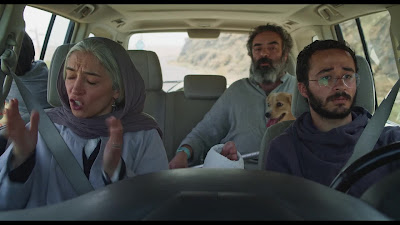
The film begins by showing a SUV parked along the side of a highway, and the viewer is not given any real background information as to what’s going on.  Instead the film employs the cinematic technique of “slow disclosure” to draw the viewer in to learning more about the situation.  The SUV has four people in it, evidently a family headed somewhere.  In the front is a twenty-something young man behind the wheel and a middle-aged woman in the front passengers’ seat.  In the backseat area is a middle-aged man with his leg in a cast that stretches out into the space between the two front seats.  Sitting next to this man in the backseat is a rambunctious and naughty six-or-seven-year-old boy, This family, the viewer will eventually surmise, is fleeing from some unspecified, dangerous situation in Tehran, probably brought about by the oppressive government of the Iranian Islamic Republic.  Indeed the young driver of the SUV has probably been conscripted into military service, which can in Iran be a very dangerous situation to be in..

So in this film the focus is primarily on the four contrasting members of the family in the SUV heading west out of Tehran:
  • The Mother (we are never told her name).   She is played by well-known actress Pantea Panahiha, and she is the most heartwarming person in the story.  She wants the best for her grumpy older son, but she has to hold her ground in the face of her family’s banter in the car.
     
  • The Father (known as Khosro) is played by Hasan Majuni.  He is an enigmatic, grouchy character, probably because he has had his foot in that caste four months.  But he sometimes quietly displays a warm heart, especially towards his mischievous young son sitting next to him in the back seat.
     
  • The young boy (nicknamed “Monkey the Second” by his Dad) is played by Rayan Sarlak and is an impish little boy constantly causing trouble.  But there is an innocence about him, too; for example when he occasionally kneels down by the roadside and prays to God.
     
  • The older brother (played by Amin Simiar) is known as Farid and is the taciturn young man behind the wheel of the vehicle.
     
  • In the very back of the SUV, is a pet dog, “Jessy”, who is apparently dying of a fatal condition.
As the family heads west in the SUV towards the Turkish border and hopeful refuge for Farid, we gradually learn amidst all the wisecracks along the way, that they have made great sacrifices to save the young man.  In order to get the money to pay off illegal, underground human-smugglers at the border, the family has sold their family house and car – the SUV they are driving is a borrowed vehicle.  All these details have to be kept away from the younger boy (the “2nd Monkey”), because he is such a young blabbermouth that he can’t be trusted with this information – he might give the game away if he converses with someone they meet along the way.  

So as the journey proceeds, the viewer is privy to two levels of concurrent inside-the-vehicle conversations — (1) the lightweight smart-alecky patter on the surface and (2) the guarded worry-laden remarks revealing concerns about constant surveillance threats and upcoming dangers.  These ingredients make the film special and have led it to receive accolades from the critical community [1,2,4,5,6,7,8,9,10,11].  As A.O. Scott of The New York Times remarked in this regard [4]:
“What makes Hit the Road so memorable and devastating is the way it explores normal life under duress. An unseen, oppressive force — presumably some aspect of the government that has harassed Panahi’s father for more than a decade and tried to prevent him from making films — imposes its will on them. That invisible cruelty makes the tenderness and good humor of this movie all the more precious, and almost unbearable.”
And as critic Tomris Laffly more generally commented [5]:
“Here, the details don’t matter as much as their heartbreaking consequences: the irreversibly burdened families unfairly torn away from their loved ones, and a society that carries those scars.”
Panahi achieves all this emotive filmmaking with the help of his excellent production staff.  This  included the always emotive music by Peyman Yazdanian (which also featured some diegetic pop music from pre-revolutionary times).  The cinematography by Amin Jafari and film editing by Amir Etminan and Ashkan Mehri, much of which was focused on activities inside the SUV, was excellently executed, included many long takes that were adroitly performed and that added to the intimacy of the goings on.  One highly imaginative sequence featured their visual rumination on 2001: A Space Odyssey (1968) (you will have to see the film to see how that fits into the storyline).  As critic Richard Brody of The New Yorker commented more generally [6]:
"[Panahi’s] visual compositions are essential elements of his world view, whether in a poised side-by-side image of Farid and his mother evoking ineffable love at a rest stop with a discussion of 2001: A Space Odyssey or an unbearable moment of separation that’s ingeniously filmed from hundreds of feet away, with heartbreaking reserve that nonetheless captures both its frantic energy and its poignant intimacy. Panahi’s visual correspondence of elisions and separations replicates the silences and mysteries that mark the characters’ own adventure.”
And so the family of four proceed along their stressful, doubt-laden path.  Although the outer structure of the story suggests one of event-filled adventure and danger, this is really a story about human relationships.  In fact it’s a story about love – family love.  You can watch Hit the Road to see what happens at the end of their journey and how things come out.
★★★½

Notes:
  1. Carlos Aguilar, “For Panah Panahi, Being the Son of an Iranian Auteur Wasn’t Entirely Helpful”, The New York Times, (22 April 2022).   
  2. Soheil Rezayazdi, “‘For Us Iranians, the Car Has Become a Second Home’: Panah Panahi on His Debut Feature, Hit the Road”, Filmmaker Magazine, (22 April 2022).   
  3. “Jafar Panahi”, Wikipedia, (1 April 2022).   
  4. A.O. Scott, “‘Hit the Road’ Review: Wheels Within Wheels”, The New York Times, (21 April 2022).   
  5. Tomris Laffly, “Hit the Road”, RogerEbert.com, (22 April 2022).   
  6. Richard Brody, “‘Hit the Road,”’Reviewed: A Mysterious and Thrilling Revelation from Iran”, The New Yorker, (18 April 2022).    
  7. Leigh Singer, “Hit the Road packs humour and heartbreak into an oddball Iranian family’s SUV”, Sight and Sound, (11 July 2021).   
  8. Scout Tafoya, “NYFF 2021: Hit the Road, Unclenching the Fists, The Girl and the Spider”, RogerEbert.com, (7 October 2021).   
  9. Jordan Mintzer, “‘Hit the Road’ (‘Jadde Khaki’): Film Review | Cannes 2021", The Hollywood Reporter, (12 July 2021).   
  10. Jessica Kiang, "‘Hit the Road’ Review: Several Stars Are Born in an Irresistible Iranian Road-Movie Debut”, Variety, (29 August 2021).    
  11. David Ehrlichm, “‘Hit the Road’ Review: An Iranian Family Makes a Run for the Border in Panah Panahi’s Unforgettable Debut”, IndieWire, {5 October 2021).    

Panah Panahi

Films of Panah Panahi:

“The Pianist” - Roman Polanski (2002)

The Pianist (2002), the story of a Polish concert pianist’s harrowing experiences during the German Nazi occupation of Warsaw in World War II, has been perhaps famed film director Roman Polanski’s most lauded work [1,2,3,4,5,6,7].  It won the Cannes Film Festival’s Palme d'Or, and it was nominated for seven U.S. Oscars, winning three of them (for Best Director, Best Adapted Screenplay, and Best Actor).  The film also won the British Academy of Film and Television Arts (BAFTA) Awards for Best Film and Best Direction, and it won seven French Césars (the French national film awards), including those for Best Picture, Best Director, and Best Actor.  In addition, the Internet Movie Database (IMDb) currently has The Pianist ranked 34th on its list of all-time greatest films [8].  So we are dealing here with a film that may be headed for status as a classic.  

The story of The Pianist is based on the experiences of a real person, Wladyslaw Szpilman, who was a young Jewish pianist living in Warsaw when the Nazis attacked and invaded the city in 1939.  In fact Ronald Harwood’s screenplay for the film was adapted from Szpilman’s personal memoir, Smierc Miasta. Pamietniki Wladyslawa Szpilmana 1939–1945 (Death of a City: Memoirs of Wladyslaw Szpilman 1939–1945), which first appeared in Polish in 1946.  A significant additional background feature that undoubtedly had further impact on the telling of this tale was Roman Polanski’s own personal experience as a young Jewish boy who somehow managed to escape from the Nazi Krakow Ghetto during the war.  On account of this background, The Pianist may be one of Polanski’s most personally felt film accounts.

The film begins in 1939 with Wladyslaw Szpilman (played by Adrien Brody) performing a piano piece on-the-air at a Warsaw radio station.  Just then the building is subject to a cannon fire attack by the invading German army.  Everyone flees except Szpilman, who continues playing on the piano.  But finally, with the cannon fire now destroying the wall of the studio Szpilman is in, he is forced to face reality and flee, himself.  This hesitancy here on the part of Szpilman to shift his focus and react to the threats around him will be a metaphor that is repeated throughout the story.

Szpilman belonged to a well-off Jewish family, and Jews had long been well-treated in Poland.  But the invading German army are shown to be almost uniformly ruthless and cruel – and they are particularly vicious towards Jews.  They seem to shoot and kill civilians on the street just out of whim – and then they laugh about it.  The people are powerless to respond.  Soon the Szpilman family is moved, along with all other Jews, to the walled-off and encapsulating Warsaw Ghetto.

In 1942 Szpilman and his family are to be transported to the Treblinka extermination camp when an acquaintance who is collaborating with the police recognizes Wladyslaw and pulls him away just as he is about to be forced into a departing train car.  In the subsequent confusion, Wladyslaw manages to escape and find a temporary hiding place in the city.  This is just one of the many out-of-the blue strokes of good fortune in the tale that save Wladyslaw from imminent annihilation.

Over the next few years Wladyslaw is compelled to move from one hastily-found hiding place to another just before he is about to be exposed to the authorities.  Sometimes he is helped by non-Jewish friends that he encounters, but most of the time he finds himself alone in abandoned buildings and without food.  During this time, he sometimes looks out through the window of his room to see activities of the failed Warsaw Ghetto Uprising (1943) and the Warsaw Uprising (1944), both of which are cruelly crushed by the Nazi authorities.  Ultimately, it appears that the whole city of Warsaw is destroyed.  And always the savagery of the German military is on full display.

Over the course of these years, the fugitive Wladyslaw has great difficulty finding any food in the abandoned buildings that he finds to hide in, and he is always on the brink of starvation.  So he becomes more and more emaciated.  It is said that the actor who played the part of Wladyslaw Szpilman, Adrien Brody, who was already slim, lost thirty pounds so that he could present a realistic emaciated physiognomy for this part of his role.  

Eventually while trying to open a can of pickles he has found, Wladyslaw is finally discovered by a German military officer. Captain Wilm Hosenfeld (Thomas Kretschmann).  When Wladyslaw tells the man that he is a pianist, the skeptical Hosenfeld demands that Wladyslaw demonstrate his prowess on a piano located in the apartment they find themselves in.  So Wladyslaw plays a Chopin piece for him, and that stirs the sympathies in Capt. Hosenfeld, who agrees to hide Wladyslaw in the attic and secretly supply him food on a regular basis.  In 1945 with the German army now retreating, Hosenfeld comes to Wladyslaw before departing and gives him his army overcoat to keep warm.  (This German military attire would later cause problems for Wladyslaw when the allied forces arrive.)  Note that Wilm Hosenfeld is just about the only German in the film who is presented sympathetically as a humane person.  

At the close of the film and with the war over, a formally-attired Wladyslaw is shown playing the piano with orchestral accompaniment at a posh recital hall.  For Wladyslaw, at least, life has regained its former beauty.  

Altogether, The Pianist is a polished and fascinating work, with excellent production values featuring the cinematography of Pawel Edelman and the film editing of Hervé de Luze.  The music includes a number of melodious pieces written by famed Polish classical composer Frederic Chopin.  And director Roman Polanski has gone to great lengths to conjure up an atmospheric setting that evokes the ravages of a war-torn city of that time.  In addition the acting of protagonist Adrien Brody as Wladyslaw Szpilman is particularly notable, because, even though he doesn’t have a lot of spoken dialogue lines to speak, he conveys the increasing angst of a man constantly faced with life-threatening circumstances. 

Nevertheless, and despite these undeniable virtues, I think The Pianist is not a great movie – it is a very good film, but not a great one.  The problem here is the absence of a compelling narrative structure to the events that are covered in the film.  For me the best films are those that portray the protagonist(s) engaged in some metaphorical “journey” for which they have some options concerning which “paths” they may choose to take.  I have remarked on this theme before, notably in connection with my review of Nomadland (2020) [9]:
“Almost all films (as well as dramas, stories, and novels) have a narrative that provides a structure for the events depicted.  The metastructure of these narratives is often characterized metaphorically as a journey.  There are one or more protagonists on such a 'journey' who are struggling to reach a desired 'destination', and there are usually other agents along the way who assist or stand in the way of progress.  Much has been written about the narrative-as-journey metaphor [10,11,12,13,14], notably the more formalized characterization of it known as the 'hero’s journey' [15] that was popularized by Joseph Campbell [16].”
In the story of The Pianist, however, our protagonist, Wladyslaw, is relatively passive.  Things just happen to him, and he is never shown to be in any situations where he can exercise any agency, where he can choose one among several optional “paths” to take.  All we see is a perpetual victim who manages to survive one catastrophic life-threatening situation after another mainly by pure luck.  Wladyslaw’s adversaries are cruel and, at bottom, inscrutable.  They are like dark, unfathomable forces beyond his and our comprehension.  All Wladyslaw can do is helplessly react and try to hide.  This character of a darkened world with more or less unfathomable adversaries has been seen in other Polanski films (e.g. Rosemary's Baby (1968) and Chinatown (1974)) and may be something of a pattern for him.

Of course, Polanski could have added some narrative elements to The Pianist that would have made Wladyslaw’s experiences more of an agency-oriented journey (if not a “hero’s journey”), but that would have compromised the historical authenticity of Wladyslaw’s tale.  What Polanski did do was insert a couple of narrative elements that were presumably intended to add some characterological depth to the Wladyslaw character.  One concerned a couple of sequences involving some flirtatious encounters Wladyslaw had with an attractive young woman, Dorota (Emilia Fox).  But these encounters don’t lead anywhere.  Another inserted narrative element was Wladyslaw’s aforementioned encounters with the taciturn German Captain Wilm Hosenfeld.  But while these encounters with Hosenfeld were among the most interesting human interactions in the film, they represented an isolated occurrence and failed to give us a feeling for the earlier parts of Wladyslaw’s quest.  So the two narrative insertions did not fulfill my desire for narrative material that would flesh out Wladyslaw’s mental journey.

Nevertheless, The Pianist does feature a meaningful and heartfelt message that is a key to the film and must not be overlooked – it is one that is concerned with a fundamental aspect of human nature.  Despite the vast differences that stretch across humanity with respect to language, education, abilities, customs, norms, and culture, there is something that we all share, and that is the capability to have a direct aesthetic experience in response to something we see or hear (or even taste) in the world.  An example might be something like seeing a beautiful flower or waterfall or hearing beautiful music.  These aesthetic experiences are immediate and intuitive, and they do not require cogitation or thinking about what is being experienced [17].  Thus they are universally available and open to everyone, regardless of one’s background.  This means that, despite their hugely discordant backgrounds, a Jewish musical artist like the pianist Wladyslaw Szpilman and a German Nazi military officer like Wilm Hosenfeld can share direct aesthetic experiences, such as the Chopin musical piece that Szpilman plays for Hosenfeld, experiences that offer opportunities for bonding and that can ultimately open the door to shared understanding.

This was the message that Szpilman and Polanski offered to the viewer – that even amidst the most horrific atrocity-filled conflicts, shared aesthetic experiences can offer an opening toward salvation.
★★★½

Notes:
  1. A. O. Scott, “FILM REVIEW; Surviving the Warsaw Ghetto Against Steep Odds”, The New York Times, (27 December 2002).         
  2. Peter Bradshaw, “The Pianist”, The Guardian, (24 January 2003 ).   
  3. Roger Ebert, “The Pianist”, RogerEbert.com, (3 January 2003).   
  4. David Edelstein, “The Sound and the Saved”, Slate, (27 December 2002).   
  5. Jeffrey M. Anderson, “The Pianist (2002)”, Combustible Celluloid, (n.d.).   
  6. Dennis Schwartz, “Pianist, The”, Dennis Schwartz Movie Reviews, (16 December 2002).   
  7. Duminica, “The Pianist, written by Ronald Harwood, based on the book by Wladyslaw Szpilman, 9 out of 10", Notes on Films, (16 July 2017).   
  8. “IMDb Top 250 Movies”, IMDb, (n.d.).  
  9. The Film Sufi, “''Nomadland’ - Chloé Zhao (2020)”, The Film Sufi, (30 September 2021).   
  10. Roger Schank and Gary Saul Morrison, Tell Me a Story: Narrative and Intelligence (Rethinking Theory),  (1990), Northwestern.
  11. Jerome Bruner, "The Narrative Construction of Reality", Critical Inquiry, 18:1, 1-21, (1991).
  12. Jerome Bruner, “The Narrative Construction of Reality”, Narrative Intelligence (2003), Michael Mateas and Phoebe Sengers (eds.), John Benjamin Publishing Co.
  13. Paul Ricoeur, Time and Narrative, vols. I- III, (1983-1985), University of Chicago Press. 
  14. Christopher Vogler, The Writer’s Journey, 2nd Edition, Michael Wiese Productions (1998).
  15. “Hero’s Journey”, Wikipedia, (17 September 2021).    
  16. Joseph Campbell, The Hero with a Thousand Faces, 1st edition, Bollingen Foundation (1949), 2nd edition, Princeton University Press (1990), 3rd edition, New World Library (2008).
  17. Eckhart Tolle, The Power of Now: A Guide to Spiritual Enlightenment, Chapter 5, New World Library, (2004).   

Roman Polanski

Films of Roman Polanski:

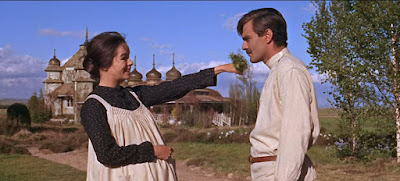
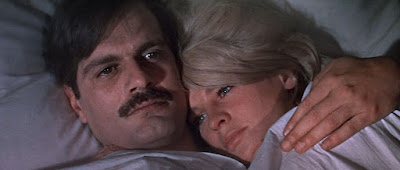
“Doctor Zhivago” - David Lean (1965)

Doctor Zhivago (1965) is an epic historical romantic drama directed by British film director David Lean.  Lean’s meticulous cinematic craftsmanship had already been manifested in his earlier prize-winning epics, The Bridge on the River Kwai (1957) and Lawrence of Arabia (1965); but here indeed in Doctor Zhivago the term “romantic epic” is a particularly definitive characterization of this film.  That is because it emphatically exemplifies many of the features that go into the making of a romantic epic film – (a) a dynamic and disruptive historical setting, (b) emphatically stylized principal characters, and (c) passionate, romantic relationships.  In these respects, the film that most closely comes to my mind for comparison with Doctor Zhivago is Gone with the Wind (1939).  And like that earlier classic romantic epic film, Doctor Zhivago was (generally) a success with the critics and with the public.  The film that David Lean fashioned here, with the help of Robert Bolt’s screenplay, Freddie Young’s cinematography, Norman Savage’s film editing (despite numerous jump-cuts), and the musical score by Maurice Jarre (who also wrote the haunting musical score for Sundays and Cybele (1962)), was a masterpiece; and it earned 10 Oscar (U.S. Academy Awards) nominations and winning five of them, as well as numerous other accolades.
 
The film Doctor Zhivago was based on Boris Pasternak’s Nobel-prize-winning novel of the same name that was published in 1957 and is about a Russian physician and poet who lived during the turbulent years of World War I and the subsequent Russian Communist Revolution of 1917 and the Russian Civil War.  Both the novel and the film take a skeptical view of the Communist Revolution, and so it was not surprising that the early distributions of both of these two works in the Soviet Union were suppressed.  And in addition, since both of them were made during the height of the U.S.-Russian Cold War, there was an inordinate amount of critical interest in the West in these political aspects of the story.  But we must remember that the film Doctor Zhivago was more than just a political saga about disruptive social conflict; rather, like Gone with the Wind, it was really about in-depth human feelings and experiences of some passionate people who lived inn the midst of this turmoil.

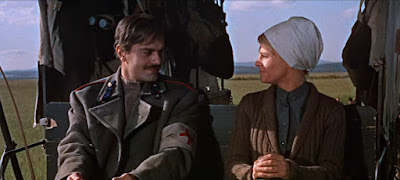
As mentioned, the story of this film concerns the experiences of a young Russian doctor, Yuri Zhivago, (played by Omar Sharif), during the early part of the 20th century.  When Yuri is a boy, his mother passes away, and he is taken in by family friends Alexander (Ralph Richardson) and Anna (Siobhán McKenna) Gromeko.  The Gromeko's have a daughter, Tonya (Geraldine Chaplin), and Yuri and Tonya soon become fast friends.  After a period of schooling in Paris, Tonya returns to Moscow, and Yuri and Tonya develop a mutual romantic attachment which leads to their becoming engaged to be married.  

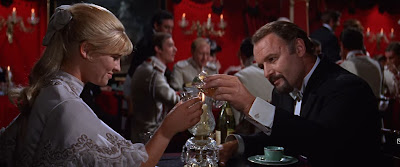
In an initially separate thread, beautiful 17-year-old Larissa ("Lara", and played by Julie Christie) is coercively seduced sexually by her own mother’s paramour, the cynical opportunist Victor Komarovsky (Rod Steiger).  When Lara’s mother learns of Komarovsky’s infidelity, she attempts suicide, and one of the doctors summoned to attend to the woman is Yuri Zhivago.  This is the first time that Yuri becomes aware of Lara.  Anyway, Lara’s real romantic interest is in a younger, idealistic political revolutionary, Pasha Antipov (Tom Courtenay), and the two of them eventually get married and have a child.


When World War I breaks out, the idealistic Pasha enlists in the military, but he is soon reported missing-in-action.  So Lara enlists as a military nurse in hopes of finding her husband.  Meanwhile Yuri Zhivago is drafted into the military to serve as a doctor.  When Yuri meets Lara out in the field, they join up to work together in a field hospital, where the two of them soon fall  in love.  This is the major romantic relationship of the story.  However, since both Yuri and Lara have spouses to whom they feel they should be faithful, they separate wistfully at the end of their term of service, and Yuri returns home.

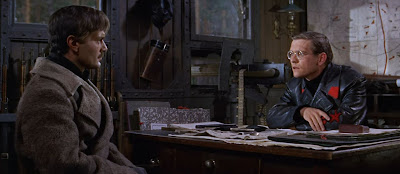
At this point, though. we are still in the early stages of a complex drama, and there is still much more to come.  The Russian Revolution and Civil War break out, and the whole society is further disrupted.  Because of Communist disapproval of his poetry, the Zhivagos take refuge at a Gromeko-owned home in the Ural Mountains.  In that area Yuri encounters Lara, and they resume their romantic passion for each other.  He also encounters Lara’s supposedly missing husband, Pasha Antipov, who now identifies himself by the name “Strelnikov” and has become a high Bolshevik commander.  When Pasha had been seen earlier, he had been an idealistic revolutionary, but skeptical of the communist Bolsheviks; however, now, as Strelnikov, he is seen to have become a dogmatic and ruthless Bolshevik fanatic.

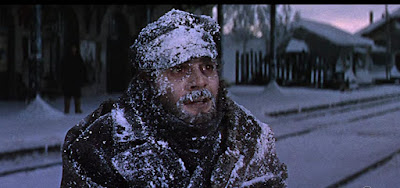
Revolutionary turmoil has further disruptive effects on our characters.  Though Tonya manages to escape with her children to France, Yuri is captured by communist forces and impressed into field medical service.  After a couple of years of forced service, however, Yuri escapes from his captors and harrowingly makes his way back to Lara, whereupon they again resume their romantic affair.  

Later Komarovsky surprisingly shows up where Yuri and Lara are living, and this time, even more surprisingly, the normally opportunistic Komarovsky seeks to help someone other than himself.  He informs Lara that her estranged husband Strelnikov’s political enemies are out to kill him, and since her life is thereby endangered, too, he offers to facilitate her escape.  In the escape event, though, Lara and Yuri become separated again, this time for good.  And so it goes.

The whole story of Doctor Zhivago, which covers the full span of Yuri Zhivago’s life, from his boyhood to his death many years after the primary events I have described here, is encapsulated in a narrative framing device set in the 1940s that involves a high officer of the state police, Yevgraf Zhivago (Alec Guinness), who is Yuri Zhivago’s half-brother and who is looking for the lost daughter of Yuri and Lara.  Yevgraf finds a young woman, Tanya Komarova (Rita Tushingham), who was separated from her parents when she was a very small child and who may be the missing daughter.  To help prod Tanya’s memory, Yevgraf tells her the story of Yuri Zhivago’s life.  This narrative framing device has seemed artificial to some viewers, but I believe it contains a crucial hint as to what this film is ultimately about.  


Many critics have liked the film (e.g. [1,2,3,4,5,6]), although some of them did complain that the film’s running time, which comprises about three-and-a-quarter hours of screen time, is too long [5,6,7].  And there were some naysayers.  For example, notable critic Andrew Sarris was sarcastically critical of how he felt the film overlooked Pasternak’s original message [8].  And New York Times critic Bosley Crowther complained about what he felt was the film’s lack of depth [9].  But despite this range, none of the reviews that I encountered made much mention of what I think is the film’s ultimate message.

So what is this tale, ultimately about?  It seems up-front to be essentially a tale about the love between Yuri and Lara.  In this sense it is like Gone with the Wind, which despite its highly dramatic backdrop, is really a story about the romantic relationship between Scarlett O’Hara and Rhett Butler.  And also, similarly to the situation in Gone with the Wind (with its iconic characters like Scarlett O’Hara, Rhett Butler, Ashley Wilkes, and Melanie Hamilton), we have here in Doctor Zhivago several iconic characters:
  • Doctor Yuri Zhivago – the poetic humanist who sought the welfare of all concerned;
     
  • Lara – the passionate romantic who couldn’t help giving way to her feelings;
     
  • Komarovsky – the selfish opportunist who always sought to maximize his own utility;
     
  • Strelnikov (Pasha) – a person who dogmatically sought the establishment of an uncompromising political order that, even though it may trample the welfare and “rights” of many. was believed to be best for the society as a whole;
     
  • Tonya – the loyal, loving, and considerate wife.
This character breakdown, as well as the final spoken lines that close the narrative framing device, point us to what is Doctor Zhivago’s real message.  That message revolves around Yuri Zhivago’s character and what it represents as to the meaning of life.  What is it, after all, that makes human life so special, so different from that of the animals?  What is it that we should pursue and treasure?  We know that it must be more than just the acquisition of material comforts and the satisfaction of physical lusts, as was the practice of the ruthless utilitarian Komarovsky.  He was successful in his selfish pursuits, but he was little more than a clever animal.  We also know that it must go beyond the collectivist vision of someone like Strelnikov, who was also operating on the material plane, but at the same time suppressing the freedom of individuals.  As for love, as embodied by Lara and Tonya (and also by Yuri), we know that that is special, but it is often ephemeral and localized.  

But Yuri added something more, and that was his ability to see and appreciate all the beautiful experiential moments of human life that were happening around him all the time – and then to aesthetically express his feelings about those experiences by means of his poetry.  This was a “gift” that he presumably shared with Tanya Komarova, the girl who was probably Yuri’s daughter and who had a gift for music.

Life is beautiful all the time, but we too often neglect the constant flow of beautiful moments by our petty involvements in the mundane.  Our lives can be enhanced by being exposed to those people who have this gift for sharing their feelings about life’s beauty in aesthetic form.  This was the film Doctor Zhivago’s final message, and its final scene shows the gifts of Boris Pasternak and David Lean in displaying it.  As critic Powers remarked [1],
Doctor Zhivago is more than a masterful motion picture; it is a life experience.”

Notes:
  1. James Powers, “‘Doctor Zhivago’: THR’s 1965 Review”, The Hollywood Reporter, (23 December 1965).  
  2. “Cinema: To Russia with Love”, Time, (31 December 1965).   
  3. Arthur D. Murphy, "Film Reviews: Doctor Zhivago", Variety, (29 December 1965).   
  4. Roger Ebert, “Doctor Zhivago”, RogerEbert.com, (7 April 1995).   
  5. Philip K. Scheuer, "'Zhivago'---a Poetic Picture", Los Angeles Times, (24 December 1965).   
  6. Richard L. Coe, "Doctor Zhivago", The Washington Post, (4 February 1966).   
  7. Clifford Terry, “Acting Excellent, So Is Production in ‘Doctor Zhivago’”, Chicago Tribune, (28 January 1966 ).   
  8. Andrew Sarris, “films”, The Village Voice, (30 December 1965).  
  9. Bosley Crowther, “The Screen: David Lean’s ‘Doctor Zhivago’ Has Premiere, Adaptation of Pasternak Novel at the Capitol”, The New York Times, (23 December 1965).