The Social Network (2010) is about one of the hot cultural topics of the moment, the massive move to computer social networking and the extraordinary rise of its primary platform, Facebook. So even a poorly crafted film would have attracted considerable interest from many quarters. But the public and the critics generally judged The Social Network to be top-notch entertainment, giving it thumbs up all round: it earned eight US Academy Award Oscar nominations and has grossed well over $200 million. Based on Ben Mezrich's book, The Accidental Billionaires, about the founding of Facebook, it is notable that this mainstream Hollywood production is not a product of the youth culture it examines, but is instead something of an examination from the outside of that sphere – it was directed by David Fincher (Fight Club, 1999) and scripted by Aaron Sorkin (West Wing, 1999-2006). In fact the clinical examination metaphor is made explicit in the production, since all the events depicted are seen from the framing device of two concurrent court depositions associated with lawsuits that were filed about the events depicted in the film: the law courts are trying to get at the truth of what exactly took place in 2003-2004 concerning the rise of Facebook
 primary platform, Facebook. So even a poorly crafted film would have attracted considerable interest from many quarters. But the public and the critics generally judged The Social Network to be top-notch entertainment, giving it thumbs up all round: it earned eight US Academy Award Oscar nominations and has grossed well over $200 million. Based on Ben Mezrich's book, The Accidental Billionaires, about the founding of Facebook, it is notable that this mainstream Hollywood production is not a product of the youth culture it examines, but is instead something of an examination from the outside of that sphere – it was directed by David Fincher (Fight Club, 1999) and scripted by Aaron Sorkin (West Wing, 1999-2006). In fact the clinical examination metaphor is made explicit in the production, since all the events depicted are seen from the framing device of two concurrent court depositions associated with lawsuits that were filed about the events depicted in the film: the law courts are trying to get at the truth of what exactly took place in 2003-2004 concerning the rise of Facebook
In fact the film’s viewers, too, are probably looking for some kind of truth, or perhaps many truths when they go to see this film. After all, in just a couple of years, Facebook has amassed 750 million users and is considered to be worth more than $70 billion. How did this thing that was started by a single 19-year-old programmer get so big, so fast? Depending on what part of society they are coming from, viewers probably wanted to know the real story, the truth, that could provide answers to the following questions:
- What made Facebook different from its other social networking competitors (Myspace, Friendster, Bebo, Orkut, . . .) and how did it come to dominate the market? Does it have special technical features, algorithms, or user affordances that make it so much better?
- How does the youth-dominated high-tech computer industry work and what is it like to be a computer hacker?
- Who is Mark Zuckerberg, Facebook’s founder, and what lies behind his success?
- Did Mark Zuckerberg actually steal the idea of Facebook from some of his fellow students and cash in all by himself?
Amazingly (for a film that has satisfied so many viewers presumably looking for these answers), the film doesn’t provide definitive information for any of these questions. Although The Social Network is grounded in actual court testimony (much of the testimony in the hearings is taken directly from the court transcripts), some knowledgeable critics have even complained that the depiction of the main character, Mark Zuckerberg, has serious inaccuracies [1,2,3]. In particular they argue that the film shows Zuckerberg to be
- insecure – but they say he is not;
- being obsessed with gaining an invitation to one of the prestigious, upper-class Harvard Final Clubs – but Zuckerberg denies having had an interest in that;
- being a social outcast who could not find a girlfriend or relate to girls – but apparently he has had a steady girlfriend since 2003.
Besides the issue of whether the characterization of Zuckerberg is authentic or not, the film doesn’t even say much of anything about the experience of computer social networking or how the software that drives it was constructed.
Despite these criticisms concerning the film’s failure to reveal authentic and realistic information about its main subjects, though, I would say that the film does have its virtues. We just have to realize that this film is not about gritty reality, but is actually more of an expressionistic fable about characters that exist partly in our collective imagination. And on these terms, the film does convey something of an interest. So for the moment, let’s consider the fictionalized characters as shown, who may differ considerably from the real personages after whom they were fashioned.
First let’s consider the surface reality of the film. From the outset we are plunged into something of a dreamworld, or at least the dreamworld of TV dramas. What we see is not how real people really act, look, or talk. The pacing is too fast, filled with snappy and smart verbal comebacks to any remark. The girls, most of them Asian, are all slender, glamorous, and enticing. This is more the stuff of male fantasies than of the literal truth. At a social mixer party that takes place at a Harvard Jewish fraternity in the film, a male friend of Eduardo, one of the film’s main characters, remarks that he wants to develop an algorithm to explain the connection between Jewish guys and Asian girls. Eduardo responds,
But it is exactly this dreamworld that makes the film compelling. The story is not about social networks, but about a particularly bizarre social network, in fact the social network (as the title reminds us). In this case the social network concerns the principal characters, an odd pairing that fate and circumstance has thrown together:
Despite these criticisms concerning the film’s failure to reveal authentic and realistic information about its main subjects, though, I would say that the film does have its
 virtues. We just have to realize that this film is not about gritty reality, but is actually more of an expressionistic fable about characters that exist partly in our collective imagination. And on these terms, the film does convey something of an interest. So for the moment, let’s consider the fictionalized characters as shown, who may differ considerably from the real personages after whom they were fashioned.
First let’s consider the surface reality of the film. From the outset we are plunged into something of a dreamworld, or at least the dreamworld of TV dramas. What we see is not how real people really act, look, or talk. The pacing is too fast, filled with snappy and smart verbal comebacks to any remark. The girls, most of them Asian, are all slender, glamorous, and enticing. This is more the stuff of male fantasies than of the literal truth. At a social mixer party that takes place at a Harvard Jewish fraternity in the film, a male friend of Eduardo, one of the film’s main characters, remarks that he wants to develop an algorithm to explain the connection between Jewish guys and Asian girls. Eduardo responds,
“I don’t think it’s that complicated. They’re hot, they’re smart, they’re not Jewish, and they can’t dance.”I guess that just about sums it up.
But it is exactly this dreamworld that makes the film compelling. The story is not about social networks, but about a particularly bizarre social network, in fact the social network (as the title reminds us). In this case the social network concerns the principal characters, an odd pairing that fate and circumstance has thrown together:
- Mark Zuckerberg, the gifted and nerdy computer whiz who starts Facebook.
- Eduardo Saverin, a Brazilian math major at Harvard and Mark’s roommate. Eduardo works as Mark’s early financial advisor.
- The Winklevoss twins, two studly and patrician Harvard upperclassmen who want to recruit Mark to work for their own fledgling computer company.
- Sean Parker, a West Coast entrepreneur who was part of the founding of two well-known computer startups, Napster and Plaxo. Sean entices Mark to move Facebook out to the West Coast.
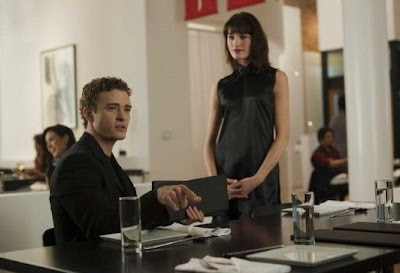

The plot is crafted as a variant on the classical “hero’s journey” [4], an oft-told story of a dangerous and lonely passage into a mysterious realm in quest of a hidden treasure – but fraught with multiple temptations and dire jeopardy. An iconic example of the hero’s journey is The Wizard of Oz (1939), and in fact I was reminded of David Lynch’s expressionistic turn on that very tale, Wild at Heart (1990), while watching this story unfold.
The film narrative is divided into three acts, and each one features alliances, betrayals, and the confrontation of threats. In each case the protagonist Zuckerberg is faced with a test that he manages to pass through by means of a shaky and not altogether trustworthy alliance. All three acts are framed, as I mentioned earlier, in the context of the later lawsuit deposition hearings, so they represent selected flashbacks of key events during the period under examination.
But this victory comes at a price, and at the end of the film, Zuckerberg is still thinking about Erica and wishing that he could get her back. He has created the social networking behemoth, but his own social network is defunct.
This brings us to the larger issue, beyond the hero’s journey depicted in the film, concerning what Facebook really offers to us. Zuckerberg said that it was all about people making connections. When you can do that effectively online with Facebook, you can presumably find out what your friends are doing, eating, drinking, and watching. But the way Facebook works, subtlety and context are lost, and so, too, is privacy
In my view Facebook does not have a magic formula for social interaction. It was simply slightly better and slightly less bothersome than its competitors, and in the power-law economics of global electronic commerce, the leader, no matter how small its initial lead, will dominate overwhelmingly in the marketplace, whether it's in search engines (Google), operating systems (Microsoft), or social platforms (Facebook). And since Facebook is now so pervasive, the information that it has collected about everyone is enormously valuable to commercial enterprises, who will pay high fees to get at that information and make Facebook even more wealthy – a wealth that has been amassed by its acquiring and aggregating personal information from you and me. But we should not be seduced by mere size. As a social tool, Facebook is no more innovative than mass-market TV.
Facebook in fact is based on a reductionist, Objectivist view of reality – an impoverished perspective founded on a simplified and uniform ontology (mental model of the world). In terms of world modelling, it has always been the goal of the natural sciences to develop a universal model of reality, and we all know about the great advances in physics, chemistry, and biology towards this direction. But the complexity of human social interactions is well beyond the explanatory powers of the natural sciences. It is admittedly true that it is possible to employ simplified, quasi-universal ontologies that cover simple products and processes that we use for common and straightforward actions. But the human social world is at the other end of the spectrum in terms of complexity, and it is precisely that sphere of activity that will not succumb to such simplicity. In the social domain, everyone develops their own mental model of reality based on what they can learn from others and from their local contexts. To interact effectively in society, one has to have empathy: one’s mental model of reality must include the notion of other people who have their own, different mental models of the world – and they in turn have mental models that include guesses concerning what our own mental models may be like to them. We do this all the time, almost unconsciously, when we try to navigate in the social world, but in fact it is an extraordinarily complex mesh of multiple models within multiple models.
There are people, however, who have difficulty empathizing, the more extreme examples of whom may exhibit autism, Asperger’s Syndrome, and ADHD. Since they don’t empathize and imagine the mental models of others, they don’t see a social world out there of multiple models. For them, the external world, including it social aspects, has only a single, universal model. It would be natural for such a person to come to the idea that the way to extend our understanding of that single, social model is to connect as many people as possible together so that they can all share what they know. This is apparently how Mark Zuckerberg, and people like him, thinks. That’s why the mere act of social connection was so fundamental to him and became his mantra. In this way of thinking, when a person connects with a “friend”, he is connecting with someone who is on the path to being mentally identical to him. They are just at various stages along that path towards comprehending the universal ontology.
But we should not let such empathy-challenged people wire us into a social system that diminishes the rich potential of our interactions. Deep down, we know, of course, that the idea of a “friend” is far more subtle than the way it has been defined in Facebook. In fact the real meaning of friend, just as the meaning of love, is actually so deep and context dependent, that it has forever challenged the world’s poets and artists. And each beautiful poem and work of art that has been produced on these subjects has been understood individually by each listener/observer in terms of his or her own meaningful local context. In contrast, Facebook, as it stands today as the product of Objectivist computer geeks, lumps every connection with another user as simply an unqualified and undistinguished “friend”. You may be electronically connected by this process, but these are often meaningless connections. As Zadie Smith reminded us [3], we need computer systems that empower us to be even more human, not reductionist-driven systems that only provide us with a fast, but barren, landscape of meaningless connections. Those better systems that we need will certainly come eventually, I am sure, and when they do, they will be produced by technically skilled teams that can go beyond reductionism and incorporate the poetry and empathic compassion of complex social interactions.
★★★½
Notes:
The film narrative is divided into three acts, and each one features alliances, betrayals, and the confrontation of threats. In each case the protagonist Zuckerberg is faced with a test that he manages to pass through by means of a shaky and not altogether trustworthy alliance. All three acts are framed, as I mentioned earlier, in the context of the later lawsuit deposition hearings, so they represent selected flashbacks of key events during the period under examination.
1. The Harvard Startup.Many people have criticized the real Zuckerberg for being an ego-obsessed monomaniac, using his calm demeanor to mask a heartless arrogance that is willing to exploit anyone (and everyone, when it comes to people’s privacy) who stands in his way. Yet in this film, anyway, his character comes across as essentially innocent. He is the lone hero who pursues his dream to do it his own way. He spurns easy money and never lets distraction get in the way of his efforts to make Facebook into the what he had originally envisioned: a mechanism to connect people together. So as a drama, The Social Network works. Even though Zuckerberg’s relentless drive led him to move on from his friendship with Saverin, he does get what he wanted: the Facebook that can change the world.
In the first act we meet the Aspergerish Zuckerberg talking to his girlfriend, Erica, and manically maintaining two conversation threads with thesame person at the same time. She eventually zones out of his narcissistic and insensitive ramblings and announces that she is dumping him. Bewildered, Mark goes back to his room and vengefully calls Erica a bitch on his Friendster blog page before turning away from the too-complicated human world and spending all night hacking up a computer mashup, called “FaceMash”, that enables Harvard students to rate and compare how “hot” the coeds are on campus. Although this computer application is immediately popular, it gets Mark in trouble and leads to his suspension. But the bravura exploit draws the attention of the Winklevoss twins, who, together with their classmate Divya Narendra, have decided to start a local blogging and social networking platform at Harvard called “Harvard Connect”. They offer Mark the job of programming their service platform, and Mark agrees to join them. But it’s clear that these guys are just out to use Mark and exploit his programming genius. He’s just a tool for these sophisticates, who dominate Mark by virtue of their being upperclassmen, their immense wealth, and their social status. Meanwhile Mark secretly decides to go off and develop his own social networking platform, and this activity delays his work for the Winklevosses. These are the key events associated with the subsequent Winklevoss lawsuit against Zuckerberg, which claimed that Mark had stolen their idea (their “intellectual property”) for Facebook. We never do get much of a feeling whether Mark meant to screw the Winklevoss twins from the outset and how much of his own venture, initially known as “thefacebook.com”, was his original idea. Actually, it turns out that even his original FaceMash application was not such an original idea, since something very similar had appeared at MIT a year earlier [5].
But somehow the issue of Mark’s originality doesn’t seem to matter in this story told on screen. We are basically on the side of this innocent, naive kid struggling against the super-confident giants that are always expected to win, because the deck is inevitably stacked in their favor. Although on the surface Zuckerberg appears completely outmatched by the Winklevoss twins, in the end it is Mark, like the mouse topping the cat in the Tom and Jerry cartoon, who dumps the Winklevoss twins and plows ahead with his own company.
2. TheFaceBook.Com
Zuckerberg and his roommate and pal, Eduardo Saverin, set out to build thefacebook.com (which will eventually become Facebook.com). Saverin is no slouch, by the way – we are told early on that one summer he made $300,000 investing in oil futures, and he becomes the Chief Financial Officer for the startup company. Throughout The Social Network, much of the action is seen from Eduardo’s perspective, and he is something of a narrator for this tale. This feeling of him being the narrator arises naturally from the fact that Saverin was Mezrich’s principal source for The Accidental Billionaires (Zuckerberg did not cooperate on the book or the film). So we are just getting Saverin’s side of the story all the way along. It is not surprising then that Saverin is the most sympathetic and human of the principal characters in the film. In fact only his role (played well by Andrew Garfield) and that of Erica (Rooney Mara) who come across as real, believable people. Therest of the roles, though well-acted, are heavily dramatized caricatures.
Anyway, in the context of this tale as its cinematically told to us, it is evident that Saverin’s sensitivity and humanity are necessary counterbalances to Zuckerberg’s disconnected and obsessive focusing on his own narrow goals. After some successes both with Facebook and with meeting girls, the two close friends meet up with the next turning point, the encounter with Sean Parker.
3. The Journey Out West
In a way, Parker (in an enthusiastic performance by Justin Timberlake) turns out to be the key pivotal figure to the narrative. He is a dazzling and seductive Mephistopheles, as he completely awes Zuckerberg with his glitzy familiarity with California showbiz-style entrepreneurship. The innocent and genuine Saverin is no match for this smooth operator, and he is easily sidelined by Parker’s almost demonic presence. In fact there is a scene in a San Francisco nightclub that summons up the images of the devil, himself, in the form of Parker seductively leading the ensnared Zuckerberg into a netherworld of forbidden rituals. It is certainly the “innermost cave” [4] of danger for the naive Zuckerberg. Parker represents a different kind of threat than the Winklevoss twins. While the Winklevosstwins were imposing and formidable antagonists, they were external threats – like powerful beasts of the forest. But Parker is even more dangerous – he appears to be attacking Zuckerberg from within and threatening to capture his very soul. And the horrified Eduardo is powerless to stop him. Parker soon engineers a semi-takeover of Facebook by landing some big-time investors to invest heavily in Facebook, thereby establishing Parker as president of the company and forcing Eduardo out of the picture (he would later Zuckerberg over this).
In the end, though, fate plays its hand and saves Zuckerberg from being completely taken over by Parker, as Parker’s fast-paced social life leads to a cocaine bust that removes him from the scene. In the film’s closing sequences, Zuckerberg is seen as having triumphed over everyone. He cam pay off the lawsuits and still be the world’s youngest and perhaps most powerful billionaire.


But this victory comes at a price, and at the end of the film, Zuckerberg is still thinking about Erica and wishing that he could get her back. He has created the social networking behemoth, but his own social network is defunct.
This brings us to the larger issue, beyond the hero’s journey depicted in the film, concerning what Facebook really offers to us. Zuckerberg said that it was all about people making connections. When you can do that effectively online with Facebook, you can presumably find out what your friends are doing, eating, drinking, and watching. But the way Facebook works, subtlety and context are lost, and so, too, is privacy

In my view Facebook does not have a magic formula for social interaction. It was simply slightly better and slightly less bothersome than its competitors, and in the power-law economics of global electronic commerce, the leader, no matter how small its initial lead, will dominate overwhelmingly in the marketplace, whether it's in search engines (Google), operating systems (Microsoft), or social platforms (Facebook). And since Facebook is now so pervasive, the information that it has collected about everyone is enormously valuable to commercial enterprises, who will pay high fees to get at that information and make Facebook even more wealthy – a wealth that has been amassed by its acquiring and aggregating personal information from you and me. But we should not be seduced by mere size. As a social tool, Facebook is no more innovative than mass-market TV.
Facebook in fact is based on a reductionist, Objectivist view of reality – an impoverished perspective founded on a simplified and uniform ontology (mental model of the world). In terms of world modelling, it has always been the goal of the natural sciences to develop a universal model of reality, and we all know about the great advances in physics, chemistry, and biology towards this direction. But the complexity of human social interactions is well beyond the explanatory powers of the natural sciences. It is admittedly true that it is possible to employ simplified, quasi-universal ontologies that cover simple products and processes that we use for common and straightforward actions. But the human social world is at the other end of the spectrum in terms of complexity, and it is precisely that sphere of activity that will not succumb to such simplicity. In the social domain, everyone develops their own mental model of reality based on what they can learn from others and from their local contexts. To interact effectively in society, one has to have empathy: one’s mental model of reality must include the notion of other people who have their own, different mental models of the world – and they in turn have mental models that include guesses concerning what our own mental models may be like to them. We do this all the time, almost unconsciously, when we try to navigate in the social world, but in fact it is an extraordinarily complex mesh of multiple models within multiple models.
There are people, however, who have difficulty empathizing, the more extreme examples of whom may exhibit autism, Asperger’s Syndrome, and ADHD. Since they don’t empathize and imagine the mental models of others, they don’t see a social world out there of multiple models. For them, the external world, including it social aspects, has only a single, universal model. It would be natural for such a person to come to the idea that the way to extend our understanding of that single, social model is to connect as many people as possible together so that they can all share what they know. This is apparently how Mark Zuckerberg,
 and people like him, thinks. That’s why the mere act of social connection was so fundamental to him and became his mantra. In this way of thinking, when a person connects with a “friend”, he is connecting with someone who is on the path to being mentally identical to him. They are just at various stages along that path towards comprehending the universal ontology.
But we should not let such empathy-challenged people wire us into a social system that diminishes the rich potential of our interactions. Deep down, we know, of course, that the idea of a “friend” is far more subtle than the way it has been defined in Facebook. In fact the real meaning of friend, just as the meaning of love, is actually so deep and context dependent, that it has forever challenged the world’s poets and artists. And each beautiful poem and work of art that has been produced on these subjects has been understood individually by each listener/observer in terms of his or her own meaningful local context. In contrast, Facebook, as it stands today as the product of Objectivist computer geeks, lumps every connection with another user as simply an unqualified and undistinguished “friend”. You may be electronically connected by this process, but these are often meaningless connections. As Zadie Smith reminded us [3], we need computer systems that empower us to be even more human, not reductionist-driven systems that only provide us with a fast, but barren, landscape of meaningless connections. Those better systems that we need will certainly come eventually, I am sure, and when they do, they will be produced by technically skilled teams that can go beyond reductionism and incorporate the poetry and empathic compassion of complex social interactions.
★★★½
Notes:
- David Kirkpactrick, “What’s True in the Facebook Movie”, The Daily Beast, September 30, 2010, http://www.thedailybeast.com/articles/2010/09/30/the-facebook-and-zuckerberg-in-the-social-network-arent-real.html.
- Jose Antonio Vargas, “The Face of Facebook”, The New Yorker, September 20, 2010, http://www.newyorker.com/reporting/2010/09/20/100920fa_fact_vargas?currentPage=all.
- Zadie Smith, “Generation Why?”, The New York Review of Books, December 23, 2010, http://www.nybooks.com/articles/archives/2010/nov/25/generation-why/?pagination=false
- Christopher Vogler, The Writer’s Journey, (1992).
- Facemash was preceded at MIT by “Hot or Not” in 2002. See http://tech.mit.edu/V121/N69/69hotornot.69n.html.


 Posts
Posts


