"The House is Black" - Forough Farrokhzad (1962)


Forough Farrokhzad, the remarkable and groundbreaking Iranian woman poet [1,2], studied to be a filmmaker but only directed one short film, The House is Black (Khaneh Syah Ast, 1962), before her tragic early death at the age of thirty-two. But that 22-minute film by itself stands as a fitting monument to her unique expressiveness – on this occasion in cinematic form [3]. Her poetry expressed strong feminine feelings and passions that were considered beyond the bounds of the restrictive social mores for women [4]. In The House is Black, too, strong feelings about social conditions are expressed, although the subject on this occasion, leprosy, is one that would seem to be remote from our everyday concerns.  And yet Ms. Farrokhzad was able to present this dire subject matter as one of common, indeed universal, concern.

Living in a patriarchal society that greatly constrained women’s freedom of expression, Ms. Farrokhzad was, and perhaps still is, a controversial figure in Iranian culture. Married at the age of sixteen, Farrokhzad soon sought her freedom and three years later obtained a divorce, which led to her losing custody of her infant son.  Estranged now from both her own and her former husband’s families, she started working at some odd jobs and began publishing some of her poetry.  In 1958, at the age of twenty-three, she landed a position as a clerk at Golestan Film Studio and developed a close relationship with its head, film producer and director Ebrahim Golestan.  Soon she became involved in the studio’s production activities, and she made some trips to Europe to study filmmaking techniques.   Finally in 1962 on the occasion of visiting a leper colony in Azerbaijan, she wrote and directed her major work, the documentary film The House is Black.

As a documentary film, The House is Black is somewhat different from those efforts that more or less attempt to capture “objective reality”, such as have been manifested in the traditions of “direct cinema” and cinema vérité [5]. Though this film is closer to cinema vérité, what we have is not so much a detached depiction of objective reality, but rather an impassioned essay on the part of the poetic narrator. Although what the viewer sees is the direct presentation of the lepers in the leper colony, it is overlaid with voice-over narration of Farrokhzad’s emotive poetry, which, I would say, makes the film thematically interpretable on three different levels:
  1. The first level concerns the immediate and concrete conditions of the lepers in the leper colony – their circumstances of social neglect and misery.
  2. There is a second level or theme concerning how we understand and respond to what we encounter in the world, especially given the fact that there are always mysteries that we can’t explain.  On this level the film contrasts two main approaches  – the religious and the scientific – and how they deal with the scourge of leprosy.
  3. At a still more abstract level there is the despondent idea of leprosy seen as a general metaphor for the human condition.  Under this guise, we are all seen as lost and lowered to the lepers’ level of misery.
The film touches on these three thematic levels as it progresses through various scenes in the leper colony.  Somewhat arbitrarily, I see it moving through three general stages.

1.  “The City of Dreadful Night”
The film opens with a black screen warning the viewer that the forthcoming scenes will be disturbing and ugly.  
‘To wipe out this ugliness and to relieve the victims is the motive of this film and the hope of the filmmakers.”
The first images show a woman looking at her leprosy-ravaged face in the mirror.  This is then followed by shots of afflicted boys and young men shown reading prayers that offer thanks to God for endowing them hands, eyes, feet, etc. that can be used to enjoy God’s creation.  But, of course, these endowments have been largely taken away by disease.  Then we hear a woman (presumably Farrokhzad) in voice-over asking,
“Who is this in Hell praising you, O Lord?”
We have moved from thematic level 1 to level 2.  There are now many more shots of deformed people, some singing and dancing.  But there is also a 90-second shot of a blind man walking outside by feeling his way along an external wall, as the days of the week are recited in endless monotony. These disturbing images of damaged people pass before us accompanied by Farrokhzad mournful poem about this hell (despite the shortcomings of translating poetry into another language, here English, her words are still evocative):
“I will sing your name, O Lord. 
I will sing your name with the 10-string lute. 
For I have been made in a strange and frightening shape.
My bones were not hidden from you when I was being created. 
I was molded in the bowels of the earth.
In your book all my parts have been written . . .
. .  And your eyes, O Lord, have seen my fetus. 
I won’t see the spring. 
These lines are all that will remain. 
As the heavens circles, I fell into the bedlam.
I’m gone.
My heart is filled with sorrow. 
O Muslims, I am sad tonight.”

2.  How to Deal with this Affliction? 
But then we return to thematic level 2, as images of rational attempts to treat leprosy are contrasted with shots of people fervently reciting by rote prayers to a presumably absent or non-answering deity. The suggestion is clear: the rational approach takes positive steps, while blindly and stubbornly following ancient liturgical practices leads nowhere.

Shots are shown of leprosy sufferers being treated by medics and being fed at food canteens (within the colony) that are accompanied by a male voice-over that rationally discusses leprosy. Although leprosy is chronic and highly contagious, it is a disease that can be treated and cured (it’s progress can be arrested) by antibiotics.
“When the leper is cared for early, he can be treated completely.”
[Not discussed in this film, but worth noting in the context here are some other facts about leprosy.  About 95% of people are believed to have a natural immunity to the leprosy pathogens [6].  The number of leprosy cases worldwide is apparently a few hundred thousand, down from an estimated 5.2 million in 1985 (presumably this number was much higher at the time of this film’s production in 1962) [7].  But although the numbers of cases are in decline, there are still hundreds of thousands of people newly afflicted with this curse – in 2012 there were over 200,000 new cases of leprosy reported [8].]

Again Farrokhzad’s poetic laments are in the background:
“I said if I had wings of a dove,
I would fly away and be at rest.
I would go far away and take refuge in the desert.
I would hasten my escape from the windy storm and tempest. 
For I have seen misery and wickedness on earth. “

“The universe is pregnant with inertia .
. . and has given birth to time. 
Where would I escape from your face? 
And where would I go from your presence? 
If I hang on to the wings of the morning breeze
And reside in the deep of the sea,
Your hand will still weigh on me.
You have made me drunk with indecision. 
How awesome are your deeds!”


“I speak of the bitterness of my soul. 
I speak of the bitterness of my soul.
When I was silent, my life was rotting
. . . from my silent screams all day long.
Remember that my life is wind.
I have become the pelican of the desert,
. . the owl of the ruins,
And like a sparrow, I am sitting alone on the roof..”

“I am poured out like water
. . . as those who have long been dead. 
On my eyelids is the shadow of death. 
Leave me. 
Leave me, for my days are but a breath.
Leave me before I set out for the land of no return,
. . . the land of infinite darkness."

3.  We are All Like Them
The latter stages of the film show the deformed, crippled people exhibiting normal emotions –  having fun, playing games, etc. Crippled parents are shown attending to young children (some of whom may not be afflicted with leprosy). Other scenes show women, having what appear to us as deformed faces, delightedly grooming themselves. There is even what appears to be a wedding ceremony involving these people celebrating a matrimonial union.  These people, in these moments at least, appear happy. 

We have to ask ourselves, are they really deformed, or just different from us?  Are not our impulses to turn away from these strange faces similar to the way so many people reject others from different races? 

There is then a well-edited scene of some boys joyfully playing with a ball. There is also a classroom scene where young boys are asked by the teacher to name beautiful things. A boy responds by mentioning items from the natural world. But when another boy is asked to name ugly things, he responds with “hand, foot, head, . . . “  He knows that his human reality is deformed.

The closing mood is one of sadness and despair.  We are on thematic level 3 now.  Why all the suffering?  Why are there such deformities?  Why are we lost in this world? 
“Alas, for the day is fading,
the evening shadows are stretching. 
Our being, like a cage full of birds,
Is filled with moons of captivity. 
And none among  us knows how long he will last. 
The harvest season passed,
The summer season came to an end,
. . . and we did not find deliverance. 
Like doves, we cry for justice.
. . and there is none.
We wait for light and darkness reigns."

“O overrunning river driven by the force of love,
. . . flow to us, flow to us.”
See this movie.
★★★½ 

Notes:
  1. Farrrokhzad's poem, “The Wind Will Carry Us”, was an inspiration for the themes and title of Abbas Kiarostami’s film The Wind Will Carry Us (1999).
  2. See Michael Hillmann, A Lonely Woman: Forugh Farrokhzad and Her Poetry (1987), Three Continents Press, cited in “Films/Theater”, Forugh Farrokhzad, (http://www.forughfarrokhzad.org/filmstheatre/films.htm).
  3. You may find The House is Black on YouTube – try here
  4. "Forough Farrkhzad", Iran Chamber Society, 4 March 2015.
  5. I have discussed the traditions of “direct cinema” and cinema vérité in connection with my reviews of Louis Malle’s Phantom India (L'Inde Fantôme, 1969) and Michael Moore’s SiCKO (2007).
  6. Iara de Messias-Reason, Peter G. Kremsner, and Jürgen F. J. Kun, "Functional Haplotypes That Produce Normal Ficolin-2 Levels Protect against Clinical Leprosy", The Journal of Infectious Diseases, (2009), Oxford Journals,  2009:199, pp. 801-804.
  7. “Leprosy Fact sheet N°101", World Health Organization (January 2014).
  8. Ibid.

"Birds of a Feather" - Ali Khazai-far (2010)


Birds of a Feather (Kabootar ba Kabootar, 2010), a romantic comedy-drama written and directed by Ali Khazai-far, was set and filmed in Mashhad, Iran. It tells the parallel stories of two separate couples who find their romantic relationships encumbered by social expectations. Early on, the film seems to be telling two separate stories with their separate focalizations, but as things unfold, some connections between the two are established. And the themes underlying those connections are what elevate this film somewhat above what at first seems to be just a cute but mundane comedy.

One of the interesting aspects of the film is its presentation of small social class distinctions. That is, the film is not examining distinctions between the upper and lower classes, but is looking at the more subtle social distinctions among people who we might say are mostly all (lower) middle class.  And for many people, such small social distinctions can be matters of great importance.

There are three dramatic theatres of action in the film, and the first twelve minutes of the film introduces each of them. 
  1. Saeed and Mahboobeh are a newly married couple and in love.  In the opening scene Mahboobeh expresses regret that they got married too soon – before her father was able to deliver a dowry (jahizieh) for her [1].  So they don’t have basic household items (refrigerator, TV, etc.) that Mahboobeh is used to.  And since Saeed is a freelance plasterer for small projects in Mashhad, they don’t have much of an income and have to share an apartment with another couple.  Saeed, though, doesn’t seem to care much about that and is just happy to be with Mahboobeh.
  2. Ghassem Maleki operates a small print and photocopying shop near a government office (an office of the home ministry, I think) and his customers are mostly people who have to submit copied forms to that government office.  He is a jovial, thirtyish, and chubby bachelor who lives with his retired, widowed father – a man who is also jovial, but who complains that it is long past the time for his son to have found a wife. But it is evident that Ghassem’s unglamorous appearance doesn’t identify him as the ideal marriage partner.
  3. Saeed’s mother, Banoo, works as a cleaning woman for Mrs. Entesham, an elderly widow living alone in a large stately house. Mrs. Entesham cordially treats Banoo as an equal and invites her to join her for lunch at her dining table. But Banoo is too aware of their perceived social separation and humbly prefers to sit on the floor, where she is more comfortable.  It is later revealed that Mrs. Entesham lives on her deceased husband's small pension and his little money, but that fact does not diminish the wide social gulf between her and Banoo's family.
From the early scenes two issues emerge: Saeed’s desire to improve his material circumstances so that he can please his wife and Ghassem’s desire to find a wife for himself.  In both cases the men are frustrated and feel they have to respond to perceived social expectations.

Ghassem’s supposed ally in his quest to find a suitable wife is Rafat, who is the wife of his brother. To make marriage proposals in the traditional Iranian culture, one goes through the khastegari process, which is a semi-formal practice dating back to Zoroastrian (i.e. pre-Islamic) times. Under these arrangements, a member of the would-be groom’s family pays a formal visit to the parents of the intended bride, during which meeting the merits of the two candidates, who are usually not present, are discussed.  If the proposed couple has not met previously, then the girl is supposed to come out after the meeting between the family representatives and serve tea to the potential groom, during which time they may become better acquainted. Rafat has been arranging various khastegari sessions in search of a bride for Ghassem, but her focus on wealth and upscale family status instead of looking for a suitable personal match almost guarantees failure. In one humorous khastegari session setup by Rafat, the bridal candidate, after taking one look at the schlumpy Ghassem, feigns to be suffering from schizophrenia.

Later we see Ghassem in his print shop, where a woman, Reyhaneh, arrives looking for suitable forms for filing a complaint. We get a wry view of how things work in this sphere of interacting with the government when Ghassem shows her the form and adds, “we have filled-out forms as well” and “there’s a guy in front of the court who can type out your complaint.”  Reyhaneh explains that her brother has stolen her intended dowry (that is, the dowry that would be offered were she to get married), and she wants to sue him for the theft.  She confesses glumly to Ghassem that her brother told her, “you never had a suitor and you never will”, so he might as well take the dowry merchandise for himself.

We learn a bit later that Reyhaneh’s brother is the already-introduced Saeed, who has taken her dowry things and now given them to Mahboobeh, who had lamented not having her own dowry.  Anyway, Ghassem is naturally attracted to Reyhaneh, and they each admire each other’s genuineness and avoidance of pretence (Ghassem openly confesses to her that he doesn’t even have a high school diploma).  He decides that Reyhaneh is the woman for him and tells Rafat to initiate a khastegari proposal with Reyhaneh’s family.

Rafat agrees to do it, but when she goes alone to visit Reyhaneh’s mother, Banoo, she is scornful of the family’s low social status. After all, Reyhaneh and Banoo live in a small apartment in a shabby part of town, and Banoo has to work as a cleaning woman. Rafat comes back to tell Ghassem that he should marry into a better family than that. For Rafat, marriage signifies an alliance between two families, and the two families should match, and she reminds him that “birds of a feather flock together”.

Reyhaneh is humiliated by Rafat’s dismissive attitude towards her, and she hasn’t even discussed with her that she has no dowry to offer.  So she decides to preempt a process that can only end in disappointment, and she responds to the khastegari proposal by refusing the offer.  Ghassem is stunned to hear of the rejection, and presumes that Reyhaneh has rejected him for being unattractive.  It is evident to the viewer, though, that Ghassem and Reyhaneh are right for each other, but social prejudices are preventing them from getting together.

Meanwhile Banoo has been asked to come over and dust off Mrs. Entesham’s tall bookshelves, and to reach their height, she brings Saeed along to help her. Saeed is wide-eyed when he sees the  large, well-furnished house, and when he is left alone to do some dusting, he succumbs to temptation and steals one of Mrs. Entesham’s necklaces. When he returns home he gives the necklace to Mahboobeh, claiming that he had recently received it in payment for his plastering work.

The story has now reached its low point.  Ghassem and Reyhaneh are apart and lonely. There are more khastegari meetings arranged for both of them, but neither wants to have anything to do with these supposed birds of the same feather that are introduced to them.  And, of course, Mrs. Entesham soon discovers that one of her necklaces is missing, and she knows full well who took it. 

But the film does come to an uplifting resolution not by righting wrongs or exposing wrongdoing, but by acts of grace. 
  • Mrs. Entesham speaks to the guilt-stricken Saeed and tells him that he is already a rich man, because he is loved by his mother, his sister, and his wife.  She forgives him and suggests some minor work he can do for her to “pay” for the necklace.  Saeed’s tears reveal that he has seen her compassionate and soul-stirring light. 
  • And Ghassem, after reflecting on what happened, comes to the conclusion that Reyhaneh rejected him out of compassion, not calculation.  He goes to her and revives their relationship by reasserting his commitment to her.
In the end, the story does show people coming together who have the same feathers. But these are "inner feathers" of compassionate character, not the external feathers that appear in superficial social circumstances. Mrs. Entesham and Ghassem decide to project their love, even when they may have felt that they experienced some form of manipulation. And this loving response not only redeems them, but also the people with whom they interact.  The art of this film is the way it reveals those inner feathers to the other characters and to us, too.

On the surface, Birds of a Feather seems like just another lightweight comedy, but it goes beyond that and has an uplifting philosophical message in the way the relationship issues are resolved.  Interestingly, we are shown people who follow traditional customs but who also capable of seeing things and acting in flexible ways [2].

Khazai-far visually tells his story simply, but skilfully. Cinematically, there are few establishing shots, and much of the film comprises medium closeups of individuals conversing with each other in shot/reverse-shot sequences.  There are also very few moving-camera shots, but there are occasional shots involving a slow forward-tracking towards the subject to enhance our focus of attention.  Overall the cinematography is unspectacular, but the presentation of visual dialogic separation is expertly carried out.   

Of the two romantic relationships presented, the one involving Ghassem and Reyhaneh is more interesting and dramatically compelling. The basic outline of this narrative thread reminds me very much of Paddy Chayefsky’s Marty (1953), an award-winning television play that was directed by Delbert Mann and which was the basis for their subsequent Oscar-winning film, Marty (1955). I wonder if Khazai-far was familiar with that earlier work. In any case, both works celebrate a person’s ability to ignore circumstantial social constraints and choose what is most true to his authentic nature: to seize love's opportunity when it appears.
★★★

Notes:
  1. There are actually two types of dowry in Iran.  Like the customary dowry in other parts of the world, the jahizieh is provided by the bride’s family and comprises household items. There is also the mehrieh, however, which is more of a financial investment (often in the form of gold coins) supplied by the groom’s family to the bride and carries specific legal stipulations. In this film only the jahizieh is mentioned.
  2. The presentation of human hair was interesting. Like Salma and the Apple (2011), none of the women in the film show any head hair at all. The men, on the other hand, are mostly clean-shaven, with a few having tidy mustaches.

"The Last Command" - Josef von Sternberg (1928)


In 1927 Paramount Pictures had already signed up renowned German actor Emil Jannings to work in Hollywood and also had in their corral the up-and-coming director Josef von Sternberg, fresh off his first box-office hit, Underworld (1927).  So it was natural for them to hook up these two agents of German Expressionism for their next production. This turned out to be The Last Command (1928), which was also a hit with the public.

The basic outline of the story concerns a Russian general who had fled the 1917 Russian Communist Revolution with just the clothes on his back and had managed to get to America.  Ten years later this now poverty-stricken man gets hired for a bit part in a Hollywood movie as a Russian general. This may sound like an extremely contrived plot scheme, but it was apparently inspired by some real circumstances.  Film director Ernst Lubitsch once mentioned that he had met a former general from the Imperial Russian Army, Theodore A. Lodigensky, who had turned up in Hollywood looking for work as a movie extra [1].  Of course this idea of a once-powerful man reduced to self-parody is perfect for the Hollywood grist mill.  But von Sternberg took this basic scheme and crafted something even more darkly romantic and interesting (as he also did in connection with his subsequent film featuring Jannings, The Blue Angel).  As The Last Command unfolds, the viewer is presented with two narrative scenarios – an outer, framing story and an inner flashback story– and each is sufficiently compelling that it could almost stand on its own.  What makes things even more interesting is when we consider the thematic elements of those two scenarios together.

The narrative of The Last Command can be considered to have five acts – acts 1 and 5 belonging to the outer narrative, and acts 2-4 belonging to the inner narrative.
1.  Hollywood, 1928
At the outset Hollywood film director Leo Andreyev (played by William Powell) is looking to hire some people as extras in a film about Russia.  For the poor and unemployed, getting a job as an extra has few requirements, so a job call attracts a mob of the desperate.  Among those applying for work is a middle-aged Russian man, Sergius Alexander (Emil Jannings), who claims, to the disbelief of all who listen, that he was once the supreme commander of the Imperial Russian Army.  Andreyev hires him to play the role of a Russian general, and Sergius is shown scrambling with the other, peon-like extras to get his assigned uniform that he will wear on screen.  But Sergius is clearly a shattered and enfeebled person who is barely able to look after himself.  While putting on his makeup, he looks at himself in a mirror and lapses into a flashback revery of what he was doing ten years earlier.

2.  Grand Duke Sergius Alexander
The time is 1917 and Russia is engaged in a devastating war with Germany and also threatened by a revolutionary insurrection from the Communists.  The authoritative, robust, and super-confidant Grand Duke Sergius Alexander, the commander of the entire army and a cousin of Czar Nicholas II, inspects his troops.  In addition to fighting the war, Sergius’s army is in charge of arresting “revolutionists” (the term for communists in this film), and he is informed that two people working as theatrical performers to entertain the troops are suspected of being such revolutionists.  The two suspects are Leo Andreyev (who we know will later become a Hollywood film director) and his companion, Natalie Dabrova (Evelyn Brent), who is said by a staff officer to be “the most dangerous revolutionist in Russia.” When Sergius is shown pictures of the two, he takes an interest in interviewing them and summons them to his office. When they arrive he haughtily dismisses Leo as an unmanly artiste and a coward for not serving in the armed forces. When Leo contemptuously responds that “it doesn’t require courage to send others to battle and death,” Sergius beats him with his whip.  Leo is sent to jail, but Sergius is attracted to Natalie’s beauty and treats her with respect.

3.  Sergius and Natalie
This next and most interesting section of the film shows the growing relationship between Sergius and Natalie.  Sergius is charmed by Natalie and treats her like a princess, inviting her to join him in the staff officers’ quarters, in the face of which Natalie responds with coy smiles.  But we know from earlier shots that she really is a revolutionist, so she must be play-acting here.

At a sumptuous dinner with Natalie and his general staff present, Sergius is interrupted by an order that the Czar wants to see an attack launched the next morning.  To everyone’s amazement Sergius defies the Czar and refuses the order, because his troops are not in condition to stage such an attack.  To do so would just provide “fuel for the revolution,” he says.  His defiance of the Czar impresses Natalie, and he tells her that he acted so strongly, because he loves his country.
Natalie: “Then why do you continue this stupid war?” 
Sergius: “We must have victory! Defeat means revolution and the collapse of Russia!” 
Natalie: “Then you love Russia so much?” 
Sergius: “I would gladly die tonight if it would help Russia.”

At this, Natalie becomes warmer to Sergius and invites him up to her room.  But this is quickly seen as a pretence, inasmuch as prior to his entry to her quarters, she prepares a gun to use to kill him.  When Sergius arrives, they kiss.  He soon spots the gun under her quilt, though, but pretends not to notice and turns his back on her so that she can shoot him.  There is an interesting camera pan which (a) starts with Natalie in frame drawing her gun to shoot and then (b) pans over to Sergius with his back to her, but fatalistically watching her in the mirror as she is taking her aim. 

But she doesn’t shoot.  She collapses and drops her gun (presumably now expecting that she will be executed).  He asks her why she didn’t shoot, and she says,
“I suppose it was because I couldn’t kill anyone who loves Russia as much as you do.”
They then embrace in mutual confession of their love for each other.  So Natalie had been play-acting about being charmed by Sergius, but gradually she started really falling in love with him.

4.  The Revolution

With Sergius, accompanied by Natalie, heading out on a train to supervise the troops at the war front, the Russian Revolution is coming to a head.  Leon Trotsky is shown preparing for the takeover, and a signal event will be the capture of the train Sergius and his officer staff are on. At a stop along the way, the train is duly overrun by an angry revolutionary mob, and all the officers are dragged out.  The mob looks like they will tear Sergius to pieces, but Natalie jumps out and becomes a fiery revolutionist again. She grabs a revolutionary flag, mocks Sergius in front of the crowd, and tells them that it would be best first to subject him to extreme humiliation before killing him. So she convinces them to make him stoke the locomotive engine all the way to Petrograd before he is to be executed there.

The train sets out with Sergius stoking the engine.  Along the way, Natalie sneaks to the engine cabin and tells him that she still loves him – she only called him out to save his life at that moment.  She gives to him the pearl necklace he had earlier given to her so that now he can use it to bribe his way out of Russia. Then Sergius jumps from the train and watches from the ground as it steams away from him.  But in the distance, he sees the train crossing a railway bridge that collapses, killing all on board, including his beloved Natalie.

5.  The Hollywood Film Shoot
Sergius’s flashback is over, and we return to the present on the film stage.  The director Leo Andreyev is inspecting his army-costumed extras just as haughtily as Sergius used to do. When Sergius sees Andreyev, he finally recognizes him for the first time.  Now it’s Leo’s turn to lord it over Sergius.  A studio scene has been setup to show a Russian army charge to be led by Sergius.  Leo establishes the atmosphere for the shoot by having the Russian national anthem played (remember this is a silent film, so this is to inspire Sergius), turning on the wind machine, and having the stage dramatically lit. This atmosphere turns out to be too real for the mentally scarred Sergius, and he starts believing that this is a real battle. With the cameras rolling, his passion and fire come back to him, and he dramatically leads what he believes is a real charge. The strain, though, is too much for him, and he collapses and dies of a heart attack. The assistant director, amazed at Sergius’s performance, notes sadly that he was a great actor. Leo responds reflectively by saying he was more than that, he was a great man.

Von Sternberg cinematically tells the story of The Last Command with his expressionistic techniques.  These include many dramatically lit, in-depth camera compositions that establish the desired context and mood.  Almost everything takes place at night, when shadows loom. Further colouring the proceedings was the use of cigarette smoke. The main characters, particularly Powell and Jannings, are almost constantly shown puffing on cigarettes and enshrouding themselves in billowing smoke. These often smoky, in-depth establishing shots were punctuated with dramatic closeups that conveyed the characterological developments. Although Jannings was a veteran of conventional silent screen aesthetics and liked to make exaggerated dramatic gestures, von Sternberg kept these relatively under control and got more out of the moody, expressive closeups of both Jannings and Evelyn Brent.

With these expressive techniques, von Sternberg essentially wove together two stories, each with its own theme:
  • The outer story of Sergius’s fall from power and his “last command” in Hollywood.  This story is basically told in acts 1, 2, a piece of 4, and 5.  The theme for this narrative is basically dignity.
  • The inner story of Sergius and Natalie.  This story is told in acts 3 and 4.  Here the theme is love.
Sergius’s Fall
The outer story is the one people usually talk about in connection with this film and is about Sergius’s loss of status and reduction to an impoverished state.  But in the final scene he is thought to have achieved some sort of redemption. The underlying theme for this scenario may be referred to here as dignity, although that particular term is fraught with misunderstandings. I basically agree with Arthur Schopenhauer, who correctly dismissed the notion of dignity as “the shibboleth of all perplexed and empty-headed moralists” [2]. In fact this fabricated pseudo-concept (I say “pseudo” because there is no common agreement on what it means) is, rather than a human right, often evoked simply to justify violent acts of vengeance that obliterate human rights, particularly in the Middle East and in Asia. Unfortunately, the idea of dignity was explicitly championed by Kant and was later enshrined in the UN Universal Declaration on Human Rights [3], so it does retain some currency today.  Samuel Moyn offers some further useful commentary on this troublesome notion in his article, “Dignity’s Due” [4]. Anyway, although I do not believe that dignity is at all a human right, we might agree that, on the basis of a person’s folk-psychological self-conception, someone might (a) believe that they inherently have dignity or (b) be thought to have it. And in some societies across the ocean from America, maintaining one’s dignity is all-important.  So in the outer story Sergius is shown to have lost his dignity, but (perhaps) to have regained it at the end.

Sergius’s and Natalie’s Love
However, it is the inner story about the improbable relationship between Sergius and Natalie that elevates the film to a high level and shows off von Sternberg at his best. There are clearly paradoxes about this relationship.  How could Natalie fall in love with Sergius, and so quickly? Does she only love him because he loves Russia? Does Sergius have faith in her, or is he fatalistic, when he turns his back on her, knowing that she intends to shoot him?  These questions probably have no answers.  All we can say is that for von Sternberg, love is not rational; true love invariably involves complete surrender to the beloved (and this notion is repeated in many of his greatest films).


Crucial to this narrative theme is the performance of Evelyn Brent, who had earlier starred in Underworld but is even more dramatically alluring here.  To me, she embodies the unique, animated glamour characteristic of the 1920s – a special kind of allure that has only been retained by French women today. She is seen to move from play-acting to authenticity and back with bewildering precipitancy, but she has her heart in it all the way. 

Their love sheds light on what was the real admirable virtue of Sergius. And this is the ultimate romantic message that von Sternberg delivers. Sergius was not a man who loved both Russia and Natalie just for reasons that could be argued logically. He loved them without rational justification or qualification. And whenever he felt he was in a position to do good (even in his final delusional state), he took action with passion.  For this reason he really was a “great man”, although I don’t think Leo Andreyev understood it that way.
★★★½

Notes:
  1. Anton Kaes, “Illusions and Delusions”, 3 Silent Classics by Josef von Sternberg, (2010), The Criterion Collection.
  2. Arthur Schopenhauer, The Basis of Morality, (1837/2005), Dover Classics, p. 51.
  3. “United Nations Universal Declaration on Human Rights”, (1948), The United Nations
  4. Samuel Moyn, “Dignity’s Due”, (2013), The Nation, November 4, 2013.

“The Wolf of Wall Street” - Martin Scorsese (2013)

Marti Scorsese’s black comedy The Wolf of Wall Street (2013) relates the hectic experiences of a Wall Street financial trader whose life story serves as a metaphor for the out-of-control world of today’s market trading.  The film was an immediate success (in fact Scorsese’s highest grossing film), and perhaps one of the reasons why the public was so fascinated with the story is that the outlandish, hard-to-believe events presented are based on the true-life account of the main character, Jordan Belfort [1].  In any case the film was popular with the critics, too, and garnered Oscar nominations for Best Picture, Best Director, Best Actor, Best Supporting Actor, and Best Adapted Screenplay. 

The narrative of The Wolf of Wall Street has affinities with one of Scorsese’s best films, Goodfellas (1990) – both films describe something of a netherworld of vice and recklessness, and they try to capture the seductive tempos of those worlds and what they lead to. But in my view, The Wolf of Wall Street doesn’t measure up to Goodfellas, and I will try to explain why.

One of the differences between the two films is that the characters in The Wolf of Wall Street, despite their sex-and-drugs lifestyles, are not very interesting, even though they presumably are more educated and sophisticated than the “wiseguys” of Goodfellas.  This reduces most of the personal interactions depicted to mere silliness.  I did find two of the interactions interesting, however, and the film’s tale revolves around them.  If there had been more such interactions, the film might have had a more sustained narrative.

The story begins with Jordan Belfort (exuberantly played by Leonardo DiCaprio) facing the camera and beginning to tell the viewer about his roller-coaster life as a financial analyst.  Then we move to flashback scenes of the various stages of his career.
1.  Early Days on Wall Street

Belfort starts out in his mid-twenties trying to enter the financial marketing world and manages to join a Wall Street firm as a trader.  On his first day at the firm, he is taken out to lunch by a senior trader, Mark Hanna (Matthew McConaughey), who clues the young Belfort in on how to make it on Wall Street.

Now we have been told that financial markets are designed to make it easy to move resources over to organizations and operations that are comparatively more productive. Thus by this means new ideas can be given resources to implement them, and this should make the world richer.  But Hanna, in this 4½-minute lunch scene, which is a tour-de-force for McConaughey, articulates in capsule form the narcissistic philosophy of how financial trading really works, and that is an underlying theme of the film.  He tells Belfort that his only professional goal should be to “move money from your client’s pocket into your pocket.”  And he crucially reminds Belfort:
“We don’t create [anything] . . . . we don’t build anything”
The only thing to do, he is told, is to get the client to keep reinvesting whatever he or she has earned in new stocks, so that he can thereby collect more commissions for himself.  “Keep the client on the Ferris wheel,” he tells Belfort.  And to stay energized at this constant task, he tells the young man, he needs to indulge in as much sex and cocaine consumption as possible.

Though the investment company Belfort joined soon folds as a result of a stock market crash, he learns about penny stocks and quickly assembles a collection of misfits to help staff his own company in this area. 

2. Making it Big
Not only does Belfort make relatively high commissions with his penny stocks, he learns how to employ shady “pump and dump” tactics to artificially inflate stock prices of his own stocks and then dump them at a profit.  Soon he is filthy rich, and he continues to employ the ideas he learned from Mark Hanna, including encouraging heavy doses of sex and drugs at his company, which he has named Stratton Oakmont to make it sound like it has a suitable pedigree.


This section of the film is mostly an account of how Belfort indulges himself in connection with various after-hour orgies that he sponsors at his company. He meets a gorgeous blonde, Naomi (Margot Robbie),  and though married to an attractive woman, he cannot suppress his appetites there, either. In short order he gets a divorce and marries Naomi.

3.  The FBI Enters the Picture
Stratton Oakmont’s nefarious swindles come to the attention not only of the SEC, but also the FBI, which is concerned not with financial irregularities but with criminal activities.  Belfort receives a visit on his luxurious yacht from FBI officer, Patrick Denham (Kyle Chandler), who wants to learn more about the company’s operations.  This conversation, a 7-minute  sequence, is the second interesting personal interaction in the film and Scorsese’s high point, as Belfort and Denham politely try to avoid revealing what is truly on each of their minds.

This doesn’t stop Belfort from continuing his hedonistic ways, and there are more sex orgies and drug-imbibing scenes presented. There is a scene showing Belfort and his sidekick Donnie Azoff  (Jonah Hill) staggering and struggling under an overdose of quaaludes that some people find side-splittingly funny.   I found this kind of slapstick stuff just sophomoric and only a distraction.

Now with the FBI on his back and watching his transactions, Belfort seeks to sequester his ill-gotten gains into a Swiss bank account, and he figures out a way to sneak his cash over there by hiding it on a woman accomplice’s body.

4.  Downfall
Belfort almost gets away with everything, but eventually the law catches up with him.  Even though he has given up some of his worst practices, the FBI charges him with crimes associated with his past activities, and he faces the prospects of a long prison sentence unless he “cooperates”.  This he willingly does, and he agrees to wear a “wire” and incriminate all his past business associates.  In appreciation for his double-crossing his former compatriots, the US government gives him a 3-year sentence (he served 22 months) and fines him $110 million.  But he doesn’t lose heart or his belief in his own abilities to effectively swindle people.  At the end of the film, we see Belfort visiting Auckland, New Zealand, and selling his new package of persuasive techniques.  Incidentally the unnamed actor in the film who introduces him (DiCaprio) to the Auckland audience is the real Jordan Belfort.
So the narrative arc seems basically similar to that of Goodfellas. Again we have a protagonist getting more irretrievably immersed in out-of-control illegal activities and finally saving himself by ratting on his colleagues. But to me Wolf on Wall Street doesn’t deliver the goods that Goodfellas did.

For one thing, the adolescent, frat-boy humor in Wolf on Wall Street wears thin pretty quickly.  For much of the film’s near three-hour running time, the audience is treated to one ridiculous drunken binge after another.  This is evidently intended to be funny, because we are watching supposedly well-educated, sophisticated financiers engaged in these silly shenanigans.  The only thing missing is the skateboards.


Another problem is that most of the characters are not well developed and are largely uninteresting.  In Goodfellas, there was a steadily intensifying degree of the protagonist, Henry Hill, being out of control as the story progressed.  This gave the entire narrative of that film a sense of progression towards disaster and a sense of movement in Hill’s character. But with The Wolf of Wall Street, there isn’t this movement.  It’s just one dang thing after another. At least Jonah Hill, in the role of Belfort’s sidekick, is goofy enough to serve as a foil to enhance DiCaprio’s charisma. But much of his screen time is devoted to showing him doing something outrageously gross or weird that is presumably not in keeping with what would appear to be his nerdy character.

Another distinction between this film and Goodfellas is that in that earlier film there were more two-way interactions involving principal characters – sometimes they do things, other times things happen to them.  But in The Wolf of Wall Street, the interactions are mainly one-way – the principal characters, Belfort and Donnie, are primarily only perpetrators and wreak havoc on others.  There was one interesting interaction scene – the one between Belfort and FBI agent Patrick Denham conducted on Belfort’s yacht.  If there had been more scenes like that, then we would have had a more interesting story.

Scorsese was limited, of course, by having to stick to what is thought to be a true story, Belfort’s own published account. But there are suspicions that Belfort embellished his own story, anyway, so sticking closely to that account may not have been the best strategy.

OK, if The Wolf of Wall Street is lacking in the degree to which it portrays interesting characters and how they develop, perhaps we should look at the film as a broad social satire in the fashion of Dr. Strangelove (1964).  From this perspective we might consider that this film is satirically depicting a crazy, out-of-control aspect of our increasingly interconnected financial market system, much as Dr. Strangelove depicted an out-of-control military-industrial complex. 


In the US there has emerged a paradoxical political coalition of convenience that links the opportunist banking and financial sectors with the conservative right-wing portion of society – the top and the bottom in terms of wealth.  These groupings are joined, because they both claim that US society success should be based on limiting the involvement of the federal government in their lives.  But what the conservatives fail to see is that the government does have a legitimate role to play in protecting the commons, human rights, and maintaining a stable and open market environment.  So we might think that The Wolf of Wall Street exposes the financial sector for what it really is: an extractive and exploitative collection of manipulators primarily devoted to fleecing the public with their various types of pump-and-dump tactics. This perspective could have been adopted and presented in the film – indeed the conversation with Mark Hanna in the early stages appears to head the film in this direction. But the viewer is never given any coverage or analysis, even in simplified form, of the financial operations that are thought to have been harmful or criminal. And so this potentially compelling satirical perspective is more or less dropped as the film progresses in favor of showing more meaningless gross-outs and over-indulgences.

So as I mentioned above, there are two interesting conversations in The Wolf of Wall Street that could have taken the film in interesting directions: (1) the conversation with investor Mark Hanna (in the direction of social satire) and (2) the conversation with FBI agent Patrick Denham (in the direction of a character-oriented narrative).  But neither of these directions were taken, and so the opportunity for having a truly interesting and entertaining narrative was lost.
★★½

Notes:
  1. Jordan Belfort, The Wolf of Wall Street (2007), Bantam.

“Kaagaz Ke Phool” - Guru Dutt (1959)


Kaagaz Ke Phool (English meaning: “Paper Flowers”, 1959) is a landmark film of legendary Indian filmmaker Guru Dutt (“Guru Dutt” was his stage name, he was born “Vasanth Kumar Shivashankar Padukone”).  It is one of a set of classic films which also included Mr. & Mrs. ‘55 (1955), Pyaasa (1957), Chaudhvin Ka Chand (1960), and Sahib Bibi Aur Ghulam (1962) that the gifted producer-director-actor made over the course of his meteoric career.

Of Dutt’s great films, Kaagaz Ke Phool has come to hold a special place perhaps because of its curious embodiment of Dutt’s own tragic narrative arc.  The story of the film concerns a famous film director whose downfall is precipitated by his encounter with and subsequent attachment to an unknown schoolteacher whom he fashions into a matinee idol.  Although the story has mythic qualities, when the film was first released it was an unqualified financial disaster that damaged Dutt’s status as a surefire hit maker.  A probable reason for the film’s failure at the box office is its lengthy presentation of personal disintegration (the entire second half of the film), culminating in an uncompromisingly unhappy ending. 


Despite its failure at the box office, however, Kaagaz Ke Phool is today regarded as among the greatest Indian films ever made [1,2].  Certainly it does show a range of film studio techniques that display Dutt’s command of cinematic storytelling.  These techniques include 
  • composition-in-depth long shots in widescreen (this was India’s first film in cinemascope).  Unfortunately, the image quality of the film that I saw was poor and had a limited contrast range, so much of the chiaroscuro imagery in these shots was lost in dark shadows.  But I still got a glimpse of the atmosphere these shots created.
  • music-laden montages featuring rhythmically edited dissolves.
  • narratively-embedded songs.  There are seven songs in the film, several of which lift the film to a higher level.
  • emotive closeupsThese capture much of the unspoken but passionate feelings of the two principal characters.
All of these Dutt-specialized techniques came to set a standard for Hindi-film cinematic expression.

Nevertheless, the film has its flaws, in my opinion, too.  These are perhaps partly due to the compromises that were necessarily part of Indian films of that period.  Remember that television was only introduced experimentally in India in 1959 and did not achieve widespread coverage until the 1970s.  So the movies were the form of popular mass-media entertainment and had to be made to appeal to the full range of societal tastes.  The films of those earlier days tended to feature simplified characterizations, lots of music, and comic relief in order to hold the casual viewer’s attention.  These elements could sometimes get in the way of the principal narrative themes, and this is what happens in Kaagaz Ke Phool, too.

The story of Kaagaz Ke Phool begins with an old man, Suresh Sinha (played by Guru Dutt), making an off-hours visit to a Bombay film studio, where he lapses into reminiscences about his earlier days.  The resulting narrative in flashback is presented in four acts.
1.  The Great Film Director
The first one of the film’s seven songs accompanies the old man’s memories of the days when he was a top film director in command of hundreds of assistants on the studio set.  Suresh, shown in flashback in his prime, is preparing for the production of an ambitious film of Devdas, a famous Bengali novel written in 1917 about a man whose hesitancy causes him to lose his chance to marry his true love and which ultimately leads to his self-destruction in alcohol and dissolution [3].  Suresh is looking for an actress to play the lead role of Devdas’s love, Paro, who must embody innocence and natural beauty.


Later Suresh is shown traveling to Delhi to see his beloved teenage daughter, Pammi (Kumari Naaz), and we gradually learn that Suresh is separated from his wife, Veena (Veena Sapru), and that Suresh is denied even visitation rights to see his own daughter. The reason for their breakup is that Suresh’s wife, along with her snooty parents, feel that the movie industry is scandalously low class and condemn Suresh for his involvement in such a vulgar medium. His insufferable in-laws, including his eccentric brother-in-law, Rocky, and his snobbish father-in-law, Sir. B.  V. Varma, are shown to be stuffy Anglophiles, and their presence in the film seems to be primarily just for comic relief.

After the unsatisfactory visit with his in-laws, Suresh walks in the rain through a Delhi park and, seeing a young schoolteacher, Shanti (Waheeda Rehman), who is unprotected from the rain, he loans her his umbrella.

2.  A Star is Born
Back at the Bombay film studio, Suresh is shooting some footage on the set.  Shanti who has come to Bombay looking for work, arrives to return the umbrella and accidentally stumbles into a shoot that is then mistakenly developed and printed in the editing rushes.  When Suresh sees Shanti’s footage, he realizes that her innocence and grace would make her perfect for the role of Paro.
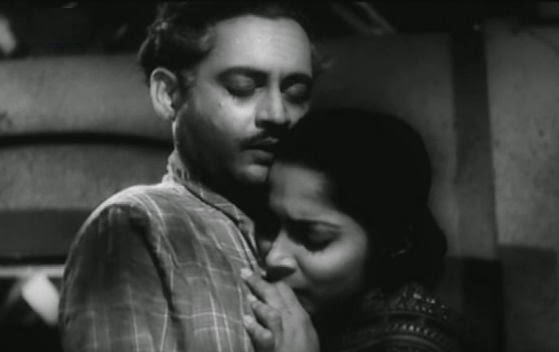
The rest of this section shows Suresh and Shanti getting to know each other, and this is where the film achieves its high point.  Shanti goes to a production-sponsored party heavily laden in makeup, and Suresh scolds her for besmirching her innocent allure and “looking like a monkey”.  He treasures her natural beauty.  Later Suresh is shown to have been seriously injured in an auto accident, and Shanti lovingly (but discretely) looks after him.  As their mutual attraction becomes more apparent, Suresh warns Shanti that he is a married man, but it is too late to stem their growing passion.  Then in a moving scene one early morning in the empty studio, they wordlessly face each other and exchange amorous glances while the soundtrack plays the song, “Waqt ne Kiya”.  This is a truly sublime aesthetic moment and the most memorable point in the film.  The song is sung by Guru Dutt’s own wife, Geeta Dutt, who was a prominent playback singer at that time.  The song’s lyrics capture the ethereal feeling of Suresh’s and Shanti’s burgeoning, unspoken ardor: 
What a sweet pleasure of pain life has brought to us.
You are no longer yourself.
I am no longer myself.

Our longing hearts met in such a way
As though we were never apart.
You became lost,
I became lost, too,
As we walked a few footsteps along  the same path

We cannot see where our path will lead.
What do we seek?
I don’t even know.
But with every breath, my heart weaves another dream

What a sweet pleasure of pain life has brought to us.
You, yourself, are no more.
I, myself, am no more.
3.  The Unwinding
While the production of Devdas is ongoing, gossip columnists, without evidence or justification, start speculating about a possible on-the-set romance between Suresh and Shantti.  Troubled by these reports, Pammi runs away from school and comes to visit Shanti.  She begs Shanti not to ruin her family life (although it is evident to the viewer that the rift between Suresh and his wife is irreparable) and asks her to leave Bombay.

The film Devdas is finally premiered to great acclaim, and both Suresh and Shanti are heaped with praise.  But Shanti cannot share in the joy and goes to the studio producer to announce her resignation.  Disturbed, Suresh accuses Pammi of interfering and goes to Shanti.  He knows why she is leaving, and the two of them wordlessly accept their fate of life apart.  After giving him the scarf she had been knitting for him, she departs.

Suresh’s noble efforts for Pammi, however, go unrewarded.  He loses to his wife and Sir Varma in a court case his attempts to have Pammi live with him.  And disconsolate from parting with Shanti, he begins heavy drinking and loses his professional focus, leading to his making flops at the box office.  When he is criticized and reigned in by his producers, his pride is affronted, and he walks out on them.  Shantti goes back to being a schoolteacher and is shown singing a lilting little song to her students about the number system.

4.  Lost Last Chances
The story now skips ahead two years and shows that Suresh has not been able to find any work and must auction off his personal belongings. Meanwhile Shanti is legally coerced by the film producers’ enforcement of her contract to return to film acting, and she returns to stardom. Shanti is now on top, and Suresh has become a penniless drunk. 

In an effort to rescue Suresh from his descent and see him again, Shanti goes to visit him in his slum quarters and tells him there is a deal arranged for him to be the director for her next film.  But he pridefully dismisses this opportunity, telling her that he knows she has just come to him out of pity.  Mindful of his ego and hoping that if she can get him to return, she can explain her true feelings later, Shanti tells him that he is nothing to her – her visit is purely professional.  But this tack by Shanti doesn’t work either.  Suresh tells her, “I have only one thing left in me – my pride.”  Again they part.


More years pass, and now Pammi is getting married. Shanti is a successful actress, but still pines miserably for her lost love. In an effort to get some money to buy Pammi a wedding gift, the down-and-out and rarely sober Suresh gets hired as a movie extra.  It turns out that the movie he is to be in stars Shanti, and when he sees her on-camera (she doesn’t recognize him in his makeup beard), he is struck speechless and unable to utter the brief line assigned to him.  When he removes his makeup after being summarily fired from the set, Shanti recognizes her love and chases after him out into the city streets. But she cannot catch up with him.  This is accompanied by a haunting soundtrack song, “Ud Ja Ud Ja Pyase Bhanwre”, which provides a second aesthetically moving highpoint in the film and a termination of their story.
The extended flashback comes to an end with the aged and enfeebled Suresh back in the empty studio, where he sits down in the portable director’s chair and dies.

So Suresh had three great loves in his life: (1) Shanti, (2) his daughter, Pammi, and (3) his work as a film director.  We could also add a fourth item to that list: his own pride.  This story tells how circumstances and his own limitations led to his loss of all of them. I have been told that with Indian society’s vast range of material circumstances – from the extravagantly rich to the desperately poor – there is a quiet apprehension that if one drops out of the middle or upper classes, the abyss into which one might fall might be bottomless. This is what happens to Suresh.  And the responsibility for his fall and his failure to connect rests mostly with his own inhibitions.

Guru Dutt expresses this tale of doomed passion and self-destruction with thoroughgoing expressionism all the way through.  Almost every character other than Shanti is presented schematically in exaggeration.  For example, Suresh is almost always seen holding a pipe in his hand, which presumably iconizes him as a thoughtful and reflective person.  This exaggerated, expressionistic presentation works in some ways and not in others. For example the hyperbolic surroundings help make the relationship between Suresh and Shanti appear that much more subtle.  But outside the performances of Guru Dutt as Suresh and Waheeda Rehman as Shanti, the expressionistic coloring has weaknesses. 


The relationship between Suresh and his wife Veena, presumably meaningful at one point in Suresh’s life, is never really shown – they do not interact at all in the film.  And Veena’s parents, particularly her titled father, are shown as ludicrously pompous – the sort who believe that aping the British entitles them to an elevated social status. The biggest problem, though, is the presentation of the outrageously effeminate Rocky (Johnny Walker, born Badruddin Jamaluddin Kazi).  He is shown at various points in the film irritatingly parading around like a foppish clown, which is apparently supposed to add some elements of farce to the proceedings. His activities contribute nothing to the plot progression, however, and are purely distractions from the main themes.  Incidentally, Johnny Walker’s characterization of Rocky reminded me of Billy De Wolfe, an effeminate comedian of the 1940s and 50s, and I wonder if he was influenced by De Wolfe.

Despite those detractions, though, the overall feeling of romantic doom remains a strong current, and the film has an epic quality that evokes memories of other classic tales.  A few of them come to mind.  The expressionistic presentation of a public figure’s glory and then extended decline is somewhat reminiscent of Citizen Kane (1941).  In both that story and Kaagaz Ke Phool the protagonist dies unfulfilled.  However, what makes Kaagaz Ke Phool a memorably compelling story is not really so much the focus on Suresh’s personal downfall; it is more the anguished expression of romantic unfulfillment. So one might think of Shakespeare’s Romeo and Juliet, where the lovers are blocked by societal divisions and conventions. But at least those star-crossed protagonists do manage to come together to express their love and have one night of rapture.  Another classic of frustrated love is Gone With the Wind (1939), but, again, Rhett Butler and Scarlet O’Hara did have their moments of passion.  No, in my opinion the story that most closely compares with Kaagaz Ke Phool is Wong Kar Wai’s In the Mood for Love (2000).  In both that story and Kaagaz Ke Phool the lovers are paralyzed not so much by external adversaries but by their own self-imposed restraints.  They stand back and helplessly watch their dreams evaporate. 

From a dramatic standpoint this kind of story poses problems, because the storyteller must describe a situation where not much happens – it’s what didn’t happen, and the internal turmoil associated with it, that was important.  Given such dramatic limitations, Guru Dutt did well to tell the story of this nature – a story for which we all have empathy and our own similar experiences.

As I alluded above, another aspect of Kaagaz Ke Phool that has added to its mystique is its eerie narrative hierarchical structure comprising similar thematic elements. According to this scheme, there are three narrative levels about a man whose hesitancy leads to his frustration and decline:
  1. At the inner level, there is the story of Devdas, which was the subject of the film Suresh Sinha was making in Kaagaz Ke Phool.  In that story, Devdas baulks when he has the chance with Paro.  Having missed his opportunity, he then turns to alcohol and ruins himself.
  2. The middle level is that of Kaagaz Ke Phool, itself, which I have related above. 
  3. At the outer level, there are Guru Dutt’s own real-life experiences.  Somewhat similar to the protagonist in Kaagaz Ke Pool, Dutt’s romantic interest in his lead actress, Waheeda Rehman, led his wife, Geeta, to separate from him. But the marriage was not dissolved, and the strain eventually caused Waheeda Rehman to withdraw from Dutt’s life.  Moreover, the financial failure of Kaagaz Ke Phool led Dutt, like Suresh Sinha in his film, to resign from further directing films [4].  Although he continued to produce films, he turned to drinking and died of an overdose of sleeping pills and alcohol at the age of 39 in 1964.
★★★½

Notes:
  1. Indeed, film critic Murtaza Ali Khan ranked it 62nd on his 2013 worldwide list of all time greatest films at A Potpourri of Vestiges
  2. See also Sight and Sound’s 2002 list of all-time top films, Cinemacom, 2002.
  3. The story has been filmed several times, notably Bimal Roy's Devdas (1955).
  4. There is some belief, however, that he surreptitiously directed or co-directed some subsequent films that he produced, such as Chaudhvin Ka Chand (1960), and Sahib Bibi Aur Ghulam (1962).