“Port of Call” - Ingmar Bergman (1948)


When Port of Call (Hamnstad) was released in 1948, it was already the fifth film that the thirty-year-old Ingmar Bergman had directed.  It included a number of stylistic features that demonstrated the range of Bergman’s cinematic expressiveness even then. One such element was the film’s presentation of working-class realism, a particularly popular mode of expression during a period that marked the rise of Italian Neorealism. But unlike a number of neorealistic films of that time, Port of Call does not have a largely unprofessional cast from the given social milieu. Bergman had a stage theatrical background, and the visual production of this film, in collaboration with cinematographer Gunnar Fischer, was very carefully composed, staged, and photographed according to Bergman’s preset dramatic requirements. 

In fact the careful staging of Port of Call’s dark, brooding environment, along with the dead-end prospects of its two main characters, contribute to another feature of the film – it’s film noir flavor.  Despite the noirish tendencies, though, this film also addresses some social issues, notably two of particular interest across the world at that time – juvenile delinquency and abortion.

The story concerns two relatively disconnected souls, Gösta, an ordinary sailor who has just landed in the port of Gothenburg after a long voyage, and  Berit, a young woman with a troubled background.  The first few scenes show that Gösta is tired of being at sea and wants a landlubber job, while Berit is so down that she attempts suicide by jumping off the same pear that landed Gösta’s incoming ship. 

A short time later, however, Gösta, not recognizing the girl who had just attempted suicide, picks up Berit at a local dance hall and escorts her home.  Although neatly attired in a coat and tie, it is clear that the relatively taciturn Gösta does not have very advanced social skills. But they are good enough to get what he wants – the opportunity to go to bed with Berit that evening.  The rest of the film charts the ups and downs of their rather fragile relationship. 

It is soon revealed that Berit has a miserable home life and has spent a considerable amount of time at a reformatory. Berit’s mother is a cold and scornful person who would be impossible for anyone to live with.  She mistreats her daughter at every opportunity and does everything she can to undermine the girl’s shaky existence.  Berit’s time locked up in a reformatory was due to some sexual episodes she had when she was a teenager, and now everyone around her (except Gösta who is unfamiliar with her past) dismisses her a “tart”.  Although she is currently “free” to live at home with her mother, Berit is constantly threatened with being sent back to the reformatory if she makes one more false move.

Nevertheless, Berit’s relationship with Gösta progresses well, in its own stumbling fashion, thanks to the encouragement of Berit.  Gösta takes her for a night to a hotel room where they can do as they please, and Berit is clearly in love.  But now she is faced with a crisis – she feels that for their relationship to proceed, it is necessary for her to tell Gösta about her scandalous background, and she does so.


Although Gösta is a bit different from his longshoremen comrades in that he actually reads books on occasion (seeing this, an older workmate friend grabs his book and warns him that he is wasting his time), he is till a conventional male.  Learning about Berit’s past sexual adventures turns him off Berit, and their relationship hits the rocks.

Their own difficulties are interrupted at this point by the more severe problems of Berit’s old reformatory friend Gertrud.  The girl suddenly needs an abortion, and she has to go to an underground practitioner to have it performed.  This was a topic of particular interest to contemporary Sweden, which in 1946 had legalized certain abortions for “social medicinal grounds” – for example, as mentioned by Berit, abortions were okayed when a girl was made pregnant by a retarded person and the potential child would presumably be a burden on the state. But abortions in general were unavailable to desperate young women. 

As we almost expect in this dark tale, Gertrud soon dies from complications of the abortion’s aftermath. Berit is immediately detained by the police, who seek the identity of the abortionist in order to make an arrest.  Threatened by the authorities with three more years in the reformatory if she doesn’t tell them, the browbeaten Berit finally breaks down and caves in to their demands. 

Meanwhile the man of few words, Gösta, is still agonizing over Berit’s scandalous past, and he expresses his frustrated feelings by going on a destructive rampage in his apartment. 

But at the very end of the film, Gösta comes to Berit and asks forgiveness for his pigheaded reaction to her life’s story.  Berit is thrilled to hear what she had always longed for. They agree that no matter how badly the world might treat them, they cannot be happy living without each other. 

Although Port of Call seems to package itself as an essay on the social problems of young women and delinquency in contemporary Sweden, it doesn’t come across well on that level.  This is primarily the fault of the exaggerated characterizations of just about every authority figure in the film.  The police, the factory managers, the social worker, and Berit’s mother are so categorically against young women, and so stupefyingly heartless to the point of cruelty in general, that it destroys all viewer empathy for what they might represent.  Indeed these stilted performances undermine the suspension of disbelief that is required for the viewer to engage with the narrative. Even Gertrud’s father, whose only appearance in the film comes when he is questioned by the police after his daughter’s death, says of her demise, “she never gave my any joy.  Perhaps it’s turned out for the best.”  So much for any hint of parental compassion.

But the film is redeemed as a love story, and this is almost entirely due to the moving performance of Nine-Christine Jönsson as Berit. While Bengt Eklund as Gösta is relatively wooden, Nine-Christine Jönsson’s performance reveals a character that seems to be the only real person in this story capable of genuine human engagement.  Even though she is cast in a rather melodramatic role, Ms. Jönsson manages to come across as a compassionate and vulnerable young woman who, despite repeated disappointments and reversals, is always opening her heart to the people she meets. Her responses, alternatively anxious, depressed, and joyful, are convincing throughout. Although she is not a naturally glamorous girl, she wins Gösta over, and she won me over, too.
★★½

“Tokyo Twilight” - Yasujiro Ozu (1957)


Yasujiro Ozu’s last black-and-white film, Tokyo Twilight (Tokyo Boshoku, 1957), was one of his darkest works – even more downbeat than his preceding effort, Early Spring (1956). This was the case despite the fact that, unlike his usual examinations of family life from a multi-generational perspective, these two films focused mainly on young people, who we might expect to be more enthusiastic and upbeat than their elders.  In Tokyo Twilight, though, the viewer is presented with the story of two adult daughters of a middle-aged banker who are very unsatisfied with their respective circumstances.  How this story is told is what makes it interesting.

As with most all of Ozu’s films, the pace is leisurely, tracking the everyday life of ordinary middle-class people going through their mundane activities.  Scenes are entered into without much framing or contextual setup, and slow disclosure is used concerning the relationships that exist among the characters.  It can take a few minutes to discover the existing relationships among the characters in a given scene.

The four principal players in the film are

  • Shukichi Sugiyama (played by Chishû Ryû) is the middle-aged banker and father of two daughters. The always sympathetic Chishû Ryû was a longtime Ozu favorite and appeared in 52 of Ozu’s 54 films.
  • Takako Numata (Setsuko Hara), the older daughter of Shukichi, is married to a professor and has a two-year-old daughter.
  • Akiko Sugiyama (Ineko Arima) is the younger and unmarried daughter of Shukichi.
  • Kisako Soma (Isuzu Yamada), a middle-aged woman, is introduced as the proprietor of a Tokyo mahjong gambling parlor.
The story of Tokyo Twilight unfolds as essentially a series of short conversations – more than 26 scenes, none more than six minutes in length. But the psychological atmosphere surrounding these conversations has a cumulative, almost noirish, effect that sustains interest throughout the drama.  These episodic, usually gloomy, conversations are woven together into a narrative that gradually moves through roughly four phases.
1.  Shukichi and his daughters
In the early scenes, the viewer is introduced to a middle-aged banker, Shukichi Sugiyama, and it seems possible that the film will be about him.  But in fact this tale turns out be entirely about women and the difficulties they were faced with in contemporary Japanese family life.  Shukichi has two adult daughters: Akiko, college-aged and still single, and her older sister Takako, who is married.  The absence of their mother is not explained at this point, but she will appear later.

Takako has a troubled marriage and has just left her husband and taken her two-year-old daughter to come and live with Shukichi. The word is that her husband, Professor Numata, is selfish, abusive, and a borderline alcoholic. Shukichi goes to Numata’s home to talk politely about the situation, but the professor proves to be detached and evasive, and nothing comes of their meeting.

On another occasion, when Shukichi has lunch in town with his sister, he learns that his younger daughter had asked the woman, without telling her father, to loan her a substantial sum of money, 5,000 yen.  So Shukichi now has two worries: Takako’s marriage problem and why Akiko needs money. The two daughters are quite different, though, and this is reflected in their external mannerisms.  Takako is traditionally attendant to her father and wears traditional clothing, while Akiko wears Western clothing, acts nonchalant, and smokes cigarettes.

2.  Akiko’s problem
It would seem that the story will now cover these two issues with equal weight, but that turns out not to be the case.  The rest of the film really revolves around Akiko, who is movingly portrayed by one of Ozu’s most beautiful performers, Ineko Arima. 

Akiko is trying to track down her elusive boyfriend Kenji so that she can talk to him, and she visits his flat, some bars, and a mahjong parlor in search of him. At the mahjong parlor the lady proprietor, Kisako, takes a warm interest in Akiko and tells her that she knew her family years ago when they lived in another town, Ushigome. 

Eventually Akiko runs into Kenji and confronts him with the news that we already suspected: she’s pregnant. Kenji is clearly irresponsible and even suggests to her that he may not be the father.  He runs off and tells her to wait for him later on that evening, at 9:30pm, at a cocktail lounge so that they can discuss things further.  Akiko dutifully goes there and waits, but Kenji fails to show up. 

Then, in a sequence that I found curious, Akiko gets arrested by a plainclothes policeman and taken into custody.  For what crime?  The cop tells her that, “a girl shouldn’t stay out late alone for any reason.”  This incident, which seemingly has little to do with the main story, is connected with an important theme in the film: the dubious and confused roles that women were (variously) understood to have in Japanese society. 

Takako rushes to the police station to take Akiko home.  Akiko, now seriously depressed and feeling abandoned by everyone including her now frowning father, moans to Takako that she should never have been born because she wasn’t wanted.

3.  Akiko and Kisako
From Akiko’s comments and other sources, Takako figures out that the mahjong parlor woman, Kisako, is actually their long lost mother who had abandoned the family and run off with another man many years ago when they were children.  Kisako is now married to a different man and had only recently come to Tokyo.  Filled with revulsion for her errant mother, Takako goes to confront Kisako, hatefully tells her off, and orders her not to reveal her identity to Akiko.

Meanwhile Akiko, having managed to borrow money from another source, goes to a clinic and goes through the anguish of getting an abortion (Japan had legalized induced abortions in 1948, but it was probably an ongoing subject of controversy for Japanese society [1]). While Akiko is off having her abortion, Shukichi is taking time off from work to visit his favorite pachinko parlor [2].

Later when Akiko learns that Takako had gone to the mahjong parlor, she mistakenly fears that Takako had learned about her pregnancy and abortion (which was still a secret to the rest of her family), so she confronts Takako about why she had gone there.  Takako responds angrily what she had intended to keep secret: that the mahjong parlor owner is their mother.  Akiko then goes to Kisako and expresses her own hatred for having been abandoned, even questioning her mother as to who her real father might be.

4.  Separations
Akiko finally runs into the elusive and uncaring Kenji at a noodle shop, but the encounter so upsets the girl that she bursts into tears and runs distractedly out into the street. In a classic instance of Ozu’s ellipsis, the scene shifts to a hospital ward, and it is revealed that the distraught girl had been hit by a trolley.  With her father and sister at her bedside, she now swears that she doesn’t want to die; she wants to start everything over.  But it is too late, and the most important character in the film is  gone, just like that.


Takako goes to Kisako and hatefully tells her that Akiko’s death is ultimately the fault of her runaway mother.  Faced with such venomous rejection from her old relatives, Kisako agrees to go away with her husband and live in another city.  Before leaving, she gives an offering for Akiko to Takako and tells her that she is leaving on the evening train to Hokkaido.  She hopes that her only daughter will break down and see her off at the train station.  Ozu stretches out the anticipation of this possibility as if it might really happen, but Takako doesn’t budge. Kisako departs presumably never to see her daughter again.

In the final scene, Takako tells her father that she intends to return to her husband and try and make their marriage work.  She says she is doing this for her daughter, because a child should not grow up without the presence of both parents around her.

So finally, Akiko, Kisako, Shukichi, and Takako have gone off in different directions without any solace or grace.
In case you might think that the Tokyo Twilight ends on a relatively positive note, let me assure you that it does not.  Takako’s closing vow to return to her husband is not an act of love, but more an expression of anger over the fact that she and Akiko were raised without a mother’s love.  This is an implicit criticism of Shukichi, too, since it implies that his fatherly love just wasn’t enough, by itself.

Like many of Ozu’s films, Tokyo Twilight has a theme concerning Japanese family life. But the tone here is more tragic than heartwarming. The underlying problem, the true theme of the film, is the difficult position that women have trying to operate in a disrupted social structure that offers them little support. The three principal women, Takako, Kisako, and Akiko, face these circumstances in their own fashions:

  • Takako, the traditional girl, often offers ingratiating smiles, but they seem forced. She remains bitter about her husband and bitter about her mother’s abandonment. 
  • Kisako appears to be very benign throughout the film.  She acknowledges that she had erred in the past, and when she is condemned by her own daughters in the present, she accepts the verdicts stoically. There is something in her countenance that suggests warmth and compassion.  But still she is made to suffer.
  • Akiko, the modern girl, is condemned by everyone for having fallen in love with a man and succumbed to his embraces.  Everyone she meets think that she is just a tramp, but she, too, appears to be a sincere and compassionate person.  Interestingly, she almost never smiles in the entire film – somewhat unusual in a culture where smiles are almost required by protocol.  And yet she comes across as the most open, unguarded person of them all – the one most ready to commit totally to love.
All three of these women, each faced with trying circumstances, really just want to love, but they are denied.  In fact they should not only not be condemned, but be loved in return.   That is what Ozu is showing us here.
★★★½

Notes:
  1. Ozu’s previous film, Early Spring, had also alluded to the issue of abortion in one of the minor subplots.
  2. The first commercial parlor for pachinko, a sort of pinball slot-machine, was opened in Japan in 1948, so they were a relatively new way to waste time.

“La Dolce Vita” - Federico Fellini (1960)


Federico Fellini’s La Dolce Vita (1960) won the Palme d’Or (“Best Picture”) at the Cannes Film Festival and was his biggest hit with the public.  For American viewers, though, its popularity was probably due to its perception as a phantasmagoric parade of European decadence among the privileged classes.  But underlying and unifying the film’s episodic and histrionic extravagances is something more interesting – a philosophical quest for life’s ultimate fulfilment.  Of course, the search for life’s meaning can be said to lie in the background of almost all stories, but La Dolce Vita’s almost picaresque journey through the various quarters of Roman pleasure-seeking represents a beautifully artistic articulation of this quest.

The film was shot in Rome and set mostly along the famous Via Veneto boulevard with a huge cast of characters.  The most prominent roles among the many players are:

  • Marcello Rubini (played by Marcello Mastroianni),  an aspiring writer who currently toils as a tabloid journalist.
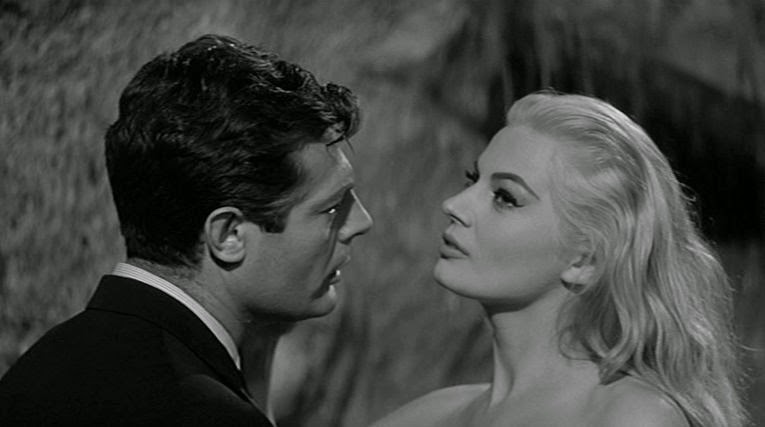
  • Sylvia (Anita Ekberg), a hyper-glamorous Swedish-American movie star.
  • Maddalena (Anouk Aimée), a beautiful and extremely wealthy woman devoted to pleasure-seeking
  • Emma (Yvonne Furneaux), Marcello’s devoted girlfriend
  • Steiner (Alain Cuny), Marcello’s wealthy intellectual friend and role-model
  • Marcello’s father (Annibale Ninchi)
  • Paparazzo (Walter Santesso), a free-lance photojournalist and representative of the class of lower-class publicity hounds in modern urban life.  His character name became eponymous with an entire class of frantic, media-chasing mindlessness.
The story of the film comprises a sequence of expressionistic episodes, almost like symphonic movements, that follow Marcello’s search path towards . . . what? It’s not simply enlightenment that he seeks, but something more complete – that which we all seek, a life of fullness and total engagement. We can call it “love”, but it is almost inexpressible.

The genius of Fellini was his ability to choreograph cinematically these kinds of feelings by means of expressive characterizations and group interactions in dynamic, involving environments.  Each of the episodes represents a specific tangent of Marcello’s quest for fulfilment.  For the most part, a given episode involves an evening of increasing delirium that ends with the cold light of morning daylight.
1.  With Maddalena

The opening scenes feature the frenetic life of Marcello, the tabloid journalist, who frequents nightlife on the Via Veneto in search of celebrity scandals.  He is often accompanied by Paparazzo, who seeks to take candid shots of celebrities in distress.  At a nightclub, Marcello runs into an old friend, the beautiful and engaging Maddalena.  Maddalena is so rich that she is bored with all of Rome; but Marcello says he likes Rome, because it is a jungle in which he can conceal himself behind many different roles. To amuse themselves with a game, they go off and pick up a prostitute so that they can use her place to have their own sexual tryst.  These early sequences also introduce the viewer to Emma, Marcello’s clinging fiancé, who is literally suicidal whenever she suspects Marcello might stray.  Thus from the outset, one sees Marcello torn between two unsatisfactory choices: the lascivious Maddalena, who only offers momentary pleasures, and Emma, whose obsessive possessiveness is oppressive to him.

2.  Sylvia
In perhaps the most famous sequence of the film, the extravagantly buxom movie star Sylvia visits Rome and so, unsurprisingly, comes to the attention of Marcello and the other media hounds.  Marcello is immediately infatuated with the luscious beauty, but what he sees is only a voluptuous mirage, not the promise of a fulfilling relationship. 

3.  Emma and the Miracle Sighting

Another news event to be covered is the reported miraculous sighting of the Virgin Mary by two lower-class children, which has caused a frenzy on the part of the religiously-devoted Italian public. This is also a memorably staged scene – here of religious enthusiasm run rampant, and the tradition-bound Emma is caught up in it, too. The crowd of worshipers that surrounds the two fantasy-inspired children grows unruly, and then chaos ensues when a rainstorm disrupts the activities. It all ends in chaos and acrimony, a far cry from whatever message of spiritual harmony that is supposed to be the foundation of religious narratives.

So by this point, more than 70 minutes into the film, there have been three less-than-satisfactory sociocultural illusions presented: (1) the conflicting allure of sexual loyalty (to oneself) and freedom (for oneself), (2) the illusory imagery of bewitching beauty, and (3) the limitations of conventional religion.

4.  Steiner’s party
Marcello has a friend, Steiner, who represents another path. Steiner is a refined intellectual with aesthetic taste, a beautiful wife, and adorable young children. He is wealthy, cordial, and sensitive to all those around him. For Marcello, who seeks to abandon journalism and become a serious writer, Steiner is his ultimate role model.  During a party at Steiner’s place that is filled with artists and intellectuals, Steiner and Marcello huddle together and discuss how one should live life.  Marcello says he wants to have the courage to abandon his materialistic lifestyle and be like Steiner, and he seeks his advice.  But Steiner expresses caution and ambivalence about the unknown fury of existence that is just beyond our gaze:
"Safety is not being locked up in one’s home. . . . A more miserable life is better, believe me, than an existence protected by a perfectly organized society."
A little later, his countenance darkens further:
"Sometimes at night, this darkness, this silence, weighs on me. Peace frightens me. I’m afraid of peace. It looks like an appearance hiding hell. I think of what my children will see tomorrow. They say the world will be beautiful. How?  A phone call can announce the end of the world."

His solution to these horrors seems to be withdrawal and disengagement:
"One should live beyond emotions in the harmony of art works. .in the enchanted order. . . We should learn to love each other so much, to live outside of time, detached. . . Detached!"
5.  With Paola
A little later (the next day?) Marcello, evidently inspired by Steiner to do some serious writing, is seen working at his typewriter at a beachside café.  The waitress there is the essence of utter innocence, and Marcello is captivated – not by carnal lust, but by such an image of untarnished genuineness.  Paola represents another image of life, another pathway – unreflective immediateness – which Marcello encounters but over which he does not linger.  This notion is revisited at the end of the film.

At this point we are about halfway through the film.  The remainder of the story depicts progressive estrangement and detachment from authentic communication.  This detachment is not the intellectual, Platonic detachment that was seemingly invoked by Steiner, but merely distraction from serious engagement.

6.  Father’s Visit
The next day Marcello is informed that his father, a professional salesman, has visited Rome and is looking for him on the Via Veneto. They meet up, and Marcello entertains his father at a Roman nightclub.  But this sequence, also interesting in its portrayal, shows Marcello how little he knows about his father and how separated they are from each other.  Their mutual lack of interest in each other both bemuses and troubles Marcello.


The next evening Marcello has further tempestuous interactions with the overly-clinging Emma,  and this is followed the next morning by the shocking news that, while his wife was out, Steiner killed his two children and committed suicide. Evidently Steiner was unable to face the darkened world that his fearful imagination only skirted. The ensuing scene of the paparazzi almost fiendishly buzzing around Steiner’s bewildered wife when she is informed of the tragedy is one of the most memorable moments of the film.

7.  Party at the Castle
The increasingly disillusioned Marcello follows a group of wealthy partygoers and artists to an engagement party for Marcello’s friend Nico (played by the real Nico, a famous model and singer) at her fiance’s castle.   Marcello runs into Maddalena again, and there is a brief contemplation of further involvement between the two.  But Maddalena warns him: 
“I’ve never wanted to make a choice.  I‘m a prostitute, you know it.  It’s hopeless, I’ll always be.”
8.  Party at the Villa

The final sequence shows another party of wealthy time-wasters. What makes this party different? Here, some time may have passed, and things have degenerated further. Marcello has given up his job as a journalist and become a cynical publicist.  Now, there is no pretense at telling the truth: he writes the lies that his employers pay him to write. While the previous scenes showed refined decadence, this sequence descends entirely into depraved and destructive debauchery. The determinedly enamored Emma is now nowhere in sight. 

In the early hours of the morning, the inebriated partygoers go down to the beach and see that some fishermen have netted a huge sea monster (looking like a giant stingray). The estrangement of the curiosity seekers is complete. They look at the sea monster with utter revulsion, and yet they try to make jokes about it to amuse themselves, too.

In the final moments, Marcello notices Paola from a distance.  She is waving to him, but what was once the image of pure, innocent engagement is now bewildering to him.  He doesn’t even remember her.

There are some great things about Fellini’s work in this film.  Although the story seems to wander almost aimlessly at times, it has its relentless progression from hope to hopelessness. Marcello, who remains the center of focalization throughout, has companions in the various sequences who turn out to represent blind alleys for him:
  • Emma represents drudgery and routine – the promise of a boring life of duty.
  • Maddalena represents complete self-indulgence, a never-ending search for momentary distractions.
  • Sylvia represents fantasy that can never reach realization.
  • Marcello’s father represents estrangement from the traditional values on which he was raised.
  • Steiner represents the reflective life that is so detached from genuine engagement that it can undertake its own dissolution.
  • We are left with only Paola.  Is she, too, an illusion, or does she represent the only real way?
To describe it this way may make the film seem schematic and artificial, but as brought to cinematic realization by Fellini, La Dolce Vita has a narrative movement that is continually gripping. 

It is interesting to compare La Dolce Vita with Michelangelo Antonioni’s vaguely similar La Notte (1961). After all, the two films were both made at about the same time, both starred Marcello Mastroianni, and both were centrally concerned with existential aimlessness. But there are significant differences between the two films, as well. Antonioni’s film focuses more on the multiple internal psychologies of the four principals, each of whom attempts empathetically to ascertain what others around them are really thinking.  Fellini’s La Dolce Vita, on the other hand is more externalized – the psychological ambience in this case is created by the exterior world around Marcello, as realized expressionistically by Fellini. 

The philosopher Martin Heidegger refers to authentic and inauthentic being, two fundamental ways of personal existence [1].  When we are inauthentic, we often attend to what we assume that “they” (a collective, unspecified other) are thinking and demanding; we are existing in accordance with our inner compass.  Heidegger says that we all are mostly and for the most part inauthentic, but sometimes, when we are true to our inner natures, we are authentic. In this regard the main characters in Antonioni’s La Notte continually strive for the illusive authenticity.  They seek authenticity in themselves and others. In La Dolce Vita, however, authenticity is less explicit and even more remote, perhaps only fleetingly suggested by the characters of Steiner and Paola.

On the whole, though, one has to admire the mastery of Fellini's cinematic storytelling. There are numerous scenes in La Dolce Vita that will linger in your memory for years.  Roger Ebert recalls seeing the film five times over a period of almost forty years, and each time he saw new things in the film to appreciate [2].  This is what great films can offer – a portrayal of the fundamental issues of life that we can relate to our own most personal experiences.
★★★★

Notes:
  1. Martin Heidegger, Being and Time (1926/1953/1996), Joan Stambaugh (trans.), State University of New York Press, New York, pp. 126-130.
  2. Roger Ebert, “La Dolce Vita”, RogerEbert.Com, January 5, 1997.

Yasujiro Ozu

About Yasujiro Ozu:
Ozu’s Cinematography (from the review of Early Spring)
Ozu’s mise-en-scene was famously different from most other filmmakers across the globe, although his style has directly influenced some filmmakers, such as Hou Hsiao-Hsien.  His camera is almost invariably set at a low angle, as if from a low sitting position and looking up at the characters.  The image compositions are static, and there is almost no camera movement.  Even when the camera tracks horizontally, it maintains a fixed composition on the principal characters of the shot.  Thus the camera seems to be rooted to the environment, and pays little attention to the eye-line axes of the characters.  Nevertheless, there is quite a bit of cutting on action, which evokes the idea of the camera representing the “invisible” witness whose focus of attention changes naturally with an action cut.  Sometimes, at dramatically significant moments in the story, there is a straight-on camera shot, with the principal character speaking directly to the camera, which places the invisible witness directly in the middle of the interaction, empathetically assuming the role of the recipient of the speaker’s words.

For scene transitions, Ozu often shows static cityscape images that are empty of human content.  Sometimes these scene transitions elliptically pass over a significant piece of action that must be inferred by the viewer.  Altogether these effects create their own special cinematic atmosphere  that seems to place the viewer in an intimate position to witness the scene, and yet not always privy to everything that is going on. 

Ozu probably developed this consistently rigorous visual methodology during his early days in the period of silent filmmaking.  Surviving storyboards of Ozu’s work show his meticulous concern for background compositions and are indicative of his static camera methods [1].
Notes:
  1. “The director’s storyboards suggest Ozu envisioned his trademark rigorous-style compositions long before cameras rolled. In them, sets are lined with geometric beauty and are much darker than drawings done to illustrate the characters.” – quoted from “Ozu's Movies Continue to Win New Fans”, by Noriki Ishitobi and Aiko Masuda, The Asahi Shimbun, January 28, 2014.
Films of Yasujiro Ozu:

“Early Spring” - Yasujiro Ozu (1956)


Like most of the films of his mature period, Yasujiro Ozu’s Late Spring (Soshun, 1956) concerns the various personal and social relationships that structured contemporary middle-class Japanese life. In this case the primary theme concerns the workaday dissatisfactions among the burgeoning class of low-level white-collar workers. The men (the primary breadwinners)  refer to themselves as “salarymen”, and for the most part, they feel their work is boring and meaningless – they merely work to collect their meager weekly salaries.

The story concerns one of these salarymen, a young married office worker, and it traces events that bring about a crisis in his life.  The ending of this crisis may bring about different critical interpretations, depending on how one views the bigger social picture.  But whatever your interpretation, a key component of the film is, of course, the manner in which Ozu tells the story cinematically. 

Ozu’s Cinematography
Ozu’s mise-en-scene was famously different from most other filmmakers across the globe, although his style has directly influenced some filmmakers, such as Hou Hsiao-Hsien.  His camera is almost invariably set at a low angle, as if from a low sitting position and looking up at the characters.  The image compositions are static, and there is almost no camera movement.  Even when the camera tracks horizontally, it maintains a fixed composition on the principal characters of the shot.  Thus the camera seems to be rooted to the environment, and pays little attention to the eye-line axes of the characters.  Nevertheless, there is quite a bit of cutting on action, which evokes the idea of the camera representing the “invisible” witness whose focus of attention changes naturally with an action cut.  Sometimes, at dramatically significant moments in the story, there is a straight-on camera shot, with the principal character speaking directly to the camera, which places the invisible witness directly in the middle of the interaction, empathetically assuming the role of the recipient of the speaker’s words.

For scene transitions, Ozu often shows static cityscape images that are empty of human content.  Sometimes these scene transitions elliptically pass over a significant piece of action that must be inferred by the viewer.  Altogether these effects create their own special cinematic atmosphere  that seems to place the viewer in an intimate position to witness the scene, and yet not always privy to everything that is going on. 

Ozu probably developed this consistently rigorous visual methodology during his early days in the period of silent filmmaking.  Surviving storyboards of Ozu’s work show his meticulous concern for background compositions and are indicative of his static camera methods [1].

Using these cinematic techniques, Ozu presents in Early Spring over the course of two hours and twenty-four minutes, Ozu’s longest film, a close-to-the-ground study of the pointless tedium of modern middle-class existence.  Despite the careful brush strokes, however, I wouldn’t say that this film aesthetically matches the enervating existential ambience of Olmi’s Il Posto (1961). 

The Cast
There are three principal characters in Early Spring:
  • Shoji Sugiyama (Ryo Ikebe), an office worker at the Toa Fire Brick Company,
  • Masako (Chikage Awashima), Sugiyama’s wife,
  • Chiyo Kaneko, “Goldfish”, (Keiko Kishi), a girl at Sugiyama’s work place.
The focalization is almost exclusively on Sugiyama and Masako. Nevertheless, I would say that there are three focal spheres in the story, and the narrative meanders back and forth across all three spheres throughout the film:
  • Sugyiyama’s world - the man's world
  • Masako’s world - the woman's world
  • The salarymen milieu at the company office.  It is this third sphere that is, in my view, the most important.
The Story
The story moves through four stages, and in each stage the three subject spheres are visited.
1.  Morning in the City
In the first part, we are introduced to the rather regimented world of the Tokyo office workers [2].  They all live in cramped apartments, all wear the same “office” clothes, and commute back and forth to work in crowded trains. Sugiyama and Masako are just one couple in this crowd.  During a lunch break, a number of the workers decide to break the monotony of work by going on a day hike at a nearby mountain.
2.  Sugiyama and Goldfish
On the hike, Sugiyama begins chatting with a girl from the company’s typing pool, “Goldfish”.  Soon they are shown having lunch together, and thanks to the vivaciousness of Goldfish their acquaintanceship blossoms into an affair.  The actual moments of passion are omitted by Ozu’s ellipsis here.

3.  Breakdown at the Office
Although Sugiyama and Goldfish conceal their relationship, their gossipy coworkers at the office begin to suspect something. A few of them arrange a fake party that is intended to serve as a kangaroo court to accuse Goldfish and Sugiyama of adultery. Sugiyama is preoccupied with news that he is going to be transferred by the company to the remote town of Mitsuishi, and he misses the setup party.  But Goldfish show up, and she is reduced to tears by their nasty allegations.

4.  Breakdown at Home
Eventually the suspicious Masako becomes sure of Sugiyama’s infidelity, and their ensuing quarrel leads to her moving out of their apartment to go live with a girlfriend.  Masako cuts herself off from Sugiyama, hanging up the phone when he calls her up.  So Sugiyama glumly goes off alone to Mitsuishi to take up his new post.  In the end, though, friends and family intervene to convince Masako to go join her husband.  They meet up, mutually apologize, and agree to start a new life together.

Themes
Some people view this story as a heartwarming domestic drama about a good traditional marriage that is almost ruined by the crafty machinations of the immoral Goldfish.  According to this view, Goldfish, whose hairstyle and clothing have a Western look, represents the corrupting influences of modernity.  Sugiyama is seen as initially succumbing to the evil temptations, but he eventually repents, and order is finally restored by his forgiving wife. 

But I take a different view.  To me the film is about the hollowness of “modern” Japanese middle-class life.  Among the men at the office, there is little authentic communication.  They compulsively reach for their cigarettes in order to give the appearance of being occupied. Much of the time they complain about the barren life horizons of all the salarymen [3]. At one point in the story when Sugiyama is having a drink at a bar, he hears an elderly white-collar worker at the adjacent barstool tell him, “I’ve worked 31 long years to find life is just an empty dream.”  In fact in this social climate, drinking alcohol seems to be the only means that a man has to throw off the yoke of his social harness and be uninhibited.  This is shown when Sugiyama gets together with his war veteran buddies, and they all get heavily and satisfyingly drunk.

In the milieu of the women, life is equally dreary.  Masako chats with her mother and various female acquaintances, and they all tell her that men are inherently cheaters.  Although the mother is rather stoic about this, the others advise her to make men suffer as much as possible for their sins.


Goldfish, in fact, is the only authentic person in the story.  She is the one person who can feel love, honestly express her emotions, and make direct engagement with the people around her. Her habitually good-natured demeanor arouses jealousy. When the man she loves, Sugiyama, turns his back on her, she accepts and forgives him, only asking him to be honest with her. At the kangaroo-court party after Goldfish departs in tears, the men, who had just sanctimoniously attacked her, then admit to each other that it was probably Sugiyama who had seduced her. This is an erroneous belief – Goldfish had actually seduced Sugiyama – but it shows how men typically and immediately heap blame on women for acts in which they themselves are complicit. They go on to confess that they actually envy Sugiyama’s good luck at having scored with Goldfish.  Hypocrisy is the rule with everyone but Goldfish.

So to me the narrative of Early Spring ends gloomily – as a defeat.  Sugiyama and Masako succumb to the oppressive, dead-end system that surrounds them and vow to make a go of it.  But the joys and wonders of life, its magic as represented by the way Goldfish engaged with it, are evidently abandoned.  This is a sad ending indeed.
★★★

Notes:
  1. “The director’s storyboards suggest Ozu envisioned his trademark rigorous-style compositions long before cameras rolled. In them, sets are lined with geometric beauty and are much darker than drawings done to illustrate the characters.” – quoted from “Ozu's Movies Continue to Win New Fans”, by Noriki Ishitobi and Aiko Masuda, The Asahi Shimbun, January 28, 2014.
  2. This was by no means only a concern in Japan.  Everywhere there was a growing concern about the new social forms of the “Organization Man”, as attested to by bestselling books of that time:
    • The Organization Man (1957), by William H. Whyte, Jr., Doubleday Anchor Books, and
    • The Lonely Crowd (1953), by David Riesman, Doubleday Anchor Books.
  3. This, of course, is a worldwide problem.  Consider this contemporary commentary on the salaryman's dismal landscape (from “World Processor”, by Jacob Silverman, The Baffler, No. 25, 2014):
    "Utopian reveries spill forth almost daily from the oracles of progress, forecasting a transformation of Information Age labor into irrepressible acts of impassioned fun. But we know all too well the painful truth about today’s ordinary work routines: they have become more, not less, routinized, soul-killing, and laden with drudgery.
    . . .
    The computerization of the workplace brought regulated workflows, surveillance by managers, deference to the dictates of software, and a machine with which you couldn’t keep up. It meant a noticeable loss of autonomy and a dawning sense—seen in the rapid turnover guaranteed by planned obsolescence—that productivity and growth had become ends in themselves. The most dangerous -isms turned out to be those preceded by 'Ford' and 'Taylor,' and they exerted their ultimate hold by becoming technologized and dispersed throughout our homes, our offices, our cars, and our cities."