“The Wolf of Wall Street” - Martin Scorsese (2013)

Marti Scorsese’s black comedy The Wolf of Wall Street (2013) relates the hectic experiences of a Wall Street financial trader whose life story serves as a metaphor for the out-of-control world of today’s market trading.  The film was an immediate success (in fact Scorsese’s highest grossing film), and perhaps one of the reasons why the public was so fascinated with the story is that the outlandish, hard-to-believe events presented are based on the true-life account of the main character, Jordan Belfort [1].  In any case the film was popular with the critics, too, and garnered Oscar nominations for Best Picture, Best Director, Best Actor, Best Supporting Actor, and Best Adapted Screenplay. 

The narrative of The Wolf of Wall Street has affinities with one of Scorsese’s best films, Goodfellas (1990) – both films describe something of a netherworld of vice and recklessness, and they try to capture the seductive tempos of those worlds and what they lead to. But in my view, The Wolf of Wall Street doesn’t measure up to Goodfellas, and I will try to explain why.

One of the differences between the two films is that the characters in The Wolf of Wall Street, despite their sex-and-drugs lifestyles, are not very interesting, even though they presumably are more educated and sophisticated than the “wiseguys” of Goodfellas.  This reduces most of the personal interactions depicted to mere silliness.  I did find two of the interactions interesting, however, and the film’s tale revolves around them.  If there had been more such interactions, the film might have had a more sustained narrative.

The story begins with Jordan Belfort (exuberantly played by Leonardo DiCaprio) facing the camera and beginning to tell the viewer about his roller-coaster life as a financial analyst.  Then we move to flashback scenes of the various stages of his career.
1.  Early Days on Wall Street

Belfort starts out in his mid-twenties trying to enter the financial marketing world and manages to join a Wall Street firm as a trader.  On his first day at the firm, he is taken out to lunch by a senior trader, Mark Hanna (Matthew McConaughey), who clues the young Belfort in on how to make it on Wall Street.

Now we have been told that financial markets are designed to make it easy to move resources over to organizations and operations that are comparatively more productive. Thus by this means new ideas can be given resources to implement them, and this should make the world richer.  But Hanna, in this 4½-minute lunch scene, which is a tour-de-force for McConaughey, articulates in capsule form the narcissistic philosophy of how financial trading really works, and that is an underlying theme of the film.  He tells Belfort that his only professional goal should be to “move money from your client’s pocket into your pocket.”  And he crucially reminds Belfort:
“We don’t create [anything] . . . . we don’t build anything”
The only thing to do, he is told, is to get the client to keep reinvesting whatever he or she has earned in new stocks, so that he can thereby collect more commissions for himself.  “Keep the client on the Ferris wheel,” he tells Belfort.  And to stay energized at this constant task, he tells the young man, he needs to indulge in as much sex and cocaine consumption as possible.

Though the investment company Belfort joined soon folds as a result of a stock market crash, he learns about penny stocks and quickly assembles a collection of misfits to help staff his own company in this area. 

2. Making it Big
Not only does Belfort make relatively high commissions with his penny stocks, he learns how to employ shady “pump and dump” tactics to artificially inflate stock prices of his own stocks and then dump them at a profit.  Soon he is filthy rich, and he continues to employ the ideas he learned from Mark Hanna, including encouraging heavy doses of sex and drugs at his company, which he has named Stratton Oakmont to make it sound like it has a suitable pedigree.


This section of the film is mostly an account of how Belfort indulges himself in connection with various after-hour orgies that he sponsors at his company. He meets a gorgeous blonde, Naomi (Margot Robbie),  and though married to an attractive woman, he cannot suppress his appetites there, either. In short order he gets a divorce and marries Naomi.

3.  The FBI Enters the Picture
Stratton Oakmont’s nefarious swindles come to the attention not only of the SEC, but also the FBI, which is concerned not with financial irregularities but with criminal activities.  Belfort receives a visit on his luxurious yacht from FBI officer, Patrick Denham (Kyle Chandler), who wants to learn more about the company’s operations.  This conversation, a 7-minute  sequence, is the second interesting personal interaction in the film and Scorsese’s high point, as Belfort and Denham politely try to avoid revealing what is truly on each of their minds.

This doesn’t stop Belfort from continuing his hedonistic ways, and there are more sex orgies and drug-imbibing scenes presented. There is a scene showing Belfort and his sidekick Donnie Azoff  (Jonah Hill) staggering and struggling under an overdose of quaaludes that some people find side-splittingly funny.   I found this kind of slapstick stuff just sophomoric and only a distraction.

Now with the FBI on his back and watching his transactions, Belfort seeks to sequester his ill-gotten gains into a Swiss bank account, and he figures out a way to sneak his cash over there by hiding it on a woman accomplice’s body.

4.  Downfall
Belfort almost gets away with everything, but eventually the law catches up with him.  Even though he has given up some of his worst practices, the FBI charges him with crimes associated with his past activities, and he faces the prospects of a long prison sentence unless he “cooperates”.  This he willingly does, and he agrees to wear a “wire” and incriminate all his past business associates.  In appreciation for his double-crossing his former compatriots, the US government gives him a 3-year sentence (he served 22 months) and fines him $110 million.  But he doesn’t lose heart or his belief in his own abilities to effectively swindle people.  At the end of the film, we see Belfort visiting Auckland, New Zealand, and selling his new package of persuasive techniques.  Incidentally the unnamed actor in the film who introduces him (DiCaprio) to the Auckland audience is the real Jordan Belfort.
So the narrative arc seems basically similar to that of Goodfellas. Again we have a protagonist getting more irretrievably immersed in out-of-control illegal activities and finally saving himself by ratting on his colleagues. But to me Wolf on Wall Street doesn’t deliver the goods that Goodfellas did.

For one thing, the adolescent, frat-boy humor in Wolf on Wall Street wears thin pretty quickly.  For much of the film’s near three-hour running time, the audience is treated to one ridiculous drunken binge after another.  This is evidently intended to be funny, because we are watching supposedly well-educated, sophisticated financiers engaged in these silly shenanigans.  The only thing missing is the skateboards.


Another problem is that most of the characters are not well developed and are largely uninteresting.  In Goodfellas, there was a steadily intensifying degree of the protagonist, Henry Hill, being out of control as the story progressed.  This gave the entire narrative of that film a sense of progression towards disaster and a sense of movement in Hill’s character. But with The Wolf of Wall Street, there isn’t this movement.  It’s just one dang thing after another. At least Jonah Hill, in the role of Belfort’s sidekick, is goofy enough to serve as a foil to enhance DiCaprio’s charisma. But much of his screen time is devoted to showing him doing something outrageously gross or weird that is presumably not in keeping with what would appear to be his nerdy character.

Another distinction between this film and Goodfellas is that in that earlier film there were more two-way interactions involving principal characters – sometimes they do things, other times things happen to them.  But in The Wolf of Wall Street, the interactions are mainly one-way – the principal characters, Belfort and Donnie, are primarily only perpetrators and wreak havoc on others.  There was one interesting interaction scene – the one between Belfort and FBI agent Patrick Denham conducted on Belfort’s yacht.  If there had been more scenes like that, then we would have had a more interesting story.

Scorsese was limited, of course, by having to stick to what is thought to be a true story, Belfort’s own published account. But there are suspicions that Belfort embellished his own story, anyway, so sticking closely to that account may not have been the best strategy.

OK, if The Wolf of Wall Street is lacking in the degree to which it portrays interesting characters and how they develop, perhaps we should look at the film as a broad social satire in the fashion of Dr. Strangelove (1964).  From this perspective we might consider that this film is satirically depicting a crazy, out-of-control aspect of our increasingly interconnected financial market system, much as Dr. Strangelove depicted an out-of-control military-industrial complex. 


In the US there has emerged a paradoxical political coalition of convenience that links the opportunist banking and financial sectors with the conservative right-wing portion of society – the top and the bottom in terms of wealth.  These groupings are joined, because they both claim that US society success should be based on limiting the involvement of the federal government in their lives.  But what the conservatives fail to see is that the government does have a legitimate role to play in protecting the commons, human rights, and maintaining a stable and open market environment.  So we might think that The Wolf of Wall Street exposes the financial sector for what it really is: an extractive and exploitative collection of manipulators primarily devoted to fleecing the public with their various types of pump-and-dump tactics. This perspective could have been adopted and presented in the film – indeed the conversation with Mark Hanna in the early stages appears to head the film in this direction. But the viewer is never given any coverage or analysis, even in simplified form, of the financial operations that are thought to have been harmful or criminal. And so this potentially compelling satirical perspective is more or less dropped as the film progresses in favor of showing more meaningless gross-outs and over-indulgences.

So as I mentioned above, there are two interesting conversations in The Wolf of Wall Street that could have taken the film in interesting directions: (1) the conversation with investor Mark Hanna (in the direction of social satire) and (2) the conversation with FBI agent Patrick Denham (in the direction of a character-oriented narrative).  But neither of these directions were taken, and so the opportunity for having a truly interesting and entertaining narrative was lost.
★★½

Notes:
  1. Jordan Belfort, The Wolf of Wall Street (2007), Bantam.

“Kaagaz Ke Phool” - Guru Dutt (1959)


Kaagaz Ke Phool (English meaning: “Paper Flowers”, 1959) is a landmark film of legendary Indian filmmaker Guru Dutt (“Guru Dutt” was his stage name, he was born “Vasanth Kumar Shivashankar Padukone”).  It is one of a set of classic films which also included Mr. & Mrs. ‘55 (1955), Pyaasa (1957), Chaudhvin Ka Chand (1960), and Sahib Bibi Aur Ghulam (1962) that the gifted producer-director-actor made over the course of his meteoric career.

Of Dutt’s great films, Kaagaz Ke Phool has come to hold a special place perhaps because of its curious embodiment of Dutt’s own tragic narrative arc.  The story of the film concerns a famous film director whose downfall is precipitated by his encounter with and subsequent attachment to an unknown schoolteacher whom he fashions into a matinee idol.  Although the story has mythic qualities, when the film was first released it was an unqualified financial disaster that damaged Dutt’s status as a surefire hit maker.  A probable reason for the film’s failure at the box office is its lengthy presentation of personal disintegration (the entire second half of the film), culminating in an uncompromisingly unhappy ending. 


Despite its failure at the box office, however, Kaagaz Ke Phool is today regarded as among the greatest Indian films ever made [1,2].  Certainly it does show a range of film studio techniques that display Dutt’s command of cinematic storytelling.  These techniques include 
  • composition-in-depth long shots in widescreen (this was India’s first film in cinemascope).  Unfortunately, the image quality of the film that I saw was poor and had a limited contrast range, so much of the chiaroscuro imagery in these shots was lost in dark shadows.  But I still got a glimpse of the atmosphere these shots created.
  • music-laden montages featuring rhythmically edited dissolves.
  • narratively-embedded songs.  There are seven songs in the film, several of which lift the film to a higher level.
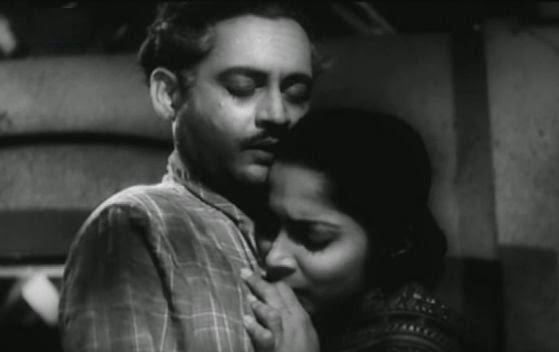
  • emotive closeups.  These capture much of the unspoken but passionate feelings of the two principal characters.
All of these Dutt-specialized techniques came to set a standard for Hindi-film cinematic expression.

Nevertheless, the film has its flaws, in my opinion, too.  These are perhaps partly due to the compromises that were necessarily part of Indian films of that period.  Remember that television was only introduced experimentally in India in 1959 and did not achieve widespread coverage until the 1970s.  So the movies were the form of popular mass-media entertainment and had to be made to appeal to the full range of societal tastes.  The films of those earlier days tended to feature simplified characterizations, lots of music, and comic relief in order to hold the casual viewer’s attention.  These elements could sometimes get in the way of the principal narrative themes, and this is what happens in Kaagaz Ke Phool, too.

The story of Kaagaz Ke Phool begins with an old man, Suresh Sinha (played by Guru Dutt), making an off-hours visit to a Bombay film studio, where he lapses into reminiscences about his earlier days.  The resulting narrative in flashback is presented in four acts.
1.  The Great Film Director
The first one of the film’s seven songs accompanies the old man’s memories of the days when he was a top film director in command of hundreds of assistants on the studio set.  Suresh, shown in flashback in his prime, is preparing for the production of an ambitious film of Devdas, a famous Bengali novel written in 1917 about a man whose hesitancy causes him to lose his chance to marry his true love and which ultimately leads to his self-destruction in alcohol and dissolution [3].  Suresh is looking for an actress to play the lead role of Devdas’s love, Paro, who must embody innocence and natural beauty.


Later Suresh is shown traveling to Delhi to see his beloved teenage daughter, Pammi (Kumari Naaz), and we gradually learn that Suresh is separated from his wife, Veena (Veena Sapru), and that Suresh is denied even visitation rights to see his own daughter. The reason for their breakup is that Suresh’s wife, along with her snooty parents, feel that the movie industry is scandalously low class and condemn Suresh for his involvement in such a vulgar medium. His insufferable in-laws, including his eccentric brother-in-law, Rocky, and his snobbish father-in-law, Sir. B.  V. Varma, are shown to be stuffy Anglophiles, and their presence in the film seems to be primarily just for comic relief.

After the unsatisfactory visit with his in-laws, Suresh walks in the rain through a Delhi park and, seeing a young schoolteacher, Shanti (Waheeda Rehman), who is unprotected from the rain, he loans her his umbrella.

2.  A Star is Born
Back at the Bombay film studio, Suresh is shooting some footage on the set.  Shanti who has come to Bombay looking for work, arrives to return the umbrella and accidentally stumbles into a shoot that is then mistakenly developed and printed in the editing rushes.  When Suresh sees Shanti’s footage, he realizes that her innocence and grace would make her perfect for the role of Paro.
The rest of this section shows Suresh and Shanti getting to know each other, and this is where the film achieves its high point.  Shanti goes to a production-sponsored party heavily laden in makeup, and Suresh scolds her for besmirching her innocent allure and “looking like a monkey”.  He treasures her natural beauty.  Later Suresh is shown to have been seriously injured in an auto accident, and Shanti lovingly (but discretely) looks after him.  As their mutual attraction becomes more apparent, Suresh warns Shanti that he is a married man, but it is too late to stem their growing passion.  Then in a moving scene one early morning in the empty studio, they wordlessly face each other and exchange amorous glances while the soundtrack plays the song, “Waqt ne Kiya”.  This is a truly sublime aesthetic moment and the most memorable point in the film.  The song is sung by Guru Dutt’s own wife, Geeta Dutt, who was a prominent playback singer at that time.  The song’s lyrics capture the ethereal feeling of Suresh’s and Shanti’s burgeoning, unspoken ardor: 
What a sweet pleasure of pain life has brought to us.
You are no longer yourself.
I am no longer myself.

Our longing hearts met in such a way
As though we were never apart.
You became lost,
I became lost, too,
As we walked a few footsteps along  the same path

We cannot see where our path will lead.
What do we seek?
I don’t even know.
But with every breath, my heart weaves another dream

What a sweet pleasure of pain life has brought to us.
You, yourself, are no more.
I, myself, am no more.
3.  The Unwinding
While the production of Devdas is ongoing, gossip columnists, without evidence or justification, start speculating about a possible on-the-set romance between Suresh and Shantti.  Troubled by these reports, Pammi runs away from school and comes to visit Shanti.  She begs Shanti not to ruin her family life (although it is evident to the viewer that the rift between Suresh and his wife is irreparable) and asks her to leave Bombay.

The film Devdas is finally premiered to great acclaim, and both Suresh and Shanti are heaped with praise.  But Shanti cannot share in the joy and goes to the studio producer to announce her resignation.  Disturbed, Suresh accuses Pammi of interfering and goes to Shanti.  He knows why she is leaving, and the two of them wordlessly accept their fate of life apart.  After giving him the scarf she had been knitting for him, she departs.

Suresh’s noble efforts for Pammi, however, go unrewarded.  He loses to his wife and Sir Varma in a court case his attempts to have Pammi live with him.  And disconsolate from parting with Shanti, he begins heavy drinking and loses his professional focus, leading to his making flops at the box office.  When he is criticized and reigned in by his producers, his pride is affronted, and he walks out on them.  Shantti goes back to being a schoolteacher and is shown singing a lilting little song to her students about the number system.

4.  Lost Last Chances
The story now skips ahead two years and shows that Suresh has not been able to find any work and must auction off his personal belongings. Meanwhile Shanti is legally coerced by the film producers’ enforcement of her contract to return to film acting, and she returns to stardom. Shanti is now on top, and Suresh has become a penniless drunk. 

In an effort to rescue Suresh from his descent and see him again, Shanti goes to visit him in his slum quarters and tells him there is a deal arranged for him to be the director for her next film.  But he pridefully dismisses this opportunity, telling her that he knows she has just come to him out of pity.  Mindful of his ego and hoping that if she can get him to return, she can explain her true feelings later, Shanti tells him that he is nothing to her – her visit is purely professional.  But this tack by Shanti doesn’t work either.  Suresh tells her, “I have only one thing left in me – my pride.”  Again they part.


More years pass, and now Pammi is getting married. Shanti is a successful actress, but still pines miserably for her lost love. In an effort to get some money to buy Pammi a wedding gift, the down-and-out and rarely sober Suresh gets hired as a movie extra.  It turns out that the movie he is to be in stars Shanti, and when he sees her on-camera (she doesn’t recognize him in his makeup beard), he is struck speechless and unable to utter the brief line assigned to him.  When he removes his makeup after being summarily fired from the set, Shanti recognizes her love and chases after him out into the city streets. But she cannot catch up with him.  This is accompanied by a haunting soundtrack song, “Ud Ja Ud Ja Pyase Bhanwre”, which provides a second aesthetically moving highpoint in the film and a termination of their story.
The extended flashback comes to an end with the aged and enfeebled Suresh back in the empty studio, where he sits down in the portable director’s chair and dies.

So Suresh had three great loves in his life: (1) Shanti, (2) his daughter, Pammi, and (3) his work as a film director.  We could also add a fourth item to that list: his own pride.  This story tells how circumstances and his own limitations led to his loss of all of them. I have been told that with Indian society’s vast range of material circumstances – from the extravagantly rich to the desperately poor – there is a quiet apprehension that if one drops out of the middle or upper classes, the abyss into which one might fall might be bottomless. This is what happens to Suresh.  And the responsibility for his fall and his failure to connect rests mostly with his own inhibitions.

Guru Dutt expresses this tale of doomed passion and self-destruction with thoroughgoing expressionism all the way through.  Almost every character other than Shanti is presented schematically in exaggeration.  For example, Suresh is almost always seen holding a pipe in his hand, which presumably iconizes him as a thoughtful and reflective person.  This exaggerated, expressionistic presentation works in some ways and not in others. For example the hyperbolic surroundings help make the relationship between Suresh and Shanti appear that much more subtle.  But outside the performances of Guru Dutt as Suresh and Waheeda Rehman as Shanti, the expressionistic coloring has weaknesses. 


The relationship between Suresh and his wife Veena, presumably meaningful at one point in Suresh’s life, is never really shown – they do not interact at all in the film.  And Veena’s parents, particularly her titled father, are shown as ludicrously pompous – the sort who believe that aping the British entitles them to an elevated social status. The biggest problem, though, is the presentation of the outrageously effeminate Rocky (Johnny Walker, born Badruddin Jamaluddin Kazi).  He is shown at various points in the film irritatingly parading around like a foppish clown, which is apparently supposed to add some elements of farce to the proceedings. His activities contribute nothing to the plot progression, however, and are purely distractions from the main themes.  Incidentally, Johnny Walker’s characterization of Rocky reminded me of Billy De Wolfe, an effeminate comedian of the 1940s and 50s, and I wonder if he was influenced by De Wolfe.

Despite those detractions, though, the overall feeling of romantic doom remains a strong current, and the film has an epic quality that evokes memories of other classic tales.  A few of them come to mind.  The expressionistic presentation of a public figure’s glory and then extended decline is somewhat reminiscent of Citizen Kane (1941).  In both that story and Kaagaz Ke Phool the protagonist dies unfulfilled.  However, what makes Kaagaz Ke Phool a memorably compelling story is not really so much the focus on Suresh’s personal downfall; it is more the anguished expression of romantic unfulfillment. So one might think of Shakespeare’s Romeo and Juliet, where the lovers are blocked by societal divisions and conventions. But at least those star-crossed protagonists do manage to come together to express their love and have one night of rapture.  Another classic of frustrated love is Gone With the Wind (1939), but, again, Rhett Butler and Scarlet O’Hara did have their moments of passion.  No, in my opinion the story that most closely compares with Kaagaz Ke Phool is Wong Kar Wai’s In the Mood for Love (2000).  In both that story and Kaagaz Ke Phool the lovers are paralyzed not so much by external adversaries but by their own self-imposed restraints.  They stand back and helplessly watch their dreams evaporate. 

From a dramatic standpoint this kind of story poses problems, because the storyteller must describe a situation where not much happens – it’s what didn’t happen, and the internal turmoil associated with it, that was important.  Given such dramatic limitations, Guru Dutt did well to tell the story of this nature – a story for which we all have empathy and our own similar experiences.

As I alluded above, another aspect of Kaagaz Ke Phool that has added to its mystique is its eerie narrative hierarchical structure comprising similar thematic elements. According to this scheme, there are three narrative levels about a man whose hesitancy leads to his frustration and decline:
  1. At the inner level, there is the story of Devdas, which was the subject of the film Suresh Sinha was making in Kaagaz Ke Phool.  In that story, Devdas baulks when he has the chance with Paro.  Having missed his opportunity, he then turns to alcohol and ruins himself.
  2. The middle level is that of Kaagaz Ke Phool, itself, which I have related above. 
  3. At the outer level, there are Guru Dutt’s own real-life experiences.  Somewhat similar to the protagonist in Kaagaz Ke Pool, Dutt’s romantic interest in his lead actress, Waheeda Rehman, led his wife, Geeta, to separate from him. But the marriage was not dissolved, and the strain eventually caused Waheeda Rehman to withdraw from Dutt’s life.  Moreover, the financial failure of Kaagaz Ke Phool led Dutt, like Suresh Sinha in his film, to resign from further directing films [4].  Although he continued to produce films, he turned to drinking and died of an overdose of sleeping pills and alcohol at the age of 39 in 1964.
★★★½

Notes:
  1. Indeed, film critic Murtaza Ali Khan ranked it 62nd on his 2013 worldwide list of all time greatest films at A Potpourri of Vestiges. 
  2. See also Sight and Sound’s 2002 list of all-time top films, Cinemacom, 2002.
  3. The story has been filmed several times, notably Bimal Roy's Devdas (1955).
  4. There is some belief, however, that he surreptitiously directed or co-directed some subsequent films that he produced, such as Chaudhvin Ka Chand (1960), and Sahib Bibi Aur Ghulam (1962).

Guru Dutt

Films of Guru Dutt:

“Still Life” - Jia Zhangke (2006)

Jia Zhangke, a leading member of China’s “Sixth Generation” of filmmakers, started off in the 1990s making “underground” films, without government support or authorization. He finally got state approval with The World (Shìjiè, 2004) and then worldwide recognition with Still Life (Sanxiá Haorén, 2006), which won the Golden Lion at the 2006 Venice Film Festival. 

The physical setting for Still Life is the Three Gorges region along the Yangtze River, one of the most spectacular scenic areas in China.  But the focus of the film is not on that beautiful natural setting, but on manmade squalor produced by the construction of the Three Gorges Dam that the ordinary people of that region had to cope with.  In particular, the action is focused on the city of Fengjie, a 2,300-year-old city that was located upstream of the newly constructed dam and was in the process of being demolished in preparation for its being flooded by the dam’s reservoir waters [1].

Some people may think of Still Life as almost an ethnographic coverage of working class people in that area of China, but I would say that the film is much more than that [2].  It is an atmospheric mood piece that reflects not so much a natural environment but more like a dystopian nightmare that the people in this film are living through.  And the principal characters in the film are essentially just animated (barely) signposts to that relentless nightmare.

Thematically there are several undercurrents suggested in the story:
  • lack of communication
  • exchange tokens and gestures.  The exchange tokens are iconized in the story as
    • cigarettes
    • liquor
    • tea
    • toffee
  • dislocation
  • alienation. 

I will allude to some of these below. A critical factor to how all this is presented is Jia’s deceptively low-key cinematography.  Frequently using long and medium-long shots with slow pans, he embeds his characters in a heavy environment of industrial desolation and human-made decay.  This is enhanced by ambient noises that tend to engulf and dominate the human participants. One might be tempted to think that Jia is merely passively documenting the reality of Fengjie’s disintegration, but there are many carefully composed and choreographed shots, some lasting more than four minutes in duration.   The whole effect reminded me somewhat of Antonioni’s Red Desert” (1964).

The story is told using “slow disclosure”, and the viewer only gradually gleans information concerning the background to various scenes.  It passes through three separate acts that cover events surrounding two principal characters:
  • Han Sanming (played by Han Sanming) a coal-miner who has come to Fengjie from his home in Shanxi province (Jia Zhangke’s native province) to look for his wife and daughter whom he has not seen for sixteen years.  His wife’s brother lives in Fengjie and may know their whereabouts.
  • Shen Hong (Zhao Tao) a young woman, also from Shanxi, searching for her husband who had come on his own to Fengjie two years earlier.
1.  Han arrives in Fengjie

Han Sanming, a laconic working-class visitor to Fengjie in search of his long-missing wife Missy Ma, upon arrival hires a motorcycle to take him to the last address he has for her, only to find that the entire street is now submerged by the newly constructed dam’s backwaters.  He then manages to find her brother, “Brother Ma”, who is laboring on a river boat in town.  The two men are so taciturn that there is almost no information exchanged during a shot lasting 3:40 – even Han’s awkward offer of liquor is barely acknowledged by the sullen Brother Ma.  But Han does learn that Missy Ma is working in a nearby town and might show up in a couple weeks or months.  So he decides to stick around a bit and gets a job as an unskilled demolition worker. 

Staying at a cheap hotel for itinerant workers where the primary gesture for social interaction is lighting a colleague’s cigarette, Han meets “Brother Mark”, a more talkative sort who dreams of being a gangster, after the fashion of Hong Kong triad gangster film star Chow Yun Fat, in the demolition racket . The thoughtful and discerning Brother Mark, aware that bride-selling had long been a lucrative business for Fengjie, extracts from Han the fact that he had purchased his bride from Fengjie many years ago for the sum of 3,000 yuan.

While walking outside, Han is only mildly interested in seeing a UFO or spaceship pass by in the sky.  The otherworldly nature of Fengjie’s self-destruction is so bizarre and unnatural that even the sight of a UFO doesn’t seem very surprising.  But this event is the transition to Act 2.

2.  Shen Hong looks for her husband

The camera now pans down to Shen Hong who has also just arrived in town and has just seen the UFO.  Also in this act there is another bizarre shot of expressionistic unreality like the UFO – this time a large building in the background is seen to takeoff like a rocket ship. Again the surreal depiction is merely atmospheric and has no significance with respect to the main events of the story. Anyway, Shen Hong finds her runaway husband’s former work place and takes some tea from his still-preserved desk that evidently reminds her of him and happier former times together. She then locates their mutual friend, Wang Dongming, who after some effort helps her find her husband, Guo Bin.  When Shen Hong and Guo Bin finally meet, their encounter is cold and emblematic of the pervasive lack of communication throughout this disintegrating environment. Guo Bin tentatively offers to embrace Shen Hong, but his weak gesture is almost offensively rude. Seeing this, Shen Hong tells him that she has found another man and wants a divorce. You can decide for yourself whether you think she really has a new love or is just fed up with Guo Bin.  This entire encounter is encompassed in a single moving camera shot lasting 4:15.  She walks disconsosately away from him, and so ends the Shen Hong story.
3.  Han meets Missy Ma

Returning to the first narrative thread, Han discovers the dead body of Brother Mark buried under a pile of construction bricks.  One gets the impression that Mark was murdered in connection with his nascent gangster activities.  Later Han finally meets his wife.  She is now working on a boat as an indentured slave to pay off her brother’s debts to the boat owner. Again, there is not much verbal communication here, but perhaps just enough.  He asks her, “are you OK these days?”, and she responds, “not so good.”  She finally says,
“You never came. Why has it taken you ten years to look for me?”
When Han tells the boat owner that he wants to take Missy Ma away with him, he is informed that he will first have to pay off the 30,000 yuan debt.  Han calmly calculates that it will take him a year working in the Shanxi coal mines to save up the money and says he will return for her in a year’s time.

In the concluding scenes, Han is talking with his fellow itinerant unskilled workers.  There is an extended session of drinking and lighting each other’s cigarettes as they display some degree of  camaraderie in a single moving-camera shot of 4:14 duration.  Hearing that the dangerous job of coal mining offers a better salary, they all say they want to go to join him in Sanxi province and work there.  As they all move to a new hotel (their previous hotel having been condemned to demolition because it is to be flooded by the rising reservoir waters) Han idly watches an unlikely image of a man walking on a high tightrope strung between two buildings. This symbolizes the kind of fate that he and his comrades have been subjected to by the inhuman dislocations and disruptions of modern industrial China.
I originally saw Still Life back when it was first released and thought it was just OK.  When I recently saw it again, I appreciated it much more.  Its mood catches up with you and eventually takes over.
★★★½

Notes:
  1. “Fengjie Vaporized for Three Gorges Project”, Xinhua News Agency, November 4, 2002.
  2. For a discussion of this film’s message in the context of Jia Zhangke’s other work, see
    • Acquarello (with “Alsolikelife”), “Still Life, 2006", Strictly Film School, February 4, 2007.

Jia Zhangke

Films of Jia Zhangke: