Showing posts with label Robert Altman. Show all posts

“The Long Goodbye” - Robert Altman (1973)

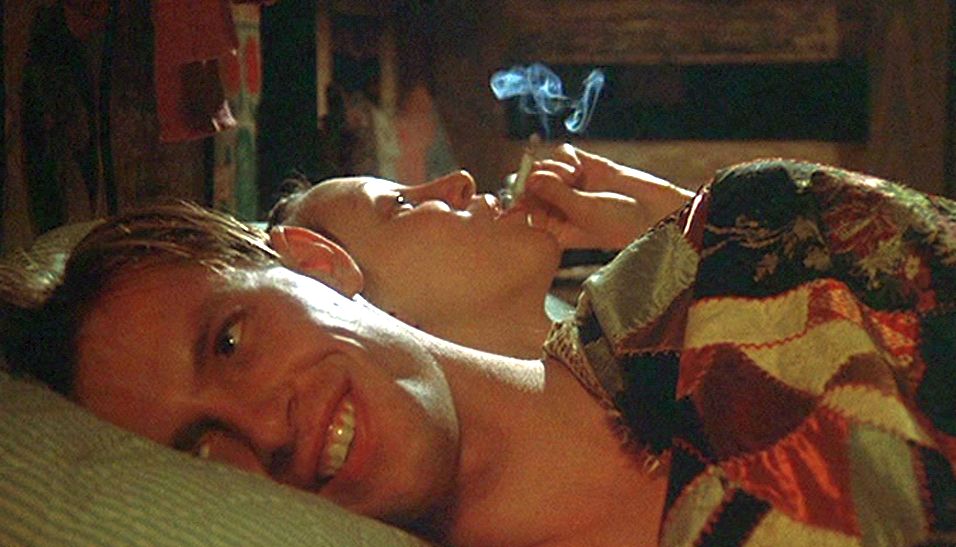
The Long Goodbye (1973) is a provocative film noir (it’s sometimes dubbed as an example of “neo noir”) that was directed by Robert Altman and based on Raymond Chandler’s 1953 detective novel of the same name.  The lead character in the novel and the film is Philip Marlowe, who appeared in a number of Chandler’s works, including The Big Sleep (1939), Farewell, My Lovely (1940), and The Lady in the Lake (1943).  Marlow was always the detective-story tough guy, and in earlier filmed versions of Chandler’s work featuring him, his role was assumed by leading screen idols of the day, such as Dick Powell, Humphrey Bogart, and Robert Montgomery.  Here in Altman’s The Long Goodbye, the Marlowe character is played by Elliott Gould, and the emphatic stamp he puts on the role is a key, though controversial, feature of the film.

The critical issue with some of the film’s critics, notably Andrew Sarris [1,2], concerned the considerable degree to which Altman’s film (and Gould’s characterization of Marlowe), deviated from Chandler’s original story.  This was perhaps surprising, because the screenplay for The Long Goodbye was written by Leigh Brackett, who had co-scripted Howard Hawks’s The Big Sleep (1946), a film that had drawn no such criticism.  But in this instance, given the uncharacteristic (for him) complexity of Chandler’s own plot in his The Long Goodbye novel, Bracket chose to make significant changes to the story for Altman’s film.  And these plot alterations were readily endorsed by Altman.  

The result was a technically-resplendent masterpiece featuring the dynamic cinematography of Vilmos Zsigmond and the moody music of John Williams.  Interestingly, the title-song  of the film, which was co-written by John Williams and Johnny Mercer, cleverly appears on numerous occasions and in various formats within the diegetic realm of the story.  

Altman was at this time at the height of his career, a period during which he made, besides The Long Goodbye (1973), his most famous films – M*A*S*H (1970), McCabe & Mrs. Miller (1971), Thieves Like Us (1974), and Nashville (1975).  Most of them take a satyrical look at American life, but also have a melancholy flavour to them.  He was famous at this time for his unique cinematic style, which besides his restlessly roving camera, featured two of his self-styled modes of cinematic expression.  I have discussed these specific innovative stylistic modes (which are partly attributable to cinematographer Vilmos Zsigmond) in my review of McCabe & Mrs. Miller, and I will only briefly mention them here:
  • Smoky effect using fog filters
    This had the effect of smudging the colors and giving the film an antique feeling.
     
  • Overlapping sound dialogues
    This was another signature aspect of Altman’s work –
“Using 8-track sound recording, [Altman] emphatically overlapped multiple conversations going on in a scene so that it was hard for the viewer to discern what was being said by the personages of presumed narrative focalization.  Indeed this made it sometimes difficult for the viewer to determine what actually was the intended narrative focalization for a scene, at least at its outset.  And this is what Altman wanted – he felt it was more true to life.” [3]
But these technical innovations are not what, for me, make Altman a great film director.  His real virtue lay in the way he could evoke in his films some melancholy themes underlying the nature of human experience.  In this film, the two major themes of this nature are, appropriately enough for a film noir, dishonesty and disloyalty.  

The plot of The Long Goodbye is, even after the streamlining performed by Leigh Brackett, quite complicated, and I won’t go over it in much detail.  Instead I will concentrate on the colorful principal characters and how they relate to the themes that I mentioned.  
  • Philip Marlowe (played by Elliott Gould) is an alienated, chain-smoking gumshoe working in Los Angeles and just trying to attend to the jobs that his clients give him.  He is the protagonist and center of focalization in this film.  In this film, Marlowe is largely a truth-teller, although he does lie to his pet cat.
     
  • Terry Lennox (played by famous baseball player Jim Bouton) is a gambler and playboy who also happens to be a close friend of Marlowe’s.  Lennox’s problems (he owes money to gangsters and he is accused of killing his wife) are what drive the events of this story.  And Lennox is a liar.
     
  • Roger Wade (Sterling Hayden) is an alcoholic novelist suffering from depression because he is experiencing writer’s block and can’t write.  Roger is also a liar.
     
  • Eileen Wade (Nina van Pallandt) is Roger’s beautiful and elegant wife.  The Wades live in the same sumptuous private housing complex in Malibu where Terry Lennox and his wife live.  Eileen initially hires Marlowe to track down her husband, Roger, who has disappeared in connection with one of his fits of depression.  And we will discover that Eileen is a liar, too.
     
  • Marty Augustine (Mark Rydell) is a gangster, whose outward conviviality masks his psychotic cruelty.  At one point in the story, he is in a conversation with Marlowe, and just to make a point of the seriousness of the threat he is making to Marlowe, he smashes and maims the face of his innocent mistress.  Later Marty calmly instructs his gang members (one of whom is played by Arnold Schwarzenegger) to castrate Marlowe, whom they have taken prisoner.  Despite this atrocious behavior and as a gangster law-breaker, Augustine presumably lies routinely; but in this film he is shown demanding adherence to honesty and contractual obligations.
     
  • Dr. Verringer (Henry Gibson) is a quack doctor who runs a private rehabilitation center for the mentally ill and who treats, for a high fee, Roger Wade at that center.  Like Marty Augustine, Verringer’s business is ultimately fraudulent, but in this film he is shown fervently demanding fulfillment of contractual obligations (i.e insisting that people honestly live up to promises).
     
  • Mexican police.  In the course of this story, Marlowe makes a couple of trips to Tijuana, Mexico, where Terry Lennox had sought refuge from the L.A. police and from Marty Augustine’s gang.  There Marlowe discovers that the Mexican police can be bribed to lie about reporting the death of an individual – and even bribed later to confess that the earlier death report was a lie.
So the tenor of this film is one of a lone private-eye caught in a web of deceptions.  This is pure film noir territory.  The most reprehensible chracters in the story, Marty Augustine and Dr. Verringer, don’t lie in what is shown, and they demand  honesty.  In contrast, the biggest liars are the people that the normally-suspicious Marlowe trusts the most – Terry Lennox and the Wades.  These are people that the loner Marlowe has come to like, and he is fooled by them.

Despite these noirish elements, though, I don’t feel The Long Goodbye is a spot-on example of film noir.  The atmospheric film noir web of suspicion is not there at the outset, and it takes some time to develop.  That characteristic atmosphere of alienation in typical films noir is normally enhanced by high-contrast lighting, which implicitly evokes an emotive setting.  But here in The Long Goodbye, Altman’s smoky fog filters only just blur the image.  They don’t color the emotional landscape.  Those smoky images may be more realistic, but visual realism is not what is called for in film noir.

Nevertheless, I still liked The Long Goodbye, and that was mostly due to another aspect of Altman’s mise-en-scene – his emotional characterizations of the stressed principal characters, all playing their existential tunes before the gaze of the bemused and detached Marlowe.  There are murders, a suicide, and a shocking ending, but, on the whole, it all does work for me, as it did for some other critics, too [4,5,6].
★★★★

Notes:
  1. Andrew Sarris, “Films in Focus”, The Village Voice, (1 November 1973). 
  2. Andrew Sarris, “Films in Focus”, The Village Voice, (29 November 1973).   
  3. The Film Sufi, “'McCabe & Mrs. Miller’ - Robert Altman (1971)”, The Film Sufi, (21 June 2018).   
  4. Vincent Canby, “Altman and Gould Make a Brilliant ‘Long Goodbye’”, The New York Times, (29 October 1973).    
  5. Roger Ebert, “A man out of time”, RogerEbert.com, (23 April 2006).   
  6. Judith Crist, “Current Shock”, New York Magazine, (29 October 1973).   

“Nashville” - Robert Altman (1975)

Robert Altman’s masterful Nashville (1975) is generally considered to be his finest work, but the film’s diffuse narrative structure makes it hard to pinpoint just what the film is about.  It covers, over a period of five days, events in the lives of some two dozen disparate people who have come to the capital of American country and western music, Nashville, Tennessee, to pursue their various ambitions and dreams.  So there are many little overlapping and intersecting stories told, but there is no high-level, overriding narrative that guides the flow of action. Instead, we just have these crisscrossing narrative fragments, and it is up to the viewer to make some thematic sense to them. 

Indeed, the film’s crisscrossing narrative structure is fascinating, since there are many intersections of these individual narrative fragments along the way; and credit must be given to screenwriter Joan Tewkesbury (she was also the principal scriptwriter for Altman’s earlier Thieves Like Us).  However, there is a degree of spontaneity to these interactions, and it is known that much of the film’s detail was made up extemporaneously on the production set  (the film was shot in Nashville in order to derive inspiration from the setting) [1].  One might therefore think that the film’s diffuse, almost chaotic, mosaic structure might have been something of an obstacle for critical success, but Nashville was a big hit with the public, and it was nominated for five Oscars and a record eleven Golden Globes.

We could say that one overriding theme of Nashville is the American Dream, which was a thematic background element to some of Altman’s earlier films, such as McCabe & Mrs. Miller (1971) and Thieves Like Us (1974), but here the American Dream takes center stage. And it turns out that the city of Nashville is the perfect setting for such a topic.  Actually, one might at first think that Hollywood, which is considered to be the American “dream factory”, would be the appropriate venue for such material; but the scope of Hollywood’s coverage is more global, while the scope of Nashville’s country themes is more personal and more specifically “American”, which makes that city more appropriate as a setting for a drama about the American Dream.  Anyone who can sing might be lured to Nashville (the city calls itself “Music City”) to try and fulfill their dream of making a name for themselves and seeing if they can take on some of the city’s romantic glamor.

One stream of American Dream expression is on the political level, where political candidates promise that there proposed government policies will directly lead to American Dream wish-fulfillment.  And such a stream is strongly present in Nashville, where two of the characters in the film, John Triplette (played by Michael Murphy) and Delbert Reese (Ned Beatty), are shown to be working for a populist third-party Presidential candidate, Hal Phillip Walker, whose anti-establishment policies, expressed in the form of terse homilies, are supposed to make America great again.  The intention of Triplette and Reese is to stage a political rally for Walker at the Nashville Parthenon that will feature music performed by leading country music singers.

Of course another thematic strain is that associated with romantic attitudes characterizing Nashville music, and a number of principal characters are singers. These include:
  • Barbara Jean (Ronee Blakley), the leading and beloved, but fragile, Nashville singer.
     
  • Haven Hamilton (Henry Gibson), a longtime Nashville country favorite.
     
  • Connie White (Karen Black), a prominent country singer who competes with Barbara Jean.
      
  • Tommy Brown (Timothy Brown), an African-American country singer who performs, like other leading figures, at Nashville’s Grand Ole Opry.
     
  • Tom Frank (Keith Carradine), Bill (Allan F. Nicholls), and Mary (Cristina Raines), a folk-singing group who have come to make a new start in Nashville. 
     
  • Linnea Reese (Lily Tomlin), the wife of Delbert Reese and a caring mother of two deaf children, sings with a black gospel music group.
     
  • Winifred, aka Albuquerque, (Barbara Harris), wannabe country singer who runs away from her ornery husband to pursue her career ambitions.
     
  • Sueleen Gay (Gwen Welles), a tone-deaf wannabe singer whose body is the only item of interest to the local male audiences.
Interestingly, although Altman wanted to evoke the Nashville “sound” in the film and the performed songs do make up about an hour of the film’s running time, he did not incorporate many well-known songs from the Nashville community, itself, into the film.  Instead, almost all of the main songs performed were written by youthful composer Richard Baskin or by performers Keith Carradine and Ronee Blakley (actors Karen Black, Lily Tomlin, Ned Beatty, and David Peel also participated in some of the film music composition).

Note however, that in addition to those above-mentioned thematic elements, I think that one of the most important thematic undercurrents in the film is associated specifically with women and how their vulnerability and courageousness play out in modern American society.  In this respect there are a number of female principals with hopeful dreams who are part of this focus.
  • Barbara Jean, of course, is a major element of this concern.  Her romantic fragility is worsened by her insensitive and domineering husband Barnett (Allen Garfield), who seems mostly only concerned with her business success.
     
  • Mary, the member of the folk-singing trio, is the wife of Bill, but she is having an illicit affair with trio partner Tom, with whom she is madly in love.  However, Tom is amiably self-centered and eager to seduce any attractive lady.  In fact in this film we see him having intimate relations with four different women: Mary, Opal, L.A. Joan, and Linnea.
     
  • Opal (Geraldine Chaplin) is an ambitious young outsider from the UK who claims to be working on a documentary for the BBC.  Seeing herself as a worthy intellectual observer, she is wrapped up in her own self-centered fantasies about Nashville and American culture.
     
  • L.A. Joan (Shelley Duvall) is a young California girl on the make.  Although she has ostensibly come to Nashville to visit her ill aunt in the hospital, her real aims are to hookup romantically with male Nashville musicians.
     
  • Linnea is the sensitive mother of two deaf children, but her marriage to Del Reese has gone stale, and she is susceptible to the romantic advances of Tom Frank.
     
  • Sueleen is a local waitress with dreams of becoming a Nashville singing star.  She tries to take advantage of her sensual physical assets, but she doesn’t realize that her inability to carry a tune means that her dreams of stardom are doomed to failure and that men will just look at her as a cheap prostitute.
     
  • Winifred, aka Albuquerque, is another plucky young woman with dreams of stardom.  But she does have some talent, and at the tragic end of the film at the Nashville Parthenon, she gets her opportunity.
All these women harbor romantic and largely innocent dreams, but at various points in the film they are all exploited by obsessively self-interested males and their vulnerabilities are exposed.  The freedom of American culture has offered these women opportunities, but the fulfillment of their fantasies has not been forthcoming.

We could identify still another theme at the end of the film, and that concerns the tendency of American culture to trivialize matters of importance.  There are two significant songs in the film that explicitly express this trivialization – "Keep A-Goin'" (written by Richard Baskin and  performed by Henry Gibson as Haven Hamilton) and "It Don't Worry Me" (written by Keith Carradine and performed by Barbara Harris as Albuquerque).  These two songs offer the counsel that you shouldn’t take anything very seriously and that you should just keep plugging along no matter what happens.  Perhaps Altman is suggesting to us that this is both a strength and a weakness of American culture.

Apart from any speculation on the film’s themes concerning American culture, though, we can still identify some beautiful moments in the film that stand out on their own special merit.  For me there were two such moments.  One was Keith Carradine’s performance in a nightclub singing his own composition, “I’m Easy”, while four of his mistresses in the audience innocently look on and assume his words only concern their own specific relationships.  This is a memorably filmed sequence of concurrent emotions, and it helped the song win both an Oscar and a Golden Globe.

Another special moment in the film was Ronee Blakley’s singing of her composition, “Dues” [2].  To me this is the film’s highlight, and her words resonate with feeling and resigned heartbreak:
"It's that careless disrespect
I can't take no more, baby
It's the way that you don't love me
When you say that you do, baby

It hurts so bad, it gets me down, down, down
I want to walk away from this battleground
This hurtin' life, it ain't no good
I'd give a lot to love you the way I used to do
Wish I could..."
Those sad words cast a melancholic shadow over my memories of this soulful film.
★★★★

Notes:
  1. Austin Trunick, “Ronee Blakley, star of Robert Altman’s Nashville, Nashville’s Barbara Jean Speaks About Her Famous Role and Current Projects”, Under The Radar, (13 December 2013).    
  2. Ronee Blakley, “Ronee Blakley – Dues”, YouTube, (24 October 2010).   

“Thieves Like Us” - Robert Altman (1974)

Robert Altman’s Thieves Like Us (1974) offered a continuation of the plaintive romantic theme that had underlain his earlier masterwork McCabe & Mrs. Miller (1971) – that of innocent love struggling to find itself in an uncaring American social setting.  Again the evocation of an historic social milieu, on this occasion the Depression-era American South, provides an atmospheric backdrop for the melancholic romantic tale that is told. 

The film was made during a period when Altman’s creative genius was at it height and led to the production of, besides McCabe & Mrs. Miller and Thieves Like Us, two other masterpieces  – The Long Goodbye (1973), and Nashville (1975).  These films were all emblematic of Altman’s distinctive group-oriented mise-en-scene, which featured several innovative techniques for embedding the viewer into the narrative, some of which I have described in my review of McCabe & Mrs. Miller.  For example in connection with Altman’s use of sound, I remarked that
“Altman’s innovations in connection with spoken dialogue, which were initiated here in this film [McCabe & Mrs. Miller], are even more well-known and have come to represent something of a stamp with respect to his filmmaking.  Using 8-track sound recording, he emphatically overlapped multiple conversations going on in a scene so that it was hard for the viewer to discern what was being said by the personages of presumed narrative focalization [5].  Indeed this made it sometimes difficult for the viewer to determine what actually was the intended narrative focalization for a scene, at least at its outset.  And this is what Altman wanted – he felt it was more true to life.”
And, of course, these production values held true for Thieves Like Us, as well.

The story of the film is based on Edward Anderson’s’ novel Thieves Like Us (1937), which had earlier formed the basis of Nicholas Ray’s film noir They Live by Night (1948).  It concerns what happens to three men serving life sentences in the Mississippi state penitentiary who break out of prison and immediately engage in a bank-robbing spree.  But a major focus of the story is on the romantic relationship of the youngest member of the gang with a girl that he meets along the way.  In that sense we could say that Thieves Like Us belongs to the special thematic category of love on the run from the law, a genre which includes such classics by well-known auteurs as the already mentioned They Live by Night (1949), as well as Gun Crazy (1950), Breathless (1960), Bonnie and Clyde (1967), Badlands (1973), and The Sugarland Express (1974).

Many of the films in this love-on-the-run genre place an emphasis on the romantic thrill of recklessness, usually on the part of the existential loner who is fleeing the law.  But Thieves Like Us is a little different; its thematic undercurrent is that of innocence.  And we must remember that in this context, innocence does not imply moral virtue, but instead simply naiveté.  When innocence is not provided with socially-inspired directions or moral themes (which can even evoke heroism), it can wind up just devoting itself to escape from boredom.  And that is what we have in Thieves Like Us. In fact Altman doesn’t provide much coverage of the dramatic bank robberies that take place in  the film; they mostly take place offscreen. Instead there is more of a focus on the more humdrum and personal aspects of the thieves’ lives.

Underscoring this point is another aspect of Altman’s innovative mise-en-scene – his aural presentation of dramatic radio shows in the diegetic background and on the soundtrack.  Radio dramas of this period before television (1937) were generally overly histrionic presentations of simple-minded narratives intended to relieve the boredom of an apathetic public weighed down by Depression-era concerns. 

In this connection the three escaped convicts making up the newly formed bank-robbing gang embody different flavors of escape from boredom:
  • T. W. “T-Dub” Mason (played by Bert Remsen) is 44 and is the organizer and supposed “brains” of the gang of thieves.  He seems good-natured and appears only to have gotten into bank-robbing as a profession just by chance circumstances.  But he is not above killing people who block his way.
     
  • Elmo “Chicamaw” Mobley (John Schuck) is 38 and is the number-2 man of the group.  He is a hot-headed narcissist whose three interests in life are alcohol, women, and robbing banks.  He is much more ruthless than T-Dub, and his main concern in life is being recognized as somebody important.
     
  • Bowie Bowers (Keith Carradine), 23, is particularly callow and amiable, but he was convicted of murder at the age of 16.  Although he is basically well-meaning, he expresses, at one point in the film, no regrets about his having entered into a life of crime.  It is his innocence and that of his love, Keetchie, that is principally focalized in the film.
These men are always congratulating themselves that life is special, indeed, among “thieves like  us”.

The story of Thieves Like Us passes through four dramatic stages.

1.  Escape and Robberies
In the opening sequences T-Dub, Chicamaw, and Bowie escape from prison and make their way to hideout with Chicamaw’s cousin, Dee Mobley (Tom Skerritt), who is an auto garage mechanic living with his daughter Keetchie (Shelley Duvall).  The three criminals then carry out some bank robberies, the details of which the viewer doesn’t see, because the focalization of this story is concentrated on Bowie, who is the gang’s getaway car driver waiting outside the bank. 

After one of the robberies, they hideout in the home of T-Dub’s sister-in-law, Mattie (Louise Fletcher).  In their leisure time they decide to play a make-believe game with Mattie’s three kids, and the make-believe game they come up with is the only thing that stokes their imaginations – robbing a make-believe bank.  During the game Chicamaw reveals his subconscious weaknesses by losing his temper and threatening to shoot the children with his real gun.

Afterwards they all decide to lay low for a month until their next appointed bank robbery to take place in Yazoo City.

2.  Bowie and Keetchie
On the road, with Bowie and Chicamaw driving separate cars and playfully trying to overtake each other, Bowie gets into an accident and is seriously injured.  The always hot-tempered and injudicious Chicamaw comes on the accident scene and shoots two investigating police officers before whisking the injured Bowie back to his cousin Dee’s home.

While recuperating in Dee’s home, Bowie gets more acquainted with Dee’s unsophisticated and artless daughter, Keetchie, and the two of them start tentatively falling in love.  Here is innocence in the flesh, and the sensitive performances of Keith Carradine and Shelley Duvall make these sequences a highlight of the film.  After time passes, though, Bowie’s appointment date approaches, and despite Keetchie’s protests, Bowie heads off to Yazoo City.

3.  The Yazoo City Caper
This time, because Bowie is actively involved inside the bank, the robbery is shown in detail, mostly in overhead shots.  Again, the robbery is successful, although T-Dub and Chicamaw fire some lethal shots at bank employees.  Afterwards, they split up with a new meetup appointment set.  But Bowie soon hears on his car radio that the police have shot and killed T-Dub and that Chicamaw has been imprisoned.

4.  No Escape
Bowie returns to the still-pouting Keetchie, and they soon renew their avowals of true love.  Bowie now takes Keetchie to a motel that T-Dub had bought with his stolen money for Mattie. Mattie is reluctant to let them stay there, but Bowie insists.

Keetchie desperately wants Bowie to give up a life of crime and place their love above all such selfish considerations, but he still has at least one more secret caper to pull off.  Masquerading as a cop, Bowie goes to the prison where Chicamaw is being held and manages to spring him.  However, after the always hot-headed Chicamaw kills the prison captain and then abusively accuses Bowie of being a two-bit hick, Bowie abandons Chicamaw on the road, presumably condemning him to death.

But when Bowie returns to the motel to see Keetchie, the viewer sees that he has been betrayed by Mattie, who has arranged for a squadron of policemen to ambush him.  They fire a fusillade of bullets into him while the screaming Keetchie looks on helplessly in horror.

The final scene shows Keetchie waiting in a train station for a long trip to Fort Worth and a new start in  life.  She is pregnant with Bowie’s child (Bowie never knew about her pregnant condition), but she informs a fellow waiting passenger that if the unborn child is a boy, she will not name it after the father, because he betrayed her.


Thieves Like Us is a sad and fatalistic film, but it is a moving one and well worth reseeing. Although it was well-received when it was released [1,2], it is not generally ranked as a classic; but it is one of my all-time favorites. It reminds us that true love is natural and can appear anytime and anywhere.  Love can bring about deliverance and redemption, but we know that it doesn’t always conquer, as was the case in this film.  So we are reminded that we must not let go of those loving encounters and relationships that are so crucially important to our lives.  And that is why the film is so especially poignant. 
★★★★

Notes:
  1. Judith Christ, “Roadside Refreshment”, New York Magazine, (11 February 1974), pp. 74-75.     
  2. Roger Ebert, “Thieves Like Us”, RogerEbert.com, (1 January 1974).   

“McCabe & Mrs. Miller” - Robert Altman (1971)

Robert Altman’s eclectic fifty-year career had a number of ups and downs, but over its course he created enough cinematic masterpieces to establish himself as one of the greatest of all film auteurs.  Critic Adrian Danks has remarked in this regard that [1]:
“It is possible to argue that Altman is the most significant and emblematic director of post-classical American cinema.”
Coming up through the more restrictive confines of network television production, rather than independent film production, Altman was something of a late bloomer – it took him awhile to unfetter his always independent approach to film expression from the demands of his studio producers.  But finally in his mid-40s, with the success of his Palme d'Or-winning anti-war black comedy MASH (1970), Altman emerged with the independence to follow his own course.  He soon started producing masterworks, which include McCabe & Mrs. Miller (1971), The Long Goodbye (1973), Thieves Like Us (1974), and Nashville (1975).  The greatest of these, in my view, was McCabe & Mrs. Miller, Altman’s melancholic tale about what happens when an ambitious man meets up with a similarly ambitious woman in a remote Pacific Northwest mining town at the turn of the 20th century. 

Film critic Roger Ebert had similar thoughts along these lines [2]:
“It is not often given to a director to make a perfect film. Some spend their lives trying, but always fall short. Robert Altman has made a dozen films that can be called great in one way or another, but one of them is perfect, and that one is McCabe & Mrs. Miller (1971).”
And the film was recently ranked in a survey of critics conducted by the BBC as the 16th greatest American film ever made [3]. 

Much has been made, over the years, of some of Altman’s eccentric modes of cinematic expression, many of which were introduced in McCabe & Mrs. Miller.  These occur with respect to both the visual presentation and the spoken dialogue.

In connection with the visual plane of the film, the innovations were partly attributable to and conducted by outstanding cinematographer Vilmos Zsigmond, who emerged as a major cinematographer with this film.  (Zsigmond would also do the cinematography for Altman’s subsequent The Long Good-bye (1973), as well as for a number of atmospheric films directed by Brian De Palma).  Here in McCabe & Mrs. Miller, Altman and Zsigmond introduced novelties directly to the image-gathering process, itself, as explained by commentator Nathaniel Rich [4]:
“As with MASH, Altman placed fog filters over the cameras to smudge the colors. But on McCabe, he went even further, partially exposing the negatives to destroy the clarity of the film, creating the impression that one is viewing it through a pane of stained glass. ‘I wanted it to have that antique, historical look . . . I really set out to make it look like those old photographs do.’“
And as Altman also pointed out, by doing this to the negative, it also prevented the studio from later overruling him during the editing stage, since that would have required re-shooting everything [5].

This smoky, stained-glass imagery had more than just a clouding effect: combined with the film’s disparate multi-character compositions, it cast an artistic pall over the cinematic tapestry of the film that Adrian Danks likened to the atmospheric works of 16th century Flemish artist Pieter Bruegel [1].

Altman’s innovations in connection with spoken dialogue, which were initiated here in this film, are even more well-known and have come to represent something of a stamp with respect to his filmmaking.  Using 8-track sound recording, he emphatically overlapped multiple conversations going on in a scene so that it was hard for the viewer to discern what was being said by the personages of presumed narrative focalization [5].  Indeed this made it sometimes difficult for the viewer to determine what actually was the intended narrative focalization for a scene, at least at its outset.  And this is what Altman wanted – he felt it was more true to life.

However, these supposed true-to-life soundtrack effects do not take into account the human capability known as the “cocktail party effect” [6], which is a capacity primarily associated with binaural hearing. Thanks to their accommodation of two slightly different sound signals coming separately to their two ears, people with binaural hearing (most everybody) can selectively single out individual conversations at a mixed gathering such as a cocktail party – this is the “cocktail party effect”.  But when watching a movie, this would only work with carefully crafted stereo sound, which is not usually available in the distributed movie, so the cocktail party effect capacity is not available to film viewers.  What we all could do at a cocktail party is something we cannot do in the movie theater.  Filmmakers are generally aware of this situation, and that is one of the reasons why they make efforts to ensure that important spoken dialogue in a crowded scene is carefully articulated and highlighted.  But Altman headed in a different direction.  He actually wanted his viewers to struggle to hear what was being said so that they would immerse themselves more fully in the psychological milieu of the film.

Indeed, it is the evocative psychological mood of the film that makes this an outstanding work, and there were a number of other contributing factors that figured into achieving this.  One of the most significant factors was the moody background music provided by Leonard Cohen singing his own compositions – “The Stranger Song”, “Sisters of Mercy”, and “Winter Lady”.  Cohen’s droning, doleful voice casts a wistful spell over the entire film and evokes a fatalistic feeling of unfulfilled longing.  Actually, Altman had finished the shooting of the film before he approached Cohen to provide his music [5].  But he had for sometime been a fan of Cohen and may well have had his music in mind while he was planning and shooting the film.  In any case, Cohen’s songs fit so perfectly that the film seems almost like a visual instantiation of Cohen’s nostalgic thoughts. 

Another contributing factor is Altman’s signature mise-en-scene, which offers his unique take on narrative composition and focalization.  In this connection, though John McCabe is the main target of focalization in the film, there are many other dramatic happenings on the periphery that are also focalized, thereby widening the viewer’s awareness of the social context (which to a certain extent mirrors our real-life, on-the-fly experiences).  And moreover, although there are many wide-screen pans and zoom shots, the presumed perspectives and focalizations for many of these shots is often unclear, sometimes suggesting an outer-eye, but still personal, narrative perspective that oversees the multifarious dramas going on in front of its wondered gaze.  We seem to be watching a mournful Bruegelian tapestry that has come to life before us.

Despite all the many and various narrative goings on in the film, there are three main foci of our attention and compassion as we watch the film.
  • John McCabe (played by Warren Beatty in perhaps his best performance) is an ambitious young entrepreneur (he calls himself a “businessman”) who seeks to make his fortune by poker gambling and by opening up his own brothel in the new mining time that he comes to.  McCabe is uneducated, and he relies on his bravado and his ability to bluff his opponents in order to succeed.
     
  • Mrs. Constance Miller (Julie Christie) is a tough Cockney lady from San Francisco with  more streets smarts than McCabe.  She, too, is seeking to make her fortune.  Although  she tells McCabe that you have to spend money to make money, she is more protective of her inner persona and less willing to take risks on the personal level than he is.
                 
  • The People of Presbyterian Church, a remote mining town in Washington state.  These people are mostly poor uneducated miners, including some Chinese coolies.   We see them as more or less friendly and innocent, but they are relatively isolated from each other and lacking in protective social institutions, which makes them vulnerable to the harsh circumstances of their environment.
The Story of “McCabe & Mrs. Miller passes through four approximate stages.  And throughout all of them, the sky is perpetually dark and overcast with rain or snow falling.

1.  A Stranger Arrives
“It's true that all the men you knew were dealers
Who said they were through with dealing
Every time you gave them shelter
I know that kind of man
It's hard to hold the hand of anyone
Who is reaching for the sky just to surrender
Who is reaching for the sky just to surrender.

And then sweeping up the jokers that he left behind
You find he did not leave you very much not even laughter
Like any dealer he was watching for the card
That is so high and wild
He'll never need to deal another
He was just some Joseph looking for a manger
He was just some Joseph looking for a manger.”
            – Leonard Cohen, “The Stranger”
To the droning strains of Leonard Cohen on the soundtrack, a well-dressed stranger, John McCabe (Warren Beatty), arrives slowly on horseback in the new and still under construction mining town of Presbyterian Church, Washington.  McCabe is a cardsharp by profession, and he quickly stops at the only local saloon in town to set up a gambling table where he can play poker with the local clientele. 

McCabe is a self-made man who is constantly muttering to himself to live  up his ambitions. He has a little money, and his larger plan is to have his own saloon built that will feature gambling and his own whorehouse.  He goes to the nearest established town, Bearpaw, to purchase three chippies that he can bring back to work as his whores.  Soon his business is up and running, and the miners now have more diversions that can help line McCabe’s pockets.

2.  A Madam Joins McCabe
“And why are you so quiet now
Standing there in the doorway?
You chose your journey long before
You came upon this highway

Traveling lady stay awhile
Until the night is over
I'm just a station on your way
I know I'm not your lover”
            – Leonard Cohen, “Winter Lady”
After some time, a primitive steam locomotive arrives in Presbyterian Church bringing some passengers, among whom is a tough-minded madam, Mrs. Miller (Julie Christie), who wants to partner up with McCabe in the brothel business.  She quickly convinces McCabe, who is snowed by both her beauty and her aggressive shrewdness, that she knows how to manage a whorehouse better than he does.  So with McCabe paying the expenses, she imports five better looking hookers from San Francisco, and they start operating a higher-class whorehouse that soon starts making even better money.

3.  Managing Relationships
“Oh the sisters of mercy, they are not departed or gone
They were waiting for me when I thought that I just can't go on
And they brought me their comfort and later they brought me this song
Oh I hope you run into them, you who've been traveling so long
. . .
When I left they were sleeping, I hope you run into them soon
Don't turn on the lights, you can read their address by the moon
And you won't make me jealous if I hear that they sweetened your night:
We weren't lovers like that and besides it would still be all right
We weren't lovers like that and besides it would still be all right.”
                – Leonard Cohen, “Sisters of Mercy”
Business is good for McCabe and Mrs. Miller, but there are other things on McCabe’s mind, too.  McCabe is clearly falling in love with the woman and wants to have a meaningful relationship with her.  He can be heard later muttering to himself that he knows he is unsophisticated, but he plaintively swears, “I got poetry in me”.  But the experienced and hard-nosed Mrs. Miller is unimpressed with McCabe’s swagger and sees him as just a tinhorn.  She is only willing to sleep with him if he pays her upscale hooker’s fee for the privilege. 
 
Mrs. Miller later explains her cynical attitude about love to Ida (Shelley Duvall), a young, recent widow who is forced by her new poverty to join Mrs. Miller’s brothel.  Ida expresses doubts about her ability to have sex with strange men, which contrasts with her having had sex with her husband, because it was her duty.  Mrs. Miller self-centeredly counters Ida’s argument with the following:
"It weren't your duty, either. You did it pay for your bed and board.  And you'll do this to pay for your bed and board, too. And you get to keep a little extra for yourself."
Further evidence of Mrs. Miller’s self-absorption is shown when she is sometimes seen alone in her room, secretly smoking on an opium pipe.

Meanwhile another complication arises.  Two men from the big Harrison Shaughnessy mining company, Sears and Holland, arrive in town and immediately make an offer to buy up all of McCabe’s holdings.  Trying to impress Mrs. Miller with his manliness and instinctively resorting to his usual bluffing tactics, McCabe turns down their first two offers. When Mrs. Miller hears about this, she is alarmed for McCabe’s safety, and she warns him that Harrison Shaughnessy are ruthless and will stop at nothing to get their way.  But McCabe, still mindful of his presumed need to show his manliness before Mrs. Miller, resignedly counters with
“I guess if a man’s fool enough to get in business with a woman, she ain’t going to think much of him.”
Before long Sears and Holland have departed without making a deal, and they are replaced by three hired armed men who menacingly have come to Presbyterian Church presumably to finish off McCabe.  McCabe quickly makes a trip to Bearpaw to see what can be done, but finds the hands-off  lawyer he talks to there to be officious and unhelpful.  McCabe is now resigned to the fact that he will have to face his apparent assailants alone.  He spends one more night with the woman he loves, during which he opens his heart, and they come closer to the amorous union that McCabe has been so desperately seeking.

4.  Playing Out the Game
“And then leaning on your window sill
He'll say one day you caused his will
To weaken with your love and warmth and shelter
And then taking from his wallet
An old schedule of trains, he'll say
I told you when I came I was a stranger
I told you when I came I was a stranger.”
            – Leonard Cohen, “The Stranger”
The three newly arrived thugs – Butler, Breed, and Kid – are hanging out in town and apparently waiting for their opportunity to do away with McCabe.  Their leader, Butler (Hugh Millais), is memorably menacing.  Tall and courteously forbidding, Butler seems implacable, almost like an inexorable abstract force of nature.  In keeping with this tenor of lethality, there is an extended and extraordinarily chilling scene in which Kid faces off with and guns down an innocent, good-natured cowboy (Keith Carradine) on a suspension bridge, just for the sake of target practice. 

The final, intense 23 minutes of the film show a hostile universe closing in on McCabe, and they take place during a heavy snowstorm. This was an unplanned event for Altman’s production team, but it works here to the film’s advantage.  Most of the earlier outdoor scenes in the film are shot in rainy weather, but the severe weather in this sequence serves to accentuate and underscore the vulnerability of all our protagonists.

The hired killers now spread out in the town and are ready to finish off McCabe once and for all.  McCabe flees to the church, and he barely escapes the prowling Butler by slipping out a side door just before Butler bursts in and mistakenly guns down the church parson.  Butler’s murderous act also accidentaly starts a fire in the church, but Butler continues searching for his prey.

There are now two parallel, desperate narrative threads: (1) McCabe trying to escape his murderous assailants and (2) the townspeople, who have no available fire department, frantically trying to organize themselves to put out the church fire.  In the face of the daunting circumstances, both attempts are gripping but look hopeless.

As these final events play out, McCabe makes a number of valiant moves and almost succeeds.  In the end the church fire does get put out by the townspeople.  But we see McCabe left mortally wounded in the frozen snow.  And Mrs. Millers is finally shown lying down in a local Chinatown  opium den and lost in an opium-fueled dream.  We are left on a note of unfulfilled romantic longing.  It seems that the cards were stacked against them.  On this score Roger Ebert remarked [2],
"This is one of the saddest films I have ever seen, filled with a yearning for love and home that will not ever come -- not for McCabe, not with Mrs. Miller, not in the town of Presbyterian Church, which cowers under a gray sky always heavy with rain or snow. The film is a poem--an elegy for the dead.”

But McCabe & Mrs. Miller is more than just a sad romantic story; its themes cover a larger scope about life itself [7].  If we consider the film’s three main protagonists, we can see that each of them had a different and ultimately inadequate approach towards facing life’s vicissitudes.  
  • The People of Presbyterian Church were generally friendly, but they lived in an American society based on individual striving and trade.  There was little in the way of supporting norms and institutions that would help them live together.  Even love was a commodity to be bought and sold in the brothel.
     
  • Mrs. Miller’s approach was one of total self-absorption and solipsistic withdrawal. Although she seemed at the end tentatively responsive to McCabe’s awkward approaches, she ultimately lapsed back into her opium-fueled haze.
     
  • John McCabe was the one who was actively seeking authentic personal engagement.  But he was trained to be a loner who bluffed his way to success.  And he lived in a world where there was little social support for the kind of engagement that he now instinctively sought.
So Altman’s film touches on some larger themes than just romantic love.  We could say that along general lines our Western world has offered two rough and contrasting schemes for organizing society – socialism and libertarian capitalism.  Socialism neglects the individual and elevates the primacy of the social class.  Libertarian capitalism, which is a dominant theme in America and is in focus in this film, emphasizes the individual and presumes society will automatically self-organize in a mutually beneficent way for all.  But we see in this film that American institutional structures in the mining town shown were hopelessly lacking for the support of what McCabe sought.  For example:
  • The church was basically unattended, and its reverend minister was reclusive and selfishly withdrawn.
  • Libertarian economics had not provided self-adjusting counterforces to curb the overweening ruthlessness of the Harrison Shaughnessy mining company.
  • The legal system and law enforcement authorities were absent or inadequate to maintain order in that society.  And the lawyer McCabe consulted seemed to think that the “invisible hand” of libertarian economics was enough to maintain a lawful society.
So there is an implicit suggestion in this film that more supportive social structures that lie somewhere in between individual-ignoring socialism and individual-centered free-market capitalism are needed.

Similarly, on the philosophical plane we seem to have two general perspectives according to which we organize the world – (1) objective materialism that is grounded on the physical sciences and (2) phenomenology and existentialism that are focused on the subjective experiences of the individual.  Neither of these perspectives offers a pathway to the fulfillment in connection with authentic engagement with the beloved other person that McCabe was seeking. 

I would suggest that there is another general perspective that can bridge the gap between the neglect of the individual (objectivism) and the exclusive focus on the individual (subjectivism), and this is what is sometimes referred to in philosophical circles as “Personalism” [8].  Personalism incorporates basic notions from existentialism and phenomenology, but it extends its compass to focus on authentic engagement with the people around us.  According to this way of thinking, our very being comprises the interactive engagements (and the narratives we construct according to which we understand those engagements) with the people with whom we have authentic interactions.  This was the missing perspective that could have provided some support for McCabe, Mrs. Miller, and the people of Presbyterian Church.  As it was, they all suffered from isolation.  And the relentless yearning and instinctive desire to give his love that was churning inside McCabe couldn’t be quenched.

But these thoughts concerning the underlying problems tormenting McCabe are only implicit in McCabe & Mrs. Miller.  It is ultimately the sadness of this romantic isolation that Altman so movingly evokes in this wistful film that makes it a true work of art.  McCabe arrived as a stranger to love and left as a stranger.
★★★★

Notes:
  1. Adrian Danks, “Just Some Jesus Looking for a Manger: McCabe & Mrs. Miller”, Senses of Cinema, (September 2000).   
  2. Roger Ebert, “MCCABE AND MRS MILLER”, Great Movie, RogerEbert.com, (14 November 1999).   
  3. “The 100 Greatest American Films”, BBC Culture, (20 July 2015).   
  4. Nathaniel Rich, “McCabe & Mrs. Miller: Showdowns”, The Criterion Collection, (13 October 2016).  
  5. Edward Copeland, “We need Bob — now more than ever”, Edward Copeland's Tangents, (23 June 2011).  
  6. “Cocktail party effect”, Wikipedia, (31 May 2018).   
  7. Roger Ebert, “MCCABE AND MRS MILLER”, RogerEbert.com, (30 July 1971).   
  8. Thomas D. Williams and Jan Olof Bengtsson, "Personalism", The Stanford Encyclopedia of Philosophy, Edward N. Zalta (ed.), (Summer 2018 Edition).    

Robert Altman

Films of Robert Altman: